
What Does EFI Mean on an ATV? The Essential System Guide
This post contains affiliate links. As an Amazon Associate, we earn from qualifying purchases.
EFI on an ATV is an Electronic Fuel Injection system. It replaces the carburetor with a computer-controlled unit that precisely meters fuel into the engine based on real-time sensor data. The result is easier cold starts, consistent power at any altitude, and better fuel efficiency, but it introduces complexity, diagnosis requires reading blink codes and checking electrical components.
That precision comes from a closed-loop system of sensors and actuators. An Engine Control Unit (ECU) acts as the brain, constantly adjusting the fuel mixture millisecond by millisecond. Where a carburetor guesses, EFI calculates.
What follows is a breakdown of the five key components that make it work, the specific failure modes signaled by manufacturer blink codes, and the real-world trade-offs every ATV owner faces between modern convenience and mechanical simplicity.
Key Takeaways
- EFI uses an Engine Control Unit (ECU) to calculate ideal fuel delivery, replacing the carburetor’s mechanical guesswork.
- A weak battery (under 12.5 volts) is the single most common cause of EFI starting problems, the system won’t even try.
- Diagnosis revolves around reading blink codes from the check engine light; Code 54 on a Polaris often points to a faulty engine temperature sensor.
- While EFI excels in cold weather and altitude changes, it is more expensive to repair and requires basic electrical troubleshooting skills.
- For reliability, stick with major brands like Honda or Polaris for their proven EFI systems and available dealer support.
How EFI Works: The Five-Component Loop
Forget abstract computing. An ATV’s EFI is a physical loop. Five hardware parts talk to each other to put the right amount of gas in the cylinder at the exact right time. Skip one, and the loop breaks.
The process starts with sensors. A throttle position sensor (TPS) on the throttle body tells the ECU how far you’ve twisted the grip. An engine temperature sensor reports if the motor is cold or at operating temperature. A manifold absolute pressure (MAP) sensor or mass airflow (MAF) sensor measures the air coming in. Some systems have an oxygen sensor in the exhaust to report on combustion quality.
This sensor data flows to the Engine Control Unit (ECU) at a rate of hundreds of times per second. The ECU references a pre-programmed fuel map, a massive table of ideal air-fuel ratios for every possible combination of RPM, throttle position, and temperature, and calculates the precise pulse width, or duration, for the fuel injector.
The ECU then commands the injector, a solenoid-operated nozzle, to spray a fine mist of fuel directly into the intake manifold or cylinder. The fuel pump, usually in the tank, maintains a constant high pressure, 39 psi (±3 psi) in a Polaris Sportsman 700 EFI, so the injector has fuel ready on demand. A fuel pressure regulator ensures this pressure stays steady.
Finally, the ignition system receives its timing signal from the ECU and fires the spark plug. The cycle repeats for the next cylinder. It’s a continuous conversation: sense, calculate, actuate, verify.
| Component | Its Job | What Happens When It Fails |
|---|---|---|
| ECU (Engine Control Unit) | The brain. Processes sensor data and commands the injector. | Engine won’t start or runs in a “limp mode” with severely reduced power. |
| Fuel Pump & Pressure Regulator | Delivers fuel at constant high pressure (e.g., 39 psi). | Weak pump = low pressure. The engine cranks but won’t start, or stutters under load. |
| Fuel Injector | Precision nozzle that sprays metered fuel. | Clogs with bad gas. Causes misfiring, rough idle, and poor fuel economy. |
| Throttle Position Sensor (TPS) | Reports throttle angle to the ECU. | Erratic readings cause surging, hesitation, and incorrect idle speed. |
| Engine Temperature Sensor | Tells ECU if engine is cold (needs more fuel) or hot. | A failed “cold” signal causes hard cold starts; a failed “hot” signal can lead to overheating. |
EFI vs. Carburetor: The Real Rider Differences
This isn’t about which is better in a vacuum. It’s about which is better for your garage, your climate, and your tolerance for tinkering. The choice dictates your relationship with the machine.
A carburetor is a venturi, air rushing through a tube sucks fuel from a bowl via a jet. It’s entirely mechanical. Adjustments are made with screws and by swapping brass jets. Its advantages are simplicity and repairability. You can rebuild a carb on a tailgate with a $30 kit and a set of screwdrivers. Its disadvantages are its inflexibility. It’s tuned for a specific air density. Take it from sea level to the mountains, and it will run rich and boggy. On a cold morning, you’re pulling a choke lever and hoping it fires.
EFI is the opposite. Its advantage is consistency. The ECU compensates for altitude, temperature, and load automatically. You turn the key and it starts, whether it’s in Florida or Colorado. Fuel economy is typically 10-15% better because the mixture is always ideal. Throttle response is instant and linear.
The trade-off: complexity and diagnosis. You can’t see a bad sensor. When an EFI system fails, you need a multimeter, a service manual, and the patience to follow a diagnostic tree. A replacement ECU can cost several hundred dollars. For the home mechanic, the learning curve is steep.
So who wins? For the rider who values turn-key reliability in varying conditions and doesn’t mind paying for dealer diagnostics occasionally, EFI is the clear answer. For the purist who wants to understand and fix every part of their machine with simple tools, the carburetor still has a place.
Common EFI Problems and What Those Blink Codes Mean
EFI systems don’t fail quietly. They report their own diagnostics through the check engine light in a sequence of flashes called blink codes. These codes are your direct translation from a silent machine to a specific faulty component.
The most common issue isn’t a failed sensor. It’s low voltage. The 2005 Polaris 700 EFI manual and the LH500ATV-D T3 EFI manual both state the same hard rule: the system needs a strong battery. If voltage drops below 12.5 volts during cranking, the ECU may not boot, the fuel pump may not prime, and you get nothing but a spinning starter.
Where this goes sideways: Assuming a no-start is a fuel issue and replacing the pump, when a $40 battery load test would have shown the real problem. Always check battery voltage and connections first.
If the battery is strong, the blink code tells the next chapter. Here’s how to read them: turn the key on (don’t start the engine) and watch the check engine light. It will flash, pause, then flash again in a sequence. For example, flash-flash-flash-pause-flash-flash-flash means code 33. You then cross-reference this code with your model’s service manual.
| Blink Code (Polaris 700 EFI Example) | Likely Failure Description | Typical Culprit |
|---|---|---|
| Code 21 | Loss of Synchronization | Faulty crankshaft position sensor or its wiring. |
| Code 22 | TPS: Short Circuit | Damaged Throttle Position Sensor or rubbed-through wires. |
| Code 54 | Engine Lamp: Open Load Temp | Failed engine temperature sensor or broken connector. |
| Code 56 | Relay: Open Load Pump | Bad fuel pump relay, blown fuse, or a failing pump itself. |
Other frequent failures include clogged fuel injectors from old gas, a dirty throttle body that gums up the TPS, and a failing fuel pump that can’t maintain pressure. The fix for a clogged injector might be running a fuel system cleaner like Techron through a full tank. A failing pump requires replacement.
The Critical Role of Maintenance and the Weakest Link
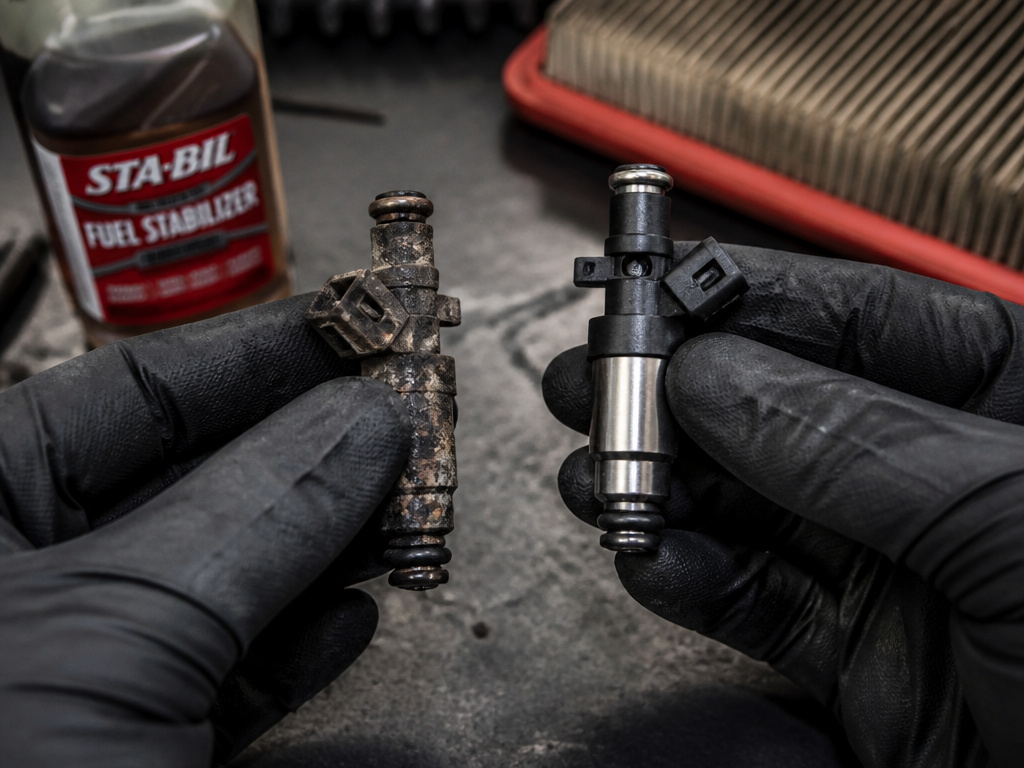 EFI rewards regular care and punishes neglect more sharply than a carburetor. The system is only as reliable as its most neglected component. You need a new maintenance mindset.
Start with the fuel. Stale gasoline is the enemy. Ethanol-blended fuel attracts moisture, which leads to corrosion in the fuel pump and injectors. Use a stabilizer like Sta-Bil if the ATV will sit for more than a month, and try to buy ethanol-free gas if it’s available. The fuel filter is not a lifetime part, change it according to your manual, usually every 100-200 hours.
The air filter is the lungs of the EFI system. A dirty filter skews the MAF or MAP sensor readings, causing the ECU to deliver the wrong amount of fuel. Cleaning a reusable foam filter or replacing a paper one is a 15-minute job that prevents hours of diagnostic headache.
Easy to miss: Electrical connectors. Vibration is constant on an ATV. Over time, the weatherproof seals on sensor connectors can degrade, letting in moisture and causing corrosion. A sporadic fault code is often a dirty connector. Unplug, spray with electrical contact cleaner, reconnect.
Finally, respect the battery. An ATV battery is small and works hard. Keep it on a smart maintainer like a Battery Tender during the off-season. A dead battery left to sulfate will never again hold the voltage the EFI system demands, leading to chronic starting issues.
Choosing an ATV: What to Know About the EFI System
Not all EFI systems are created equal. When you’re looking at a used ATV or comparing new models, the implementation matters as much as the label.
First, consider brand reputation. Honda’s PGM-FI and Polaris’s EFI systems have decades of refinement and widespread dealer support. Parts and knowledge are readily available. With a lesser-known brand, a proprietary EFI system can become a nightmare if the manufacturer disappears or the local dealer has no clue. The availability of a service manual with full diagnostic procedures is non-negotiable.
Second, look at the simplicity of the system. Some older or more basic EFI systems use a “speed-density” setup with a MAP sensor but no MAF or oxygen sensor. These are generally more robust and easier to diagnose than complex multi-sensor setups. They get the job done for most riding.
Ask about diagnostic access. Can you pull blink codes easily through the dash, or do you need a proprietary dealer scan tool? The former is a huge advantage for the owner. The 2021 Honda Foreman, for instance, will flash its PGM-FI light in a pattern to indicate a problem.
For the vast majority of riders, a modern EFI from a major manufacturer is the right choice. It transforms the ATV from a fussy machine into dependable transportation. The key is buying into a system you can actually live with and fix. That means choosing a brand with a strong parts network and a community of knowledgeable owners. For deep backcountry use where absolute mechanical simplicity is a safety feature, a well-maintained carbureted machine still has its advocates.
Frequently Asked Questions
Can you convert an ATV from carburetor to EFI?
Technically yes, with aftermarket universal EFI kits, but it’s rarely practical or cost-effective. The conversion requires installing a fuel pump, a high-pressure fuel line, all sensors, an ECU, and custom tuning. The cost and complexity far exceed the value of most older ATVs. It’s almost always better to sell a carbureted machine and buy one built with EFI from the factory.
Is EFI more expensive to repair than a carburetor?
Yes, almost always. Individual sensors and injectors cost more than carburetor jets or a diaphragm. Labor is also higher, as diagnosis requires technical skill and often special tools. However, EFI systems generally fail less often than carburetors clogged with bad gas, so your long-term repair bill might balance out. The big expense is the ECU, if it fails, replacement is costly.
What does it mean when the EFI light is blinking?
Blinking EFI or check engine light indicates an active fault that the system has detected. It’s storing a diagnostic trouble code (blink code). You need to retrieve this code to identify the problem. A solid light usually indicates the system is in a diagnostic mode or that a previous fault code is stored but not currently active. Always consult your owner’s manual for the specific meaning of the light pattern.
How do I reset the EFI light on my ATV?
You cannot simply “reset” the light to fix a problem. The light turns off by itself once the fault condition is corrected and the ATV has completed several drive cycles without the fault recurring. For some models, disconnecting the battery for 15-30 minutes may clear stored codes, but if the underlying fault remains, the light will come back on. Fix the problem first.
Does EFI improve ATV performance?
It improves consistency, which feels like performance. You get maximum power whether the engine is cold or hot, at sea level or 10,000 feet. Throttle response is immediate. However, peak horsepower gains over a perfectly tuned carburetor are often minor. The real performance benefit is that the ATV runs optimally all the time, without you having to re-jet or adjust anything.
Before You Go
EFI turns fuel delivery from an art into a science. It asks for clean fuel, a strong battery, and a basic understanding of electrical diagnostics. In return, it gives you an ATV that starts on the first try and pulls strong from the bottom of a muddy hill to the top of a mountain pass.
Your job is to listen to it. Learn how to read its blink codes. Keep its battery charged and its connectors clean. When you do, that complexity becomes reliability. And that’s the point of any good tool, to work so well you forget it’s there, until you need it to do something impossible.
