
Toyota bZ4X | The Recalls, Specs, and Owner Realities
This post contains affiliate links. As an Amazon Associate, we earn from qualifying purchases.
The Toyota bZ4X is a compact electric SUV with a 71.4 kWh battery pack, offering up to 252 miles of range. Its ownership story is defined by three early recalls, including a critical wheel detachment issue, and subsequent software updates that refined its charging and range display functions. Toyota’s warranty covers these fixes for 8 years or 100,000 miles.
That warranty clause matters because it covers the software flashes and component replacements that followed the car’s rocky launch. A vehicle isn’t just its specs on a window sticker. It’s the sequence of fixes, owner bulletins, and service campaigns that determine what you actually live with for the next decade.
What follows: a breakdown of the three major recalls, the technical specs that define its electric system, the maintenance schedule that keeps it running, and the software quirks you’ll manage as an owner.
Key Takeaways
- The 2022 wheel detachment recall (NHTSA 22V-444) was a “DO NOT DRIVE” order requiring new hub bolts and wheels for about 260 early-build vehicles.
- A 2025 software TSB (MC-11015876) fixed a bug where the charging limit defaulted to 100% after every key cycle, potentially stressing the battery if you routinely set it lower.
- The traction battery coolant is specific and non-conductive, using standard engine coolant can cause a short circuit and is explicitly warned against in the manual.
- Maintenance is sparse but specific: the 12-volt battery health is checked at 32,000 km (20,000 miles), and the cabin air filter is replaced every 16,000 km (10,000 miles).
- Toyota’s Electric Vehicle Drive Components Warranty (96 months/100,000 miles) is the backstop for many of these early issues, covering software updates and related component repairs.
What are the main recalls for the Toyota bZ4X?
Three recalls define the bZ4X’s early history. Each one targeted a different system, and each had a specific, documented remedy. Ignoring a recall notice is never wise, but on this car, one of them carried immediate physical danger.
The first and most serious was the wheel detachment recall. Filed in June 2022, it affected about 260 vehicles built between late March and late April of that year. The official NHTSA safety recall 22TA06 notice stated that hub bolts could loosen after low-mileage use, leading to a wheel coming off. Toyota’s instruction was unambiguous: “DO NOT DRIVE.” The fix involved replacing the hub bolts with a newly designed set that included washers and installing improved wheels. Any affected vehicle needed a flatbed tow to the dealer.
Where this goes sideways: Driving a vehicle under this recall before the remedy. The hub bolts were under-torqued from the factory. A loose wheel doesn’t just wobble, it shears the remaining bolts and detaches, usually at low speed when turning. The vehicle becomes uncontrollable instantly.
The second recall, issued in September 2025, involved the HVAC system. A fault in the electrical compressor could cause the defroster and defogger to become completely inoperative. This isn’t a minor comfort issue. An inoperative defroster in humid or cold conditions can frost the windshield from the inside in minutes, blinding the driver. The remedy, as outlined in the NHTSA bZ4X recall document, was a software update to the HVAC control ECU and an inspection, and potential replacement, of the compressor itself.
The third issue was addressed via a Technical Service Bulletin (TSB), not a full recall. In early 2025, Toyota identified a software bug where the charging limit setting would default back to 100% after every ignition cycle. If you routinely set your limit to 80% to preserve battery longevity, the car would ignore you and charge to full overnight. The fix required a dealer to reprogram the electric converter unit using GTS+ software, a procedure covered under the electric vehicle warranty. The details are in the NHTSA technical service bulletin.
| Recall/TSB | NHTSA Number | Issue | Remedy | Vehicle Count |
|---|---|---|---|---|
| Wheel Detachment | 22V-444 | Hub bolts loosen, wheel can detach | Replace hub bolts & wheels | ~260 |
| HVAC Defroster Failure | 25V-577 | Defroster/defogger system may fail | Software update & compressor inspection | 94,320 (bZ4X, RZ, Solterra) |
| Charging Limit Default | TSB MC-11015876 | Charge limit resets to 100% after key cycle | Reprogram electric converter unit | 2024 models before specific VINs |
Check if any apply to a specific vehicle using its VIN on the NHTSA website. These fixes are free, but they require a dealer visit.
What are the key technical specifications?
Forget range estimates for a second. The real character of an electric vehicle is in its underlying hardware, the battery chemistry, motor output, and the cooling systems that keep it all from melting. The bZ4X’s specs reveal a conservative, system-focused engineering approach.
The heart is a 71.4 kWh lithium-ion battery pack. It’s composed of 96 individual cells, with a nominal voltage of 355.2 volts. The manual lists a capacity of 201 amp-hours for front-wheel-drive models and 205 Ah for all-wheel-drive versions. This pack powers either a single 150 kW front motor or a dual-motor AWD setup that adds an 80 kW rear motor.
The traction battery cooling system holds 6.2 quarts for 2WD models and 7.8 quarts for AWD. The manual mandates “Toyota Genuine Traction Battery Coolant” or an equivalent that is ethylene glycol-based, has low electric conductivity, and contains no amines or borates. Pouring standard green coolant in here is a direct path to a short circuit.
The 12-volt accessory battery is a standard lead-acid unit, but it’s critical. It boots up the car’s computers before the high-voltage system engages. A weak one will leave you stranded just as effectively as a dead traction battery. The manual specifies a charging rate not exceeding 5 amps to avoid damaging it.
| System | Specification | Notes |
|---|---|---|
| Traction Battery | 71.4 kWh, 355.2V, 96 cells | Lithium-ion; 201 Ah (2WD), 205 Ah (AWD) |
| Front Motor | 150 kW (201 hp) | Permanent magnet synchronous |
| Rear Motor (AWD) | 80 kW (107 hp) | 124.3 lb-ft torque |
| Battery Coolant | 5.9 L (2WD), 7.4 L (AWD) | Must be low-conductivity, non-amine, non-borate |
| 12V Battery | 12.0V+ at 68°F (20°C) | Charge at ≤5A |
These numbers aren’t just for comparison sheets. They dictate the fluids you use, the service procedures a mechanic needs, and the failure modes you might encounter. Knowing the battery coolant spec, for instance, stops you from using a universal Toyota fuel system cleaner in the wrong place, a mistake that could cost thousands.
How does the maintenance schedule differ from a gas car?
The bZ4X schedule drops the oil changes, spark plug replacements, and air filter swaps. In their place are checks for systems that never existed in a Toyota Camry TRD. It’s not maintenance-free; it’s maintenance-different.
The factory schedule for a 2025 model, based on 50,000 km (about 31,000 miles), revolves around “e-Maintenance” blocks. The cabin air filter is the most frequent consumable, replaced every 16,000 km. Brake fluid is due at 48,000 km. The critical checks are for the 12-volt battery health at 32,000 km and for leaks in the heater and traction battery coolants at the same interval.
Common mistake: Assuming the traction battery coolant is “lifetime” fluid. It’s not. The schedule doesn’t call for a flush in the first 50,000 km, but it requires a leak check. The system is sealed, but seals degrade. A low coolant level leads to inefficient cooling, which triggers battery performance throttling and accelerated degradation.
Here’s what the first 50,000 km (31,000 mi) looks like, distilled:
- Every 16,000 km: Replace cabin air filter.
- 32,000 km: Perform 12-volt battery health check. Inspect heater and traction battery coolants for leaks.
- 48,000 km: Brake fluid replacement. Check eTransaxle fluid for leaks.
The absence of traditional engine work means your spending shifts from synthetic oil and spark plugs towards cabin filters, brake fluid, and coolant system integrity. It also means your mechanic needs a different set of tools and knowledge.
What software updates have been issued?
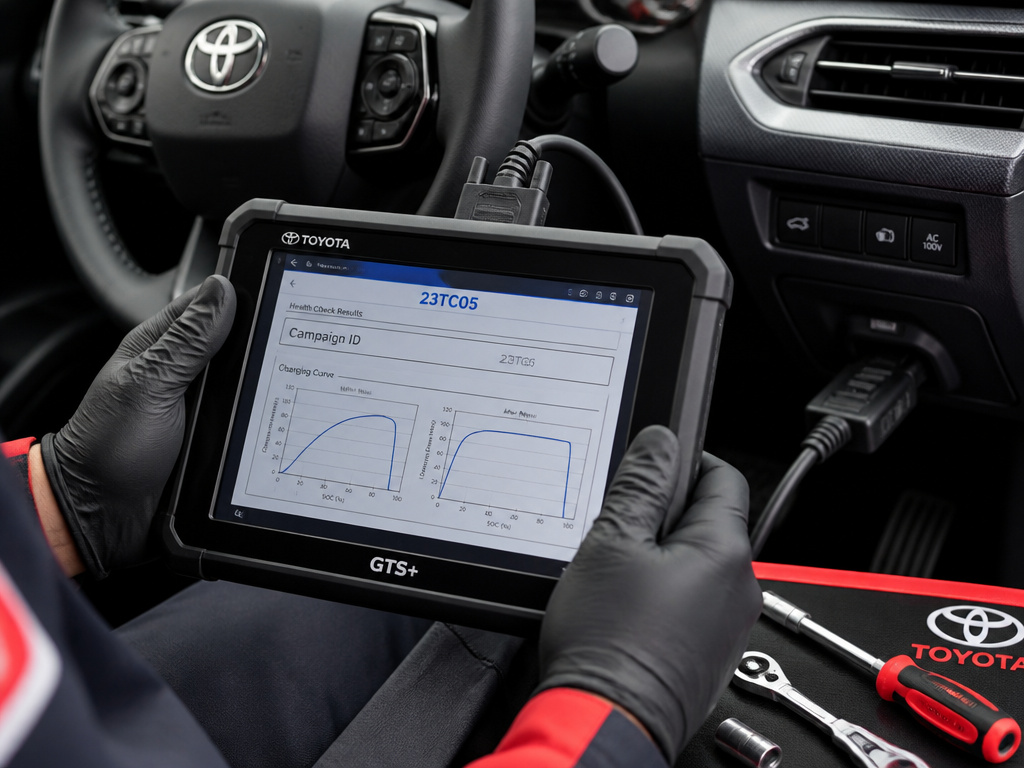
Software is the third layer of ownership, after hardware and scheduled maintenance. For the bZ4X, two major updates have been deployed to address real owner complaints, not just add features.
The first, campaign 23TC05, rolled out in 2023. It aimed to improve DC fast-charging performance and, more visibly, enhance the accuracy of the range display and energy consumption readouts. Early owners reported that the guess-o-meter was pessimistic and that charging curves could be inconsistent. This update required a dealer visit and the use of Toyota’s GTS+ diagnostic tool. Techstream wouldn’t work.
The second was the TSB MC-11015876 from February 2025, which fixed the charging limit bug. This is a classic example of a software glitch with a physical consequence. If you set a daily limit of 80% to reduce battery stress, but the car ignores it and charges to 100% every night, you’re adding unnecessary charge cycles. The update modified the logic in the electric converter unit assembly.
The software update confirmation process is strict. Toyota requires a second technician to verify the update was applied to all relevant ECUs before the car is returned to the owner. This prevents half-applied updates that can cause more problems than they solve.
Both updates are covered under the Toyota Electric Vehicle Drive Components Warranty. There’s no charge to the owner, but you must take the vehicle in. You cannot install these over-the-air.
What is the warranty coverage?
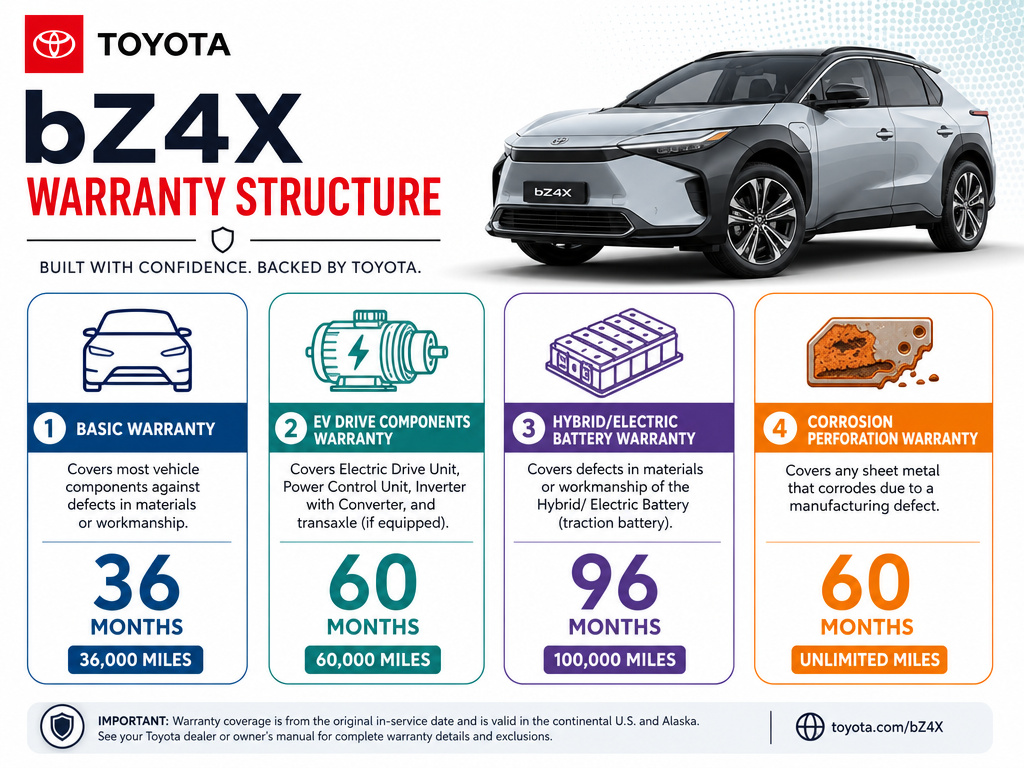
Toyota bundles several warranties into the bZ4X package. The one that matters for the electric powertrain is separate from the basic bumper-to-bumper coverage.
The Toyota Electric Vehicle Drive Components Warranty lasts for 96 months or 100,000 miles, whichever comes first. This is the warranty that specifically covers the repair for the charging limit TSB and other software-related issues with the drive system. It’s a long backstop, but it’s not unlimited. The basic vehicle warranty is the standard 3 years/36,000 miles, covering most other components.
Worth knowing before you start: The electric vehicle warranty is specific to “drive components.” It may not cover every high-voltage part if the failure is deemed unrelated to propulsion. The 12-volt battery, for example, is covered under the basic warranty, and its health is your responsibility to maintain, a weak one isn’t a warrantable failure.
A separate Hybrid/Electric Battery Warranty covers the traction battery against defects and excessive capacity loss (typically below 70% of original capacity) for 10 years or 150,000 miles in some states, and 8 years/100,000 miles federally. This is the guarantee that the battery won’t fail prematurely.
| Warranty | Duration | What It Covers |
|---|---|---|
| Basic | 3 yrs / 36,000 mi | Most vehicle components, excluding wear items |
| EV Drive Components | 8 yrs / 100,000 mi | Traction motor, inverter, converter, related software |
| Hybrid/Electric Battery | 10 yrs / 150,000 mi (state) / 8 yrs / 100,000 mi (fed) | Traction battery defects & capacity loss |
| Corrosion Perforation | 5 yrs / Unlimited mi | Rust-through of body panels |
This structure means a failed CV axle would fall under the basic warranty, while a glitchy power converter is an EV drive component issue. Knowing which is which saves time at the service desk.
Toyota bZ4X vs. Common Comparisons
The bZ4X doesn’t exist in a vacuum. It’s often cross-shopped with other electric SUVs and, curiously, with Toyota’s own hybrid stalwarts. The comparisons hinge on technology versus proven reliability.
Against a Volkswagen ID.4, the bZ4X feels more conventional. The ID.4 has a more playful interior and slightly quicker charging on paper. The bZ4X counters with Toyota’s reputation for build quality and a potentially more robust dealer network for service. The ID.4 hasn’t had a wheel detachment recall, but it has had its own share of software gremlins.
The more telling comparison is with the Toyota RAV4 Hybrid. The RAV4 is a known quantity. It’s a combustion vehicle with electric assist. Its maintenance involves familiar items like engine oil for RAV4 and a RAV4 battery that’s a straightforward replacement. The bZ4X is a complete paradigm shift. You’re trading fuel stops for charging logistics, oil changes for software updates. The RAV4 Hybrid appeals to caution; the bZ4X appeals to a willingness to engage with a newer, more complex system.
Against a Tesla Model Y, the difference is stark. Tesla’s strength is its seamless, extensive charging network and over-the-air updates that often feel magical. The bZ4X’s advantage is traditional dealership service and a physical warranty you can take to a local shop. Tesla handles everything remotely until they need to, and then you might wait for a mobile technician. The bZ4X lets you walk into a service bay.
The bZ4X isn’t the car for someone who wants the absolute latest tech or the longest range. It’s for the buyer who wants an electric vehicle but values the structured, familiar framework of a traditional automaker’s support system, even if that system had a few stumbles at the starting line.
What ownership is really like
Forget the marketing. Ownership is defined by the interaction between the car’s systems and your daily habits. The bZ4X asks you to pay attention to different things.
The range display becomes a point of focus after the 23TC05 update. Is it accurate now? You’ll watch it, matching miles driven to percentage dropped, recalibrating your trust. The charging limit setting requires a ritual: plug in, check the dash, confirm it’s at your set 80% or 90%. After the 2025 TSB fix, you might still glance at it, a habit formed from the bug.
The 12-volt battery is a silent point of failure. In a gas car, a weak battery might cause a slow crank. In the bZ4X, it can prevent the high-voltage contactors from closing, leaving you with a dead, unresponsive vehicle that won’t accept a charge. The maintenance schedule’s specific check at 32,000 km is there for a reason. It’s as crucial as checking the fuel injector cleaner in a high-mileage Camry.
Then there’s the sound. Or the lack of it. The cabin is quiet, which makes other sounds more apparent. You’ll hear the subtle whine of the reduction gear, the click of the battery coolant pump cycling on, the hum of the AC compressor. These are normal, but they’re new. You learn the car’s acoustic signature.
It’s not a set-it-and-forget-it appliance. It’s a vehicle that demands you understand its language, a language of kilowatt-hours, software versions, and coolant specifications instead of quarts of oil and spark plug gaps.
Frequently Asked Questions
Is the Toyota bZ4X reliable?
Its long-term reliability is still being proven. The early recalls for wheels and software were significant, but they were addressed with specific, documented fixes under warranty. The underlying electric powertrain components are covered for 8 years/100,000 miles, which suggests Toyota has confidence in them. It’s more accurate to say it had a problematic launch that has been systematically corrected.
How long will the Toyota bZ4X battery last?
The lithium-ion battery is warranted against defects and excessive degradation (usually below 70% of original capacity) for 8 years or 100,000 miles under federal law, and longer in some states. Real-world lifespan depends heavily on usage, frequent DC fast charging and consistently charging to 100% will accelerate capacity loss. Following the manual’s guidance, like using the charging limit feature, is key to longevity.
Can I fix a Toyota bZ4X myself?
Your ability to perform DIY repairs is severely limited compared to a gasoline car. You cannot safely work on the high-voltage traction battery, motor, or cooling systems without specialized training and equipment. Tasks like cabin air filter replacement, windshield washer fluid, and tire rotations are still owner-friendly. For anything involving the drive system or software, you must rely on a dealer with the proper tools like GTS+.
What is the real-world range of the bZ4X?
After the 2023 software update (23TC05), the displayed range and consumption are more accurate. In moderate temperatures with mixed driving, most owners report achieving close to the EPA estimates of 242-252 miles for front-wheel-drive models. Cold weather, high speeds, and use of climate control can reduce that by 20-30%. The range gauge is now a better tool, but it’s still an estimate.
Does the bZ4X have regenerative braking?
Yes, it has multiple regenerative braking settings controlled by paddle shifters behind the steering wheel. You can adjust the level of regen to suit your driving, from a coasting feel to a strong one-pedal driving effect that significantly slows the car when you lift off the accelerator. It’s not as aggressive as some competitors, but it’s effective for daily driving.
The Bottom Line
The Toyota bZ4X is an electric SUV built on a conservative platform that faced aggressive early problems. Its story is one of rectification: a wheel recall fixed with new hardware, a display update to improve trust, and a software patch to honor your charging preferences. The specs are competitive, the maintenance is light but specific, and the warranty is long where it counts.
It’s not the flashiest or longest-range option. It’s the choice for someone who wants an electric vehicle but places a higher value on the security of a traditional manufacturer’s service network and warranty structure. You’re buying into Toyota’s system, with all its methodical fixes, as much as you’re buying the car itself. For the right owner, that’s exactly the point.
