
Compare the Kia EV9 and Mazda CX-90 PHEV for Family Travel
This post contains affiliate links. As an Amazon Associate, we earn from qualifying purchases.
Choosing between the Kia EV9 and the Mazda CX-90 PHEV comes down to your relationship with electricity. The EV9 is a dedicated electric vehicle with a 99.8 kWh battery, offering an EPA-estimated 280 miles of range but requiring strategic stops on long trips. The CX-90 PHEV uses a 17.8-kWh battery for about 26 miles of electric-only driving before its 2.5-liter engine takes over, eliminating range anxiety but tying you to gas stations. Your daily commute length and tolerance for charging logistics decide this match.
That 26-mile electric window is the CX-90’s entire proposition. It covers school runs and grocery trips on battery power alone for many families. But step outside that bubble—a weekend road trip, a cold morning—and you’re driving a 5236-pound hybrid SUV, not an EV. The EV9 asks for a bigger mental shift. You trade the convenience of a five-minute gas stop for the lower cost and quiet of home charging, accepting that a 1100-mile holiday drive will take a few extra hours.
What follows is a breakdown of where each vehicle excels and where it compromises, grounded in manufacturer specs and documented long-term tests. We’ll compare powertrains, real-world usability, cargo space, and the ownership experience that reviews and forums don’t always highlight.
Key Takeaways
- The Mazda CX-90 PHEV is a gateway electrification vehicle. Use its 26-mile EV range for daily errands, and rely on the gas engine for everything else without changing your habits.
- The Kia EV9 demands charging infrastructure planning. Its 270-mile real-world highway range is ample, but long trips require mapping DC fast chargers, a process made easier by new Tesla Supercharger access.
- Cold weather saps both vehicles’ electric performance. The CX-90’s engine will start to heat the cabin, and the EV9’s range can drop significantly, increasing charge-stop frequency on winter trips.
- Dealer experience matters as much as the car. Documented reports show wide variability in Kia dealership service competency; research your local dealer’s reputation before buying.
- For maximum cargo space with all seats up, the EV9’s 20.2 cubic feet behind the third row beats the CX-90 PHEV’s 14.9 cubic feet, a critical difference for seven-passenger travel.
The Powertrain Showdown: Electric vs. Plug-In Hybrid
This isn’t about horsepower. It’s about energy sources. The Kia EV9’s Permanent Magnet Synchronous Motor setup delivers all its power from the 99.8 kWh lithium-ion polymer battery pack. The Mazda CX-90 PHEV combines a 68-kilowatt electric motor with a 2.5-liter four-cylinder engine, drawing from a much smaller 17.8-kWh lithium-ion battery.
The difference defines your lifestyle.
Where this goes sideways: Assuming the CX-90 PHEV drives like a pure EV. In EV mode, it feels slow, and the engine will forcibly activate on moderate hills or in cold weather to provide cabin heat, cutting the electric-only experience short.
| Specification | 2026 Kia EV9 (AWD Long Range) | 2026 Mazda CX-90 PHEV |
|---|---|---|
| Powertrain Type | Battery Electric Vehicle (BEV) | Plug-In Hybrid Electric Vehicle (PHEV) |
| Combined Output | 379 horsepower, 516 lb-ft torque | 323 horsepower, 369 lb-ft torque |
| Energy Source | 99.8 kWh Lithium-Ion Battery | 17.8 kWh Battery + 2.5L Gas Engine |
| EV-Only Range | EPA-estimated 280 miles | EPA-estimated 26 miles |
| Fuel/Economy | 83 MPGe (combined) | 56 MPGe / Requires Premium for rated power |
| Charging (10-80%) | ~24 minutes (210kW DC Fast Charge) | Engine acts as generator; no DC fast charging |
The EV9’s 552-volt architecture supports ultra-fast charging. On a capable 210kW charger, you can add about 134 miles of range in 15 minutes. The CX-90 PHEV cannot DC fast charge. You plug into a Level 2 charger at home or work, filling its small battery in a few hours to regain that 26-mile buffer.
For local driving, the EV9 is cheaper to run if you charge at home. The CX-90 PHEV can also save on fuel if your daily drive fits within its electric range. But on a highway trip, the CX-90 reverts to hybrid operation, and its efficiency advantage over a conventional SUV narrows.
Cargo & Practicality: Three-Row Reality Check
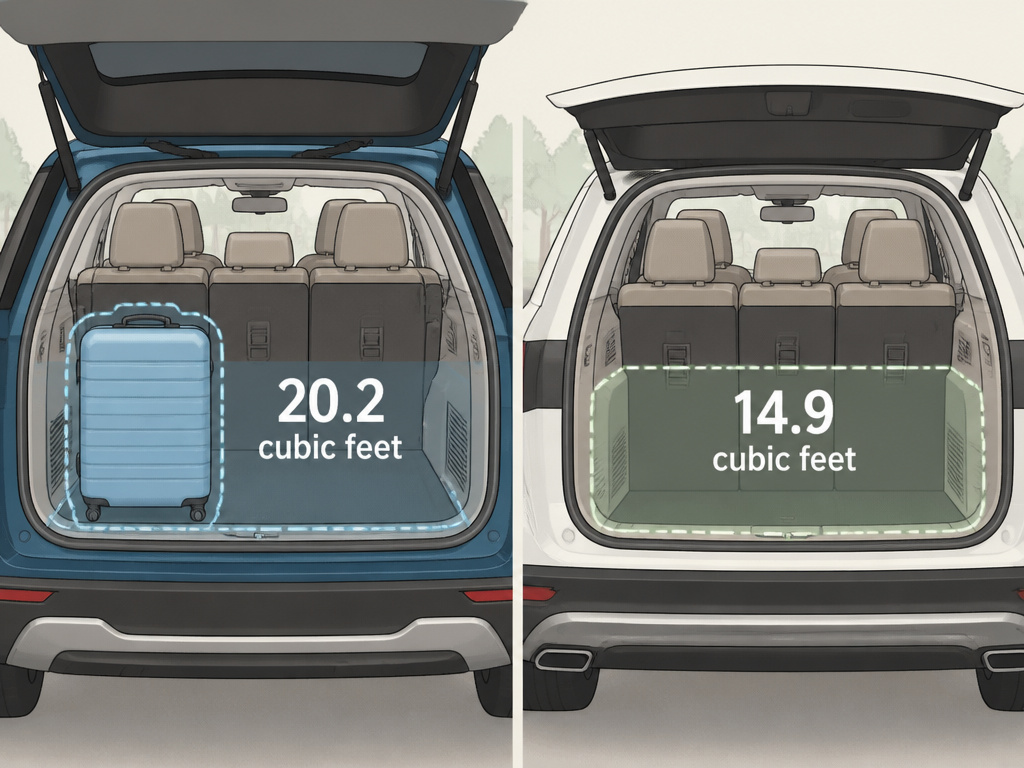
Both are family haulers. But their packaging prioritizes different things. The EV9, built on a dedicated electric skateboard platform, has a flat floor and a wheelbase of 122 inches. The CX-90 PHEV, based on a modified internal-combustion platform, has a transmission tunnel and a wheelbase of 122.8 inches.
Open the liftgate. With all three rows up, the EV9 offers 20.2 cubic feet of cargo space. The CX-90 PHEV gives you 14.9 cubic feet. That 5-cubic-foot difference is about one large checked suitcase. It matters when you’re packing for seven.
Fold the third row, and the gap widens. The EV9 provides 43.5 cubic feet, while the CX-90 PHEV has 40.0 cubic feet. For maximum cargo, with all rear seats folded, the EV9 leads with 81.7 cubic feet versus the CX-90’s 74.2 cubic feet.
The EV9 also has a small front trunk (frunk). It’s only about 1.8 cubic feet, but it’s perfect for storing the mobile charging cable, keeping the main cargo area clean. The CX-90 PHEV’s engine bay leaves no room for a frunk.
Inside, both offer premium materials. The EV9’s cabin in Land or GT-Line trim feels minimalist and tech-forward. The CX-90 PHEV’s interior leans into a driver-focused, almost luxury aesthetic. The Mazda’s infotainment is controlled by a rotary knob, which some prefer over touchscreens while driving.
The Real-World Road Trip Test
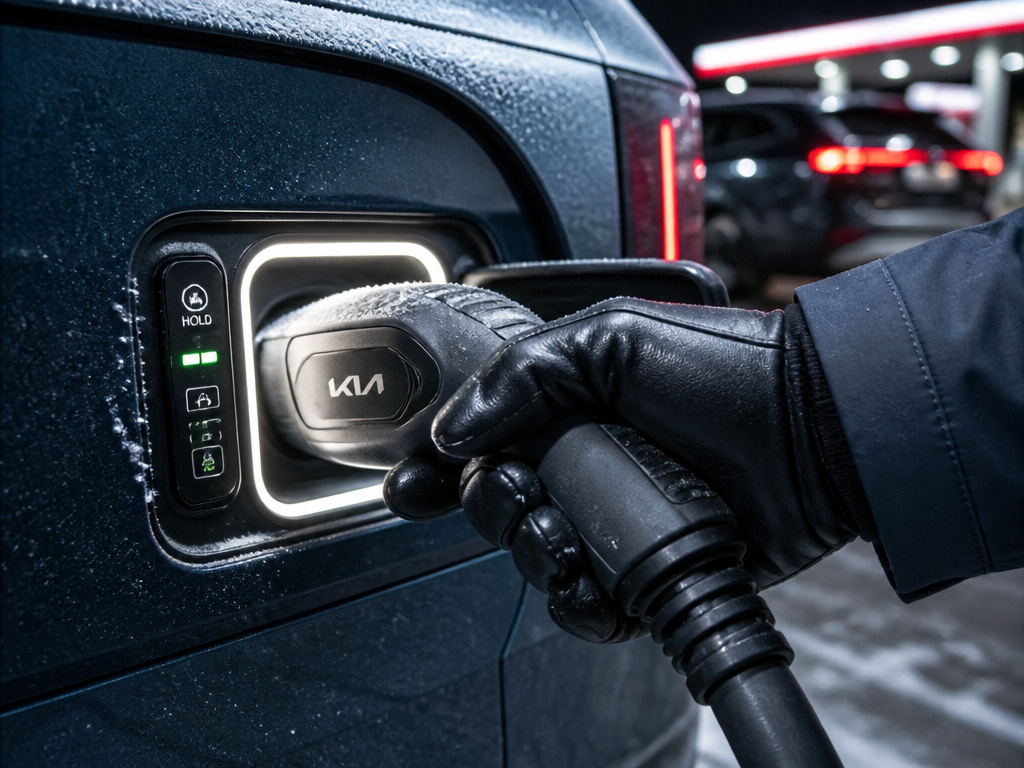
Spec sheets dissolve on the highway. Here, the fundamental difference between a BEV and a PHEV becomes a tangible experience.
A MotorTrend long-term test of the EV9 included a 1,100-mile Thanksgiving trip in freezing temperatures. The cold reduced range, requiring stops every two hours or so. The test noted that with kids needing breaks anyway, the charging stops felt less intrusive. However, they also wasted 30 minutes at a slow 50-kW charger, a planning mistake that highlights the remaining fragility of public charging networks.
I spent 40 minutes eating dinner without charging the vehicle. These were choices I never would have made if I were traveling alone. At the same time, the kids made the frequent stops more tolerable—they rarely make it more than two hours without a break in a gas vehicle, anyway. – MotorTrend long-term test driver
The CX-90 PHEV doesn’t have this problem. You drive until the gas tank is near empty, then stop for five minutes. Its 26-mile battery range is irrelevant on the interstate. You’re driving a hybrid, and a good one at that, with smooth transitions between power sources. The trade-off is you’ll be visiting gas stations and paying volatile fuel prices for the entirety of your journey.
The charging landscape is improving. Kia owners now have access to Tesla’s Supercharger network, vastly increasing reliable charging options. The EV9 can’t hit its full 210-kW charge rate on Tesla’s 500-volt hardware, but the convenience often outweighs the speed penalty.
Ownership & Reliability: Beyond the Brochure
A car is a long-term relationship. The initial excitement fades, and you’re left with maintenance, software, and dealer interactions.
Documented EV9 Quirks:
- Armrest Rattle: A MotorTrend long-term tester reported two rubber nubs that prevent the front armrest from rattling broke. The replacement part was backordered, a common gripe in owner forums. Some owners used cheap earbud tips as a temporary fix.
- Software Hiccups: The same test noted occasional failures of the digital gauge cluster to boot and a multi-day system outage that disabled in-car navigation routing. These were resolved with reboots or over-the-air updates but represent the growing pains of highly digital cars.
- Dealer Service Variability: The test’s first service visit turned a simple tire rotation into a $322 bill with an unnecessary alignment that left the steering wheel crooked. A second dealer performed the correct service for under $100. This underscores a critical rule: shop for a reputable dealer, not just the car.
The CX-90 PHEV, with its conventional engine and transmission, presents fewer novel tech glitches. Its maintenance schedule is more familiar to any mechanic. However, its complex powertrain still represents more potential failure points than a pure gas engine.
For peace of mind, the EV9’s 10-year/100,000-mile powertrain warranty (including the battery) is a strong asset. The CX-90 PHEV’s standard warranty is shorter, though the battery component is also covered for 8 years/100,000 miles.
Which One Should You Choose?
This isn’t a tie. One vehicle will fit your life better.
Choose the Kia EV9 if:
- Your daily driving is under 200 miles, and you can install a Level 2 home charger.
- You take a few long road trips a year and are willing to plan charging stops using apps like PlugShare.
- You want the lowest possible running cost and prefer the silent, instant torque of electric drive.
- Cargo space with all seats up is a frequent priority.
Choose the Mazda CX-90 PHEV if:
- Your daily commute is under 25 miles, but you frequently take unplanned long trips or live in an area with poor charging infrastructure.
- You want to dip a toe into electrification without changing your refueling habits.
- You prefer the driving engagement and interior design philosophy of Mazda.
- You cannot reliably install a home charger but have access to public Level 2 charging at work.
For most families who can charge at home and whose long trips are planned, the Kia EV9 is the more transformative and ultimately cheaper vehicle to live with. For those who need maximum flexibility and cannot commit to the EV lifestyle, the Mazda CX-90 PHEV is a brilliant compromise that still saves gas on most days.
Frequently Asked Questions
Is the Kia EV9 more expensive than the Mazda CX-90 PHEV?
Typically, yes. The EV9 starts at a higher price point, especially for the all-wheel-drive, long-range versions that are most comparable to the CX-90 PHEV. However, potential federal and state tax incentives for electric vehicles can significantly narrow or even reverse that gap. Always check current incentives during your purchase process.
Can the Mazda CX-90 PHEV tow as much as the Kia EV9?
No. The Kia EV9 AWD has a maximum towing capacity of 5,000 pounds when properly equipped. The Mazda CX-90 PHEV is rated to tow 3,500 pounds. If towing a camper or boat is a regular need, the EV9’s higher capacity and the electric motor’s instant low-end torque provide a clear advantage.
How does cold weather affect these vehicles differently?
Cold weather impacts both, but in distinct ways. The CX-90 PHEV’s engine will start automatically in cold temperatures to provide cabin heat, even with a full battery, reducing pure electric driving. The EV9’s range will decrease due to battery chemistry and the energy needed to heat the cabin. In extreme cold, the EV9’s highway range could drop by 25-30%, requiring more frequent charging stops on a trip.
Which one has better performance?
On paper, the Kia EV9 AWD is quicker, with a 0-60 mph time as low as 5.0 seconds. The Mazda CX-90 PHEV is no slouch at around 5.5-6.0 seconds, but its character is different. The EV9 delivers silent, relentless shove. The CX-90 PHEV feels more mechanical, with the engine note becoming prominent under hard acceleration. The “better” performance depends on whether you prefer electric smoothness or traditional feedback.
Before You Go
Look past the badge and the body style. The choice between the Kia EV9 and Mazda CX-90 PHEV is a choice about how you want to interact with energy. One asks you to think ahead and plug in, rewarding you with quiet and low cost. The other lets you live between two worlds, offering a taste of electric driving without ever letting the gas needle hit empty.
Test drive both. But more importantly, audit your life. Map your weekly mileage. Be honest about your road trip habits. Your answer will be obvious.
