
Volkswagen Tiguan Automobiles: Engine Specs That Impact Fuel Costs
This post contains affiliate links. As an Amazon Associate, we earn from qualifying purchases.
The Volkswagen Tiguan is a compact SUV built on a transverse 2.0-liter turbocharged four-cylinder engine (code CCTA in many models) with specific bore and stroke dimensions of 82.5 mm and 92.8 mm. Its maintenance schedule is dictated by factory-set PR numbers, with intervals ranging from 5,000 km to 30,000 km, and it carries documented recalls for a fuse defect and fuel line crystallization.
That engine specification is a critical number that explains the Tiguan’s strong pull from 1,600 RPM and the risk of a check engine light from using the wrong oil viscosity early on. The PR number system is how VW hides the real service cost behind a flexible schedule that most owners never decode.
What follows is the spec sheet the brochure doesn’t print: the torque curves, the service codes, the two NHTSA bulletins that explain why a 2013 model might not start on a hot day, and the direct comparison to its platform-mate, the Audi Q5. By the end, you’ll read a Tiguan’s VIN and know its likely failure points before you turn the key.
Key Takeaways
- The Tiguan’s 2.0L TSI engine (often code CCTA) uses an 82.5 mm bore and 92.8 mm stroke; its 221 lb-ft of torque arrives at 1,600 RPM, which defines its driving character. Service intervals are set by a specific PR code and are not universal.g., QI6 for 30,000 km/flexible); missing the DSG transmission fluid change at 60,000 or 120,000 km destroys the mechatronics unit.
- A 2013 NHTSA recall (97Z9/2V) addressed F16 fuse overheating in 2009-2011 models due to thermal cycling abrading a soft coating, causing exterior light failure.
- Another NHTSA bulletin documented 2012-2014 models suffering “crank, no start” after sitting 3+ days in heat above 77°F, traced to PA12 fuel lines crystallizing from ethanol interaction.
- The Tiguan shares its fundamental MLB platform with the Audi Q5, but tuning, interior materials, and standard equipment create a tangible price-to-refinement gap.
The 2.0L TSI Engine: Bore, Stroke, and Torque Curves
Look under the hood of any modern Tiguan and you find a transverse-mounted 2.0-liter inline-four. The “TSI” badge means turbocharged and stratified injection. This isn’t a generic motor.
The specific architecture matters. According to the 2022 Volkswagen technical specifications, the bore is 82.5 mm and the stroke is 92.8 mm. That’s an oversquare design (bore larger than stroke). It favors higher RPM breathing and allows a larger turbocharger to be fitted in the tight transverse bay.
The 2.0L TSI engine in the Tiguan produces 184 horsepower and 221 lb-ft of torque. This torque peak arrives at 1,600 RPM and holds flat, which is why the SUV feels responsive in city driving despite its curb weight. The compression ratio is 11.65:1, requiring premium fuel (95 RON) for optimal performance and to prevent knock.
The engine block is cast iron. The cylinder head is aluminum alloy. A timing chain drives the dual overhead camshafts. You hear that detail about the chain because it’s a lifetime component, until it isn’t. Stretch or tensioner failure on high-mileage units isn’t a question of if, but when, and the repair bill reflects the labor to get to it.
For the common CCTA engine code, the NHTSA technical service bulletin 2012 lists further specifics: output of 147 kW (197 hp) at 5,100 RPM, 280 Nm (207 lb-ft) of torque at 1,700 RPM, and a 9.6:1 compression ratio. It also states the oil drain plug torque is 30 Nm.
| Engine Spec | 2022 Tiguan 2.0T | CCTA Engine (per NHTSA) | Why It Matters |
|---|---|---|---|
| Bore x Stroke | 82.5 mm x 92.8 mm | 82.5 mm x 92.8 mm | Oversquare design supports turbo response. |
| Peak Torque | 221 lb-ft @ 1,600 RPM | 207 lb-ft @ 1,700 RPM | Defines low-RPM pulling power; towing capacity is limited to 1,500 lbs. |
| Compression Ratio | 11.65:1 | 9.6:1 | Higher compression in newer models demands premium fuel to avoid pre-ignition. |
| Oil Spec | VW 502 00 / 5W-40 | VW 502 00 / 5W-40 or 5W-30 | Using generic oil can void warranty and cause hydraulic lifter noise. |
The oil specification is non-negotiable. It must meet VW 502 00. Pour in a random 5W-30 that doesn’t carry that approval, and the variable valve timing system gets sluggish. You’ll see a low oil pressure warning on the dash within a few thousand miles. The correct oil filter for the CCTA is part number 06J 115 403 Q.
This engine is also used in other Volkswagen Group products, including some configurations of the Audi Q5. The fundamental block is the same, but software tuning, intake components, and sometimes the turbocharger itself differ. That’s why a base Tiguan and a base Q5 with similar power outputs feel different on the road, the delta is in the calibration, not the castings.
Decoding Service Intervals: PR Numbers and the Fine Print
Volkswagen doesn’t have one maintenance schedule. It has several, and which one your Tiguan follows is locked into the vehicle’s build data via a PR number. This code determines everything.
The system is designed for flexibility. The ideal for the manufacturer is the long-life schedule, code QI6. This allows up to 30,000 km or two years between service points, assuming you drive in ideal conditions and use the correct synthetic oil. Most Tiguans sold in North America are set to this from the factory.
But there are other codes. QI1 is 5,000 km or one year. QI3 is 10,000 km or one year. Your owner’s manual has a table, but the car’s computer decides based on how you drive. Frequent short trips, cold starts, and heavy loads trigger the system to shorten the interval.
The part nobody mentions: resetting the service reminder yourself is straightforward, but doing so without actually performing the required checks is a shortcut to accelerated wear. The 2017 Tiguan repair instructions detail the reset procedure via the instrument cluster menu.
The critical items that aren’t part of the flexible schedule are the time-and-mileage bombs: 1. Brake Fluid: Change every two years, full stop. It absorbs moisture, which lowers its boiling point and corrodes the ABS pump. Skip this, and a hard stop on a mountain descent can cause brake fade. 2. DSG Transmission Fluid: The dual-clutch gearbox (code 0DD or 0GC) has a sealed unit. The fluid and filter must be changed every 60,000 km for the 0DD or 120,000 km for the 0GC. Neglect this, and the mechatronics unit, the brain of the transmission, fails from clutch debris contamination. The repair cost exceeds the value of an older Tiguan. 3. All-Wheel Drive Coupling Fluid: For 4Motion models, this transfer case fluid needs changing every two years. If you never off-road, you might skip it. The coupling seizes quietly, and you only discover it when you need traction and the rear wheels get zero power.
Where this goes sideways: Following the oil-change reminder alone. The car’s computer tracks oil life, not brake fluid age, DSG fluid degradation, or haldex pump health. You must keep a separate log for these items.
| Service Item | Fixed Interval | Flexible (QI6) Interval | Consequence of Delay |
|---|---|---|---|
| Engine Oil & Filter | As per PR code (5k-30k km) | Up to 30,000 km / 2 yrs | Sludge formation, turbocharger bearing failure. |
| Brake Fluid | 2 years | 2 years (overrides flexible) | Corroded ABS valve block, spongy pedal, potential failure. |
| DSG Transmission Fluid | 60,000 km (0DD) or 120,000 km (0GC) | Not monitored; fixed interval applies | Mechatronics unit failure, harsh shifts, total transmission replacement. |
| Pollen/Cabin Air Filter | 2 years / 30,000 km | 2 years / 30,000 km | Reduced HVAC airflow, musty odors, potential blower motor strain. |
| Spark Plugs | 60,000 miles (96,000 km) | 60,000 miles | Misfires under boost, reduced fuel economy, potential coil pack damage. |
For the spark plugs, use the OEM-specified type. The wrong heat range in a turbocharged engine leads to pre-ignition under load, which the knock sensors will try to correct by pulling timing. You’ll lose power and fuel economy long before a misfire code appears.
Known Issues and Recalls: Two NHTSA Bulletins Tell the Story
Every model has its quirks. For the Tiguan, two official documents from the National Highway Traffic Safety Administration (NHTSA) define the most significant widespread problems.
Recall 97Z9/2V (2009-2011 Models):
In November 2013, Volkswagen recalled 62,155 Tiguans. The issue was the fuse in position F16 in the under-hood fuse box. The official vehicle recall documentation explains the mechanism: high thermal cycling and a soft-coated fuse blade caused movement between the socket and the fuse. This abrasion increased electrical resistance, leading to localized overheating.
The result wasn’t a fire, but a partial loss of exterior lighting, taillights or headlights might dim or go out intermittently. The instrument cluster would light a warning lamp. The fix was a dealer-replaced, hard-coated fuse. If you own a 2009-2011 model and this hasn’t been done, the fuse box may show melted plastic around the F16 slot.
Service Bulletin V201308 (2012-2014 Models):
This is a “crank, no start” condition. The NHTSA service bulletin PDF details that vehicles left undriven for more than three days in ambient temperatures above 77°F (25°C) could fail to start. The root cause was the PA12 nylon material in the in-tank fuel lines reacting with alcohol (ethanol) in the fuel, forming white crystalline deposits that clogged the fuel pump or lines.
Common mistake: Using fuel with higher ethanol content (like E85) in a vehicle not designed for it. In these specific Tiguans, even standard E10 fuel could cause the issue if the car sat in a hot airport parking lot for a week. The diagnostic trouble code might be P0087 (Fuel Rail Pressure Too Low), or there might be no code at all.
The repair involved replacing the entire fuel delivery module and lines with a revised part. This wasn’t always a full recall; many owners faced this as a costly repair until the bulletin provided guidance to dealers.
Beyond these, watch for: * Water Pump Leaks: The plastic-impeller water pump on the 2.0T is a wear item. It typically starts weeping coolant from its weep hole between 60,000 and 100,000 miles. If you see a pink crusty residue below the thermostat housing, address it immediately. Overheating this engine even once can warp the head. * Sunroof Drain Tubes: If the sunroof is equipped, the drain tubes can clog. Water then drips into the headliner, the footwells, or onto the body control module under the passenger seat. A musty smell or unexplained electrical gremlins often trace back here. * Carbon Buildup: Direct injection engines like the TSI inject fuel directly into the cylinder, bypassing the intake valves. No fuel washes over the valves, so oil vapor from the PCV system bakes onto them. By 80,000 miles, this can cause rough idle and loss of power. The fix is a “walnut blast” media cleaning service.
For diagnosing any of these issues, a quality OBD-II scanner that can read Volkswagen-specific codes is essential. Generic scanners will miss many body control and transmission faults.
Tiguan vs. The Platform-Shared Audi Q5
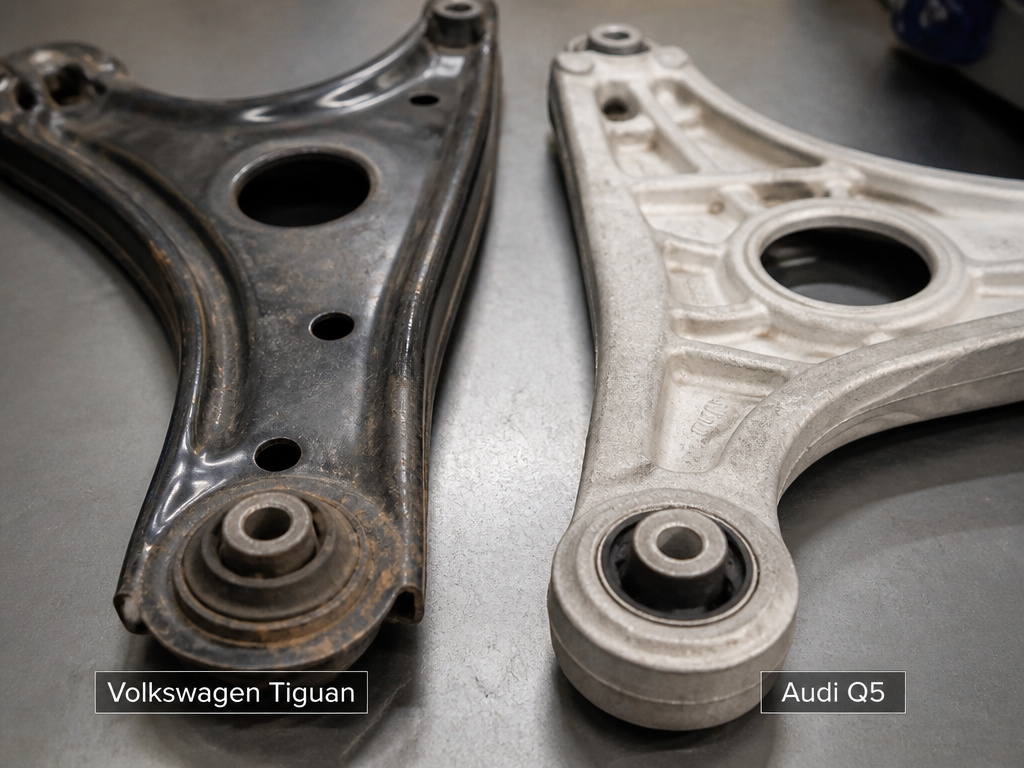 The Volkswagen Tiguan and the Audi Q5 are more than just competitors. For many model years, they are close relatives. They share the Volkswagen Group’s MLB platform. This means fundamental similarities in chassis architecture, all-wheel-drive systems, and engine options.
The differences are in the execution. The Audi Q5 typically uses more aluminum in its suspension components (like control arms) for reduced unsprung weight. Its interior materials, soft-touch plastics, leather, switchgear, are a grade above the Tiguan’s. Sound insulation is more comprehensive.
The Audi Q5 crossover also often features a more sophisticated version of the all-wheel-drive system. Where the Tiguan’s 4Motion is typically a front-biased, haldex-based system that engages the rear wheels when slip is detected, many Q5s use a permanent all-wheel-drive system with a center differential (like Quattro with a torsen differential). This provides more predictable handling, especially in variable traction conditions.
| Aspect | Volkswagen Tiguan | Audi Q5 |
|---|---|---|
| Platform | MQB (Transverse Engine) | MLB (Longitudinal Engine) for most generations |
| Base Drivetrain | Front-Wheel Drive (FWD) available | All-Wheel Drive (AWD) standard in most markets |
| Suspension | Strut front, multi-link rear (steel components) | Strut front, multi-link rear (often aluminum components) |
| Interior Focus | Practicality, space, value | Material quality, technology, driver-centric design |
| Typical Buyer | Family-focused, value-conscious | Luxury-seeking, performance-aware |
Driving the two back-to-back reveals the gap. The Q5 feels more planted, quieter, and solid. The Tiguan feels lighter, more utilitarian, and sometimes noisier over broken pavement. You pay for the difference in the showroom and at the service department. Audi labor rates and parts costs are higher.
This doesn’t make the Tiguan worse. It makes it different. For a family needing maximum cargo space (up to 73.4 cu ft behind the first row) on a budget, the Tiguan’s value is clear. For someone prioritizing driving dynamics and cabin isolation, the Q5 justifies its price. It’s a classic case of shared DNA expressing itself for different target audiences.
The same logic applies when comparing the Tiguan to the broader market of hybrid cars and electric SUVs. The Tiguan is an internal combustion proposition. Its value is in proven mechanics and lower initial cost compared to a hybrid vehicle or an electric vehicle. Your choice hinges on your priority: upfront cost and range flexibility (Tiguan) versus fuel savings and environmental impact (EV/hybrid).
The Ownership Proposition: Costs, Tools, and Reality
 Owning a Tiguan means owning a European vehicle with corresponding service expectations. You can’t take it to a quick-lube shop for the cheapest oil and expect 200,000 trouble-free miles.
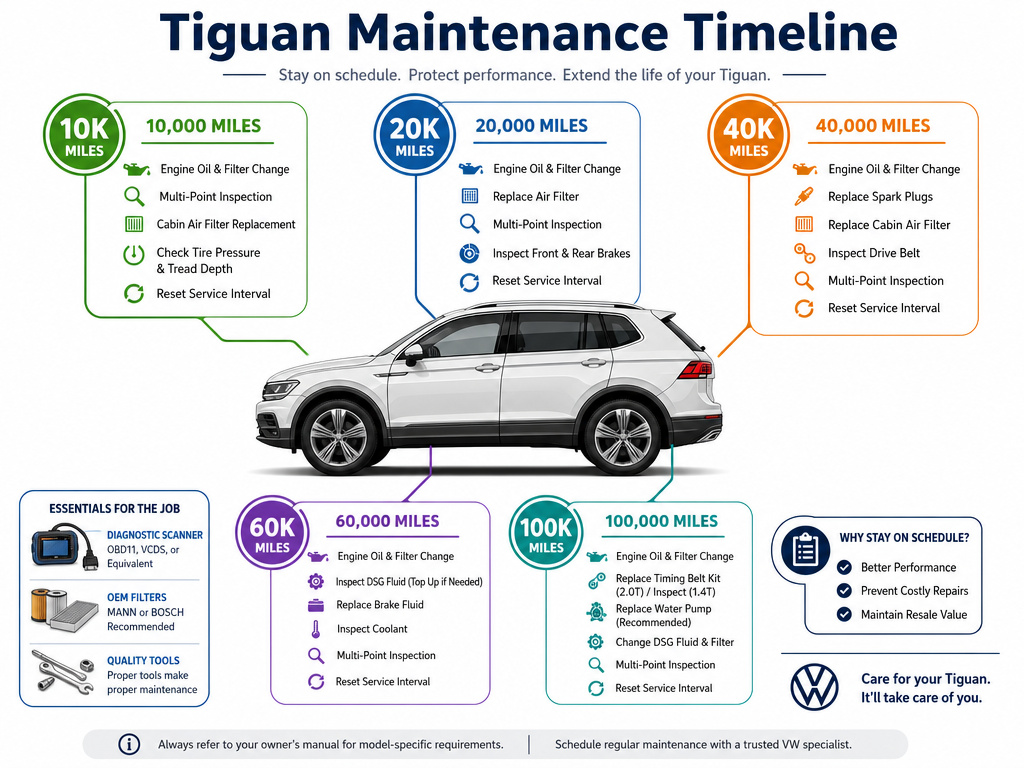
The first tool you need is a proper diagnostic tool for Volkswagen. A basic code reader won’t reset the service light or code a new battery. Look for a scanner that can access all control modules, engine, transmission, ABS, airbags, and especially the infotainment system. This is non-negotiable for serious DIY work.
Second, find a source for OEM or high-quality aftermarket parts. The oil filter, air filter, and cabin filter should be Mann, Mahle, or Bosch, the same companies that supply VW. For brakes, Zimmermann or Textar rotors with Jurid or Pagid pads match OEM performance.
Here’s a realistic maintenance timeline based on the fixed intervals, assuming a mix of DIY and professional service: 1. Every 10,000 miles/1 year: Oil and filter change (VW 502 00 5W-40). Inspect brakes, tires, and for any fluid leaks. Check sunroof drains. 2. Every 20,000 miles/2 years: Replace cabin air filter. Change brake fluid (every 2 years is critical). 3. Every 40,000 miles: Replace engine air filter. Inspect serpentine belt and tensioner. 4. Every 60,000 miles: Replace spark plugs. Change DSG transmission fluid and filter (if equipped). This is a major but vital service. 5. Every 100,000 miles: Replace timing chain and tensioner (preemptive, based on common failure window). Flush and fill coolant. Inspect carbon buildup on intake valves.
The all-wheel drive system in 4Motion models adds another layer. The haldex coupling fluid and filter change is a separate, often-forgotten service. If you hear a whining or binding sensation during tight turns, the coupling is likely starved of clean fluid.
Is it worth it? For the right owner, absolutely. The Tiguan offers a compelling mix of interior space, turbocharged performance, and polished highway manners that many Japanese competitors still struggle to match. But you must go in with eyes open. Budget for premium fluids, follow the precise intervals, and use a scanner that speaks the car’s language. Do that, and the Tiguan rewards you with a driving experience that feels a class above its price.
Frequently Asked Questions
What is the Volkswagen Tiguan’s towing capacity?
The Volkswagen Tiguan is rated to tow a maximum of 1,500 pounds across all model years and trims. This is for a braked trailer. It is not designed for heavy towing; this capacity is sufficient for a small utility trailer or a pair of jet skis, but not for a large camper or boat.
How often does a Volkswagen Tiguan need a timing belt change?
The Volkswagen Tiguan uses a timing chain, not a belt. It is designed as a “lifetime” component. However, on the 2.0L TSI engine, chain stretch and tensioner failure are known issues, typically appearing between 80,000 and 120,000 miles. Preemptive replacement of the chain, guides, and tensioner is a common and recommended major service to avoid catastrophic engine damage.
Is the Volkswagen Tiguan considered a reliable car?
The Tiguan’s reliability is conditional. When maintained strictly according to factory specifications with the correct fluids and parts, it can be durable. However, it is less tolerant of neglect or incorrect maintenance than many Japanese rivals. Known trouble spots include the water pump, sunroof drains, and on earlier models, the high-pressure fuel pump and ignition coils. Its reliability is above average for a European compact SUV but requires a more involved and informed ownership approach.
What’s the difference between the Tiguan and the Touareg?
The Tiguan is a compact, transverse-engine SUV based on a car platform (like the Volkswagen Golf). The Touareg is a mid-size, longitudinal-engine SUV that shares its platform with the Porsche Cayenne and Audi Q7. The Touareg is larger, more powerful, more luxurious, more capable off-road, and significantly more expensive to buy and maintain. The Tiguan is a family hauler; the Touareg is a premium cruiser.
Can I use regular unleaded gas in my Volkswagen Tiguan?
Volkswagen recommends premium unleaded fuel (91 octane or higher) for optimal performance and fuel economy in the Tiguan’s turbocharged engine. The engine computer will adjust timing if you use regular (87 octane), but you will experience reduced power and potentially lower fuel efficiency. For the long-term health of the turbocharger and to prevent knock, using premium fuel is strongly advised.
The Bottom Line
The Volkswagen Tiguan is a smart, space-efficient package wrapped around a potent turbocharged engine. Its appeal is real: a premium feel at a non-premium price. But that appeal is a contract. You agree to feed it specific oil, change its DSG fluid on a strict timetable, and pay attention to its unique failure modes like the F16 fuse or fuel line crystallization.
Treat it like an appliance, and it will become a financial headache. Treat it like the complex, driver-focused machine it is, with the right OBD-II scanners and OEM parts, and it delivers a rewarding ownership experience that few in its class can match. Your decision involves a commitment to the detailed requirements in the service manual, not merely a preference for the SUV.
