
Specs and Recalls for the Audi Q5 Crossover Automobile
This post contains affiliate links. As an Amazon Associate, we earn from qualifying purchases.
The Audi Q5 is a midsize luxury crossover SUV that balances performance, technology, and practicality. For the 2022 model year, it offered three core powertrains: a 261-horsepower 2.0L turbo-four (45 TFSI), a 362-hp plug-in hybrid four-cylinder (55 TFSI e), and a 349-hp 3.0L turbocharged V6 in the SQ5. All use Audi’s quattro all-wheel drive, but critical differences in fuel capacity, towing, and weight exist, alongside specific NHTSA safety recalls for engine and battery defects.
That 18.5-gallon fuel tank in the gas models shrinks to 14.3 gallons in the plug-in hybrid. It’s not a footnote, it changes the math on a road trip before the electric range even factors in. The hybrid also drops the max tow rating from 4,400 pounds to 2,000. These aren’t minor trim differences; they’re fundamental splits in what the vehicle is built to do.
What follows is a breakdown of the specs that aren’t in the brochure, the two recalls that affected over 50,000 vehicles, and the one oil specification you must get right to avoid warranty issues. We’ll start with what’s under the hood.
Key Takeaways
- The 2022 Q5 lineup splits into three distinct powertrains: the standard 2.0T, the performance-oriented SQ5 V6, and the efficiency-focused 55 TFSI e plug-in hybrid, each with major differences in capability.
- Two significant NHTSA recalls exist: one for engine connecting rods (Recall 22V-753) affecting over 44,000 U.S. Vehicles, and one for high-voltage battery modules (Recall 24V-898) in hybrids, with a 1% estimated defect rate.
- Official Audi oil specification VW 502 00 calls for synthetic SAE 5W-40, 5W-30, or 0W-40, with a 4.6L capacity for gas models, using the wrong oil can void powertrain coverage.
- Towing capacity is not uniform: the 55 TFSI e plug-in hybrid is rated for only 2,000 lbs, half that of the conventional gas and SQ5 models.
- Always verify a used Q5’s VIN against open recalls, focusing on production dates from August 2021 to December 2022 for hybrid battery concerns.
What engine options are available for the Audi Q5?
Forget “good, better, best.” The 2022 Q5 offered three different vehicles disguised as one model line. Your choice locks in your performance ceiling, your fuel stops, and your utility.
The base engine is the 2.0 TFSI turbocharged four-cylinder. In the 45 TFSI trim, it makes 261 horsepower and 273 lb-ft of torque. Audi pairs it with a seven-speed S tronic dual-clutch transmission. This is the commuter spec. It works.
The 3.0 TFSI turbocharged V6 is the heart of the SQ5. It produces 349 horsepower and 369 lb-ft, sent through an eight-speed Tiptronic automatic. The 0-60 mph time drops to 4.7 seconds. The extra two cylinders and the conventional torque-converter automatic change the character completely, it’s smoother under low throttle and pulls harder at the top end.
The 3.0 TFSI V6 in the SQ5 uses a bore of 84.5 mm and a stroke of 89.0 mm for a displacement of 2,995 cc. Its compression ratio is 10.1:1, and it requires premium fuel. The engine is front-mounted with an aluminum alloy cylinder head.
The wild card is the 55 TFSI e plug-in hybrid. It uses a version of the 2.0L four-cylinder paired with an electric motor and a 17.9 kWh battery for a combined 362 hp and 369 lb-ft. It also uses the seven-speed dual-clutch. The numbers look great, but the trade-offs are physical: a 4,619 lb curb weight and a reduced 14.3-gallon fuel tank.
| Powertrain | Horsepower (SAE) | Torque (lb-ft) | Transmission | 0-60 mph (sec) |
|---|---|---|---|---|
| 2.0 TFSI (45 TFSI) | 261 | 273 | 7-Speed S tronic | 5.7 |
| 3.0 TFSI (SQ5) | 349 | 369 | 8-Speed Tiptronic | 4.7 |
| 2.0 TFSI e (55 TFSI e) | 362 | 369 | 7-Speed S tronic | 5.0 |
The short version: Want one answer? The 45 TFSI is fine. But if you ever floor the throttle, the SQ5’s V6 is the only engine that doesn’t sound and feel like it’s working against itself.
Known Issues and Recalls You Must Check
A clean Carfax isn’t enough. Two federal safety campaigns targeted specific batches of the Q5, and they’re serious enough to check before any purchase. This is where the Audi Q5 features and specs page ends and the real ownership story begins.
Recall 22V-753 (Engine Connecting Rods): Issued in January 2023, this NHTSA safety recall notice covers 44,724 U.S. Market Q5 and Q5 Sportback vehicles from model years 2021-2023. The defect involves deviations in the mechanical production of the engine’s connecting rods. These deviations may cause increased particle occurrence in the engine oil circuit.
Where this goes sideways: The particles lead to accelerated wear. That can cause a sudden loss of motive power while driving. In rare cases, it could also lead to engine oil loss and a fire risk. The repair is a complete engine replacement.
Recall 24V-898 (High-Voltage Battery): This March 2025 NHTSA 2024 recall report affects 4,616 Audi Q5 55 TFSI e plug-in hybrids from the 2022-2023 model years. The affected high-voltage battery modules, supplied by Samsung SDI in Hungary, may experience a thermal overload.
The estimated defect rate is 1%. The consequence is a possible battery fire. The part number for the Q5’s battery is 80A.915.099. If you’re looking at a used Q5 hybrid, this is the single most important document to verify clearance for.
| Recall | NHTSA Number | Models Affected | Defect | Remedy |
|---|---|---|---|---|
| Engine Connecting Rods | 22V-753 | 2021-2023 Audi Q5/SQ5 | Production flaw causes oil contamination & engine failure. | Engine replacement. |
| High-Voltage Battery | 24V-898 | 2022-2023 Audi Q5 55 TFSI e | Battery module may overheat, causing fire risk. | Battery module inspection and replacement. |
The part nobody mentions: These recalls have specific VIN ranges and production windows. The hybrid recall targets vehicles built between August 10, 2021, and December 10, 2022. A dealer can run the VIN in seconds. Skip this step and you’re assuming a previous owner did the work.
Dimensions, Towing, and Practical Specs
The Q5’s shape hides its size. At 184.3 inches long with a 111.0-inch wheelbase, it’s within an inch of most rivals like the BMW X3. The numbers that matter are inside and underneath.
Passenger space is consistent. All 2022 models have 40.9 inches of front legroom and 38.0 inches in the rear. The cargo area offers 25.9 cubic feet behind the rear seats and 54.1 cubic feet with them folded. A panoramic sunroof cuts about 0.3 cubic feet from that total headroom.
Towing capacity is where the powertrain choice hits hardest. The 45 TFSI and SQ5 can tow a 4,400 lb braked trailer. The 55 TFSI e plug-in hybrid is rated for only 2,000 lbs. That’s less than many compact crossovers. The hybrid’s battery pack, electric motor, and reduced cooling capacity dictate the limit.
Common mistake: Assuming all AWD Q5s have the same tow rating. The hybrid’s rating is printed on a label inside the driver’s door jamb for a reason, it’s half the others.
Fuel economy follows the same split personality. The 45 TFSI gets an EPA-estimated 23 city/28 highway mpg. The SQ5 drops to 18/24. The 55 TFSI e is rated at 43 MPGe combined when counting both electric and gas operation. Its smaller 14.3-gallon tank gives it a shorter driving range between fill-ups than the gas models’ 18.5-gallon tank, even with a full battery charge.
Drivetrain and the Quattro System
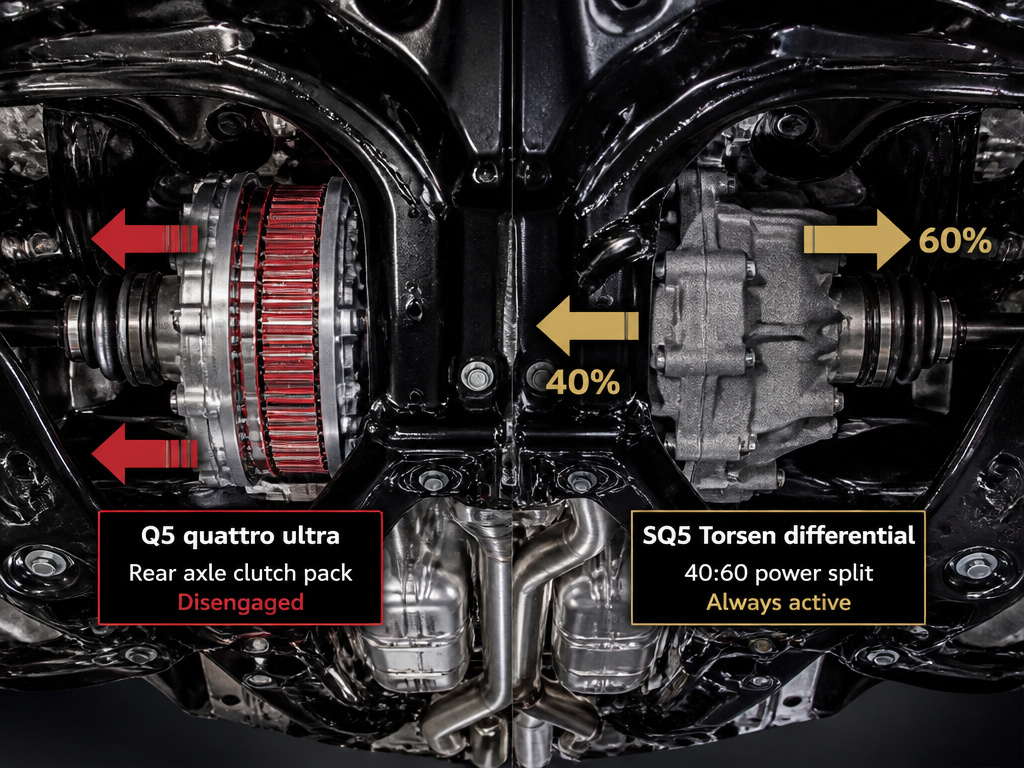 Every Q5 sold in the U.S. Uses a version of Audi’s quattro all-wheel drive. But “quattro” is a brand, not a single technology. The system differs between the four-cylinder, hybrid, and V6 models, impacting how the car feels in low-traction situations.
The 45 TFSI and 55 TFSI e models use quattro with ultra technology. This is a front-biased, on-demand system. A clutch pack at the rear axle can disconnect the rear driveshaft entirely during steady-state cruising to save fuel. It re-engages in milliseconds when the front wheels slip or when you accelerate hard. It’s efficient, but the engagement isn’t always seamless.
The SQ5 uses a traditional mechanical quattro system with a center Torsen torque-sensing differential. Power is split 40:60 front-to-rear by default, and it can send up to 70% forward or 85% rearward as needed. This system is always active, giving a more rear-driven feel and predictable handling.
I prefer the Torsen system in the SQ5. The ultra system saves a fraction of a mile per gallon, but the slight delay in power transfer during a tight corner on a damp road is noticeable. For pure winter confidence, the mechanical system wins.
Both systems are competent, but they serve different masters. The ultra system prioritizes efficiency for the SUV market at large. The Torsen system prioritizes performance and traction, similar to the setup in the Audi S3 and RS3 all-wheel drive models. Your driving environment should decide.
Maintenance and Service Specifics
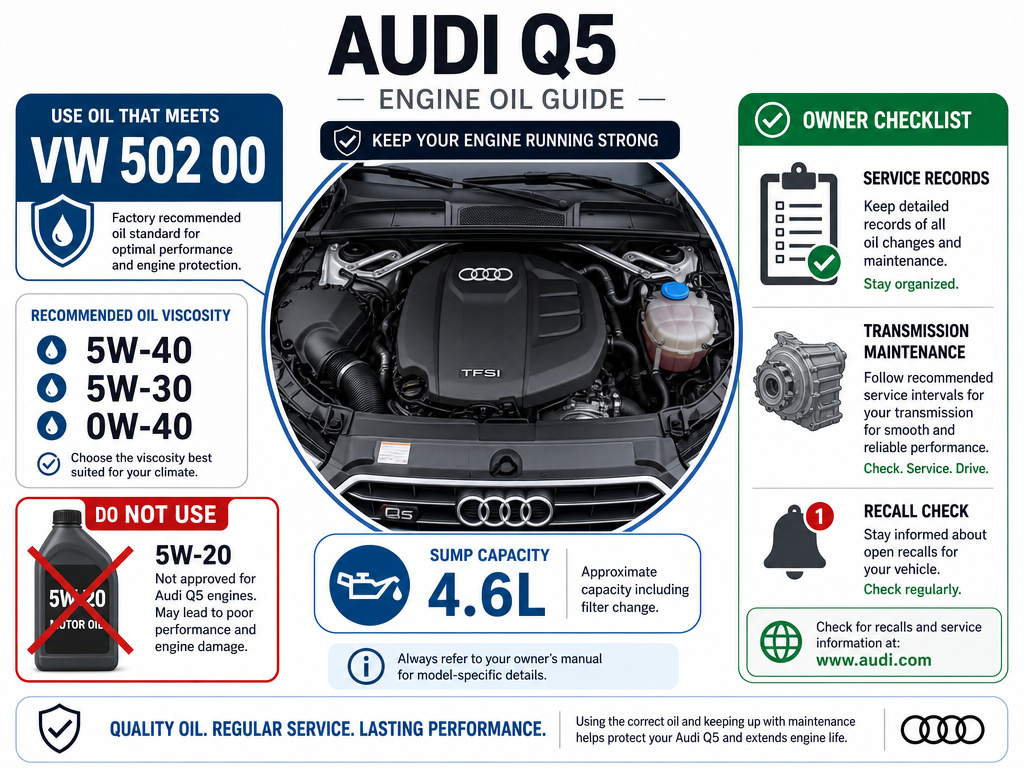 Audi maintenance isn’t cheap, but the biggest cost comes from ignoring the factory specs. The oil specification is the first place independent shops get it wrong.
For the 2.0T and 3.0T gas engines, Audi mandates oil meeting standard VW 502 00. According to a 2015 NHTSA technical service bulletin, this translates to synthetic SAE 5W-40, 5W-30, or 0W-40. The sump capacity is 4.6 liters (about 4.9 quarts). Using a generic 5W-20 or a non-synthetic oil can lead to premature wear and void your powertrain warranty.
The plug-in hybrid has a different set of needs. Its 2.0L engine also uses VW 502 00 oil, but the hybrid system adds a high-voltage battery coolant loop and a dedicated transmission oil check. TSB 2070965/1 outlines a procedure to check and top up the dual-clutch gearbox oil (part number G 055 529 A2) if slippage is detected.
Here’s a quick service checklist for a used Q5 purchase inspection: 1. Pull all service records. Look for dealer or specialist stamps using the correct oil spec. 2. Check the transmission. For S tronic models, listen for hesitation or shuddering at low speed, a sign the dual-clutch fluid may be low or degraded. 3. Verify recall completion. Use the NHTSA website or have a dealer check the VIN for open campaigns 22V-753 and 24V-898. 4. Inspect the sunroof drains. A common, non-recalled issue is clogged drains leading to water leaks in the footwells.
Skipping the oil spec check is the most common error. It’s a five-minute phone call to the last shop that did the work. Don’t guess.
How does the Q5 compare to its rivals?
The luxury compact SUV segment is crowded. The Q5’s real competition isn’t a mystery, it’s the BMW X3, the Mercedes-Benz GLC, and the Hyundai Tucson. The Q5 stakes its ground on a specific blend.
Against the BMW X3, the Q5 trades sharp, sporty handling for a slightly more comfortable ride and a more intuitive infotainment layout. The X3’s steering feedback is better. The Q5’s cabin feels more solid over broken pavement. It’s a choice between engagement and isolation.
Against the Mercedes-Benz GLC, the Q5 feels more driver-focused. The GLC prioritizes plushness and interior ambiance. The Q5’s controls are more tactile; the GLC’s are more elegant. For long highway trips, the GLC might be preferable. For daily driving with more varied roads, the Q5 connects better.
Against the Lexus NX, the Q5 offers more powerful engine options and a more engaging all-wheel drive system. The Lexus wins on predicted reliability and hybrid efficiency, but it falls behind on performance and interior tech responsiveness.
The Q5 doesn’t dominate any one category. It’s a strong all-rounder. Where it pulls ahead is in offering a genuine performance variant (the SQ5) that feels meaningfully different from the base model, and a plug-in hybrid that doesn’t completely sacrifice driving dynamics. Most rivals make you choose between efficiency and speed; the Q5 lineup lets you pick your priority.
Frequently Asked Questions
Is the Audi Q5 a reliable car?
The Q5 has average predicted reliability for the luxury segment. Its core mechanical components are proven, but complexity is the enemy. The turbocharged engines are sensitive to correct maintenance, specifically, using the exact VW 502 00 oil specification. The two major NHTSA recalls (engine and hybrid battery) also indicate specific, batch-related failure points that must be checked on any used model. A well-maintained Q5 can be reliable; a neglected one is a significant financial risk.
What is the difference between the Audi Q5 and SQ5?
The difference is fundamental, not just cosmetic. The SQ5 uses a 3.0L turbocharged V6 engine (349 hp) versus the standard Q5’s 2.0L turbo-four (261 hp). The SQ5 employs a traditional Torsen mechanical all-wheel-drive system, while the standard Q5 uses a front-biased, on-demand “quattro ultra” system. The SQ5 also has a sport-tuned suspension, larger brakes, and distinct interior trim. It’s a different driving experience focused on performance.
Is the Audi Q5 good in snow?
Yes, with the right tires. Both quattro systems provide excellent all-weather traction. The SQ5’s Torsen system may offer a slight edge in predictability and rear-bias feel. However, no all-wheel-drive system compensates for inadequate tires. For serious winter conditions, fitting a set of dedicated winter tires on all four wheels is mandatory for safe stopping and cornering, a principle true for any winter driving with AWD.
Does the Audi Q5 have a third row?
No. The Audi Q5 is a five-seat midsize crossover. It does not offer a third-row seat option. For three-row seating within the Audi lineup, you must step up to the larger, three-row Audi Q7.
What is the towing capacity of an Audi Q5?
Towing capacity depends on the engine. The 45 TFSI (2.0T) and SQ5 (3.0T) models are rated to tow a maximum of 4,400 pounds for a braked trailer. The 55 TFSI e plug-in hybrid has a significantly lower rating of 2,000 pounds due to its battery weight and cooling system limitations. Always confirm the rating via the vehicle’s door jamb label.
Before You Go
The Audi Q5 is a competent, well-rounded luxury crossover. Its strength is offering three genuinely different powertrains under one roof. But the details dictate ownership.
Check for the two major recalls first, engine and hybrid battery. They’re serious and VIN-specific. Understand that the plug-in hybrid trades substantial towing capacity and fuel tank size for its electric range. And never let a shop pour generic oil into the engine; the VW 502 00 specification is non-negotiable.
For most buyers, the standard 45 TFSI with quattro is the sensible choice. But if your budget allows, the SQ5’s V6 and mechanical AWD deliver the premium experience the badge promises. Just make sure it’s had its recall work done.
