
Are Audi A3s 4 Wheel Drive? AWD Guide & Quattro Truth
This post contains affiliate links. As an Amazon Associate, we earn from qualifying purchases.
Most Audi A3 models are front-wheel drive. The A3 40 TFSI quattro, S3, and RS3 trims are the only ones equipped with Audi’s all-wheel drive system. This AWD is a Haldex-based, on-demand system that sends power rearward only when slip is detected, not a permanent mechanical 4×4.
That distinction between standard and optional drive wheels is the first filter. The second is mechanical: the transverse-engine A3 uses a different quattro system than Audi’s longitudinal-engine cars. It’s a clutch-pack setup that can fail in a specific, documented way.
What follows: the exact trims that get AWD, the engineering behind the Haldex coupling, the one service bulletin every A3 quattro owner should know about, and how this system compares to the Audi Q3’s quattro system or the permanent setup in larger Audis.
Key Takeaways
- Front-wheel drive is the standard configuration for the Audi A3 Sedan, Sportback, and allstreet.
- All-wheel drive is reserved for the A3 40 TFSI quattro, S3, and RS3 performance models.
- The A3’s AWD is a Haldex-based, on-demand system, not a traditional permanent 4WD.
- A 2017 NHTSA Technical Service Bulletin documented a sludge-clogging failure in the AWD coupling for 2013-2016 models.
- The system’s operation is dependent on a specific high-performance oil; using the wrong fluid guarantees premature failure.
Which Audi A3 Models Have All-Wheel Drive?
You don’t pick all-wheel drive on an A3. You pick a trim that has it. The configurator doesn’t offer a checkbox for quattro on a base A3 35 TFSI. The drivetrain is baked into the model code.
For the current generation (Type 8Y, 2020-present), the rule is simple. The A3 35 TFSI (110 kW) is front-wheel drive. The A3 40 TFSI quattro (147 kW) gets all-wheel drive. The S3 (228 kW) and RS3 (294 kW) are exclusively all-wheel drive. This pattern holds for the Sedan, Sportback, and Cabriolet body styles. The A3 allstreet, a raised wagon, is FWD-only in its standard form.
The A3’s all-wheel drive availability is engine-dependent. The 2015 Audi A3 Running Gear eSelf Study Program states the A3 is available with all-wheel drive “in combination with the four-link rear suspension,” and the use of the torsion beam or four-link rear suspension “is dependent on engine horsepower output.”
This isn’t new. Looking back at the previous generation (8V, 2012-2020), the same logic applied. The 1.8T and 2.0T models could be had with quattro, often bundled with the more powerful engine option. The entry-level 1.4T and 1.6 TDI were almost exclusively front-drivers. This creates a clear divide in the used market: if you see a non-S3 A3 with a 2.0-liter engine, it might be AWD. If it’s a 1.4 or 1.8, it almost certainly is not.
Front-Wheel Drive vs. All-Wheel Drive in the A3
Why would Audi, a brand synonymous with quattro, sell so many front-wheel drive A3s? Weight, cost, and fuel efficiency. A front-wheel drive A3 Sedan 35 TFSI has an unladen weight of 1,290 kg. Adding the Haldex module, rear driveshafts, and a rear differential adds roughly 60-80 kg. That weight penalty shows up in the combined fuel consumption figure, a FWD A3 is rated around 5.5-6.2 L/100km, while an AWD model will typically consume 0.5-1.0 L/100km more.
The driving feel is different. A front-wheel drive A3 is a competent, neutral handler. The electromechanical steering is light, and understeer is the default limit behavior. The all-wheel drive system, even in the standard 40 TFSI quattro, changes the balance. Power-on understeer is reduced, and the car feels more planted exiting wet corners. It’s a safety and traction benefit first, a performance enhancer second.
For most daily driving in moderate climates, front-wheel drive is sufficient. The stability control system is excellent. The decision for AWD often comes down to climate and intent. If you regularly face heavy snow or plan for aggressive driving, the quattro system is a tangible upgrade. It’s a similar calculus drivers make when comparing AWD vs 4WD in snow for larger vehicles.
The Haldex System: How the A3’s “Quattro” Actually Works
Forget the iconic longitudinal quattro with a Torsen center differential. The transverse-engine A3 uses a fifth-generation Haldex clutch system. This is an on-demand, electronically controlled all-wheel drive system. Under normal conditions, 100% of the engine’s torque goes to the front wheels. The system is pre-emptive, not reactive.
Sensors monitor wheel speed, steering angle, throttle position, and lateral acceleration hundreds of times per second. The moment the control unit predicts slip, like a hard acceleration or a sudden steering input, it engages an electrohydraulic pump. This pump pressurizes a clutch pack that connects the rear axle. Torque can be transferred rearward in milliseconds. The maximum split is typically around a 50/50 front/rear distribution under extreme slip.
Where this goes sideways: Assuming the A3’s quattro is a full-time mechanical system. It’s not. It’s a front-wheel-drive car with a clutch that can send power backward when told to. If that clutch or its pump fails, you’re driving a FWD car without any warning lights until you need traction and it’s not there.
This design is shared across many Volkswagen Group vehicles. It’s effective for its intended purpose: improving traction and stability. It is not, however, a system designed for sustained, heavy off-road use or for creating a rear-wheel-drive-biased driving character. That’s a key differentiator from the standard system in a BMW X3 xDrive or the more robust setups in a Jeep Grand Cherokee’s 4WD systems.
| System Component | Function | Failure Symptom |
|---|---|---|
| Haldex Clutch Pack | Transfers torque to rear axle | No rear drive, front-wheel spin |
| Electrohydraulic Pump (V181) | Engages clutch via fluid pressure | Warning light, “AWD malfunction” message |
| Pump Strainer | Filters fluid | Clogs with sludge, causes pump failure |
| Control Module | Processes sensor data | Erratic engagement, system deactivation |
The Known AWD Coupling Sludge Failure
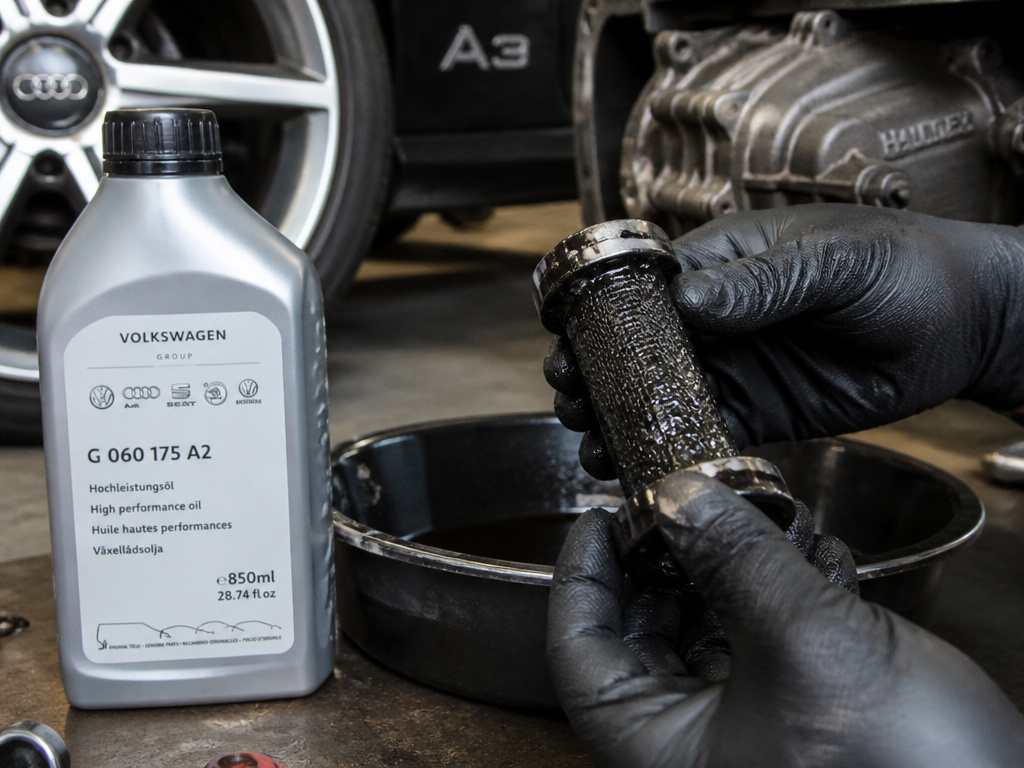
This is the non-commodity part. The Haldex system in the A3 isn’t just an abstract spec. It has a documented, widespread failure mode tied to a specific service item.
Audi Technical Service Bulletin 2049498/1, dated November 30, 2017, addresses “All-wheel drive coupling is stuck on or doesn’t engage” in 2013-2016 Audi A3, A3 Cabriolet, and S3 models. The cause is precise: “precipitations of water (condensed water from air and surrounding area)” mixing with clutch and steel plate particles to form a black sludge. This sludge clogs the pump strainer (Figure 1 in the TSB), the pump (V181) fails, and the AWD system stops working.
The TSB specifies a repair procedure: drain and replace the high-performance oil for the four-wheel drive clutch, replace the pump (V181), and thoroughly clean the strainer and pump housing. Crucially, it notes that “Until the end of 2014 the oil used for the All-Wheel Drive Clutch led to precipitations of water… An improved oil was introduced in the parts catalogue.”
The 2017 NHTSA safety circular states the repair requires “G 060 175 A2 High performance oil for 4 wheel coupling 2.” Using the wrong oil, or extending the service interval, directly leads to the sludge condition.
This failure isn’t a maybe. It’s a when. The service interval for the Haldex fluid is often overlooked because it’s not part of the standard “Audi Care” maintenance plan. Most owners, and many dealers, don’t touch it until a problem arises. By then, the repair bill involves a new pump at a minimum. The fix is preemptive: change the Haldex fluid every 3 years or 30,000 miles, whichever comes first, using the exact specified fluid. Ignoring this turns a $200 service into a $1,500 repair.
Audi A3 vs. Other Audi Models & Competitors

The A3 sits at the entry point of Audi’s lineup, and its drivetrain reflects that. Comparing it to other models shows the hierarchy.
A3 vs. A4: The Audi A4 offers a clearer choice. For many years, the A4 was offered with both front-wheel drive and quattro all-wheel drive configurations on the same engine, allowing customers to select. The A3’s system is more package-defined. Furthermore, the A4 (on the longitudinal MLB platform) uses the more traditional Torsen-based permanent all-wheel drive system, which is mechanically different from the A3’s Haldex setup.
A3 vs. Q3: The Audi Q3’s quattro system is virtually identical to the A3’s, it’s a Haldex-based, on-demand system. They share the same transverse-engine architecture. The main difference is marketing and default expectation; buyers assume an SUV has AWD, while sedan buyers might not.
A3 vs. Mainstream AWD Sedans: Against rivals like the Subaru Impreza (standard symmetrical AWD) or the BMW 2 Series Gran Coupe (also a Haldex-style system), the A3 quattro is competitive. Its advantage is integration with Audi’s drive-select modes, which can subtly alter the system’s pre-emptive behavior. For a broader look at the category, our guide on AWD sedan options breaks down the field.
Maintenance & Long-Term Ownership Considerations
Owning an A3 quattro means committing to a specific maintenance schedule that goes beyond oil changes. The Haldex system is the priority.
1. Haldex Fluid Service: This is non-negotiable. Every 3 years or 30,000 miles. The official Audi fluid is G 060 175 A2. Aftermarket “equivalent” fluids are a gamble. The system is sensitive to the fluid’s specific additives that combat water absorption and sludge formation.
2. Listen for Noises: A faint whirring or grinding from the rear of the car during low-speed, tight maneuvers (like parking) can indicate a failing Haldex pump or a dry clutch pack. Don’t ignore it.
3. Scan for Codes: If an “All-wheel drive: malfunction!” message appears, a basic OBD-II scanner might not see the code. You need a scanner that can access the AWD control module (address 0x22). The fault code will often point directly to the pump (V181) or a pressure deviation.
4. Understand the Limits: This system is for road traction. It’s not for rock crawling, deep sand, or sustained high-load towing. For those duties, you need the traditional 4WD systems found in trucks or SUVs with a two-speed transfer case, like many Chevrolet Tahoe configurations.
The long-term reliability of the A3 quattro hinges almost entirely on this one service item. Get it right, and the system will last the life of the car. Neglect it, and you’ll be studying that 2017 NHTSA TSB from the driver’s seat of a stationary, front-wheel-drive car stuck in snow.
Frequently Asked Questions
Is the Audi A3 a good car in snow?
With the proper winter tires, a front-wheel drive A3 is adequate in light snow. The A3 quattro with winter tires is genuinely capable in moderate to heavy snow conditions. The Haldex system provides the necessary traction for starting and climbing, while winter tires provide the braking and cornering grip. Never confuse AWD with winter driving invincibility; tires are the more critical factor.
What does “quattro” mean on an Audi A3?
On the A3, “quattro” is Audi’s branding for its all-wheel drive system. It specifically denotes the Haldex-based, on-demand system described in this article. It does not mean the car has a permanent mechanical 4WD system like an Audi Q7 or A6 with the traditional Torsen differential. It’s a trademark, not a technical specification.
Can I add AWD to my front-wheel drive Audi A3?
No. Converting a front-wheel drive A3 to all-wheel drive is not feasible. It requires adding the Haldex coupling, a rear differential, a new fuel tank (to make room for the driveshaft), a new rear floor pan, a different rear suspension (four-link instead of torsion beam), and extensive wiring and programming. The cost would far exceed the value of the car.
Are all Audi S3 and RS3 models all-wheel drive?
Yes. Every Audi S3 and RS3 model, across all generations and markets, is equipped with all-wheel drive as standard equipment. It is a core part of the performance package for these models. The system may have been tuned for a more rear-biased torque distribution in performance modes, but it remains a Haldex-based system in the S3 and RS3 as well.
How can I tell if my used Audi A3 has AWD?
Check the model badge on the rear. Look for “quattro” script. If it’s missing, check the Vehicle Identification Number (VIN) decoder or the original build sheet. Physically, you can look under the rear of the car. A front-wheel drive A3 will have a simple rear beam axle. An AWD model will have a more complex independent rear suspension (four-link) and a rear differential between the rear wheels.
The Bottom Line
The answer to “Are Audi A3s 4 wheel drive?” is a conditional yes. Most are not, but the ones that matter, the more powerful and performance-oriented trims, are. This all-wheel drive is a sophisticated, on-demand Haldex system, not a traditional 4×4. Its greatest strength is its seamless operation in daily driving. Its greatest weakness is a dependency on a specific maintenance item that is too often ignored.
If you’re buying an A3 quattro, factor in the Haldex service from day one. Check its history, and if there’s no record, get it done immediately. That single action is the difference between owning a car with a legendary traction advantage and owning a car with a documented, expensive failure waiting to happen. For everyone else in a standard A3, you’re driving the efficient, capable default, and now you know exactly what you have, and what you don’t.
