
Are All BMW X3s All Wheel Drive? Decoding Drivetrain Codes
This post contains affiliate links. As an Amazon Associate, we earn from qualifying purchases.
No, not all BMW X3s are all-wheel drive. The answer hinges on two letters in the model badge: “xDrive” means all-wheel drive (AWD), while “sDrive” means rear-wheel drive (RWD). BMW has produced rear-drive X3 models, specifically the sDrive30i, for certain markets like North America in model years such as 2018, 2019, and 2020.
That distinction between xDrive and sDrive is the whole game. It’s not a marketing whim, it’s a direct line to the vehicle’s mechanical layout and a choice BMW made to offer a lower-cost entry point in specific regions.
What follows: a breakdown of the sDrive model years, the primary-source evidence that proves they exist, how to read your own X3’s badge and VIN, and why this matters for everything from tire rotation to resale value.
Key Takeaways
- Look for the “sDrive” or “xDrive” badge on the rear liftgate. “sDrive” means rear-wheel drive; “xDrive” means all-wheel drive.
- Rear-drive BMW X3 sDrive30i models were officially offered in the US market for the 2018, 2019, and 2020 model years.
- The vehicle’s VIN is the definitive source. The 7th character can often indicate the drivetrain, and a BMW dealer can decode the full build sheet.
- In snowy climates, an xDrive X3 with proper winter tires will outperform an sDrive model. The drivetrain alone isn’t a substitute for seasonal rubber.
- Maintenance differs. An sDrive model has a simpler drivetrain with no front driveshafts, transfer case, or front differential to service.
The sDrive vs xDrive Model Code Rule
Forget guessing. The model name printed on the back of the vehicle tells you everything. BMW uses a clear naming convention: “X3 sDrive30i” designates a rear-wheel-drive model, while “X3 xDrive30i” designates an all-wheel-drive model. This “s” versus “x” prefix is consistent across their SUV lineup.
The “s” in sDrive doesn’t stand for a specific word like “sport.” In BMW’s lexicon, it simply denotes a two-wheel-drive configuration, and for the X3, that means power sent exclusively to the rear wheels. This is the same rear-drive layout found in a traditional rear-wheel drive sports sedan, just packaged in an SUV body.
Where this goes sideways: Assuming an X3 is AWD because it’s an SUV. Brands like Audi often make Quattro standard on their SUVs, but BMW has always treated xDrive as an option or trim level, not a mandate. This flexibility created the sDrive niche.
The Evidence: Primary Source Proof of RWD X3 Models
This isn’t speculation. BMW’s own ordering and product guides confirm the sDrive30i’s existence. For the 2019 model year, the North American ordering guide listed a model code “19XQ” for the X3 sDrive30i (G01) with a start of production (SOP) of April 2018. A 2018 product guide similarly listed model code “1883” for the X3 sDrive30i.
These documents are the factory’s playbook. They prove that rear-drive X3s were not a European-market quirk but a planned offering for the US and Canada. The availability was likely limited to specific trim levels and was discontinued after the 2020 model year as consumer preference and marketing solidified around AWD for SUVs.
| Model Year | Model Name | Drivetrain | Model Code | Key Source |
|---|---|---|---|---|
| 2018 | BMW X3 sDrive30i | RWD | 1883 | 2018MY BMW X3 Product Guide |
| 2019 | BMW X3 sDrive30i (G01) | RWD | 19XQ | 2019 BMW X3 sDrive Ordering Guide |
| 2020 | BMW X3 sDrive30i | RWD | (Varies) | Continuation of model line |
The takeaway is concrete. If you’re looking at a 2018-2020 X3 30i, you must check the badge. It could very well be an sDrive.
How to Decode Your X3’s Drivetrain
Don’t rely on the previous owner’s word or a generic listing. Use these three methods to get a definitive answer.
1. Read the Badge.
Open the tailgate and look at the model designation on the lower right. It will say either “X3 sDrive30i” or “X3 xDrive30i” (or the corresponding “28i,” “35i,” etc.). If the badge has been debadged, move to step two.
2. Check the VIN.
The Vehicle Identification Number is the legal fingerprint of your car. You can find it on the driver’s side dashboard (visible through the windshield) or on the door jamb sticker. * Online Decoders: Use a free VIN decoder website. While not all public decoders show drivetrain, many will reveal the “Market” and “Model” codes, which can point you in the right direction. * Dealer Decode: This is the gold standard. A BMW service advisor can run your VIN and print the complete “Vehicle Inquiry Report” or build sheet. This document lists every single option and specification from the factory, including the drivetrain code (S205A for xDrive).
3. Physical Inspection (The Hands-On Test).
Jack up the front of the car safely and look at the front wheels. If you see CV axle shafts running from the center of the wheel hub inward toward the engine, you have an xDrive model. An sDrive model will have simpler front hubs with no axle shafts, as the front wheels are not driven.
This mechanical reality is why understanding your Audi A3’s all-wheel drive availability or your Jeep Grand Cherokee’s four-wheel drive options requires the same diligence, check the badge, decode the VIN.
Why the Distinction Matters: More Than Just Traction
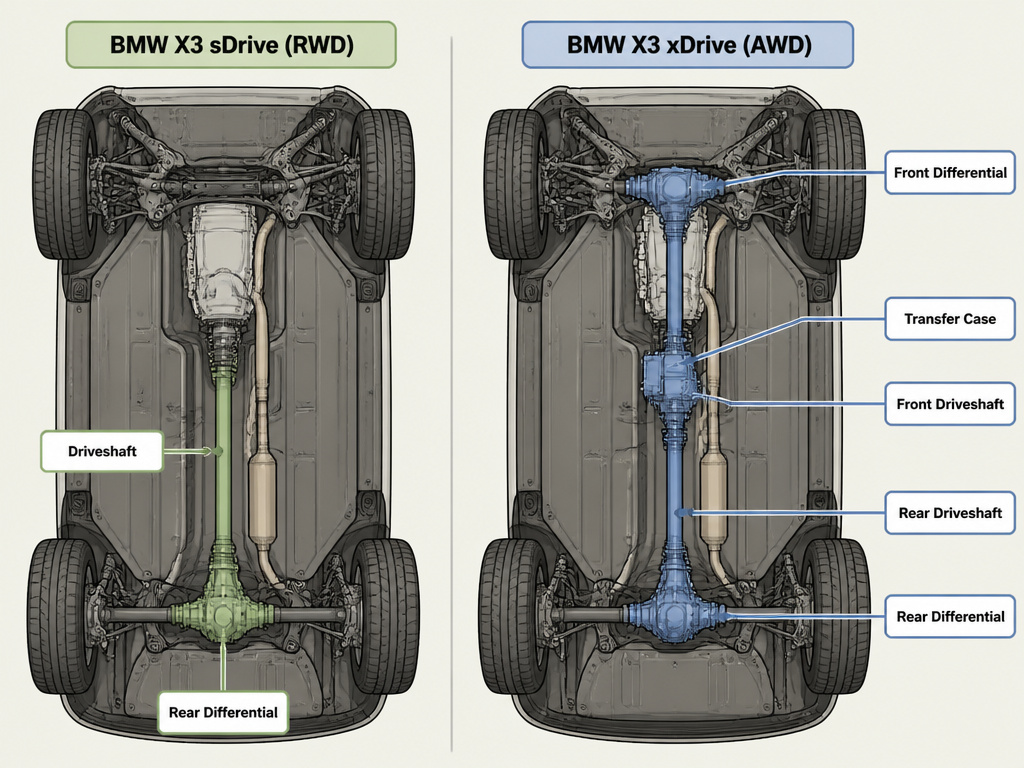
Choosing between an sDrive and xDrive X3 isn’t just a question of winter capability. It affects ownership in tangible ways.
Performance and Feel.
An sDrive X3 is lighter over the front axle because it lacks the front differential, driveshafts, and transfer case. This can translate to slightly sharper steering feel and less understeer in dry conditions. The xDrive system, while heavily rear-biased in normal driving, adds weight and complexity.
Maintenance and Repair Costs.
The xDrive system is robust, but it is another system to maintain. The transfer case fluid, front differential fluid, and front CV axles are all service items that don’t exist on an sDrive model. A failure in any of these components is a repair bill an sDrive owner will never see.
Resale Value and Market Perception.
In regions with snow, an xDrive model typically commands a higher resale value. The market perception is that an SUV should have AWD. An sDrive X3 might be a harder sell in Denver or Minneapolis, but it could be a value buy in Phoenix or Los Angeles.
The Z71 package and four-wheel drive on a GM truck are famously linked, but you can get one without the other. The BMW X3 follows a similar logic, the platform supports both, and the choice was given to the buyer for a few model years.
xDrive: How BMW’s All-Wheel Drive Actually Works
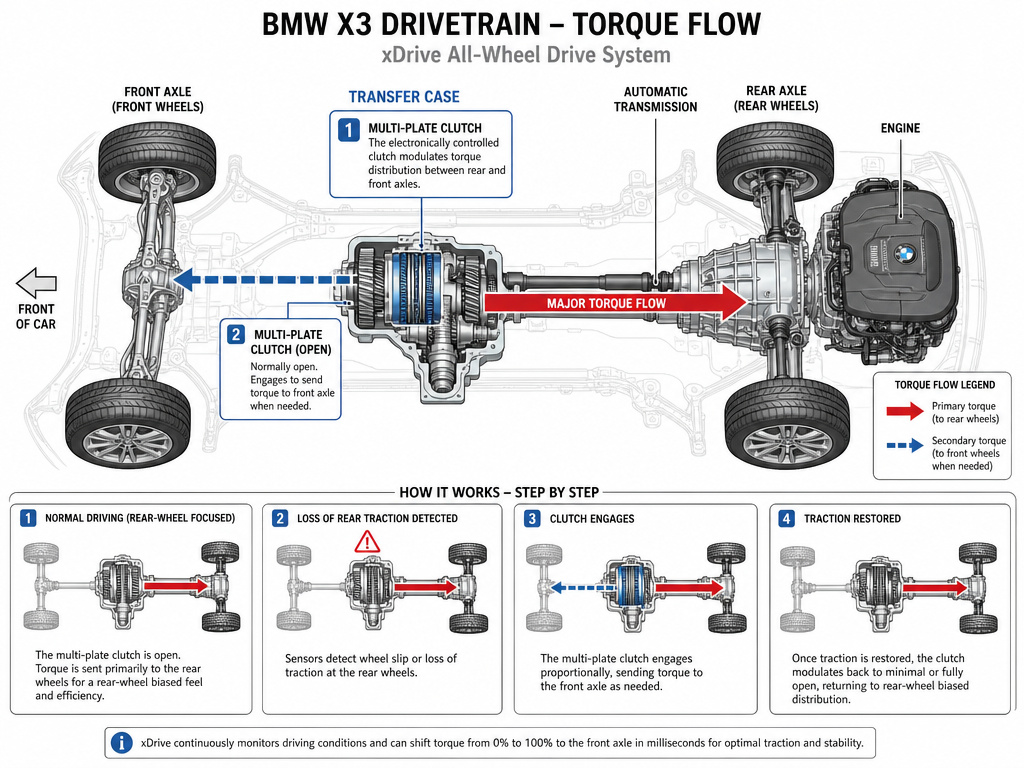
For the majority of X3s on the road, the xDrive models, the system is an intelligent, on-demand all-wheel-drive system. It’s not a full-time 4WD system like you’d find in a truck designed for heavy off-roading.
Under normal driving conditions, the system sends 100% of the engine’s torque to the rear wheels to preserve the classic BMW rear-drive dynamics. The moment the system detects rear wheel slip (or anticipates it, based on steering angle, throttle position, and lateral acceleration), an electronically controlled multi-plate clutch in the transfer case can redirect torque to the front axle in milliseconds.
This design prioritizes efficiency and driving feel. It’s a system built for secure handling on wet roads and light snow, not for rock crawling. For severe winter conditions, pairing xDrive with a set of dedicated winter tires is non-negotiable. The capabilities of all-wheel drive performance in snow are maximized only with the right tires.
sDrive vs xDrive: Which Should You Look For?
Your location and driving habits make this call.
Choose an sDrive X3 if:
- You live in a warm, dry climate with no winter snow.
- You prioritize a slightly lower purchase price and potentially lower long-term maintenance costs.
- You appreciate the purity of rear-wheel-drive handling dynamics.
Choose an xDrive X3 if:
- You experience any amount of rain, snow, or ice during the year.
- You value the added security and resale value that AWD provides in most markets.
- Your driving includes loose gravel, dirt roads, or steep, slippery driveways.
It’s not about one being objectively better. It’s about fit. An sDrive X3 in Florida is a smart buy. An xDrive X3 in Vermont is the only sane choice. This is the same calculus behind choosing a four-wheel drive Tahoe for towing in the mountains versus a 2WD model for suburban life.
Frequently Asked Questions
Did BMW ever make a front-wheel drive X3?
No. The BMW X3 has never been offered with a front-wheel-drive layout. The sDrive models are strictly rear-wheel drive. This separates it from some competitors, like certain Audi Q3 models, which can be front-drive. BMW’s SUV front-drive models are the X1 and X2.
Is the BMW X3 good in snow?
An xDrive-equipped X3 with a high-quality set of winter tires is a very capable vehicle in snow. The xDrive system provides excellent traction for accelerating and climbing hills. Remember, all-wheel drive helps you go; it does not significantly help you turn or stop. Winter tires are essential for overall winter safety.
How can I tell if my X3 is AWD without the badge?
The most reliable method is to check the VIN with a BMW dealer. A physical check involves looking for front CV axles. With the car on level ground, turn the steering wheel fully to one side and look behind the front wheel. If you see a thick, cylindrical axle shaft with a rubber boot in the center of the wheel hub, it’s xDrive.
What does “G01” mean?
“G01” is the internal BMW chassis code for the third generation of the X3, produced from 2018 to the present. The previous generation (2011-2017) was the F25. Knowing the chassis code helps when searching for parts or specific technical information, like the details in a factory service manual PDF for the older model.
Are newer X3s all AWD?
For the US market, BMW has largely standardized xDrive on the current X3. As of the latest model years, it is extremely difficult to find a new sDrive30i configuration. The market demand has shifted decisively toward all-wheel drive for this class of SUV, aligning it more closely with the standard setup of many AWD sedans.
The Bottom Line
The BMW X3 story has two chapters. For a brief period, BMW offered a rear-wheel-drive sDrive variant, confirmed by factory documents with model codes 1883 and 19XQ. Today, the xDrive all-wheel-drive system is the dominant, nearly universal choice.
Don’t assume. Read the badge, decode the VIN, and know what you’re buying. That knowledge affects your driving experience, your maintenance budget, and the car’s value when it’s time to sell. Whether you find an sDrive bargain or an xDrive staple, you’ll know exactly what’s under the sheetmetal.
