
Are All Z71 Four Wheel Drives | What GM’s Manuals Say
This post contains affiliate links. As an Amazon Associate, we earn from qualifying purchases.
No, not all Z71 models are four-wheel drives. General Motors uses the Z71 badge three distinct ways: as a standalone trim level (like the Colorado Z71), as an optional add-on package for other trims (like the Silverado 1500), and as a configuration badge on heavy-duty trucks. While 4WD is common, some models, particularly 2WD trucks from around 2009 onward, can be equipped with the Z71 package, inheriting its off-road shocks and locking differential without the four-wheel-drive system.
The label on the fender tells you what the vehicle is equipped for, not what it’s mechanically capable of. A 2WD Z71 is a real thing—it gets the Rancho shocks, the Eaton G80 automatic locker, and the skid plates, but its engine only sends power to the rear wheels. This distinction wasn’t always the case, and it’s where most casual assumptions break down.
What follows is a breakdown of the three Z71 types, the one model where GM explicitly forbids a 2WD version, and how to spot the difference on a used truck without relying on the badge alone.
Key Takeaways
- Z71 is not a guarantee of 4WD; it’s primarily an off-road equipment package that can be applied to both 2WD and 4WD vehicles.
- GM applies the Z71 badge in three forms: a standalone trim, an optional package, and a heavy-duty configuration badge, each with different drivetrain rules.
- The 2022+ Chevrolet Tahoe Z71 is a notable exception where the factory explicitly states “2WD not available,” making it a true 4WD-only model.
- The most valuable mechanical piece in the package is the Eaton G80 automatic locking rear differential, which provides off-road traction even on 2WD models.
- You can visually identify a 4WD Z71 by looking for a small, square “4WD” identification sticker on the frame rail behind the front tire; 2WD models lack this sticker.
The Three Ways GM Applies the Z71 Badge
Forget the idea of a single Z71 definition. Since its start in 1988 as an RPO (Regular Production Option) code for upgraded suspension, it has evolved into a marketing sub-brand applied inconsistently across GM’s lineup. Your truck’s capabilities depend entirely on which of the following three categories it falls into.
A 2WD Z71 isn’t a contradiction. It’s a truck built for someone who wants the improved damping and mechanical locker for dirt roads or snowy passes, but who will never need a low-range transfer case. It’s a capability package, not a drivetrain mandate.
1. Standalone Trim Level (Colorado, Tahoe, Suburban, Traverse)
Here, Z71 is the name of the trim itself, like LT or High Country. Ordering a Chevrolet Colorado Z71 or a Tahoe Z71 means you are selecting a specific model with a predetermined set of features. The drivetrain rules here are model-specific. * Chevrolet Colorado Z71: Available with either 2WD or 4WD. The 4WD system includes the Autotrac two-speed transfer case with 2WD, Auto, 4Hi, and 4Lo modes. * Chevrolet Tahoe/Suburban Z71: For the 2022 model year and beyond, the factory Preferred Equipment Package sheet states plainly: “Chassis, 4WD – Four-wheel Drive (Requires 4WD models) (2WD not available in Z71 model).” This is the exception that proves the rule. * Chevrolet Traverse Z71: As a unibody crossover, it uses a twin-clutch all-wheel-drive system, not a traditional 4WD truck system. It has no transfer case and no low range.
2. Add-On Package (Silverado 1500)
For the full-size Silverado 1500, Z71 is an optional package you can add to various trims like the LT, RST, or LTZ. This is where buyer confusion spikes. You can order a 2WD Silverado LT and check the Z71 Off-Road Package box. The truck will have the badge, the Rancho shocks, the G80 locker, and the skid plates—but it will be a rear-wheel-drive vehicle. The package does not force a 4WD selection.
| Z71 Application Type | Example Models | 4WD Required? | Key Takeaway |
|---|---|---|---|
| Standalone Trim | Colorado, Canyon, Tahoe, Suburban | No (Except Tahoe/Suburban) | Drivetrain is a separate choice on the order sheet. |
| Add-On Package | Silverado 1500 | No | Can be added to 2WD or 4WD trucks; check the build sheet. |
| Configuration Badge | Silverado 2500/3500 HD | Yes (implied) | On HD trucks, it denotes an off-road suspension pack on an already 4WD-capable platform. |
3. Configuration Badge (Silverado 2500/3500 HD)
On the heavy-duty trucks, the Z71 is more of a configuration or appearance package. Since virtually all 2500/3500 HD models are sold with 4WD for towing and worksite use, the Z71 badge here typically signifies an off-road suspension component set and visual cues. The official GM truck drivetrain documentation for these platforms covers the 4WD systems separately from the Z71 package contents.
Why the Eaton G80 Locker Matters More Than 4WD
The soul of the Z71 package isn’t the Rancho shocks or the black wheels—it’s the Eaton G80 automatic locking rear differential. This is the mechanical piece that actually gets you unstuck. On a standard open differential, if one rear wheel loses traction (on ice, mud, or lifted off the ground), all the engine’s torque goes to that spinning wheel. The wheel with grip gets nothing, and you’re stationary.
The G80 solves this automatically. Inside the differential, a flyweight governor detects when one wheel is spinning roughly 100 RPM faster than the other. It triggers a mechanism that physically locks both rear axle shafts together, forcing them to turn at the same speed. Power goes to the wheel with traction. It happens without buttons, switches, or driver input. For a 2WD Z71 truck, this locker is the primary source of off-pavement traction. It’s why a 2WD Z71 can handle a rough forest service road better than a 4WD truck with an open differential.
How to Spot a 2WD Z71 vs. A 4WD Z71
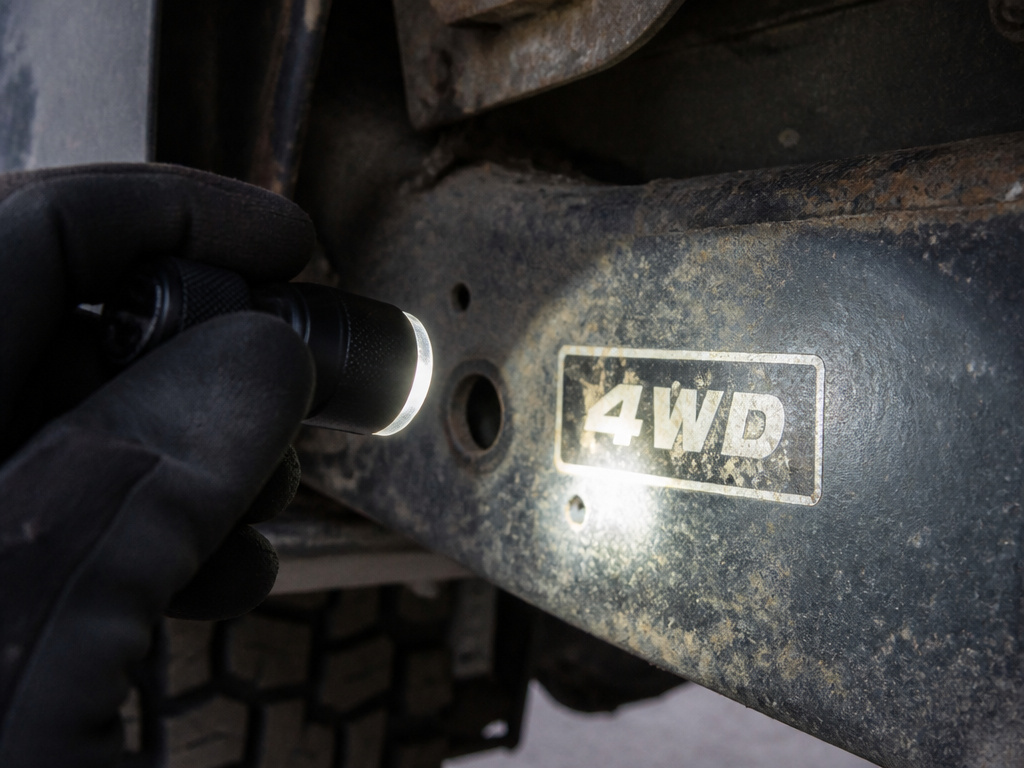 You’re looking at a used truck. It has the Z71 badge. How do you know if it’s 4WD without starting it and looking for a dial or a lever? There are two reliable methods.
First, get under the front end. Look at the front axle area. A 4WD vehicle will have a solid front differential in the center, with axle shafts running out to each front wheel. A 2WD truck will have a simpler, smooth crossmember or independent suspension components with no central differential housing.
Second, check for the label. On factory 4WD trucks, GM places a small, rectangular black-and-silver identification sticker on the driver’s side frame rail, just behind the front tire. It will clearly say “4WD.” This sticker is absent on 2WD trucks, even if they are Z71 models. This visual check is more reliable than trusting the badge or even the presence of a shift knob inside, which could have been added aftermarket.
The part nobody mentions: That 4WD identification sticker is made of thin foil and adhesive. After a decade of road grunt and Northeast winters, it can fade to a blank silver rectangle or flake off entirely. If the sticker is gone, the front differential is the only sure proof.
The Spec That Settles the Debate: Tahoe Z71
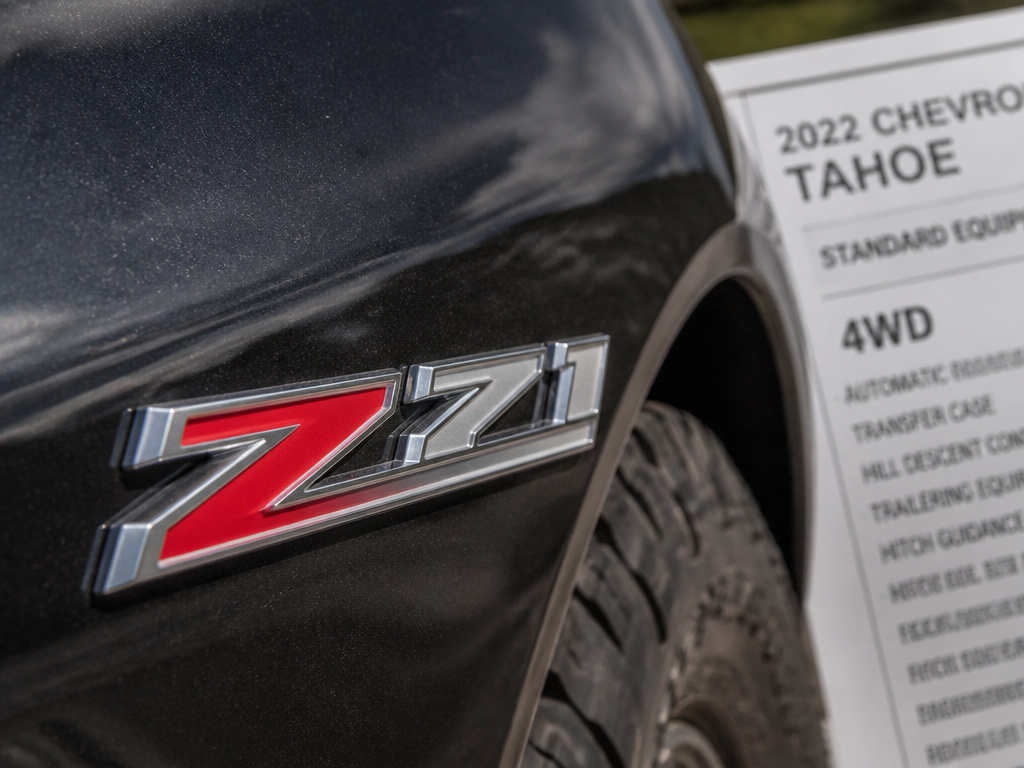 For all the talk of 2WD Z71s, there is one clear, documented exception that ends the argument. The 2022 Chevrolet Tahoe Z71’s factory equipment guide is explicit. Under “Chassis,” it lists: “4WD – Four-wheel Drive (Requires 4WD models) (2WD not available in Z71 model).”
This isn’t marketing. It’s a factory four-wheel-drive system documentation line item. If you have a 2022 or newer Tahoe with a legitimate Z71 badge, it is a four-wheel-drive vehicle. Period. This specificity matters because it shows GM itself treats the Z71 definition as model-dependent, not universal.
Z71 vs. True 4WD Off-Road Trims (Like ZR2)
It’s worth understanding what Z71 is not. It is not GM’s ultimate off-road trim. That title belongs to the ZR2 (on Colorado and Silverado) or the AT4X for GMC. These top-tier packages include Multimatic DSSV spool-valve dampers, increased ride height, reinforced chassis components, and more aggressive approach/departure angles.
The Z71 is the capable overlander or worksite truck package. The ZR2 is the desert-runner or rock-crawler package. One is for exploring forest trails while towing a trailer; the other is for conquering the trail itself. Confusing the two leads to misplaced expectations, especially when comparing the Toyota 4Runner 4WD platform, which has its own nuanced trim hierarchy.
Frequently Asked Questions
Is a 2WD Z71 just for looks?
No. A 2WD Z71 retains the core functional upgrades: the off-road tuned Rancho shocks, the Eaton G80 automatic rear locker, underbody skid plates, and all-terrain tires. These provide tangible benefits—better control on rough dirt roads, traction in mud or snow with the locker engaged, and protection from debris. It’s for someone who needs off-road resilience without the cost, complexity, or fuel economy penalty of a full 4WD system.
Can I add 4WD to a 2WD Z71 truck?
Practically, no. Converting a 2WD truck to 4WD is a prohibitively expensive and complex operation involving a new transmission, transfer case, front differential, driveshafts, front suspension, and wiring harnesses. The cost typically exceeds the value added to the vehicle. It is not a weekend garage project.
Does the Z71 package improve towing?
Not directly. The package does not change the frame, brakes, or cooling system. Tow ratings are determined by the engine, transmission, axle ratio, and factory-installed cooling packages. However, the improved damping from the Rancho shocks can provide better stability when towing over uneven terrain compared to standard shocks.
Are all modern Silverado 1500 Z71 trucks 4WD?
No. Because the Z71 is an add-on package for the Silverado 1500, it can be applied to both 2WD and 4WD versions of the LT, RST, and LTZ trims. You must check the vehicle’s specific build sheet or look for the physical 4WD identification sticker on the frame to be certain.
What’s the main downside of a 2WD Z71?
The limitation is ultimate traction. On a steep, loose, or slippery incline where both rear wheels lose grip, the G80 locker cannot help. You need power at the front wheels to pull or push the vehicle out, which only a 4WD system can provide. For serious off-road terrain, a 4WD system, like those found in a Jeep Grand Cherokee 4WD or a dedicated truck like a ZR2, is a mandatory starting point.
Before You Go
The Z71 badge signifies a meaningful upgrade in off-road preparedness, but it is not a synonym for four-wheel drive. Its application as a trim, a package, or a badge dictates the drivetrain possibilities. Your verification tools are the model-specific factory documentation and that small, often-faded sticker on the frame rail. For most buyers, the combination of a 2WD drivetrain with the Z71 package represents a smart, cost-effective way to gain substantial off-pavement capability without the full investment in a 4WD system. But if your plans involve true low-range crawling or deep snow, you’ll need to look past the badge and ensure the truck has the hardware to match.
