
Are All Trucks 4 Wheel Drives? Identifying 2WD & 4WD Options
This post contains affiliate links. As an Amazon Associate, we earn from qualifying purchases.
No, not all trucks are four-wheel drives. Every major truck manufacturer sells a base, two-wheel drive (2WD) model for every single vehicle in their pickup lineup. These 2WD trucks are the default configuration for fleet and commercial buyers, where the lower cost, reduced weight, and simpler maintenance of rear-wheel drive outweigh the need for off-road traction.
That fact reshapes the question from “Are all trucks 4WD?” to “Which trucks are only 2WD?” The answer depends entirely on the factory order sheet. A Ford F-150, Ram 1500, or GMC Sierra can roll off the line as 2WD, 4WD, or something in between like an automatic all-wheel drive system. The confusion often starts because the most photographed and advertised trucks are the high-trim, off-road-capable models.
What follows: a breakdown of factory drivetrain configurations, the specific truck segments where you’ll find 2WD as the standard, and how to decode a truck’s spec sheet so you know exactly what you’re looking at before you buy.
Key Takeaways
- Every full-size truck platform (Ford F-Series, GM, Ram) has a 2WD base model. It’s the most common configuration for fleet and commercial sales.
- Mid-size trucks like the Toyota Tacoma and Ford Ranger almost always offer 2WD, especially in base trims aimed at urban use.
- Identifying a 2WD truck is simple: look for the absence of a 4WD selector knob/lever and check the VIN or window sticker.
- For pure on-road hauling and towing, a 2WD truck is often the better, more economical choice. Four-wheel drive is a tool for specific traction needs, not a universal requirement.
The Straight Answer: 2WD vs. 4WD Trucks
A truck’s drivetrain is a factory-installed option, not a built-in feature. Think of it like choosing a transmission or a bed length. The manufacturer builds a chassis that can accept either a two-wheel drive system (power sent only to the rear axle) or a four-wheel drive system (power sent to both axles via a transfer case).
This primary distinction is why you see so many 2WD trucks for sale on dealer lots, often labeled as “Work Truck” or “Tradesman” editions. They are cheaper to produce, lighter, and have fewer components to maintain. According to Consumer Reports, all-wheel drive and four-wheel drive systems can add significant complexity and cost, which is why they are optional upgrades for most consumer vehicles, including trucks. The electronic stability control mandated in all U.S. Vehicles since 2012 improves road-holding for all drivetrains, making 2WD capable in many conditions where it once would have struggled.
Four-wheel drive is optimized for severe off-road driving situations such as climbing over boulders, fording deep water, and tackling steep hills with loose, low-traction surfaces. Most 4WD systems use a heavy-duty transfer case with a high and a low gear range.
For towing a heavy trailer on paved roads, a 2WD truck with a proper tow package is frequently more than adequate. The extra weight of the 4WD system is payload you aren’t using. The choice between 2WD and 4WD hinges on your actual needs, not marketing.
What Trucks Are Typically 2WD?
You’ll find 2WD as the standard, no-cost option in several clear categories. These trucks are built for efficiency and job-site duty, not rock crawling.
| Truck Type | Typical 2WD Models | Primary Use Case | Why 2WD is Common |
|---|---|---|---|
| Full-Size Work Trucks | Ford F-150 XL, Chevrolet Silverado WT, Ram 1500 Tradesman | Fleet sales, construction, landscaping | Lowest purchase price, best fuel economy, simplest mechanics |
| Mid-Size Base Models | Toyota Tacoma SR, Ford Ranger XL, Chevrolet Colorado Work Truck | Urban commuting, light hauling | Reduced cost and weight for buyers who never go off-road |
| Heavy-Duty Chassis Cabs | Ford F-350 Chassis Cab, Ram 4500 | Commercial upfitting (dump beds, utility bodies) | Maximizes payload capacity; 4WD is a heavy, expensive option |
| Sports Trucks | Chevrolet Silverado RST, Ford F-150 Sport (older models) | On-road performance, street appearance | Lower center of gravity, less drivetrain loss for acceleration |
The Chevrolet Silverado in its Work Truck (WT) trim is a classic example. It’s the blank canvas for commercial buyers. Similarly, a base Ford F-150 XL with the 3.3L V6 is almost always a 2WD configuration unless specifically ordered otherwise. These aren’t rare; they are the backbone of commercial vehicle sales.
How to Identify a 2WD Truck
Don’t rely on looks. Here are the definitive ways to tell if a truck is two-wheel drive.
- Check for a 4WD Selector: Inside the cabin, look for a knob, lever, or buttons near the gear selector or on the dash labeled “4WD,” “4H,” “4L,” or “4A.” If it’s not there, it’s a 2WD truck. Some automatic AWD systems have a discrete button, but traditional part-time 4WD always has a physical control.
- Look at the Front Axle: Crawl underneath (safely, with the vehicle secured). A 4WD truck will have a solid differential housing connecting the two front wheels. A 2WD truck’s front axle is just a beam or independent suspension with no differential—it’s not driven.
- Decode the VIN: The Vehicle Identification Number tells all. The 4th or 5th character often indicates the drivetrain. For example, in many GM trucks, a “Z” in a specific position might denote 4WD, while a “C” denotes 2WD. A quick online VIN decoder for the specific make will give you the answer.
- Read the Window Sticker or Badging: The original Monroney sticker (window sticker) will list “Drivetrain” or “Drive System.” It might also say “4×2” (2WD) or “4×4” (4WD). Sometimes there’s a badge on the rear fender or tailgate, though these are often removed.
Common mistake: Assuming a tall, rugged-looking truck must be 4WD. Many trucks have off-road appearance packages (like black wheels, skid plates) that are purely cosmetic and are fitted to 2WD models.
When browsing online listings or a dealer lot, the “Drivetrain” field in the specifications is the first place to look. If it says “Rear-Wheel Drive,” you have your answer.
2WD vs. 4WD vs. AWD: What’s the Difference for Trucks?
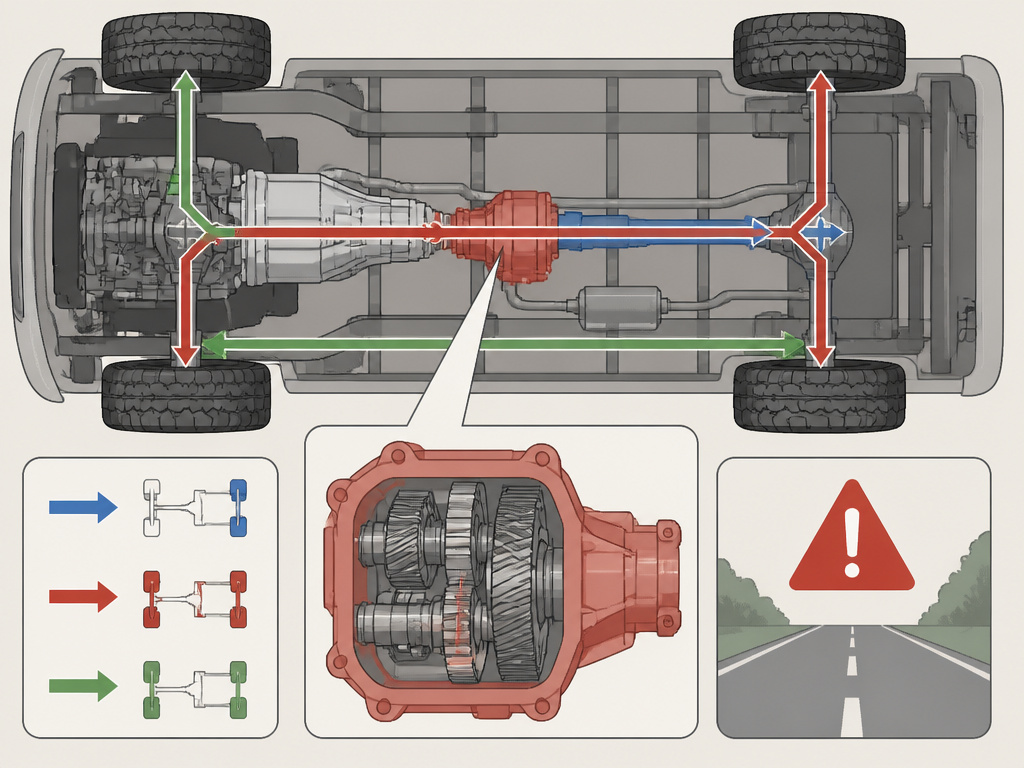
This is where the mechanical rubber meets the road. Understanding these terms explains why they are options, not defaults.
- Rear-Wheel Drive (RWD / 2WD): Power goes from the engine, through the transmission, down a driveshaft, and to the rear differential which turns the rear wheels. It’s simple, robust, and good for towing because the trailer’s tongue weight sits over the driving wheels. This is the standard setup for a 2WD truck.
- Part-Time Four-Wheel Drive (4WD): This system adds a transfer case and a front driveshaft/axle. The driver selects 2WD for normal driving. They manually engage 4WD High (4H) for slippery conditions, and 4WD Low (4L) for extreme off-road crawling. Crucially, part-time 4WD should not be used on dry pavement as it can cause “driveline bind” and damage components, as noted in the Ford Super Duty owner’s manual. Systems like Ford’s “Advanced 4×4 with 4A Mode” add an automatic setting to mitigate this.
- All-Wheel Drive (AWD): Common on SUVs and some newer trucks (like the Ford F-150 with the 3.5L PowerBoost hybrid), AWD is a full-time system that automatically sends power to the axle with the most traction. It doesn’t have a low-range gear and is meant for on-road traction in rain or light snow, not serious off-roading.
The Z71 package on GM trucks is a perfect case study. It’s primarily an off-road suspension and appearance package. While it’s often paired with 4WD, a Z71-badged truck can technically be ordered with 2WD. The package doesn’t mandate the drivetrain.
When Do You Actually Need a 4WD Truck?
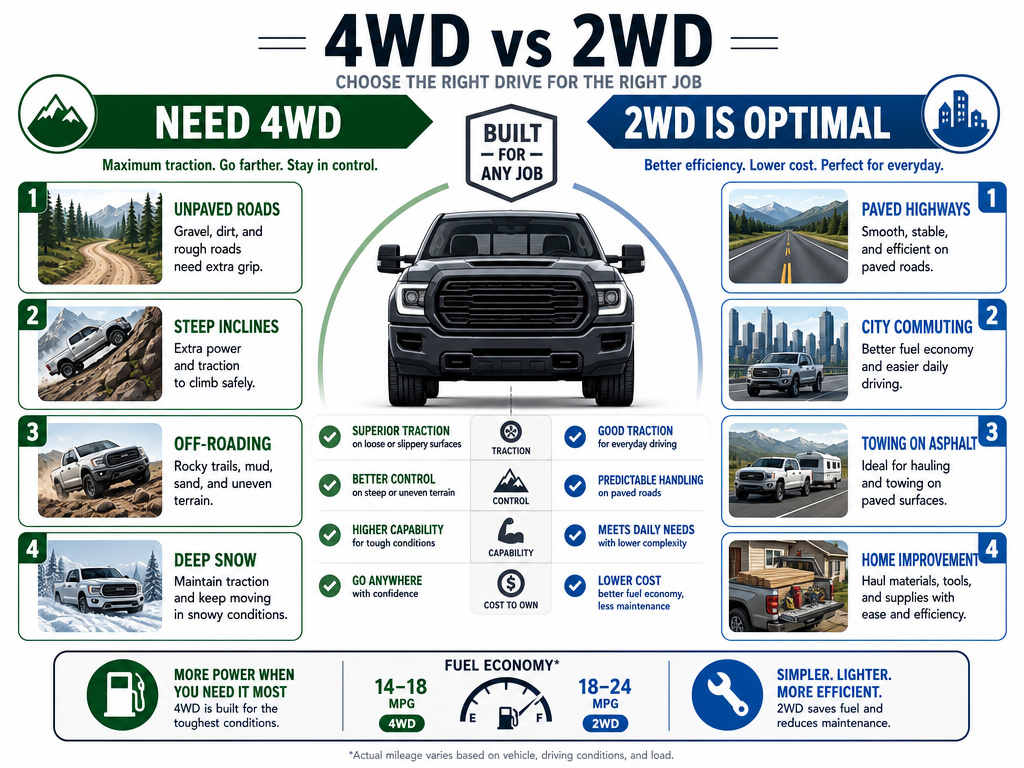
Four-wheel drive is a specific tool. It’s not for everyone, and using it incorrectly can be expensive. You need 4WD if your regular use involves:
- Unpaved, Slippery Surfaces: Regular driving on dirt, gravel, mud, or snow-covered roads where 2WD would lose traction and get stuck.
- Steep, Loose Inclines: Hauling a load up a muddy or snowy hill where rear wheels alone would spin.
- Deliberate Off-Roading: Rock crawling, deep sand, or fording where maximum traction and low-range gearing are necessary.
- Severe Winter Conditions: If you live in an area with persistent deep snow and unplowed roads, 4WD provides a significant safety margin.
For the majority of truck owners who use their vehicle on paved roads—for commuting, highway towing, or home improvement runs—2WD is not just sufficient; it’s optimal. It saves money at purchase, at the fuel pump, and in long-term maintenance. The best trucks for snow often rely more on a good set of winter tires than on their drivetrain alone. A 2WD truck with dedicated snow tires will typically outperform a 4WD truck on all-season tires in winter braking and cornering.
Frequently Asked Questions
Can a 2WD truck go off-road?
It can travel on mild, maintained dirt or gravel roads. It should not be taken on true off-road trails intended for 4×4 vehicles. Without a low-range gear or power to the front wheels, it lacks the torque and traction to handle obstacles, steep grades, or deep mud and will easily become stuck.
Is 4WD better for towing?
Not inherently. Towing capacity is primarily determined by the engine, transmission, cooling, frame, and rear axle. A 2WD truck often has a slightly higher payload capacity because it doesn’t carry the extra weight of the 4WD system. The main towing benefit of 4WD is extra traction when starting off on a slippery boat ramp or wet jobsite.
Are all Jeeps 4WD?
No. While the iconic Jeep Wrangler and Jeep Gladiator are exclusively 4WD, the Jeep Grand Cherokee has always been available with both 2WD and 4WD configurations. Many Grand Cherokees sold in sunbelt states are 2WD.
What about the Toyota 4Runner?
The Toyota 4Runner is a body-on-frame SUV that shares its rugged platform with trucks. While revered for its off-road capability in 4WD trims, it has long been available as a 2WD model, particularly in base SR5 trims. This makes it a truck-like SUV that many buyers choose for its reliability and utility, not just its off-road prowess.
Before You Go
The next time you see a truck, don’t assume it’s a 4×4. Look for the clues. The vast world of trucks is built on the versatile 2WD chassis. Your needs should dictate the drivetrain, not the other way around.
If you tow on pavement and prioritize payload, a 2WD truck is the smart, economical choice. If your life or work regularly takes you beyond the asphalt, then 4WD is a necessary investment. In either case, your choice of all-terrain tires or all-season tires will have as much impact on your daily driving experience as the hardware turning the wheels. Know what you’re buying, and buy for what you actually do.
