
Are 4Runners Rear Wheel Drive? | The Trim-by-Trim Answer
This post contains affiliate links. As an Amazon Associate, we earn from qualifying purchases.
Toyota 4Runners are not all rear-wheel drive. Only the base SR5 and SR5 Premium trims come standard with RWD. Part-time 4WD is standard on TRD Off-Road, TRD Off-Road Premium, and TRD Pro models. Full-time 4WD with a locking rear differential is exclusive to the Limited trim. So, most 4Runners sold are four-wheel drive, but the type of 4WD changes with the trim.
That split between part-time and full-time systems isn’t just marketing. It changes what you can do with the truck on pavement and dictates a specific set of rules you have to follow. Toyota’s own manuals label them separately for a reason.
The rest of this guide walks through each trim’s standard drivetrain, decodes the difference between part-time and full-time 4WD, and shows you how to identify which system you have by looking at the shift lever or reading your VIN.
Key Takeaways
- Only the base SR5 and SR5 Premium trims are rear-wheel drive from the factory. Every other trim has 4WD standard.
- The TRD Off-Road, TRD Off-Road Premium, and TRD Pro trims use a traditional part-time 4WD system with 2H, 4H, and 4L settings.
- The Limited trim is the only one with full-time 4WD, which includes a locking rear differential and different operating modes (H4F, H4L, L4L).
- Using part-time 4WD on dry, paved roads can cause binding and damage to the drivetrain. Full-time 4WD has no such restriction.
- You can identify your system by the transfer case lever: a traditional T-gate shifter means part-time 4WD; a rotary dial or button cluster typically indicates full-time 4WD.
The Short Answer: It Depends on Your Trim
The question “Are 4Runners rear-wheel drive?” has a one-word answer: sometimes. Toyota configures the 4Runner’s drivetrain by trim level, not as a blanket rule for the model. This is a crucial distinction often glossed over in general SUV comparisons.
If you walk into a dealership and point at a base SR5 sitting on the lot, there’s a high chance it’s a rear-wheel drive vehicle. That’s the default. Step up to the TRD Off-Road, and you’re almost certainly looking at a part-time 4WD system. The Limited trim stands alone with its full-time 4WD.
Common mistake: Assuming all 4Runners are built the same. The drivetrain is the single biggest functional difference between an SR5, a TRD Pro, and a Limited. It affects capability, daily driving manners, and resale value.
This trim-based strategy isn’t unique to Toyota. You’ll find similar tiered drivetrain offerings in vehicles like the Chevrolet Tahoe or across various Jeep Grand Cherokee configurations. It lets buyers pay for only the capability they need.
The 4Runner Drivetrain Trim Breakdown
The following table maps the major trim levels (2019 model year as a consistent reference) to their standard and available drivetrains. This pattern holds true for many model years.
| Trim Level | Standard Drivetrain | Available Drivetrain | Key Identifying Feature |
|---|---|---|---|
| SR5 / SR5 Premium | Rear-Wheel Drive (RWD) | Part-Time 4WD (optional) | Base model, often has “SR5” badge. |
| TRD Off-Road / TRD Off-Road Premium | Part-Time 4WD | Not Applicable | “TRD Off-Road” badge, often has crawl control knob. |
| TRD Pro | Part-Time 4WD | Not Applicable | “TRD Pro” badge, distinctive grille, upgraded suspension. |
| Limited / Limited Nightshade | Full-Time 4WD | Not Applicable | “Limited” badge, chrome accents, often has a rotary 4WD dial. |
The SR5’s optional part-time 4WD is a popular upgrade, especially in regions with snow or for buyers who plan light off-roading. It transforms the truck. Without it, you’re dealing with a rear-wheel drive SUV that relies on its electronic traction aids, like the AUTO LSD system, to manage slip. That system brakes a spinning wheel to send torque to the one with grip, but it’s no substitute for driven front wheels in deep mud or snow.
Part-Time vs Full-Time 4WD: The Owner’s Manual Split
Toyota doesn’t treat these two systems as minor variants. In the official 2024 Toyota 4Runner service manual, they have entirely separate chapters: “Four-wheel drive system (part-time 4WD models)” starts on page 294, and “Four-wheel drive system (full-time 4WD models)” begins on page 298. That’s a four-page gap dedicated to explaining their different rules.
The part-time system is what most people picture when they think “4WD.” It’s a mechanical connection. You have a transfer case lever, usually a familiar T-gate pattern, that lets you select between 2H (rear-wheel drive for normal driving), 4H (for slippery conditions at higher speeds), and 4L (for extreme low-speed crawling or pulling). The front and rear axles are locked together in 4H and 4L, turning at the same speed.
Where this goes sideways: Driving in 4H or 4L on dry, high-traction pavement. Because the axles are locked, the front and rear wheels want to turn at exactly the same speed. On pavement, even a slight turn forces the tires to scrub and the driveline to bind. You’ll feel a shuddering through the steering wheel and floor. Do it long enough, and you’ll wear out tires and strain the transfer case components. The manual is explicit: use it only when you need it.
The full-time system in the Limited trim is more sophisticated. It uses a center differential, usually a Torsen-type, to allow the front and rear axles to spin at different speeds. This eliminates the binding issue, so you can leave it in “High-4-Free” (H4F) mode all the time, even on dry highways. For more challenging terrain, you can lock the center diff with “High-4-Lock” (H4L) or drop into “Low-4-Lock” (L4L).
The Limited also includes a locking rear differential, a significant mechanical advantage over the part-time system’s open diffs. When engaged, it locks the left and right rear wheels together, ensuring both get power even if one is completely off the ground.
How to Tell Which Drivetrain Your 4Runner Has
You don’t need the window sticker. Three visual checks will tell you.
First, look at the center console. Do you see a traditional, upright transfer case lever next to the gear shifter? That’s the hallmark of a part-time 4WD system (or an SR5 with the 4WD option). The lever will have 2H, 4H, N, and L4 markings.
If you see a rotary knob or a cluster of buttons labeled “4WD,” “AWD,” “H4F,” “H4L,” or “L4L,” you’re likely in a Limited with the full-time system. Some later model years with part-time systems also use a dial, but the mode labels give it away—”2H” will be an option.
Second, check your VIN. The fifth character can sometimes indicate the drivetrain, though this requires a VIN decoder. More reliably, look for a model code sticker in the driver’s door jamb. Codes like “K280” might indicate a part-time transfer case.
Third, what’s on your tailgate or fender? “SR5” badges strongly suggest RWD unless you see a “4WD” badge nearby. “TRD Off-Road” or “TRD Pro” means part-time 4WD. “Limited” means full-time 4WD.
This process of identification is similar to checking other SUVs. Just as you’d verify the BMW X3 drivetrain by its xDrive badge or the Audi Q3 by its quattro branding, the 4Runner’s badges and levers tell the story.
The RWD 4Runner: Who It’s For and What You’re Missing
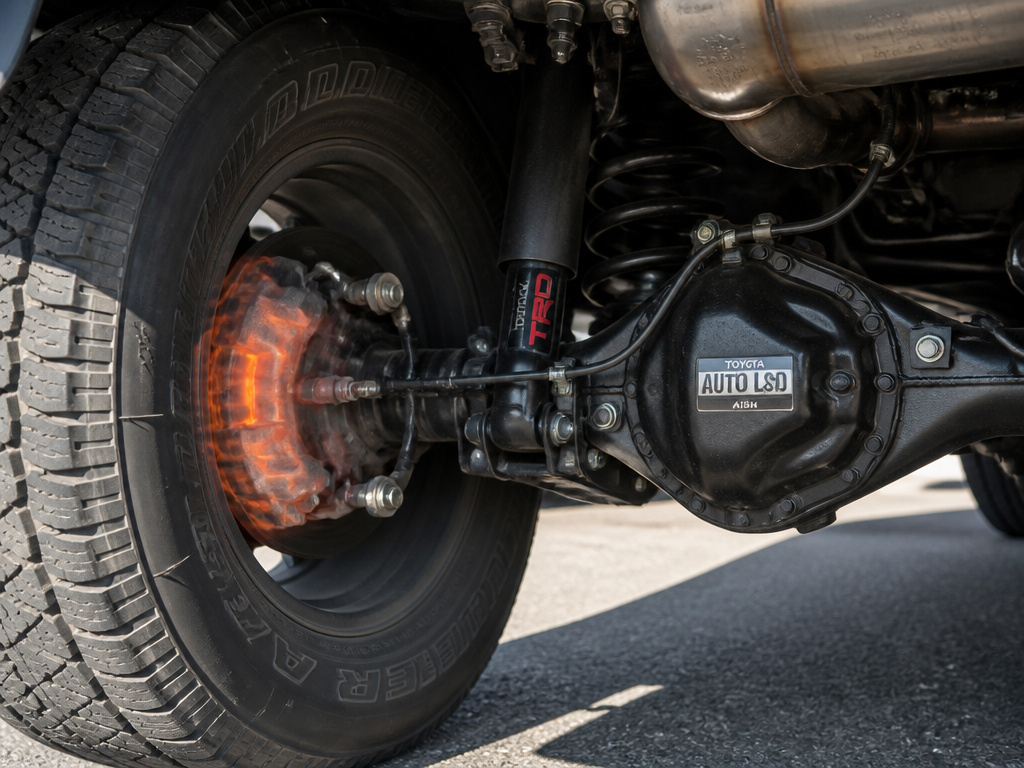
The rear-wheel drive SR5 exists for a specific buyer. It’s for someone who wants the 4Runner’s size, reliability, and towing capacity (up to 5,000 lbs) but doesn’t anticipate needing traction beyond what a paved road or flat dirt path demands. It’s also the cheapest way into a 4Runner.
On dry pavement, a RWD 4Runner drives like any other truck-based SUV. The weight over the rear axle provides decent traction. The AUTO LSD system (automatic limited-slip differential) will intervene during wheel slip, applying brake pressure to the spinning wheel to send torque to the grounded one. It’s a clever electronic solution.
But that system has limits. It uses the brakes, which generates heat and isn’t sustainable for long periods. In deep, unpacked snow or thick mud, two driven wheels will always outperform two braking wheels. The RWD 4Runner is a fair-weather adventurer.
If your needs change, adding 4WD after purchase is prohibitively expensive. You’re buying a different transfer case, front differential, drive shafts, and wiring. It’s a factory-only decision. This makes the RWD 4Runner a niche choice compared to the default 4WD stance of most truck drivetrains in this class.
The 4WD Systems Compared: Capability vs Convenience
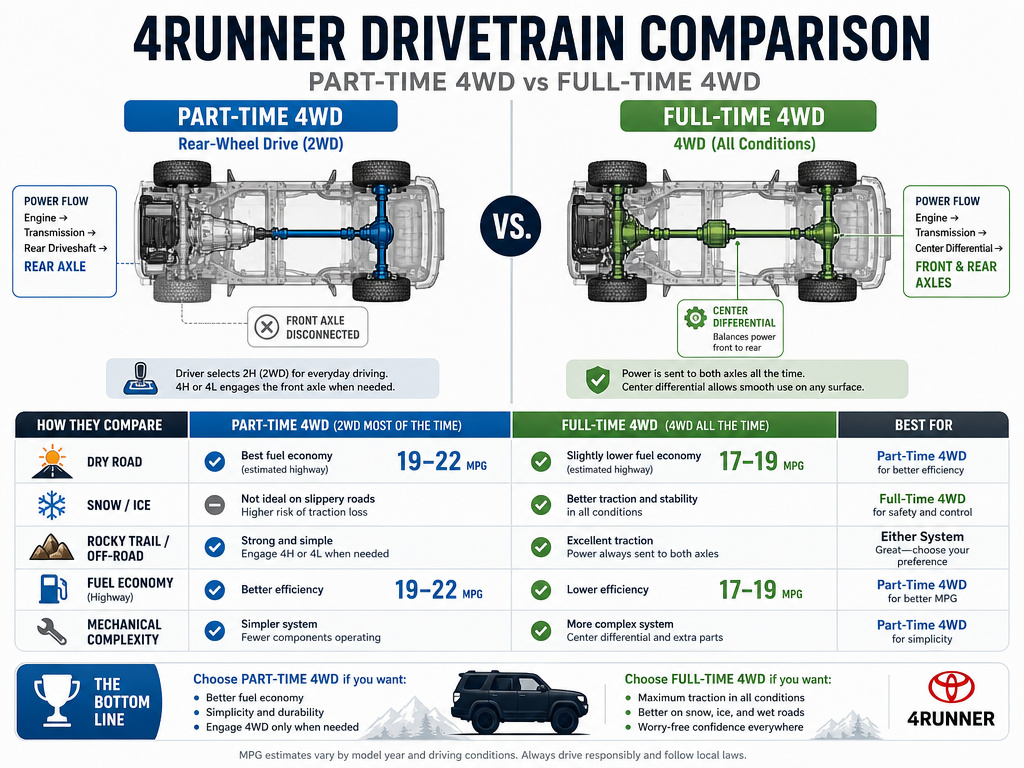
Choosing between part-time and full-time 4WD isn’t about which is “better.” It’s about matching the system to your driving mix. The following table breaks down the core trade-offs.
| Aspect | Part-Time 4WD (TRD Models) | Full-Time 4WD (Limited) |
|---|---|---|
| Daily Driving | Must be in 2H on dry pavement to avoid damage. Requires driver input to engage 4H. | Can be left in H4F permanently. No driver input needed for basic all-wheel traction. |
| Off-Road Capability | Excellent. Mechanical lock in 4H/4L provides maximum torque transfer. L4 gear ratio is extremely low for crawling. | Excellent, with a different approach. Center diff allows for better handling on mixed-traction trails. Locking rear diff is a major advantage. |
| Complexity | Lower. Simple mechanical linkage. Fewer moving parts in the center diff. | Higher. Includes a center differential and more advanced electronics. |
| Ideal For | The intentional off-roader who doesn’t mind shifting modes and will use 4WD primarily off-pavement. | The driver who faces variable conditions daily (snow, rain, gravel) and wants seamless capability without shifting. |
The part-time system demands more from the driver. You have to recognize when to shift into 4H and, critically, remember to shift back to 2H. Forget on a long stretch of dry road, and you’re asking for trouble. The full-time system is a “set it and forget it” solution for all-weather security, much like the systems found in many Ford Escape AWD models, but built on a tougher truck platform.
I prefer the part-time system for dedicated trail rigs. The mechanical connection feels more direct and robust when you’re rock crawling. But for a 4Runner that serves as a daily driver in the mountains with frequent snow, the Limited’s full-time system is the smarter, safer choice. You never get caught deciding between traction and driveline bind.
Why Toyota’s “Available AWD” Label Causes Confusion
Toyota’s marketing sometimes uses “available All Wheel Drive” as a catch-all term for both 4WD systems. This frustrates enthusiasts because it blurs a critical line. A Jeep Grand Cherokee 4xe’s AWD and a 4Runner’s part-time 4WD are fundamentally different technologies with different use cases.
True all-wheel drive systems, like those in crossovers, are typically front-wheel-drive-based and use clutches to send power rearward only when slip is detected. They’re reactive. The 4Runner’s part-time 4WD is proactive and mechanical—you decide when to lock the axles together. Calling them both “AWD” does a disservice to the buyer trying to understand their vehicle’s limits.
This terminology mix-up is an industry-wide issue. It’s why digging into the official 4Runner technical specifications is so important. The manual doesn’t use marketing speak. It calls the systems by their technical names and lays out the hard rules for their operation.
Frequently Asked Questions
Can I convert my RWD 4Runner to 4WD?
Technically possible, but practically a non-starter. The conversion requires sourcing a compatible transfer case, front differential, drive shafts, hubs, wiring harnesses, and a new center console. The cost in parts and labor far exceeds the value added. It is more economical to sell your RWD model and buy a factory 4WD one.
Is full-time 4WD bad for fuel economy?
It can cause a slight decrease, typically 1-2 MPG, compared to a part-time system kept in 2H on the highway. This is due to the constant mechanical connection and rotating mass of the front driveline. However, the difference is often smaller than the hit taken by the 4Runner’s boxy shape and weight overall.
What does the “AUTO LSD” light mean on my dash?
The AUTO LSD indicator illuminates when the system is actively intervening to control rear wheel spin. It’s not a warning light; it’s an activity light. If it flashes, it may indicate the system is overheating from prolonged use. If that happens, stop and let it cool. It’s a sign you’re in conditions that warrant true 4WD.
Are newer 4Runners going away from part-time 4WD?
As of the latest generation, no. Toyota has maintained the trim-based drivetrain strategy. The rugged, off-road-focused trims (TRD) retain the traditional part-time system with a lever, valuing mechanical simplicity and direct control. The luxury-oriented Limited trim continues with full-time 4WD for on-road refinement.
Before You Go
Most 4Runners are not rear-wheel drive. The base SR5 trim holds that title, serving a niche market. The far more common path leads to a four-wheel drive system—either the intentional, mechanical part-time setup of the TRD models or the always-ready full-time system of the Limited.
Your choice hinges on a simple question: do you want to manage traction, or do you want the truck to manage it for you? The part-time system rewards engaged driving and off-road prowess. The full-time system offers seamless, all-weather confidence at the cost of some mechanical purity. Neither is wrong, but knowing which one you have—or are buying—is the first step to using it correctly. Check the lever, read the badge, and then go use it the way Toyota engineered it to be used.
