
Not All Jeep Grand Cherokees Are 4WD: What Buyers Need To Know
This post contains affiliate links. As an Amazon Associate, we earn from qualifying purchases.
No, not all Jeep Grand Cherokees are 4 wheel drives. The model line has been offered with a two-wheel drive (2WD) configuration for many years, alongside multiple four-wheel drive systems. The owner’s manual for recent models explicitly states the 2WD version is for on-road use only and is not intended for off-road driving or severe conditions suited for a 4WD vehicle.
That warning from the manufacturer is the line that separates a pavement-oriented SUV from the Jeep brand’s legendary off-road capability. It’s not a suggestion. It’s a specification that changes what the vehicle is legally rated to handle.
What follows is a breakdown of the 2WD option, the three distinct 4WD systems (Quadra-Trac I, Quadra-Trac II, and Quadra-Drive II), and the hard numbers on fuel economy and weight that come with each choice. By the end, you’ll know exactly what you’re buying—or what you already own.
Key Takeaways
- Jeep has sold 2WD Grand Cherokees for decades; assuming 4WD is standard is a common and costly mistake.
- The factory owner’s manual for 2023–2025 models warns that the 2WD version is for on-road use only and not for off-road or severe conditions.
- Choosing 4WD adds roughly 130 pounds to the curb weight and costs about 1–2 MPG in combined fuel economy according to official EPA estimates.
- The three 4WD systems are not interchangeable—Quadra-Trac I is a single-speed full-time system, Quadra-Trac II adds a two-speed transfer case, and Quadra-Drive II includes a rear electronic limited-slip differential.
- Your vehicle’s build sheet or VIN decoder is the only way to confirm your drivetrain; exterior badges can be misleading.
The Short Answer (and the Owner’s Manual Warning)
The quick, definitive answer is no. But the more important part is the qualification that comes straight from Jeep.
The introduction of the 2025 Jeep Grand Cherokee owner’s manual states it clearly: “If equipped, the two-wheel drive version of this vehicle was designed for on-road use only. It is not intended for off-road driving or use in other severe conditions suited for a four-wheel drive vehicle.” This identical language appears in the 2023 Jeep Grand Cherokee owner’s manual and other model-year guides.
This isn’t marketing fluff. It’s a liability and safety disclaimer that defines the vehicle’s operational limits. A 2WD Grand Cherokee is a rear-wheel-drive unibody SUV with higher ground clearance. It lacks the transfer case, front driveshaft, and specialized traction management that define the 4WD models. Attempting to use it like a 4WD vehicle isn’t just inadvisable; it voids the intent of the design and can strand you.
Where this goes sideways: Assuming a Grand Cherokee is 4WD because it’s a Jeep. The 2WD models exist, often as lower-cost fleet or rental vehicles, and they cannot recover from a simple muddy campsite driveway the way a 4WD model can. The owner’s manual draws that line for a reason.
How to Know What You Have (2WD vs. 4WD)
You can’t tell by looking at it. Short of crawling underneath to look for a front differential and axle shafts, visual identification is unreliable. Badges can be added or removed.
Your vehicle identification number (VIN) is the key. The eighth character in your Jeep’s VIN often indicates the drivetrain. You can decode it using a free online VIN decoder or a service like the Mopar owner’s site. Alternatively, your original window sticker or build sheet will list the drivetrain under “Mechanical Features” as either “2-Wheel Drive” or one of the 4WD systems.
You can also check inside the vehicle. A 4WD model will have a Selec-Terrain dial or a 4WD Low button near the gear selector. Its absence strongly suggests a 2WD configuration. Finally, look at your insurance card or registration; it sometimes lists the drivetrain.
| Method | What to Look For | Reliability |
|---|---|---|
| VIN Decoder | 8th character code (e.g., ‘N’ for 4WD, ‘J’ for 2WD on some years) | High |
| Window Sticker / Build Sheet | “2-Wheel Drive” or “4×4” listed under specs | Definitive |
| Interior Controls | Selec-Terrain dial or 4WD Low button near shifter | High |
| Physical Inspection | Front differential and axle shafts visible under vehicle | Definitive, but requires a look |
The Three 4WD Systems Explained
If you have a 4WD Grand Cherokee, it uses one of three systems. They are not created equal, and the one you get is often tied to your engine and trim level. This is a critical distinction, much like understanding that a Z71 package on a GM truck is an off-road suspension and appearance group, not a synonym for 4WD.
Quadra-Trac I® is the base full-time 4WD system. It’s a single-speed transfer case that’s always engaged, automatically balancing torque front-to-rear. It uses the brakes to simulate a limited-slip effect if a wheel slips. Think of it as a sophisticated all-weather system for paved roads and light gravel. The owner’s manual notes it is “not appropriate for conditions where 4WD Low range is recommended.”
Quadra-Trac II® adds a two-speed transfer case with a low-range gear (4WD Low). This is the system that unlocks more serious capability. It works with the Selec-Terrain dial, allowing you to select modes like Auto, Sport, Snow, Sand/Mud, or Rock. The transfer case can send up to 100% of torque to the axle with the most traction. This is the minimum system you’d want for consistent off-pavement use.
Quadra-Drive® II is the top system, available with the V8 or EcoDiesel engines. It includes everything in Quadra-Trac II but adds a rear electronic limited-slip differential. This allows it to send up to 100% of the rear axle’s torque to a single wheel with traction. Combined with the 2.72:1 low-range ratio, this is the system for extreme traction needs, like rock crawling or deep mud.
The Quadra-Drive II system’s rear electronic limited-slip differential is the hardware that makes the “100% torque transfer” claim possible. Without it, the system relies solely on brake-based traction control, which is slower and can overheat under sustained wheelspin.
| System | Transfer Case | Key Feature | Best For | Common Engine Pairing |
|---|---|---|---|---|
| Quadra-Trac I | Single-speed, full-time | Brake Lock Differential | All-weather road confidence, light dirt roads | Standard on many 4×4 V6 models |
| Quadra-Trac II | Two-speed (High & Low) | Selec-Terrain with multiple modes | Serious off-road, towing, deep snow | Available on V6; standard with V8/Off-Road Group |
| Quadra-Drive II | Two-speed (High & Low) | Rear Electronic Limited-Slip Differential | Maximum traction, rock crawling, severe conditions | Standard with 5.7L V8 or 3.0L EcoDiesel on high trims |
2WD vs. 4WD: The Real-World Trade-Offs

Choosing between 2WD and 4WD isn’t just about capability. It affects the vehicle’s weight, efficiency, cost, and even maintenance.
According to the Jeep Grand Cherokee specifications document, the base curb weight difference between 2WD and 4WD is 132 pounds (4,545 lbs vs. 4,677 lbs for the V6). That weight comes from the added transfer case, front differential, driveshaft, and associated hardware. The 2025 buyer’s guide provides the official fuel economy estimates: the 3.6L V6 gets 19/26 MPG (city/hwy) in 2WD and 18/25 MPG in 4WD. That’s a typical 1 MPG penalty across the board.
The 4WD system also introduces more complexity and potential maintenance items: transfer case fluid, front differential fluid, and more wear items in the driveline. For a buyer who never leaves paved roads in a temperate climate, the 2WD model is a logically sound, more efficient choice. This is a similar decision point buyers face when comparing AWD in snow to other drivetrains—the added system must justify its cost and weight.
For the vast majority of owners who encounter snow, boat ramps, forest service roads, or simply want the security of maximum traction, the 4WD tax is worth paying. The capability gap is not incremental; it’s fundamental.
What “4WD” Actually Means for Capability
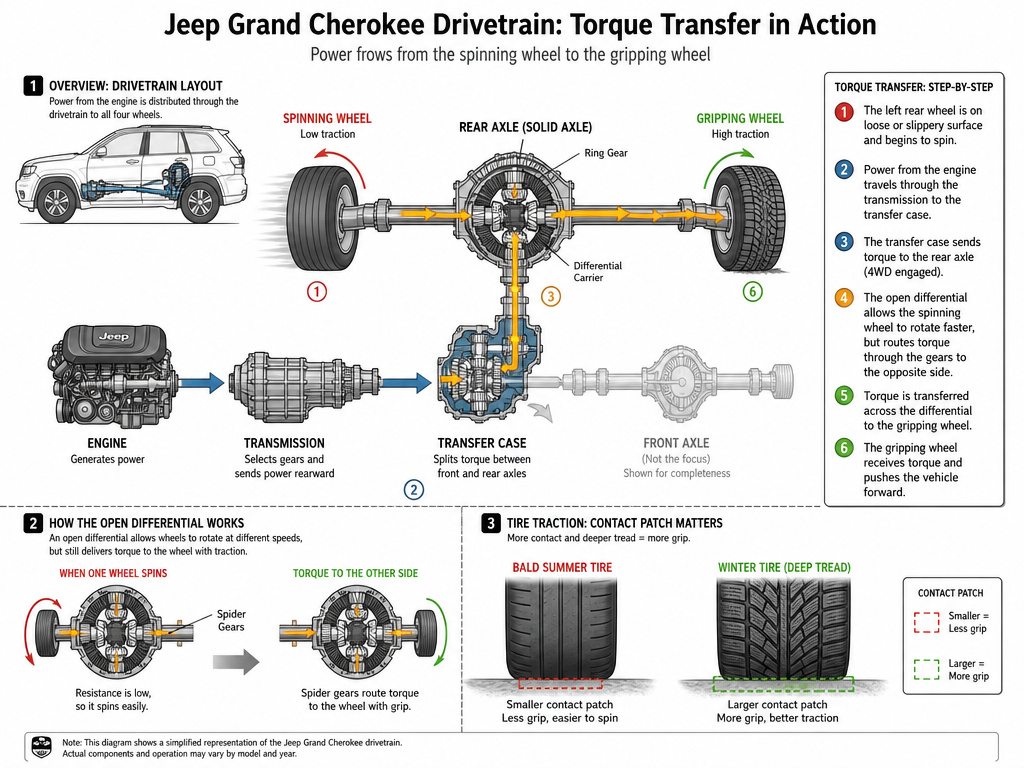
Four-wheel drive is a tool, not a magic wand. Its effectiveness is governed by physics, tires, and driver skill.
The primary benefit is sending power to at least two wheels on each axle, which doubles your chances of finding traction compared to 2WD. The low-range gear (in Quadra-Trac II and Quadra-Drive II) multiplies engine torque, allowing you to crawl over obstacles at walking speed without stalling. Systems like Quadra-Drive II go further by actively shifting torque side-to-side across an axle.
But 4WD does not improve braking distance. It does not prevent skidding on ice. It does not compensate for bald, inappropriate tires. A Grand Cherokee on summer tires will be hopeless in snow regardless of its drivetrain, whereas the same vehicle with dedicated winter tires becomes capable. The best system only manages the power delivered to the contact patches your tires provide.
This is why the conversation about 4WD in snow always circles back to tires. The drivetrain helps you go; tires determine your grip for going, turning, and stopping.
Common mistake: Using 4WD High on dry pavement. The full-time systems (Quadra-Trac I) are fine, but part-time systems or those in a locked mode can cause “driveline bind” during tight turns, leading to expensive wear on the transfer case and axles. Use the correct mode for the surface.
Frequently Asked Questions
Can a 2WD Jeep Grand Cherokee go off-road?
Not reliably, and Jeep explicitly advises against it. The owner’s manual states the 2WD version is for on-road use only. It lacks the low-range gearing, torque distribution, and often the underbody protection of 4WD models. A graded dirt road is fine; anything requiring traction from the front wheels is a gamble.
Is 4WD standard on the Jeep Grand Cherokee Trailhawk?
Yes. The Trailhawk trim is Jeep’s dedicated off-road variant. It includes the Quadra-Drive II 4WD system with the rear electronic limited-slip differential, a lifted off-road suspension, skid plates, and all-terrain tires. It is not offered in 2WD.
Do all Jeep Grand Cherokee 4xe models have 4WD?
Yes. The Grand Cherokee 4xe plug-in hybrid combines a turbocharged four-cylinder engine with electric motors. Its hybrid system inherently drives all four wheels through an electrically variable transmission, providing a form of full-time 4WD. It does not have a traditional two-speed transfer case with a low-range gear, however.
What’s the difference between 4WD and AWD?
The terms are often used interchangeably, but technically, 4WD typically refers to systems with a selectable low-range gear and often a locking or limited-slip center differential for severe off-road use. AWD is typically a full-time, single-speed system focused on on-road traction. The Grand Cherokee’s Quadra-Trac I is a blurry line—marketed as 4WD but functioning like a robust AWD system.
How can I add 4WD to my 2WD Grand Cherokee?
You cannot. Converting a 2WD Grand Cherokee to 4WD is a prohibitively expensive and complex task involving the fabrication of mounting points for a front differential, installing a transfer case, replacing the transmission output shaft, and rewiring the vehicle’s computer systems. It is not a practical aftermarket project. You would trade or sell your 2WD model for a 4WD one.
Before You Go
The Jeep Grand Cherokee is a flexible platform that serves two different masters. For one, it’s a comfortable, efficient highway cruiser available in 2WD. For the other, it’s a legitimately capable off-roader with three grades of 4WD.
The critical step is verification. Don’t guess. Run your VIN, find your build sheet, and know what you own. If you have 2WD, respect its limits as defined in the manual. If you have 4WD, understand which of the three systems you have—your approach to a snow-covered mountain pass or a rocky trail depends on it.
And remember, the drivetrain is just one part of the equation. Whether you’re looking for all-terrain tires for adventure or best tires for daily driving, your rubber is the final, critical link between all that engineering and the ground. Choose it wisely.
