
Are 4 Wheel Drive Vehicles Good in Snow? The Crucial Truth
This post contains affiliate links. As an Amazon Associate, we earn from qualifying purchases.
Yes, 4WD cars are good in the snow for one specific job: getting moving. A 4WD system sends power to all four wheels, which can provide better traction for acceleration from a stop or climbing a hill. However, it offers zero advantage for braking or steering control on ice, and using it incorrectly on dry pavement can cause expensive driveline damage.
That last clause about dry pavement is where the real conversation starts. The advantage is purely about putting power down. The moment you need to stop or turn, you have the same four contact patches as a two-wheel drive car, governed entirely by your tires and anti-lock brakes.
What follows is a breakdown of when 4WD helps, when it hurts, and why your choice of winter tire matters more than the drivetrain badge on your tailgate. We’ll cover the mechanical limits, the manufacturer warnings most people skip, and how to avoid the repair bill that comes from confusing 4WD with invincibility.
Key Takeaways
- 4WD only helps you go in snow; it does not help you stop or steer. Braking and cornering rely entirely on tire grip.
- Using 4WD High or Low modes on dry, hard pavement can cause driveline binding, vibration, and accelerated wear. Save it for loose surfaces like deep snow, sand, or mud.
- Mismatched tire sizes or tread depths are a major threat to 4WD system health and can trigger a default to two-wheel drive or cause permanent damage.
- The system can overheat during prolonged wheel slip. If you see a warning, stop safely and shut off the engine for at least 10 minutes to let it cool.
- For most snowy road driving, a set of dedicated winter tires on a front-wheel drive car will outperform all-season tires on a 4WD vehicle.
The 4WD vs AWD Difference That Changes Everything
Most people use the terms interchangeably, but the engineering distinction dictates how you should drive. A traditional 4WD system is typically a part-time system meant for low-traction off-road use. You select 2WD for normal driving, then manually engage 4WD High for slippery roads or 4WD Low for crawling over obstacles. Modern full-time all-wheel drive systems like Subaru’s Symmetrical AWD or Audi’s quattro are always active, automatically shuffling power front to rear.
The Ford Intelligent 4WD System is a full-time, automatic system that monitors conditions and adjusts torque split continuously. It requires no driver input and is designed for all conditions, from highway cruising to winter roads.
The big behavioral difference comes on dry pavement. A part-time 4WD system lacks a center differential, meaning the front and rear axles are locked together at a fixed speed. On a grippy surface, this forces the tires to scrub and bind during turns, straining the driveline. That’s why manuals explicitly warn against using 4WD High or Low on dry roads.
An AWD system, with its center differential or clutch pack, allows the axles to turn at different speeds, eliminating this bind. This is why you can drive an AWD car anywhere, anytime. Knowing which system you have is the first step to using it correctly without breaking it.
Why 4WD Doesn’t Make You Safer (The Physics)
The sensation is deceptive. You punch the gas on a snowy incline and the truck just goes. It feels planted, powerful, unstoppable. That feeling breeds overconfidence, and overconfidence in winter is what wraps vehicles around poles.
The physics are simple. Traction for acceleration comes from applying torque to the driving wheels. More driven wheels mean more potential to apply that torque without spinning. Traction for braking and cornering, however, comes from the friction between your tires and the road surface. All cars, regardless of drivetrain, use all four wheels for braking and cornering. A 4WD system doesn’t magically increase the coefficient of friction of your rubber.
Common mistake: Assuming 4WD improves braking distance. It does not. Your anti-lock brakes are working with the same tire grip as a front-wheel drive sedan. If those tires are all-seasons in 20-degree weather, you’re sliding.
This is why winter driving courses hammer the “four-wheel stop” concept. Your ability to avoid an obstacle is limited by your tires, your speed, and your reaction time—not by how many wheels are powered.
What Breaks a 4WD System? (The Edge Cases)
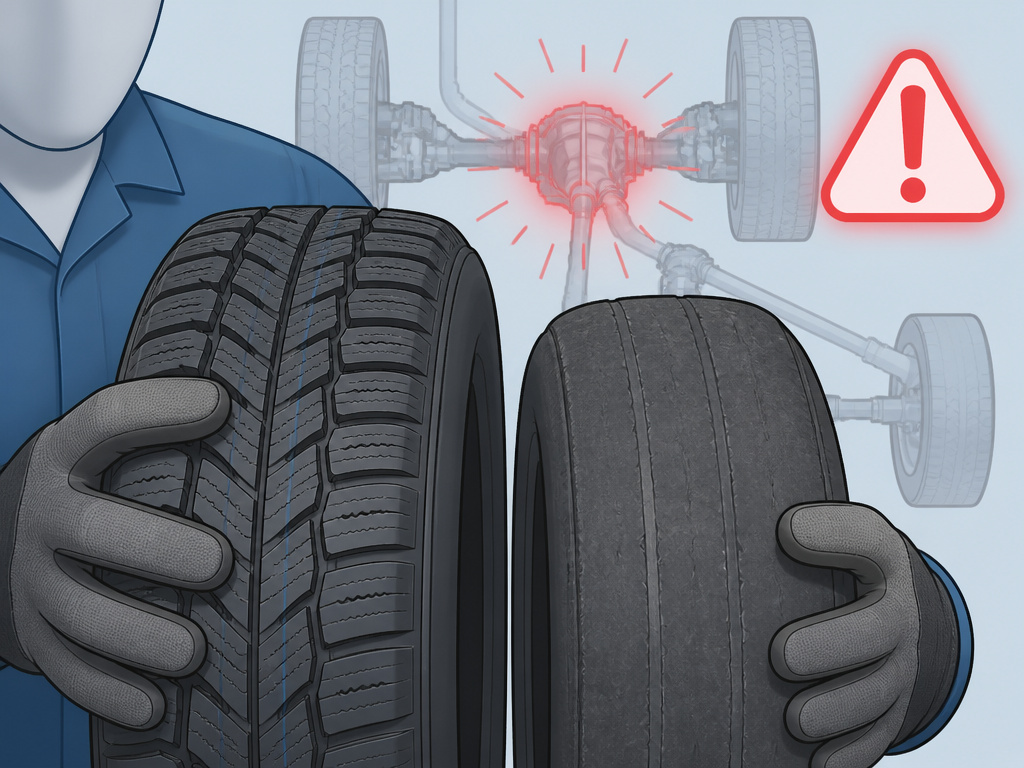 The system is robust, but it has clear failure modes spelled out in every owner’s manual. Ignoring them turns a traction aid into a very expensive paperweight.
Mismatched Tires. This is the cardinal sin. 4WD and AWD systems are designed around all four tires rotating at precisely the same speed. A significant difference in tire diameter—from mixing a new tire with three worn ones, using a mini-spare, or fitting different sizes front and rear—forces the differentials to work overtime to compensate.
Ford’s manual states that major dissimilarity “could cause the 4WD system to stop functioning and default to rear-wheel drive or damage the 4WD system.” The repair isn’t a simple sensor reset; it’s often a transfer case or differential rebuild.
| Tire Scenario | System Tolerance | Risk Outcome |
|---|---|---|
| Four identical new tires | Ideal | No issue. |
| Three worn, one new (same brand/size) | Tolerated if tread depth difference is small | Increased wear on differential clutches over time. |
| Using a temporary mini-spare | Not tolerated for extended use | Triggers warning light, potential for immediate damage if driven far. |
| Different sizes front vs. Rear (e.g., 17″ & 22″) | Not tolerated | System may disable itself or suffer mechanical failure. |
Dry Pavement Abuse. Engaging a part-time 4WD system on a dry, clean road creates driveline bind. You’ll feel it as a shuddering or hopping sensation during tight turns, like in a parking lot. Doing this repeatedly heats up the transfer case fluid, wears out the clutch packs, and can lead to a loud, expensive bang.
Excessive Wheel Spin. “Rocking” a stuck vehicle back and forth is a classic technique, but manuals caution against it. When you floor it and the wheels spin wildly, the sudden grip when they catch sends a shock through the driveline. Both Ford and Kia warn that “excessive tire slippage can cause transmission damage.”
The Right Way to Use 4WD in Winter
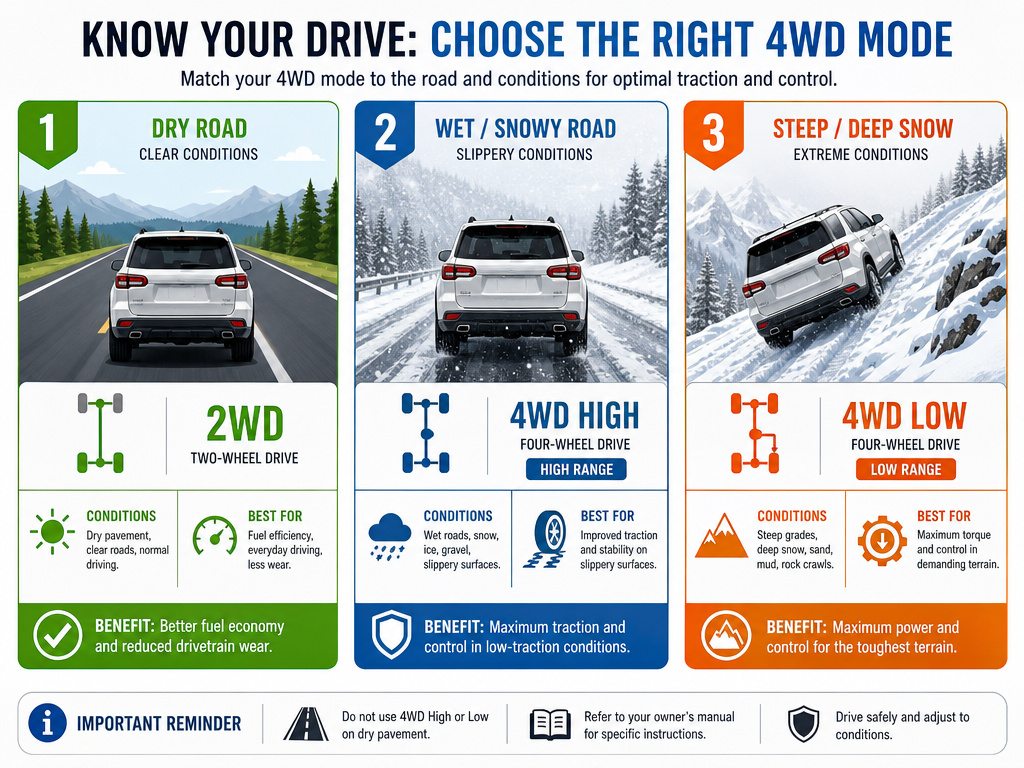 So when should you actually use it? The answer is specific and situational.
For a full-time system like Ford Intelligent 4WD, you don’t do anything—it’s always on and managing itself. For a traditional part-time system with a dial or lever, follow this logic:
- Clear, Dry Roads: Stay in 2WD. This gives you the best fuel economy and prevents any driveline bind.
- Wet Roads, Light Snow, or Packed Snow: Engage 4WD High. This gives you the extra acceleration traction you need without the low-range gearing. Disengage it when you return to clear roads.
- Deep Snow, Sand, or Steep Icy Inclines: Use 4WD Low. This setting provides maximum torque at low speeds for crawling out. Never use 4WD Low at highway speeds.
Where this goes sideways: Leaving the system in 4WD High after the roads clear. You might not feel the bind immediately on straight highways, but the first tight off-ramp will remind you. That hopping noise is money leaving your wallet.
What about tire chains? Kia’s manual specifically advises using fabric-type chains on AWD vehicles and installing them only on the rear wheels, driving under 20 mph. Chains on only one axle of a 4WD/AWD vehicle can confuse the system, so if you must use them, a full set of four is the safer, if more labor-intensive, bet.
Tires vs. Drivetrain: Where the Money Should Go
Let’s settle the eternal debate. If you have a limited budget for winter preparedness, what gives you more real-world safety: upgrading from 2WD to 4WD, or upgrading from all-season to winter tires?
The data and countless independent tests are unequivocal: tires win. A front-wheel drive car with dedicated winter tires will out-brake, out-corner, and often out-accelerate a 4WD SUV on all-season tires in winter conditions. The winter tire’s softer rubber compound stays pliable in the cold, and its siping bites into ice.
| Vehicle Setup | Acceleration on Ice | Braking Distance on Ice | Cornering Grip on Packed Snow |
|---|---|---|---|
| FWD with All-Season Tires | Poor | Long | Low |
| 4WD with All-Season Tires | Good | Long | Low |
| FWD with Winter Tires | Fair | Short | High |
| 4WD with Winter Tires | Excellent | Short | High |
The table shows the hierarchy. 4WD adds a layer on top of acceleration, but it does nothing to fix the braking and cornering deficits of all-season tires. The ultimate setup is, of course, 4WD with winter tires. But if you can only choose one, choose the tires. They work every time you touch the brake or turn the wheel, not just when you hit the gas.
This is why our lists of the best cars for snow and best trucks in snow always evaluate the entire package, with tire suitability being a primary factor.
Frequently Asked Questions
Does 4WD help you stop faster in snow?
No. Stopping power is determined solely by the grip between your tires and the road surface. All cars use all four wheels for braking. 4WD provides no braking advantage whatsoever.
Can I use 4WD on the highway?
You can use a full-time AWD system on the highway without issue. For a part-time 4WD system, you can use 4WD High on highways only if the surface is consistently slippery (e.g., snow-covered). Using it on dry highway pavement can cause damage.
Is AWD or 4WD better in snow?
For most paved-road winter driving, a modern full-time all-wheel drive system is preferable. It’s always active, requires no driver input, and doesn’t risk driveline damage on dry patches. Traditional 4WD is better suited for severe, low-speed off-road conditions like deep snow drifts or unplowed roads.
What happens if I use 4WD on dry pavement?
In a part-time 4WD system, it causes “driveline bind.” The front and rear axles are forced to turn at the same speed, but they need to turn at slightly different speeds when cornering. This causes tension, vibration, excessive wear on tires and driveline components (like the transfer case), and can lead to mechanical failure.
Do I need special tires for my 4WD vehicle?
You need matching tires. All four tires should be the same brand, model, size, and have very similar tread depth (within 4/32nds of an inch is a common rule of thumb). For winter performance, you need winter tires. The 4WD system amplifies the need for uniformity.
Before You Go
4WD is a powerful tool for gaining traction in deep snow, mud, or sand. It turns “can’t move” into “moving.” But it is not a safety force field. It does not alter the laws of physics governing stopping distance or cornering grip.
The most important winter driving equipment is between the steering wheel and the seat, followed closely by the four patches of rubber contacting the road. Invest in winter tires first, understand your vehicle’s specific 4WD or AWD system second, and always drive with the humility that ice demands. Your 4WD might get you to the mountain, but your tires and your judgment are what get you home.
