
Full-Size SUV Specs: The Definitive Guide to Chevrolet Tahoe
This post contains affiliate links. As an Amazon Associate, we earn from qualifying purchases.
The Chevrolet Tahoe is a full-size, body-on-frame SUV built by General Motors, offering V8 power, three-row seating, and available four-wheel drive. Its defining specs include a 5.3L or 6.2L V8 engine, an 8.0-quart oil capacity, a 24- or 28-gallon fuel tank, and a wheel nut torque specification of 190 lb-ft.
Those numbers are the starting point. The difference between a good ownership experience and a frustrating one often comes down to which version of those specs you actually have. A 2020 model holds a different amount of coolant than a 2023. The spark plug gap isn’t something you check; it’s something the factory sets and you leave alone.
What follows is a breakdown of the Tahoe’s mechanical identity: engine options, fluid capacities that changed between generations, and the one certification you must see on your oil bottle. We’ll also place it against its luxury cousin and its off-road rivals.
Key Takeaways
- The spark plug gap for both the 5.3L and 6.2L V8 is preset to 0.037–0.043 inches. Attempting to re-gap can crack the ceramic insulator.
- Engine oil capacity is 7.6 L (8.0 qt) with filter, but coolant capacity dropped from 16.8L in 2020 to 14.8L in 2023 for the 5.3L, indicating a redesign.
- Always use dexos1-approved full synthetic oil. Using a non-certified oil can lead to premature timing chain wear and void powertrain warranties.
- The wheel lug nuts require 190 lb-ft of torque. An under-torqued wheel can come loose; over-torquing can stretch the studs and cause failure.
- Distinguish between the workhorse 5.3L V8 (L84) and the performance-oriented 6.2L V8 (L87). The 6.2L demands premium fuel for its rated power.
What Defines the Modern Chevrolet Tahoe?
Forget the brochure talk about presence and capability. The Tahoe’s definition is in its architecture and its consistent commitment to a specific formula. It is a body-on-frame vehicle, which means the body is bolted to a separate steel ladder frame. This is the same foundation used by pickup trucks, and it provides the rigidity for heavy towing, up to 8,400 pounds when properly equipped.
The alternative is a unibody construction, where the body and frame are one piece. Most crossovers and smaller SUVs use unibody. The Tahoe’s choice is deliberate. It prioritizes payload, towing strength, and long-term durability over a car-like ride and maximum interior space efficiency. You feel the difference on a bumpy road; you appreciate it when hooking up a 7,000-pound trailer.
The 2023 Chevrolet Tahoe owner’s manual states spark plug gaps are preset by the manufacturer. Re-gapping is not recommended and can damage the spark plug. This is a service note, not a suggestion.
This frame also dictates the available powertrains. There’s no hybrid or four-cylinder option here. Your choices are between two gasoline V8 engines, both paired with a 10-speed automatic transmission. The drivetrain can be rear-wheel drive (RWD) or an on-demand four-wheel-drive system that most owners leave in auto mode. Understanding this Tahoe drivetrain is the first step in knowing what you’re driving.
The 5.3L vs 6.2L V8 Decision
This isn’t about “more power is better.” It’s about matching the engine to the truck’s daily job and your fuel budget. Both engines are technologically advanced, featuring Active Fuel Management (cylinder deactivation) and stop-start systems.
The 5.3L V8 (engine code L84) is the standard and most common powerplant. It produces around 355 horsepower and 383 lb-ft of torque. It runs happily on regular 87-octane gasoline. This engine is the rational choice. It provides ample power for 95% of Tahoe duties, family hauling, highway cruising, towing a boat or a camper under 6,000 pounds. The power delivery is smooth and the engine note is subdued.
The 6.2L V8 (engine code L87) is the upgrade. It pushes output to roughly 420 horsepower and 460 lb-ft of torque. The catch is its diet: it is tuned for and requires premium 93-octane fuel to achieve those numbers. Run it on regular, and the engine’s computer will pull timing to prevent knock, reducing power and potentially efficiency.
So who is the 6.2L for? The owner who tows at or near the maximum capacity regularly, or who simply wants the effortless acceleration and more aggressive exhaust note. It turns the Tahoe from a capable hauler into a surprisingly quick vehicle. For everyone else, the 5.3L is the financially smarter and mechanically sufficient option. When comparing to a Cadillac Escalade, note that the 6.2L is standard in that luxury SUV, reinforcing its performance role.
| Engine | Fuel Requirement | Best For | Compromise If Ignored |
|---|---|---|---|
| 5.3L V8 (L84) | Regular 87-Octane | Daily driving, light-to-moderate towing, fuel cost consciousness | None. It’s designed for this fuel. |
| 6.2L V8 (L87) | Premium 93-Octane | Max towing, performance feel, matching luxury rivals | Reduced power and potential long-term carbon buildup on valves. |
What Are the Chevrolet Tahoe’s Key Fluid Capacities?
You don’t need to memorize these numbers. You need to know where to find them for your specific model year, because they are not all the same. The most accurate source is always the factory service manual for 2023 Tahoe or the equivalent for your year. Here are the critical ones, with notes on where they change.
Where this goes sideways: Assuming all model years are identical. The 2020 Tahoe holds nearly two more quarts of coolant than the 2023. Pouring in the old spec leaves you short and risks overheating.
Engine Oil: 7.6 liters (8.0 U.S. Quarts) with filter change. This is consistent across the 5.3L and 6.2L engines and recent model years. The critical detail is the specification: dexos1. This is GM’s proprietary performance standard for synthetic oil. Using an oil that doesn’t carry the dexos1 certification, even if it’s the correct viscosity, can affect engine longevity and warranty claims. Look for the dexos1 logo on the bottle.
Engine Coolant: This is where generations diverge. The 2023 manual lists 14.8 L (15.6 qt) for the 5.3L and 14.3 L (15.1 qt) for the 6.2L. The 2020 manual lists 16.8 L (17.8 qt) for both. The change reflects updates to the cooling system design. The fluid type remains a 50/50 mix of DEX-COOL and clean water.
Fuel Tank: Capacity depends on wheelbase. The standard-length Tahoe has a 24.0-gallon tank (90.8 L). The long-wheelbase Suburban has a 28.0-gallon tank (106.0 L). Earlier models (pre-2021) had slightly smaller tanks: 26.0 and 31.5 gallons respectively. More range or more weight? That’s the trade-off.
Automatic Transmission Fluid: The 10-speed transmission uses DEXRON ULV (Ultra Low Viscosity) fluid. It’s not a lifetime fill. The severe service maintenance schedule calls for a change every 45,000 miles. Ignoring this leads to harsh shifts and eventual solenoid failure.
| Fluid | Specification | Capacity (2023 5.3L) | Capacity (2020 5.3L) | Purpose of Spec |
|---|---|---|---|---|
| Engine Oil | dexos1 Full Synthetic | 7.6 L (8.0 qt) | 7.6 L (8.0 qt) | Ensures proper lubrication for AFM system and protects against low-speed pre-ignition. |
| Coolant | DEX-COOL 50/50 Mix | 14.8 L (15.6 qt) | 16.8 L (17.8 qt) | Prevents corrosion in the aluminum components and maintains proper heat transfer. |
| Transmission Fluid | DEXRON ULV | ~10-12 L (full flush) | ~10-12 L (full flush) | Provides the precise friction characteristics for the 10-speed’s complex clutch packs. |
| Brake Fluid | DOT 4 Hydraulic Fluid | ~1 L (flush volume) | ~1 L (flush volume) | Higher boiling point than DOT 3 to handle heat from the Tahoe’s weight and towing. |
For any major service, consulting the official 2022 Tahoe technical documentation is non-negotiable. This is especially true for the torque specs on suspension and driveline components, where a mistake is costly.
Maintenance Realities: What the Schedule Actually Means
The owner’s manual presents two schedules: Normal and Severe. Almost every Tahoe falls under Severe. The definition includes frequent short trips, extensive idling, towing, and dusty or cold-weather operation. That covers most family SUVs.
The 7,500-mile/12,000-km interval is the heartbeat. This is for oil changes, tire rotations, and a multi-point inspection. The oil life monitor is generally accurate, but don’t push it past the “Change Engine Oil Soon” message by more than 1,000 miles. Synthetic oil breaks down from fuel dilution and heat cycles, not just mileage.
Every 45,000 miles (72,000 km) under severe service: change the automatic transmission fluid and filter. This is the most commonly skipped major service. The transmission won’t fail at 46,000 miles. It will start showing signs of wear, flare shifts, hesitation, by 90,000, and a rebuild then costs more than a dozen fluid changes.
Every 5 years: replace the brake fluid. Brake fluid is hygroscopic; it absorbs moisture from the air. This lowers its boiling point and promotes internal corrosion in the ABS pump and calipers. The pedal might feel fine, but the fluid’s protective capacity is gone. This interval is time-based, not mileage-based.
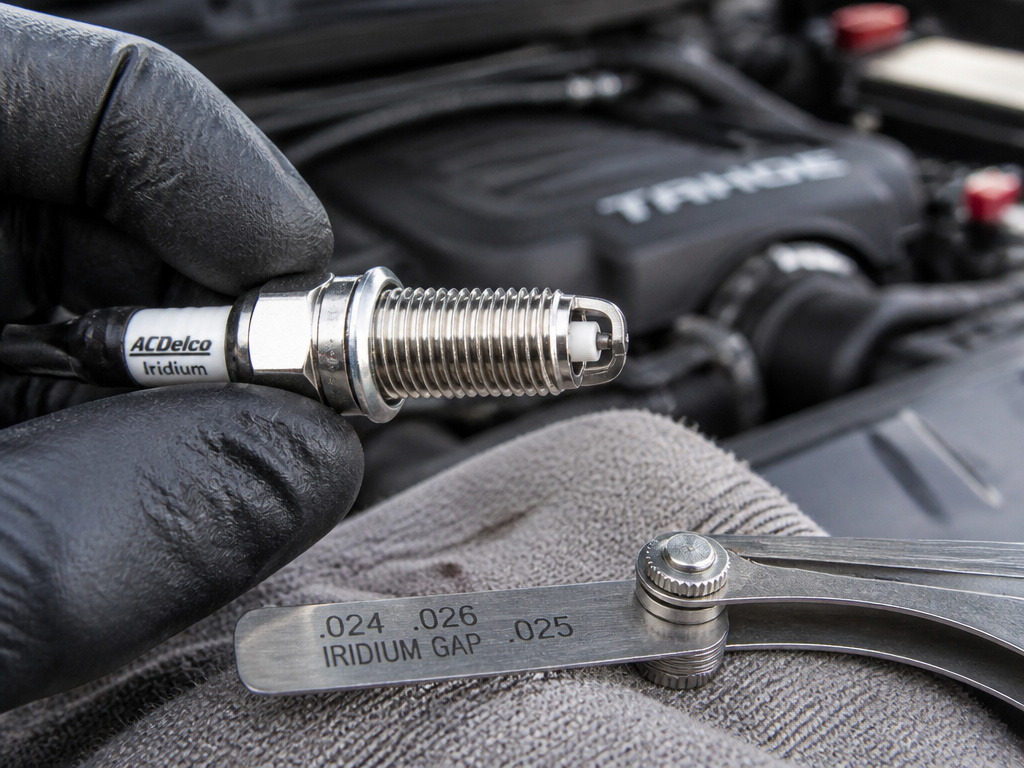
Spark plugs are rated for long life, up to 100,000 miles. The manual specifies a gap of 0.037–0.043 in (0.95–1.10 mm) for both V8s. The key sentence most miss: “Spark plug gaps are preset by the manufacturer.” Modern iridium or platinum-tipped plugs are fragile. Sliding a gap tool between the electrodes can crack the fine-wire center electrode or chip the ceramic. You verify the gap; you do not adjust it unless you are installing new plugs and the spec sheet allows it.
How the Tahoe Fits in the Full-Size SUV Landscape
The Tahoe doesn’t exist in a vacuum. Its position is defined by what it’s not as much as what it is. It is the high-volume, value-oriented cornerstone of GM’s full-size SUV lineup.
Against the Cadillac Escalade, the Tahoe is the mechanical sibling with a different suit. They share the same platform, engines, and basic dimensions. The Escalade gets more sound deadening, magnetic ride control, the 6.2L as standard, and a far more luxurious interior. You pay for refinement and status. Comparing Escalade specs reveals the premium is for features and finish, not fundamental capability.
Against the Ford Expedition, the battle is between V8 character and turbocharged efficiency. The Expedition uses a twin-turbo 3.5L V6 (EcoBoost). It makes similar power and torque to the 6.2L V8 but delivers it lower in the rpm band, which is great for towing. The Tahoe offers the traditional V8 feel and sound. The Expedition has a fully independent rear suspension for a better ride; the Tahoe uses a solid rear axle for ultimate durability and towing stability.
Then there are the purpose-built off-roaders like the Ford Bronco. This is a category mismatch. The Bronco is a midsize, body-on-frame vehicle designed for trail capability first. The Tahoe is a massive people- and gear-hauler that can handle a dirt road. If your adventure involves rock crawling, the Ford Bronco is the tool. If it involves hauling a family of seven to a mountain cabin, the Tahoe wins.
Its final competitor is the future: the electric SUV. Vehicles like the GMC Hummer EV SUV or the upcoming electric Chevy Tahoe equivalents promise instant torque and low running costs. For now, the gasoline Tahoe’s advantages are range, refueling speed, and a proven, serviceable powertrain in every town in America. The shift is coming, but today, the overview of electric SUVs shows they are still complements, not full replacements, for a vehicle with the Tahoe’s towing and range demands.
Ownership Considerations: New vs. Used and Long-Term Value
The Tahoe’s body-on-frame construction and simple mechanical layout contribute to legendary longevity. It’s common to see examples with 200,000 miles or more. This makes it a prime candidate for the used car market.
When evaluating a used Tahoe, focus on service history, not just mileage. A 2018 model with 80,000 miles of highway towing and documented transmission fluid changes is a better bet than a 2020 with 40,000 miles of city stop-and-go and no records. Listen for lifter tick on cold start from the AFM system, and check for smooth, prompt shifts from the transmission.
Resale value is among the highest in the automotive sector. This is a double-edged sword: you pay a premium up front, but you’ll get more back at trade-in time. The depreciation curve is shallow compared to most crossovers or sedans. This financial reality makes buying a well-maintained used model a solid strategy, as the first owner has absorbed the steepest part of the depreciation.
One option you will not find is a manual transmission. The Tahoe has been automatic-only for decades, as its core audience prioritizes ease of use and towing control over engagement. This is true for nearly all full-size trucks and SUVs.
Frequently Asked Questions
What is the towing capacity of a Chevrolet Tahoe?
Maximum towing capacity ranges from approximately 6,600 to 8,400 pounds, depending on the model year, engine, drivetrain (2WD vs 4WD), and the presence of the Max Trailering Package. The 6.2L V8 with the proper package achieves the highest rating. Always verify the specific rating on the door jamb sticker of the vehicle you’re using.
Does the Chevrolet Tahoe have a timing belt or chain?
All modern Chevrolet Tahoe V8 engines use a timing chain. It is designed to last the life of the engine and does not have a scheduled replacement interval. Failure is rare but can be catastrophic; symptoms include a rattling noise from the front cover at startup or severe running issues.
What does “Tahoe” even mean?
The name “Tahoe” is taken from Lake Tahoe, a large freshwater lake in the Sierra Nevada mountains, straddling California and Nevada. Chevrolet has used geographically significant names for its SUV lineup (Tahoe, Suburban, Blazer). It evokes a sense of outdoor capability and American adventure.
Is the Chevrolet Tahoe considered a truck?
Yes, due to its body-on-frame construction, the Chevrolet Tahoe is classified as a light truck by the EPA and NHTSA. This classification has implications for fuel economy standards and some regulations. It also means, mechanically, it shares far more with a Silverado pickup than with a unibody SUV like a Chevrolet Traverse.
How does the Tahoe’s reliability compare to its competitors?
The Chevrolet Tahoe consistently scores above average in long-term reliability surveys for the full-size SUV category. Its simple V8 powertrains and durable transmission are known quantities. Common issues over time can include minor electrical gremlins, wear on the active fuel management system lifters, and power running board motors (if equipped). Its main competitor, the Ford Expedition, is also highly rated, with the choice often coming down to preference for a V8 versus a turbo V6.
The Bottom Line
The Chevrolet Tahoe’s specification sheet tells a story of deliberate, conservative engineering. It’s a truck-based SUV that prioritizes payload, towing, and long-term durability over cutting-edge innovation. Your decisions come down to a few key forks: the 5.3L V8 for efficiency or the 6.2L for maximum power, understanding that your “severe” service schedule is probably normal, and knowing that a dexos1 oil bottle is a requirement, not a suggestion.
It’s a vehicle that makes sense on paper and in practice for a specific set of needs. It won’t handle like a sports car, that’s what the Camaro RWD is for, nor will it coddle you like a luxury sedan. But for moving people and their gear with uncomplicated, proven mechanicals, the Tahoe’s formula remains stubbornly effective. Keep its fluids fresh, its tires rotated, and respect its towing ratings, and it will deliver quarter-million-mile service without drama. That’s the real spec that matters.
