
Cadillac Escalade Features, Specs, Engine Price, Performance
This post contains affiliate links. As an Amazon Associate, we earn from qualifying purchases.
The 2026 Cadillac Escalade offers two distinct powertrains: a 420-hp 6.2L V8 for the standard model and a 682-hp supercharged 6.2L V8 for the V-Series. Key features include the 55-inch Horizon Display, available Super Cruise hands-free driving, and a comprehensive suite of driver aids. Potential buyers must be aware of a significant NHTSA safety recall (N252494002) issued in May 2025 for certain 2021-2024 models with the L87 engine due to a risk of propulsion loss.
That engine recall isn’t a footnote. It’s a documented safety defect with a stop-delivery order that reshapes how you should evaluate a used or new-old-stock model. The difference between the two engines isn’t just horsepower; it’s an entire driving character, from the brake components to the exhaust note.
What follows is a full breakdown of specs, performance, and the critical ownership details most glossaries miss. We’ll cover the tech that works, the recalls that matter, and where this full-size luxury SUV actually stands against its rivals.
Key Takeaways
- The V-Series’ supercharged 6.2L V8 produces 682 hp, but it drops the standard model’s maximum towing capacity by nearly 1,000 pounds.
- Super Cruise hands-free driving requires an active OnStar One plan, which is included for only three years from the vehicle’s in-service date.
- A major NHTSA safety recall (N252494002) from May 2025 affects 2021-2024 Escalades with the L87 engine due to defective connecting rods or crankshafts that can cause sudden engine failure.
- The 55-inch Horizon Display is actually three curved OLED screens fused together; a failure in one can affect the entire unit’s operation.
- Magnetic Ride Control is standard on V-Series and available on other trims; it uses magnetorheological fluid to adjust damping in milliseconds, but the system’s valves can clog over 100,000 miles.
The 2026 Cadillac Escalade: Two Engines, One Big Decision
Your first and most important choice is under the hood. Cadillac offers a familiar V8 and a ballistic supercharged version, and the decision dictates everything from your fuel stops to your repair bills.
The standard powerplant is a 6.2L V8 with Dynamic Fuel Management. It makes 420 horsepower at 5600 rpm and 460 lb-ft of torque at 4100 rpm. This engine is a known quantity across GM’s full-size truck and SUV lineup. It provides confident acceleration and a deep, traditional V8 rumble. With rear-wheel drive, this configuration can tow up to 8,100 pounds when properly equipped.
The V-Series changes the game entirely. Its hand-built 6.2L supercharged V8 (the LT4 engine) produces 682 hp at 6000 rpm and 653 lb-ft of torque at 4400 rpm. This isn’t just more power; it’s a different kind of vehicle. The supercharger’s whine under hard acceleration is unmistakable. The trade-off is capacity and efficiency. Maximum towing drops to 7,200 pounds, and the EPA fuel economy ratings are stark: 11 mpg city, 17 mpg highway.
The LT4 supercharged V8 in the Escalade V-Series shares its fundamental architecture with engines found in high-performance sports cars like the Chevrolet Corvette ZR1. It uses a 1.7L Eaton supercharger with an integrated charge cooler, an aluminum block, and forged steel connecting rods to handle the increased cylinder pressure.
Which one is right for you comes down to daily use. The standard V8 is the rational choice. The V-Series is an emotional one.
| Engine | Horsepower / Torque | Best For | Key Compromise |
|---|---|---|---|
| 6.2L V8 (L87) | 420 hp / 460 lb-ft | Towing, long-distance comfort, lower running costs | Performance feels adequate, not exhilarating. |
| 6.2L Supercharged V8 (LT4) | 682 hp / 653 lb-ft | Ultimate acceleration, prestige, auditory drama | Towing capacity drops, fuel costs rise significantly. |
The L87 Engine Recall: What You Must Check Before Buying
If you are considering a 2021-2024 model, this section is non-negotiable. In May 2025, the National Highway Traffic Safety Administration (NHTSA) issued Safety Recall N252494002. The defect involves the 6.2L V8 gas engine (RPO L87).
The official NHTSA L87 engine safety recall bulletin states that connecting rod and/or crankshaft components may have manufacturing defects. This can lead to sudden engine damage and failure, resulting in a complete loss of vehicle propulsion while driving.
Common mistake: Assuming a clean Carfax report means the recall work is done. The repair requires a full engine replacement for affected vehicles. You must check the VIN with a GM dealer to confirm the vehicle’s status in the Investigate Vehicle History (IVH) system. An unrepaired car is a safety risk.
The recall includes a critical date filter. Engines built before June 1, 2024 (or day 153 of the production year), are subject to inspection and potential replacement. Engines built after this date are not affected. A related NHTSA recall report N252494001 outlines a different procedure for vehicles still in dealer inventory, which involves a switch to a higher-viscosity dexosR 0W-40 engine oil and a new oil fill cap.
The bottom line: Never purchase a 2021-2024 Escalade without verifying the L87 recall status. An engine replacement is a major procedure, and an unrepaired vehicle should not be driven.
Performance & Handling: More Than Just Horsepower
The Escalade‘s size is a given. How it manages that mass is where the engineering shines—or stumbles. The base setup is competent, but the available systems transform the experience.
All Escalades use a 10-speed automatic transmission. It’s smooth in daily driving and generally decisive with downshifts. The V-Series includes steering wheel-mounted paddles for manual control, but most will leave it in Drive. The greater differentiator is the chassis technology.
Magnetic Ride Control is the star. This system uses dampers filled with magnetorheological fluid. An electromagnetic charge changes the fluid’s viscosity in milliseconds, allowing the suspension to instantly adapt to road surfaces. You feel it over broken pavement—the sharp impact is absorbed, not transmitted. It’s standard on the V-Series and a worthwhile option on other trims.
Where this goes sideways: Ignoring the air suspension. The available Air Ride Adaptive Suspension (often paired with Magnetic Ride Control) provides automatic leveling and a useful 4-inch lift mode for off-road clearance. However, the air compressor and air springs are wear items. A failure after warranty can cost over $2,000 to repair.
Stopping power is equally tiered. The V-Series comes standard with Brembo 6-piston front calipers and color-matched rears. These are not just for show; they provide repeated, fade-resistant stopping power that the standard single-piston floating calipers cannot match during aggressive driving.
Inside the Cabin: The 55-Inch Horizon Display & AKG Audio
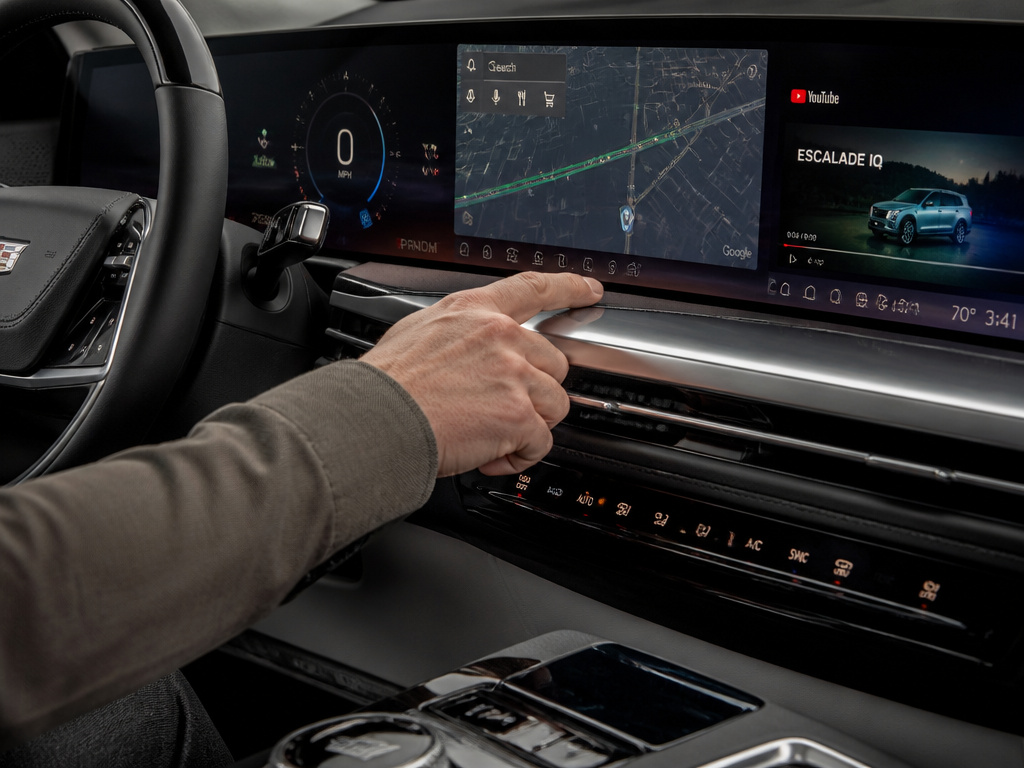 Step inside, and the dashboard dominates your view. Cadillac’s 55-inch Horizon Display is a single pane of glass housing three curved OLED screens: one for the gauge cluster, one for the central infotainment, and one for the front-passenger entertainment.
The OLED technology delivers perfect blacks and vibrant colors. The Google Built-in system provides seamless navigation and voice assistant functionality. Wireless Apple CarPlay and Android Auto are standard. The front-passenger screen can stream video while driving, a genuine luxury on long trips.
The infotainment system’s responsiveness and clarity are top-tier. However, because the displays are physically fused, a failure in one segment could necessitate replacement of the entire, prohibitively expensive unit. This is a long-term ownership consideration most reviews skip.
The audio experience is equally prioritized. A 21-speaker AKG Studio Audio System is standard. An optional 36-speaker AKG Studio Reference system in the V-Series and a 40-speaker system in upper trims offer concert-hall immersion. The sound staging is precise, with speakers integrated into the headliner and seatbacks.
Comfort is lavish. Heated and ventilated front seats are standard. Upper trims add 16-way power adjustment with massage functions. The available Executive Second-Row package transforms the cabin with captain’s chairs featuring ventilation, massage, and a floor console with stowable tables.
Safety & Driver Assistance: Super Cruise and Beyond
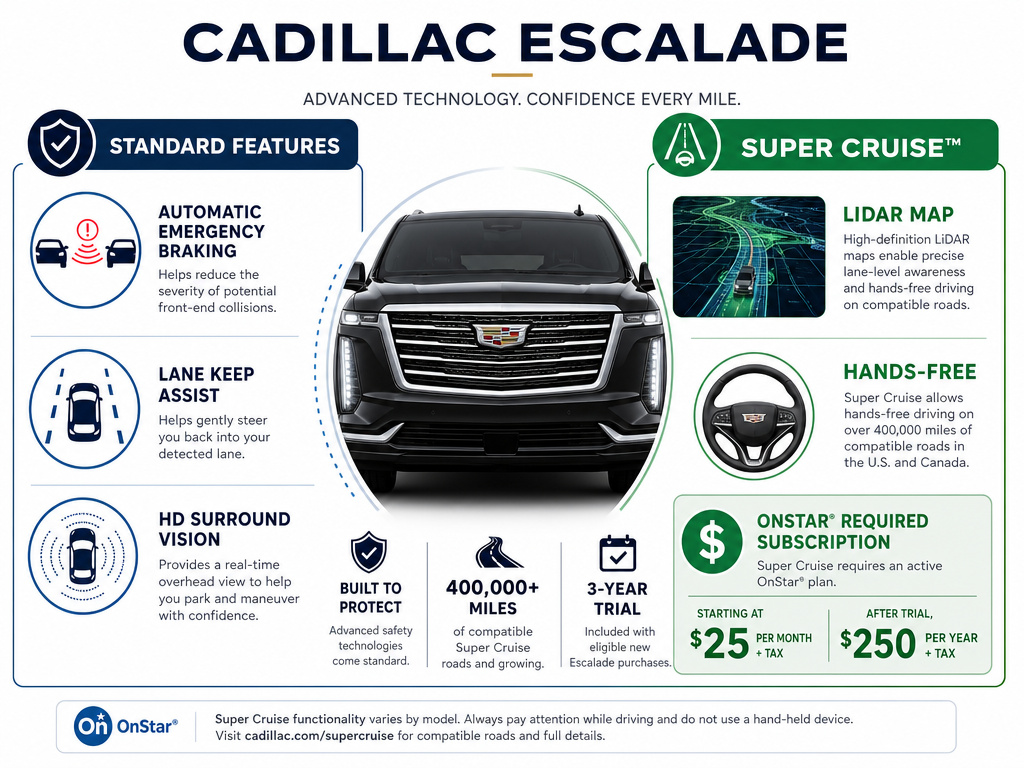 The Escalade is packed with sensors and cameras. The standard suite includes Automatic Emergency Braking, Front Pedestrian Braking, Lane Keep Assist, and a crystal-clear HD Surround Vision camera system.
The headline technology is Super Cruise. This is a true hands-free driver-assistance system for over 400,000 miles of compatible highways in the U.S. And Canada. It uses precise LiDAR map data, a driver-attention camera, and steering sensors to control acceleration, braking, and lane centering.
There’s a critical catch. Super Cruise’s functionality requires an active OnStar One plan. Cadillac includes this plan for three years from the vehicle’s in-service date. After that, you must subscribe to keep Super Cruise operational. The cost is several hundred dollars per year.
| Feature | How It Works | Real-World Limitation |
|---|---|---|
| Enhanced Automatic Parking | Uses sensors to steer into parallel or perpendicular spots. | Requires clearly painted lines; fails often in crowded urban settings. |
| Rear Cross Traffic Braking | Applies brakes if it detects crossing traffic while reversing. | Can be overly sensitive to fast-moving objects like bicycles, causing abrupt stops. |
| Adaptive Cruise Control | Maintains a set following distance from the vehicle ahead. | The system can be hesitant to resume speed after a complete stop in traffic. |
For detailed operational procedures and safety symbol definitions, always consult the 2023 Cadillac Escalade service manual.
Ownership Costs & Considerations
The Escalade is a premium vehicle with premium running costs. Planning for them avoids surprise.
Fuel Economy: As per the EPA, expect 14 mpg city/18 highway for the standard V8. The V-Series drops to 11/17. These are realistic numbers; heavy use of the air conditioning or city driving will see them dip further. The fuel tank is around 24 gallons, so fill-ups are substantial.
Maintenance: Follow the GM-scheduled maintenance in the onboard system. Key intervals include oil changes (using the correct 0W-20 or dexosR 0W-40 oil as specified), tire rotations, and brake fluid flushes. The complex air suspension and Magnetic Ride Control systems should be inspected annually after 50,000 miles. Using the right engine oil is crucial for longevity, especially in recalled models that require a specific grade.
Tires: The large, standard wheel sizes (22-inch and up) mean tire replacements are costly. A set of four all-season tires or high-performance tires for the 24-inch V-Series wheels can easily exceed $1,500. They are also more susceptible to sidewall damage from potholes.
Frequently Asked Questions
What is the real-world towing capacity of the Escalade?
When properly equipped with the factory trailering package, the standard Escalade with RWD can tow 8,100 lbs. The 4WD model drops to 7,900 lbs. The V-Series is rated for 7,200 lbs (7,000 lbs for the ESV). These are maximum ratings; for safe, long-distance towing, keep your loaded trailer weight at least 10-15% below that limit.
Does the Escalade have third-row seating?
Yes, all Escalades have a standard third-row seat that folds flat into the floor with power operation. The standard-wheelbase model offers adequate space for adults on short trips. For regular third-row use, the extended-length Escalade ESV is the better choice, adding significant legroom and cargo space behind the third row.
How reliable is the 2026 Cadillac Escalade?
It is too early for long-term reliability data on the 2026 model. However, the powertrains are largely carried over. The standard 6.2L V8 has a known history, now overshadowed by the 2025 recall for 2021-2024 models. The supercharged LT4 in the V-Series is robust but complex. The most common issues in earlier models involved electronic glitches with the infotainment system and occasional air suspension leaks.
Can you get the Escalade with a diesel engine?
No. For the 2026 model year, Cadillac offers only gasoline powertrains for the Escalade. The 3.0L Duramax turbo-diesel inline-six engine was discontinued in prior model years.
What is the difference between the Escalade and the ESV?
The Escalade ESV is the extended-wheelbase version. It is 15 inches longer overall (226.9 inches), providing more cargo space behind the third row and slightly more third-row legroom. The driving dynamics are nearly identical, but the ESV is more cumbersome in tight parking garages.
Before You Go
The 2026 Cadillac Escalade succeeds as a technological flagship and a statement of traditional American luxury. The V-Series is a thrilling, if thirsty, performance variant. Your decision matrix should weigh the stunning interior tech and comfortable ride against the very real ownership costs and the essential homework required on the L87 engine recall for recent model years. For most buyers who want the full experience without the supercharged drama, a well-equipped standard model with the Luxury or Sport trim offers the best balance.
