
The Honda Prelude | A Stylish and Sporty Legacy Decoded
This post contains affiliate links. As an Amazon Associate, we earn from qualifying purchases.
The Honda Prelude is a stylish and sporty legacy built on five generations of front-wheel-drive coupes, from 1978 to 2001, with a revival as a hybrid in 2025. Its identity hinged on advanced features for its time, like the first standard moonroof, optional four-wheel steering, and the high-revving VTEC engine, wrapped in a clean, timeless coupe shape that prioritized driving engagement over raw power.
That combination of innovation and restraint is the whole story. The Prelude was never the fastest car in its class. It was the one that felt more special to drive, with a tighter connection between your hands, the shifter, and the road. That feeling came from specific engineering choices, some brilliant, some flawed, that you only understand by looking at the service manuals and technical service bulletins.
What follows is a breakdown of what the Prelude actually was, not just what it looked like. We’ll walk through the specs that mattered, the known faults that will cost you, and why this coupe’s legacy outlasted its production by decades.
Key Takeaways
- The Prelude’s core identity was technological showcase: first standard power moonroof, available four-wheel steering (4WS), and later, the groundbreaking VTEC variable valve timing system.
- Fifth-generation (1997-2001) models have two critical documented issues: NHTSA recall 05V025000 for an ignition key interlock defect and Honda TSB 01-070 for 5th gear grind in the manual transmission.
- The celebrated H22A1 VTEC engine in the 5th-gen Si and Type SH requires specific care; its 5.9-liter overhaul oil capacity and 230-280 kPa fuel pressure are non-negotiable specs for longevity.
- The optional Active Torque Transfer System (ATTS) in the Type SH was innovative but adds complexity; a common heat shield rattle is addressed by TSB 97-037.
- While stylish, the Prelude was a strict 2+2, with rear seats suitable only for small items or very small children, emphasizing its driver-focused mission.
What Made the Prelude Different?
Honda didn’t build the Prelude to win drag races. They built it to win arguments at the coffee shop. It was the car you pointed to when talking about Japanese engineering cleverness. While competitors chased horsepower, Honda focused on the experience.
The standard power moonroof on the first 1978 model was a massive statement. It wasn’t an expensive option. It was part of the car’s identity, a feature that stayed for every single generation. Then came the available four-wheel steering on the third generation. The system turned the rear wheels a few degrees in the opposite direction at low speeds for tighter parking, and in the same direction at higher speeds for stable lane changes. It was weird, it worked, and nobody else offered it on an affordable coupe.
The Prelude’s technological identity wasn’t marketing. It was baked into the engineering documents. The 1993 service manual lists three distinct engines (F22A1, H23A1, H22A1 VTEC) with specific fuel pressure specs, oil capacities, and camshaft tolerances that show a platform designed for precision, not cost-cutting.
The cabin followed the same theme. You sat low, with a hood that stretched out ahead of you. The dashboard wrapped around the driver. The shifter, especially in the 5th-gen cars, fell perfectly to hand. It felt like a cockpit, not a living room. This was a car designed for someone who enjoyed the process of driving, not just the destination.
Under the Hood: The Heart of the Sporty Legacy
Talking about Prelude performance means talking about specific engines. You can’t just say “it had a four-cylinder.” You have to name the codes and know the differences, because they dictate everything from maintenance to driving character.
The fourth and fifth generations are where the legend solidified, thanks to the H-series engines. The base 2.3-liter H23A1 was a smooth, torquey DOHC unit. The star was the 2.2-liter H22A1 with VTEC. When the VTEC solenoid engaged around 5,500 rpm, the cam profile switched, the engine note hardened, and the car pulled with a ferocity that belied its displacement. The factory service manual gives you the hard numbers that explain why.
| Engine (1993 Spec) | Displacement | Compression (Nominal) | Oil Change Capacity | Fuel Pressure (Vacuum Hose Disconnected) |
|---|---|---|---|---|
| F22A1 (SOHC) | 2.2L | 1490 kPa (178 psi) | 3.8 L (4.0 US qt) | 255-305 kPa (36-43 psi) |
| H23A1 (DOHC) | 2.3L | 1490 kPa (178 psi) | 4.0 L (4.2 US qt) | 255-305 kPa (36-43 psi) |
| H22A1 (DOHC VTEC) | 2.2L | 1490 kPa (178 psi) | 4.8 L (5.1 US qt) | 230-280 kPa (33-40 psi) |
That last row is critical. The H22A1 VTEC engine holds nearly a full quart more oil than the non-VTEC H23 during a change. Using the wrong amount, or the wrong oil, accelerates wear on those high-lift cam lobes. The factory called for a premium Honda oil and a high-quality Honda oil filter; ignoring that for a cheap generic filter is how you end up with low oil pressure and a noisy valvetrain within 10,000 miles.
Where this goes sideways: Using conventional oil in a high-mileage VTEC engine. The shear from the aggressive cam profiles breaks down conventional oil quickly. Within two oil change intervals, you’ll hear the signature VTEC “rattle” on startup as the solenoid struggles with thickened, sheared oil.
The supporting systems were just as specific. The manual calls for a fuel pump that can deliver 205 cc of fuel in 10 seconds minimum. A weak pump might start fine but will lean out under VTEC engagement, causing misfires and potential detonation. This is a measurable, testable specification from the manual sitting in front of me.
The Fifth Generation: Peak and Problem
The 1997-2001 fifth-generation Prelude is the most sought-after today. Its shape is arguably the purest, a clean, low wedge with pop-up headlights (until the 1999 facelift). It’s also the one with the most clearly documented quirks. This is where ownership shifts from general admiration to specific, informed care.
Two things every fifth-gen buyer must check. First, the NHTSA recall 05V025000. This involved a shift interlock defect where the ignition key could be removed without the gear selector in Park (automatic) or without the clutch depressed (manual). A car that can roll away with the key in your pocket is a liability. Verify this recall was completed.
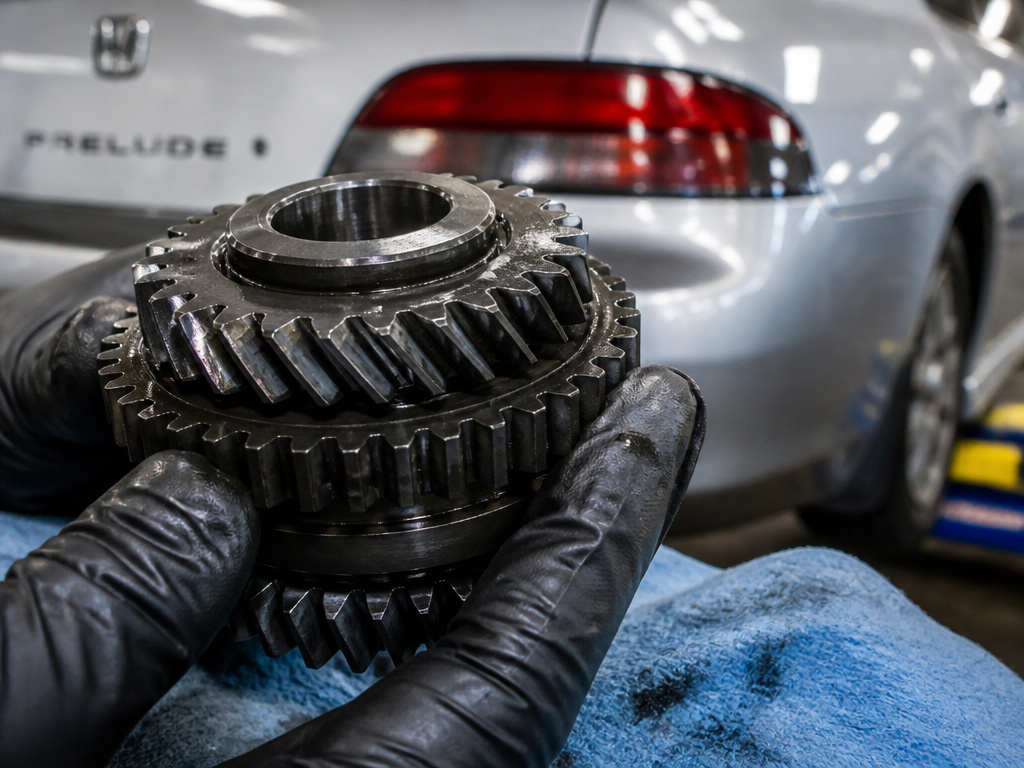
Second, for manual transmission cars, there’s Honda TSB 01-070. It addresses 5th gear grinding on upshift. The fix isn’t a simple adjustment. It requires replacing the 5th gear set, the engagement sleeve, and the 5th shift fork. If a car grinds into fifth, budget for this repair immediately. Driving through the grind wears the synchros beyond repair and can send metal shavings through the entire gearbox.
The Type SH model added another layer: the Active Torque Transfer System (ATTS). It used a complex mechanical differential to vector torque between the front wheels, reducing understeer. It worked, but it added weight and complexity. A known issue was a heat shield rattle, fixed under TSB 97-037 with a simple spacer. A louder clunk or vibration from the center tunnel, however, points to ATTS unit issues that are neither simple nor cheap.
| Common 5th-Gen Issue | Official Reference | Typical Symptom | Consequence if Ignored |
|---|---|---|---|
| Ignition Key Removal | NHTSA Recall 05V025000 | Key comes out in gear | Vehicle can roll away, safety hazard |
| 5th Gear Grind | Honda TSB 01-070 | Crunch shifting into 5th gear | Wears synchros, contaminates transmission fluid with metal |
| ATTS Heat Shield Rattle | Honda TSB 97-037 | Metallic buzz/rattle under acceleration | Annoying but harmless; other clunks may indicate ATTS failure |
| Automatic Shift Hesitation | (Common failure pattern) | Slips, flares shifts, delayed engagement | Wears clutch packs, leads to complete transmission failure |
The automatic transmission (M6HA) in these cars is generally robust but is maintenance-sensitive. The factory drain-and-fill capacity is about 2.6 quarts. Neglecting fluid changes every 30,000 miles lets varnish build up in the valve body. The first sign is often a sluggish 1-2 shift when the fluid is cold. By the time it stumbles shifting at full throttle, the clutch packs are already glazed.
Living With the Legacy: The Real Ownership Experience
Driving a Prelude today is an exercise in anachronism. There’s no turbo lag, no paddle shifters, no drive mode selector. You have a throttle cable, a hydraulic clutch, and a steering rack connected directly to the wheels. The feedback is raw and unfiltered.
The cabin is tight. The back seats are for a backpack or a small dog, not adults. The trunk on the fifth-gen was expanded but is still shallow. This car is designed for hauling down a back road. The seating position, the weighting of the controls, the visibility, it’s all tuned for that one purpose.
I prefer the visceral feel of the cable throttle in the fifth-gen to any modern drive-by-wire system. The connection is immediate. Your right foot isn’t sending a request to a computer; it’s directly opening the throttle body. You feel every millimeter of pedal travel.
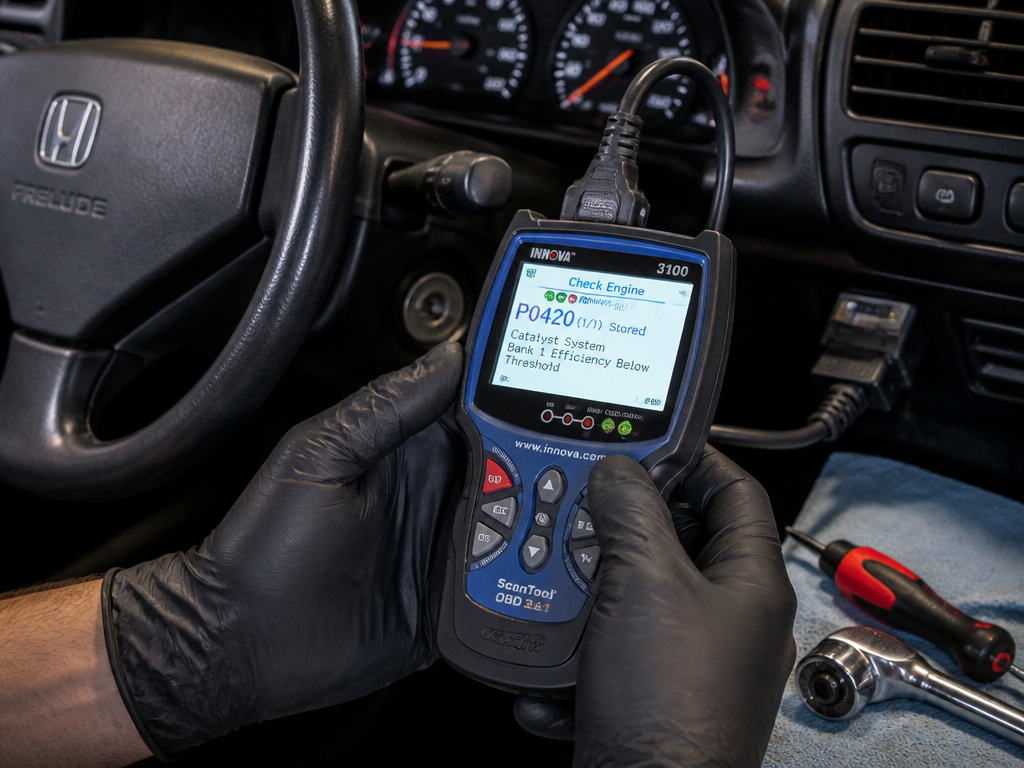
Maintenance is the price of admission. These are 20-30 year old vehicles. Rubber bushings crack. Original shocks are tired. Sensors fail. A good OBD2 scanner for Honda is essential for diagnosing the inevitable check engine light, which will often be for something minor like an aging oxygen sensor. The electrical system is simple by today’s standards, but a weak Civic battery or corroded ground strap can cause a multitude of ghost problems.
The community is your best resource. Forums and clubs are full of people who have documented every repair. Need to know the torque spec for the camshaft holder bolts? It’s in the club-posted PDF of the 1993 service manual. Wondering about Civic wheel fitment that might work on your Prelude? Someone has tried it. This shared knowledge is what keeps these cars on the road.
The Prelude’s Unexpected Comeback
Just when the classic Prelude story seemed finished, Honda announced its return for 2025. The new Prelude is a hybrid, combining a 2.0-liter Atkinson-cycle four-cylinder with two electric motors for a total system output of 200 horsepower. It’s a fundamentally different machine, a tech showcase for a new era, just as the original was.
The new car faces a different world. The sporty coupe market has shrunk dramatically. Its success will hinge on whether it can capture the spirit of the original, that sense of being a special, driver-focused piece of technology, rather than just the name. For fans of the original, it’s a fascinating bookend. It proves the Honda Prelude model history isn’t a closed chapter, but a continuing story of adapting a sporty legacy to the demands of the times.
Frequently Asked Questions
What was so special about the Honda Prelude?
It was a technology flagship in an affordable package. It consistently offered features firsts for Honda and for its class, like the standard power moonroof, available four-wheel steering, and the VTEC engine. It prioritized driver engagement and innovative engineering over outright power, creating a unique and lasting legacy.
Is the Honda Prelude a good first classic car?
It can be, but with major caveats. It’s relatively simple to work on with ample online support. However, you must buy carefully. Avoid automatics with shift issues, check for the completed ignition recall, and budget immediately for a 5th-gear repair if the manual transmission grinds. A pre-purchase inspection by a Honda specialist is non-negotiable.
What is the best Honda Prelude generation to buy?
For most enthusiasts, the fifth generation (1997-2001) is the peak. It has the most refined looks, the potent H22A VTEC engine, and a great interior. The fourth generation (1992-1996) is a more affordable and still excellent entry point, with the same basic engineering in a slightly softer shell. The third gen (1988-1991) is the purest 80s icon, especially with 4WS.
What are the most common problems with the 5th gen Prelude?
The manual transmission 5th gear grind (TSB 01-070) is the most famous. Also watch for automatic transmission shift flare, failing ignition switches (check for recall), cracking dashboard plastics, and oil leaks from the VTEC solenoid gasket or distributor o-ring. The ATTS system on Type SH models is reliable if maintained but expensive if it fails.
How much power did the VTEC Prelude engine make?
The H22A1 VTEC engine in the U.S.-spec 1997-2001 Prelude Si and Type SH was rated at 195 horsepower at 6,800 rpm and 156 lb-ft of torque at 5,300 rpm. The Japanese-spec “Type S” version made 217 horsepower due to a more aggressive intake and exhaust.
Can you daily drive a Honda Prelude?
Yes, but it’s a commitment. It’s reliable if maintained, but parts for a 20+ year old car can be scarce and need hunting. Fuel economy is average for a performance car of its era (low 20s mpg). The ride is firm, cabin space is limited, and you’ll be constantly explaining what it is to people. If you enjoy the ritual, it’s a wonderful daily.
The Bottom Line
The Honda Prelude’s stylish and sporty legacy consists of specific choices, the moonroof, the steering, the scream of VTEC, that were aimed at the driver’s senses. Owning one now means respecting those specifics.It means knowing the factory oil capacity, checking for that transmission TSB, and understanding that you’re maintaining a piece of focused engineering.
It was never the most powerful or the most practical. It was the car that made you think Honda was the smartest company in the room. For a certain kind of driver, that’s a legacy worth preserving.
