
Mitsubishi Car Review | The Overlooked CVT Data For Owners
This post contains affiliate links. As an Amazon Associate, we earn from qualifying purchases.
A Mitsubishi car review must separate marketing promises from mechanical reality. The brand offers competent, often affordable crossovers and sedans, but ownership hinges on three specific things: proactive CVT transmission maintenance, adherence to a strict fluid-change schedule, and checking your VIN against active safety recalls for components like liftgate struts.
That last point is a recent, documented fact. A 2026 NHTSA recall covers over 100,000 Outlanders for liftgate struts that can corrode and rupture.This review uses that data point, plus technical service bulletins and warranty fine print, to show what you’re actually signing up for. The value is there, but it’s conditional.
What follows is a breakdown of where Mitsubishi models excel, where they consistently falter, and the maintenance rituals that make the difference between a 200,000-mile workhorse and a money pit. We’ll walk through the powertrains, the interior compromises, the cost of upkeep, and the one system that demands more attention than any other.
Key Takeaways
- The Continuously Variable Transmission (CVT), particularly the F1CJC/W1CJC (CVT-8) unit, is the primary reliability concern, with known issues of shudder, surge, and belt wear documented in NHTSA technical service bulletins. Adherence to the factory fluid change intervals for oil, transmission, differential, and brake fluid is non-negotiable for long-term health, especially on all-wheel-drive models.
- Multiple active recalls, including a major 2026 campaign for liftgate gas spring corrosion, mean checking your Vehicle Identification Number (VIN) is a critical first step for any buyer.
- Interior materials and infotainment technology often lag behind segment leaders, prioritizing function and value over luxury or cutting-edge tech.
- The factory warranty is strong, but it explicitly requires proof of all scheduled maintenance performed on time; skipped services can void coverage.
What Defines a Modern Mitsubishi?
Forget the rally-bred Lancer Evolution. Today’s Mitsubishi lineup is a pragmatic collection of crossovers and one frugal sedan. The Outlander and Outlander PHEV are the flagships, the Eclipse Cross is the compact contender, and the Mirage serves as an ultra-budget entry point. They share a common philosophy: deliver maximum interior space and standard features for a dollar figure that undercuts Honda, Toyota, and Hyundai.
The engineering focus is on packaging efficiency and reliability through simplicity, not class-leading performance. You get competent, if uninspiring, four-cylinder engines. You get interiors built with hard plastics designed to withstand years of family use, not to win design awards. The driving experience is tuned for comfort and predictability, not engagement. This isn’t a brand you buy for thrills. You buy it because the math works, the purchase price is low, the warranty is long, and if you follow the rules, they tend to run.
The information contained in official service bulletins is subject to change. For the latest version of any technical document, Mitsubishi directs dealers and owners to the Mitsubishi Dealer Link (MDL) or the Mitsubishi Service Information website.
What’s the Most Common Mitsubishi Reliability Issue?
Open any owner’s forum or dig into the National Highway Traffic Safety Administration (NHTSA) database, and one pattern dominates: transmission complaints. Specifically, issues with the Jatco-supplied Continuously Variable Transmission (CVT), coded F1CJC or W1CJC and often called the CVT-8.
The problem is a progressive condition of shuddering or surging during acceleration, sometimes accompanied by a check engine light. A revised 2024 NHTSA technical service bulletin on transmission shudder (TSB-20-23-001REV3) describes it clearly for models like the Outlander and Eclipse Cross: “poor reaction of the hydraulic pressure circuit” leading to belt slip, which generates abrasive metal powder that then circulates and worsens the problem.
Here’s the why-layer: A CVT uses a metal push-belt between two pulleys. Hydraulic pressure controls the pulley widths to change the “gear” ratio seamlessly. If the solenoid valves or sensors in the valve body get clogged with debris or wear out, pressure regulation falters. The belt slips momentarily against the pulley, causing the shudder you feel. Continued driving grinds the belt, creating more debris. It’s a feedback loop of degradation.
The TSB lists specific Diagnostic Trouble Codes (DTCs) associated with this: P0776, P0730, P0741, P084A, P0969, P2719. If your vehicle exhibits shudder and stores one of these codes, the official repair procedure is extensive. It involves using the MUT-III SE diagnostic tool, potentially submitting data to Mitsubishi Techline, and following a strict inspection flow chart that can lead to valve body replacement or, in severe cases, a whole new transmission.
| Symptom | Likely Cause | Typical Repair | Severity |
|---|---|---|---|
| Shudder/Surge during light acceleration | Contaminated CVT fluid / Wearing valve body | Fluid flush & valve body replacement | Medium-High |
| Check Engine Light (Transmission Codes) | Faulty pressure sensor / solenoid | Diagnostic scan, part replacement | Medium |
| Lack of acceleration, engine “flare” | Severe belt slip / hydraulic failure | Transmission overhaul or replacement | High |
| Whining noise from transmission | Worn bearing or primary pulley | Transmission disassembly | High |
This isn’t a universal condemnation. Many owners go 150,000 miles without a hiccup. The split seems to depend on two factors: driving style and maintenance rigor. Aggressive, high-torque driving heats the CVT fluid faster and accelerates wear. And that leads directly to the next section.
The Maintenance Schedule That Actually Matters

Mitsubishi’s maintenance book is the terms of service for your warranty and the lifespan of your transmission. The most critical item is the CVT fluid change.While some manufacturers claim “lifetime” fluid, Mitsubishi’s own Canadian service schedule calls for transmission fluid replacement every 65 months or 104,000 km. For severe service, which includes frequent towing, mountain driving, or extensive idling, that interval should be halved.
Skipping this is the single most expensive mistake an owner can make. Old, broken-down fluid loses its lubricating and cooling properties. The metal-on-metal wear inside the transmission increases, directly leading to the valve body contamination and belt slip described in the TSB. A $200 fluid exchange every five years is cheap insurance against a $6,000 transmission replacement.
The other fluids are just as important on all-wheel-drive models: * Rear Differential / Transfer Case Fluid: Every 40 months / 64,000 km. * Brake Fluid: Every 30 months / 48,000 km (prevents internal corrosion in the ABS pump). * Engine Coolant: Every 85 months / 168,000 km.
Common mistake: Following only the engine oil change reminder. The onboard computer tracks oil life, but it has no idea about the condition of your transmission, differential, or brake fluid. These are time-and-distance items you must track separately.
Perform these services, and you drastically lower your risk of major powertrain issues. Neglect them, and you’re operating on borrowed time. This proactive stance is what separates a positive long-term Mitsubishi car review from a cautionary tale.
Recalls & Warranty: What’s Covered and What Isn’t
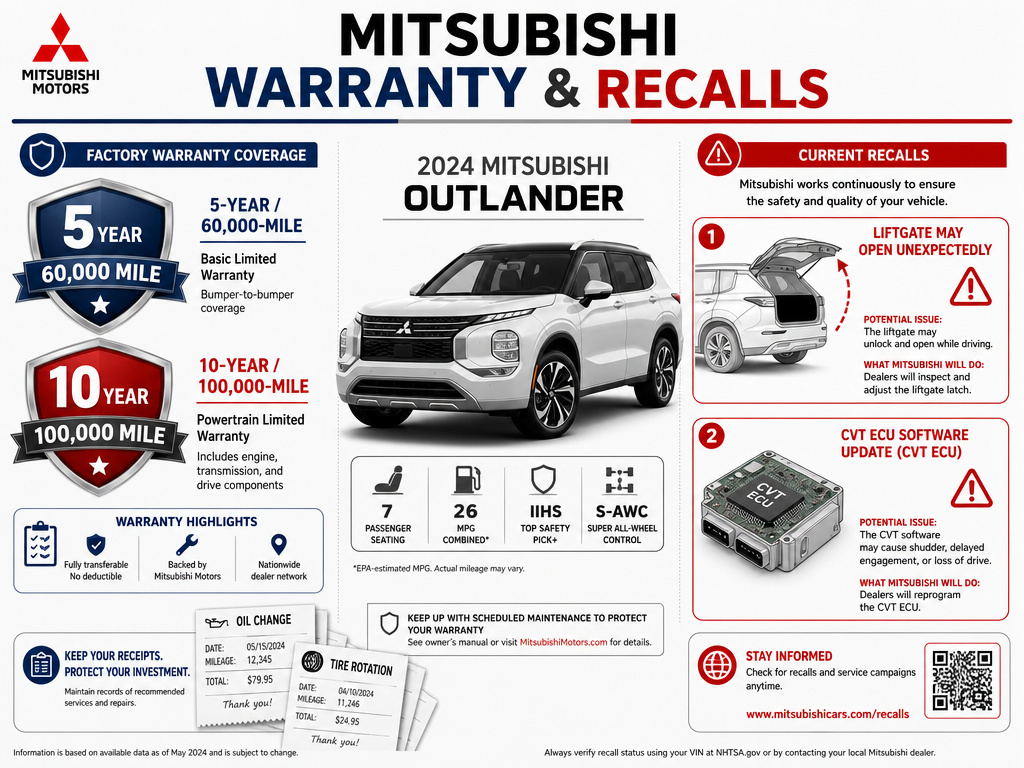
Mitsubishi’s strong suit is its warranty: 5-year/60,000-mile basic, and 10-year/100,000-mile on the powertrain. But the warranty fine print, as stated in their manual, is clear: “MMNA may deny you warranty coverage if your Vehicle or a part has failed due to abuse, neglect, improper maintenance or unapproved modifications.”
This means you must keep records. Receipts for oil changes, tire rotations, and especially those critical fluid services are your proof of proper maintenance. Without them, the dealer can legitimately deny a warranty claim on a failed transmission, blaming “neglect.”
Then there are recalls. Mitsubishi has had several significant ones, which are not maintenance items but factory defects fixed for free. Two are critical for shoppers: 1. Recall 26V252 (2026): This Mitsubishi liftgate strut safety recall notice affects 108,046 Outlander and Outlander PHEV models from 2014-2022. The liftgate gas springs can corrode, lose pressure, and potentially rupture, causing the liftgate to fall unexpectedly. If you’re looking at a used Outlander, checking for this repair is essential. 2. Recall 22V563 (2022): This CVT ECU software recall campaign targeted certain Outlander Sport models. Faulty programming could cause the transmission to suddenly downshift at high speed, leading to an engine over-rev. This recall underscores the complexity of modern transmission software.
Always check the NHTSA website with a specific VIN before purchase. An open recall doesn’t necessarily make a car a bad buy, but it must be repaired immediately.
Living With It: Interior, Tech, and Cost of Ownership
Step inside a modern Outlander, and you’ll find a roomy, functional cabin. Three rows of seating are available, making it one of the more affordable 7-passenger options. The materials, however, tell the value story. Surfaces you touch daily are often soft-touch, but lower dash and door panels are hard, scratchy plastic. It’s durable, not luxurious.
Infotainment systems have improved but still lag. The screens are smaller, the graphics less polished, and smartphone integration can be clunkier than in a Hyundai or Kia. It gets the job done, but it won’t wow you. This is a theme. Think of it like a dependable tool: a Mitsubishi mini-split HVAC unit for your house is fantastic at heating and cooling, but its remote control isn’t as slick as a Nest’s. The priority is the core function.
Ownership costs are a mixed bag. Fuel economy is generally good, especially with the Mirage’s stellar highway MPG. Insurance costs are often low due to modest repair costs and safety ratings. The big variable, as discussed, is repair costs if the CVT fails out of warranty. Parts are reasonably priced, but the labor for transmission work is intensive. This makes a well-documented service history the most valuable asset a used Mitsubishi can have.
To keep that interior presentable, a good set of all-weather mats is a wise first purchase. For the seats, regular use of a quality leather conditioner (even on leatherette) prevents cracking. And for general upkeep, an interior cleaning kit designed for automotive plastics will keep the cabin from looking worn before its time.
Model-by-Model Breakdown
| Model | Best For | Biggest Compromise | Key Consideration |
|---|---|---|---|
| Mirage / Mirage G4 | Ultra-budget commuting, city driving. | Power, refinement, highway comfort. | It’s cheap to buy and run. Expect noise and minimal features. |
| Eclipse Cross | Style-conscious compact SUV shoppers. | Cargo space, rear visibility. | The sloping rear design cuts into utility. Check for CVT updates. |
| Outlander | Families needing 3 rows on a tight budget. | Interior material quality, powertrain refinement. | The PHEV version is more compelling but costs more. Scrutinize service records. |
| Outlander Sport / RVR | Entry-level SUV buyers. | Outdated interior, engine noise. | Often the cheapest new SUV. Be militant about transmission fluid changes. |
For the Outlander, especially if you plan to keep it long-term, investing in paint protection is a good idea. The clear coat isn’t the thickest. For the Eclipse Cross or Outlander Sport, an upgrade to better 6.5-inch car speakers can dramatically improve the basic audio system. And if road noise bothers you, adding sound deadening material to the doors and floor is a common and effective owner project.
The Verdict: Who Should (and Shouldn’t) Buy a Mitsubishi?
You should buy a Mitsubishi if: * Your primary metric is low purchase price for a given set of features and space. * You are a disciplined, record-keeping owner who will follow the maintenance schedule to the letter. * You prioritize practical interior space and reliability over driving excitement or premium materials. * You plan to use the full length of the factory warranty and sell the car before major out-of-wear items come due.
You should look elsewhere if: * You want engaging driving dynamics, quick acceleration, or a luxurious cabin. * Your maintenance habits are “when the light comes on.” * You plan to keep the car well past 150,000 miles and are risk-averse to major transmission repairs. * You desire the latest infotainment and driver-assist technology.
The bottom line: A Mitsubishi is a rational choice, not an emotional one. Its value proposition is real, but it’s fenced with conditions. Do the maintenance, heed the recalls, and manage your expectations for refinement. Do that, and it can be a surprisingly sensible partner for years. Stretch the service intervals or buy a high-mileage example with no records, and you’re gambling with the most expensive component in the car.
Frequently Asked Questions
Are Mitsubishi cars reliable?
Mitsubishi cars can be reliable, but with a major caveat. Their reliability is heavily dependent on strict adherence to the factory maintenance schedule, particularly for transmission and driveline fluids. Neglect those, and the risk of expensive CVT transmission problems rises significantly. Well-maintained examples often reach high mileage without major issue.
What is the biggest problem with Mitsubishi?
The most common and costly problem is with the Continuously Variable Transmission (CVT). Issues range from shuddering and surging during acceleration to complete failure. These concerns are well-documented in National Highway Traffic Safety Administration (NHTSA) service bulletins for models like the Outlander, Eclipse Cross, and Outlander Sport equipped with the CVT-8 transmission.
Is Mitsubishi a good car to buy used?
Used Mitsubishi can be an excellent value-for-money purchase if, and only if, you can verify a complete service history. Prioritize models with records of regular CVT fluid changes. Always check the VIN for open recalls (like the liftgate strut recall) and ensure they were completed. Avoid high-mileage examples with no maintenance paperwork.
Do Mitsubishi cars last long?
Yes, with proper care, Mitsubishi cars are capable of lasting 200,000 miles or more. The engines are generally robust. Longevity hinges almost entirely on diligent maintenance, especially protecting the transmission. The cars are built with durability in mind, but they are not forgiving of neglect.
How expensive is Mitsubishi maintenance?
Routine maintenance costs are average for the Japanese segment. However, out-of-warranty repair costs can be high if the CVT fails, as replacement is labor-intensive. The key to controlling costs is preventative maintenance: spending a few hundred dollars on fluid services over the years to avoid a multi-thousand-dollar transmission repair.
What is Mitsubishi’s best model?
The Outlander, particularly the Plug-in Hybrid (PHEV) variant, is generally considered Mitsubishi’s best and most competitive model. It offers three rows of seating, standard all-wheel drive, excellent electric-only range for a PHEV, and a strong warranty. It represents the brand’s modern strengths better than any other vehicle in the lineup.
Before You Go
A Mitsubishi won’t thrill you. It won’t impress your neighbors with its interior trim. What it will do, if you listen to this review, is provide dependable transportation at a lower entry cost than most rivals. The equation only balances if you hold up your end of the bargain. Change the fluids on time. Keep every receipt. Check for recalls twice a year.
Treat it like the appliance it’s designed to be, one that requires specific, scheduled upkeep, and it will likely serve you well. Expect it to run forever on love and occasional oil changes, and you’ll be writing a very different Mitsubishi car review in a few years. The choice, and the responsibility, is yours.
