
State-by-State Guide: License to Ride an Electric Scooter
This post contains affiliate links. As an Amazon Associate, we earn from qualifying purchases.
In most states, you do not need a driver’s license to ride a standard, privately owned electric scooter, as these devices are legally treated like bicycles. However, a license, motorcycle endorsement, or registration is required if your scooter exceeds specific speed, power, or design thresholds defined by your state’s vehicle code.
That legal classification, bike or vehicle, is the whole game. Every state draws its line differently, and the line depends on three hard numbers you can find on your scooter’s spec sheet.
What follows is not a list of rules but a breakdown of the test. We’ll cover the two-part legal threshold, how to check your scooter against it, the major exceptions that trip people up, and what happens when you step over the line into moped or motorcycle territory.
Key Takeaways
- Your scooter’s maximum speed and motor wattage are the primary numbers that decide its legal class in most states.
- Even where no license is required, DUI laws still apply, with penalties mirroring those for driving a car.
- Minimum age and helmet laws are separate from license requirements and vary wildly by state and city.
- Rental scooters often have stricter rules, like higher minimum ages, than privately owned ones under the same state law.
- Exceeding your state’s speed or power thresholds moves your scooter into the moped or motorcycle category, triggering license, registration, and sometimes insurance mandates.
The Two-Part Legal Test
The question isn’t “Do I need a license?” It’s “What vehicle category does my scooter fall into under my state’s law?” Two specs answer that.
First, check your scooter’s top speed. The official NY DMV electric scooter regulations cap a scooter’s motor-only speed at 20 mph and make it illegal to operate above 15 mph. California’s law is stricter, defining a legal motorized scooter under CVC §407.5 as a device that cannot exceed 15 mph. If your scooter’s capable speed exceeds your state’s limit, even if you ride slower, you’ve likely crossed into a different legal zone.
Second, check the motor’s wattage. A common threshold is 750 watts. A 250-watt scooter humming along at 15 mph is solidly in the “bicycle-like” category in most statutes. A 1,000-watt motor pushing the same scooter to 25 mph? That’s moped territory in states like California, where a motor-driven cycle is defined as having an engine under 149 cc (roughly equivalent to a 2,000–3,000 watt electric motor).
This is a technical snippet: State laws classify electric scooters by specific numerical thresholds, primarily maximum speed and motor wattage. Devices under these thresholds (commonly ≤20 mph and ≤750W) are typically regulated like bicycles, exempt from licensing. Exceeding either threshold can reclassify the device as a moped or motor-driven cycle, triggering standard motor vehicle licensing, registration, and equipment requirements.
| Your Scooter’s Spec | Typical State Threshold | Likely Legal Category | License Required? |
|---|---|---|---|
| Speed ≤ 15–20 mph, Motor ≤ 750W | NY: 20 mph / CA: 15 mph | Motorized Scooter / Bicycle-like | No (standard driver’s license may suffice) |
| Speed > 20–28 mph, Motor 750–2000W | Varies; often a “low-speed” cap | Moped / Motor-Driven Cycle | Often Yes (M1/M2 or special permit) |
| Speed > 30 mph, Motor > 2000W | Motorcycle definitions apply | Motorcycle / eMoto | Yes (Motorcycle endorsement M1) |
Where this goes sideways: Assuming the “eco mode” setting on your 30-mph-capable scooter makes it legal. The law looks at the device’s maximum capable speed, not the setting you choose. A cop who clocks you at 18 mph can still cite you if the scooter’s manufacturer-rated top speed is 28 mph and that exceeds your state’s definition.
Why Your City’s Rules Probably Matter More
State law sets the baseline, but your city or county can layer on stricter rules. These local ordinances are where most riders get their first, and most confusing, ticket.
A state might allow scooters on roads with speed limits up to 35 mph, but your city council can restrict them to roads with limits of 25 mph or less. California state law generally prohibits riding on sidewalks, but a local ordinance could permit it in specific business districts. These local rules cover operation, parking, and sometimes even charging. Ignoring them because you followed the state guide is the most common legal mistake.
I won’t recommend assuming state law is the final word. The city of Denver, for example, requires riders to be 16, while Colorado state law sets no minimum age. You can be perfectly legal on I-25 in your car and illegal on your scooter two blocks off the highway because a municipal boundary changed the rule.
Your first stop after checking state law should be your city’s transportation or police department website. Look for a “micromobility” or “electric scooter” ordinance. If you can’t find it, a call to the non-emergency police line can clarify. It’s annoying, but it beats a $150 citation for a rule you didn’t know existed.
Minimum Age vs. Helmet Laws: Two Different Things
Many states tie helmet mandates to age, but the age to ride is often a separate, lower number, or nonexistent. This trips up parents.
New York requires scooter operators to be at least 16. Delaware sets the floor at 14. Illinois says 18. But in many of these same states, the helmet law might only apply to riders under 18. So a 16-year-old in New York can legally ride without a license but must wear a helmet. Their 18-year-old sibling, on the same scooter, needs neither a license nor a helmet under state law (though a city could require it).
This split creates a dangerous gap in safety logic, but it’s how the statutes are written. The helmet rule is a public health measure. The minimum age rule is about operator maturity and, sometimes, the state’s desire to avoid licensing a flood of young riders.
The takeaway is simple: check both numbers for your state. Assume your child needs a helmet regardless of the law. A cracked helmet is cheaper than a cracked skull, and no statute changes that math.
Shared Scooter vs. Private Ownership: The Rule Split
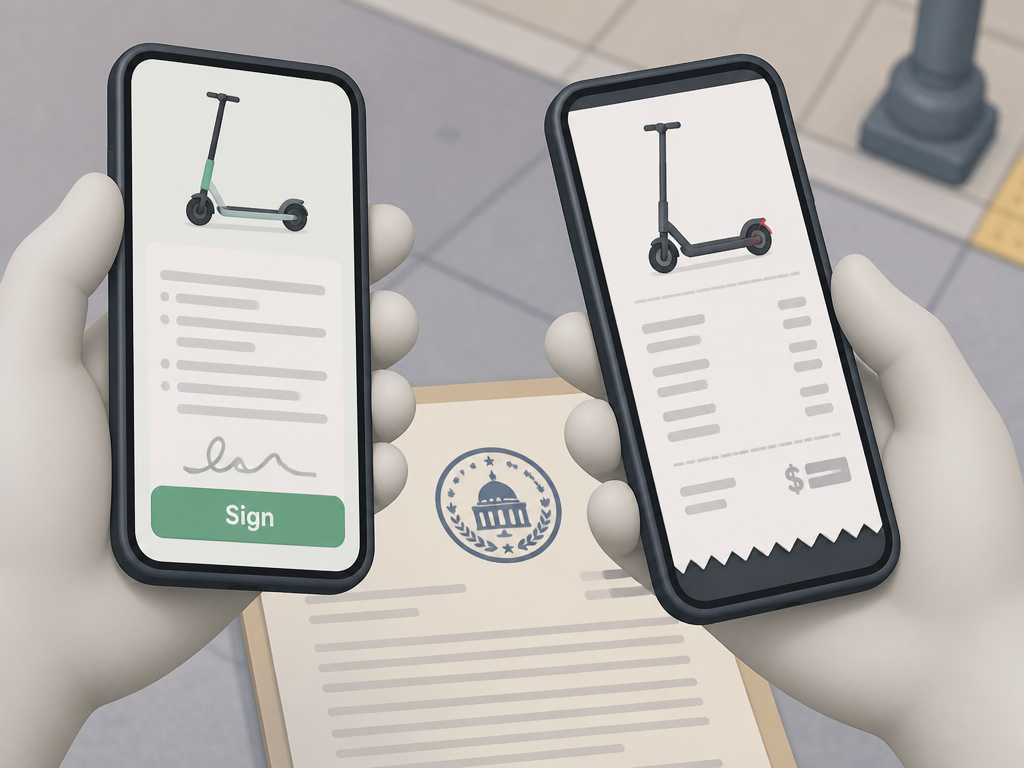
Lime, Bird, and Spin scooters parked on your corner operate under a different legal framework than the one you buy at Best Buy. Rental companies agree to city-specific rules as a condition of their operating permit.
A city might allow privately owned scooters for riders 14 and up but require shared scooter users to be 18. It might ban private scooters from sidewalks but grant shared scooters limited sidewalk access for parking. These public transit rules for bringing devices on buses and trains can also differ between private and shared models.
Common mistake: Thinking the app’s rules are just suggestions. They are a binding contract. Violating them, like parking a rental scooter outside a designated geo-fenced zone, can get your account banned and, in some cities, trigger a fine from the municipality directly to you.
If you only ride rented scooters, your main source of law is the rental agreement in the app and the local ordinance that governs the program. State law is the backdrop, but the company’s rules are the foreground you actually have to navigate.
The 3 Situations That Definitely Require a License
For most standard scooters, the answer is no. But there are clear red lines. Cross them, and you’re in a different world of regulation, cost, and paperwork.
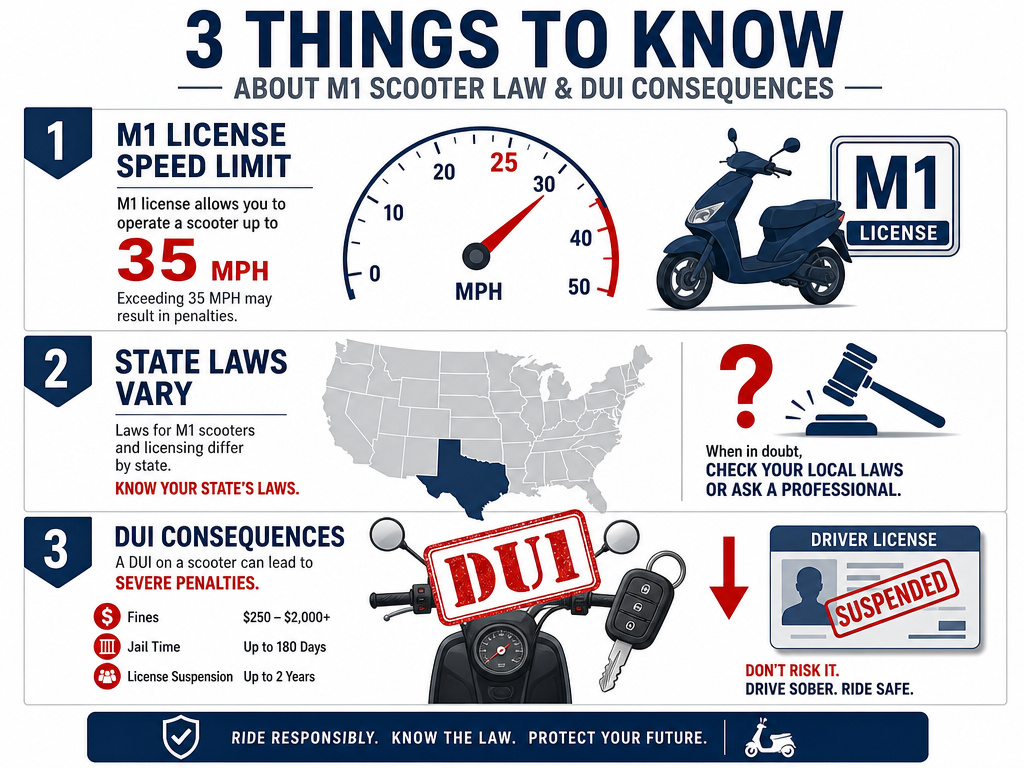
1. Your scooter is classified as a moped or motor-driven cycle. This happens when it exceeds your state’s speed or wattage limits for a “motorized scooter.” The official CA moped and scooter rules are clear: a motor-driven cycle requires an M1 motorcycle license and registration. The difference from mopeds often comes down to pedals and seat design, but the licensing requirement is the same.
2. You are riding in a state with no e-scooter law. States like Pennsylvania lack a dedicated e-scooter statute. In this legal vacuum, default categories like “motor vehicle” or “motor-driven cycle” can apply, and those categories come with license requirements. Riding there without checking first is a gamble.
3. You are charged with a DUI. This is the steepest consequence. In virtually every state, DUI statutes apply to any motorized vehicle. You can ride a scooter without a license, but if you’re intoxicated, you’ll face the same fines, jail time, and driver’s license suspension as someone drunk in a car. The legal logic is brutal: you didn’t need a license to operate it sober, but you’ll lose your license (and more) for operating it drunk.
How to Check Your Scooter’s Status in 10 Minutes
Don’t guess. Follow this sequence.
Step 1: Find your scooter’s exact specs. Look for the manufacturer’s label, usually under the deck or on the charger. Write down the maximum speed (in mph) and motor power (in watts). If you only have a model name, search “[model name] specifications.”
Step 2: Look up your state’s definition. Search “[Your State] electric scooter law” or “[Your State] vehicle code motorized scooter.” Find the exact statute. Look for the numbers, the speed cap, the wattage limit, the weight limit.
Step 3: Check your city’s municipal code. Search “[Your City] municipal code electric scooter.” Look for chapters on traffic, vehicles, or micromobility.
Step 4: Call for clarity if needed. If the language is ambiguous, call your local DMV office or police traffic division. Have your scooter’s specs in front of you. Ask directly: “With these numbers, what classification does it fall under, and what are the operator requirements?”
Skipping step 3 is where most people get a ticket. They know the state law but park illegally under a city ordinance they never read.
Street-Legal vs. Off-Road: The eMoto Trap
Some electric scooters, especially high-performance models, are sold as “off-road only” or “eMotos.” California’s DMV is explicit: these are off-highway vehicles and require an OHV permit. They are not legal for on-street use.
The sticker on the frame that says “Not for highway use” is a manufacturer’s disclaimer for a reason. Riding an eMoto on public roads is like driving a dirt bike on the interstate, it’s illegal and instantly probable cause for a stop. If you want a street legal electric scooter, buy one designed and certified for that purpose. Don’t assume you can register an off-road model later; you can’t.
The DUI Loophole That Isn’t
You might hear that Montana’s DUI statute only applies to “motor vehicles,” and its definition excludes some scooters. That’s a dangerous game.
First, proving your scooter fits that exclusion in court is a legal battle you will probably lose. Second, even if you win on the DUI, you’ll likely be charged with public intoxication or reckless endangerment. Third, and most importantly, 49 other states don’t have that loophole. The financial and personal cost of a DUI conviction, increased insurance, employment background checks, professional licensing issues, is life-altering. Treating a scooter like a toy because it’s small is the exact thinking that leads to these charges.
Frequently Asked Questions
Can I ride my electric scooter in a bike lane?
In most states with scooter laws, yes. You are typically required to follow the same bike lane rules as cyclists, including riding with traffic and using hand signals. Always check your local ordinance, as some cities restrict scooter access on certain trails or paths.
Do I need insurance for my electric scooter?
For a standard, low-speed scooter classified like a bicycle, no state requires insurance. However, if your scooter is classified as a moped or motorcycle, then your state’s financial responsibility laws apply, and you will need liability insurance to register it.
What happens if my scooter goes faster than the legal limit?
Operating a scooter that exceeds your state’s legal definition for a “motorized scooter” means you are likely operating an unregistered moped or motorcycle. This can result in citations for driving an unregistered vehicle, driving without a proper license, and lacking insurance. Penalties include fines and possible impoundment of the scooter.
Is there a weight limit for riders?
Yes, but it’s usually a scooter design limit, not a law. Manufacturers set a maximum weight limit for safety and performance. Exceeding it can damage the frame, motor, and brakes, voiding warranties and creating a hazard. Check your scooter’s manual.
What safety gear should I wear?
Always wear a helmet, regardless of the law. For higher-speed riding or daily commute use, consider additional protective equipment like gloves, knee pads, and a reflective vest. Good gear is the single most effective way to reduce injury severity.
Before You Go
The license question boils down to your specific scooter in your specific location. Find your scooter’s speed and wattage, then find your state’s legal thresholds. If your numbers are lower, you’re likely in the clear. If they’re higher, you’re looking at a trip to the DMV for a motorcycle license and a registration form.
Assume your city has extra rules. Always wear a helmet. Never ride under the influence. That’s the short version of a 2,000-word guide. Your scooter’s manual has the first number you need. Your state’s DMV website has the second. Match them before you turn the key.
