
Electric Scooter Top Speeds: How Fast Do They Really Go?
This post contains affiliate links. As an Amazon Associate, we earn from qualifying purchases.
Most electric scooters top out between 15 mph and 40 mph. Entry-level commuter models like the Ninebot KickScooter E2 max at 12.4 mph, while mid-range scooters like the Segway Ninebot F2 hit 18 mph. High-performance, dual-motor scooters can exceed 40 mph, but these speeds are often illegal on public roads and require significant experience to handle safely.
That 15-40 mph range is what’s printed on the box. The number you actually see on your dashboard is a negotiation between the scooter’s hardware, its current state, your local laws, and the road beneath you. A scooter’s advertised top speed is a lab result under perfect conditions, a 165-pound rider, a full battery, 77°F, on a flat, smooth test track.
What follows is a breakdown of where those speed numbers come from, the five variables that cut them in half, and the maintenance schedule that keeps your scooter from slowing down over time.
Key Takeaways
- Advertised speeds are lab-optimized. Real-world conditions like hills, rider weight, and battery level typically reduce top speed by 20-30%.
- Motor wattage is a clue, not a guarantee. A 350W nominal motor can peak at 700W, but actual speed depends on voltage, controller tuning, and gearing.
- Legal limits are often lower than hardware limits. Many cities cap e-scooter speed at 15-20 mph; built-in speed governors enforce this.
- Sustained speed requires maintenance. Low tire pressure, worn brake pads dragging, and a degraded battery are the most common culprits for a scooter that gets slower.
- High speed demands high safety. Scooters over 20 mph require full-face helmets, armored jackets, and experience; the stopping distance at 25 mph is triple that at 15 mph.
What is a “Realistic” Top Speed?
The spec sheet says 18 mph. You weigh 200 pounds, your battery is at 50%, and there’s a slight headwind. Your realistic top speed is now 14 mph. That gap is the single biggest point of confusion for new riders.
Manufacturers test under a controlled standard: a 75 kg (165 lb) rider, 25°C (77°F) ambient temperature, on a flat, paved surface with a full battery. The Dualtron Forever 111 manual explicitly states its “Theoretical Range” is tested at 25 km/h (15.5 mph) on average, while its “Typical Range” is tested at 50 km/h (31 mph), acknowledging that higher average speed is a different, more demanding use case.
A scooter’s speed rating is its ceiling under ideal laboratory conditions. It is not a promise of daily performance.
| Scooter Class | Example Model | Advertised Top Speed | Realistic Top Speed (200 lb rider, 50% battery) |
|---|---|---|---|
| Entry-Level / Kid’s | Ninebot ZING E12 | 10 mph (16 km/h) | 7-8 mph |
| Commuter | Segway Ninebot F2 | 18 mph (30 km/h) | 14-15 mph |
| Performance | Various Dual-motor models | 40+ mph (64+ km/h) | 35-38 mph (on private property) |
| Last-Mile Rental | Bird, Lime (Geo-fenced) | 15 mph (24 km/h) | 15 mph (hard-capped by software) |
The commuter category is where most adults shop. Models like the Segway Ninebot F2 and G65E are designed for this balance. Their speed is useful but constrained by software to comply with common urban regulations. You can sometimes unlock a “Sport” mode via the manufacturer’s app, but doing so may void your warranty and definitely increases risk.
The 5 Factors That Actually Slow You Down
Your scooter isn’t lying to you. The battery gauge and motor are responding to physical limits. Ignoring these factors is how riders get frustrated or, worse, stranded.
- Rider Weight. This is the biggest variable after the motor itself. Every pound over the test rider’s 165 lb requires more torque to accelerate and maintain speed. A 240 lb rider on a scooter rated for 265 lbs will rarely hit the advertised top speed, especially on any incline. The motor is working at its continuous power limit just to maintain a lower speed.
- Battery State of Charge. Voltage drops as the battery depletes. A lithium-ion battery pack’s nominal voltage is an average; a “36V” system might start at 42V fully charged and drop to 30V when nearly empty. Lower voltage means less power available to the motor. You’ll feel a noticeable drop in acceleration and top speed once the battery indicator shows 50% or less.
- Incline. Hills are the great equalizer. The Segway Ninebot F2 manual lists a maximum slope of 18%. Even a mild 5% grade will cut your speed by a third on most single-motor commuter scooters. The motor is diverting most of its power to fighting gravity instead of generating speed.
- Tire Pressure. Under-inflated tires create massive rolling resistance. The Ninebot F2 maintenance schedule calls for tire pressure checks every 3 months, inflating to 42-48 PSI. Riding at 30 PSI feels sluggish and can reduce your range and top speed by 15% or more. It also wears out the tire center tread faster.
- Temperature. Lithium-ion batteries hate the cold. The chemical reactions inside slow down, reducing the battery’s ability to deliver high current. Operating temperature for most scooters is listed as 14–104°F (-10–40°C). In freezing weather, you can lose 30-40% of your range and a significant portion of your available power, making top speed impossible.
Where this goes sideways: Ignoring tire pressure. A drop from 48 PSI to 35 PSI isn’t always visible, but the motor feels it immediately. You’ll burn through battery 20% faster and the scooter will struggle to reach its usual cruising speed within two weeks.
These factors compound. A heavy rider with a half-charged battery going up a slight hill on soft tires is asking the motor for perhaps double its rated continuous power. The thermal protection in the motor controller will eventually throttle power output to prevent burnout, slowing you down even more.
Motor Power & Speed: Watts, Volts, and Torque
A 350W motor does not automatically mean 18 mph. You need to look at three numbers together: nominal power (350W), peak power (often 700W+), and system voltage (36V, 48V, 52V).
- Nominal Power (e.g., 350W): The continuous power the motor can handle without overheating. This determines sustained cruising ability.
- Peak Power (e.g., 700W): The burst power available for acceleration and hills. This is what gets you up to speed.
- Voltage (e.g., 48V): Higher voltage systems can deliver more power to the motor at lower current, which is more efficient. A 48V 350W system will often outperform a 36V 350W system in both top speed and hill-climbing.
Hub Motor vs. Dual Motors: Most commuter scooters use a single rear hub motor, it’s simple and reliable. For higher speeds and torque, performance scooters use dual motors, one in each wheel. This effectively doubles the available power and provides all-wheel drive traction. Our guide on dual-motor scooters breaks down the models where this engineering makes a tangible difference.
| Motor Configuration | Best For | Top Speed Range | Trade-off |
|---|---|---|---|
| Single Hub Motor (250-500W) | Flat urban commuting, light riders | 12-20 mph | Struggles on hills >10% grade |
| Single Hub Motor (500-1000W) | Commuters who encounter bridges/hills | 20-28 mph | Reduced range per charge |
| Dual Hub Motors (500W+ each) | Performance riding, steep hills | 30-45+ mph | Significant weight, cost, and shorter battery life |
The controller is the brain. It dictates how power from the battery is delivered to the motor. A well-tuned controller is why two scooters with identical motor wattage can feel completely different, one might accelerate smoothly, while the other jerks or feels weak at the top end.
Legal Speed Limits and Governors
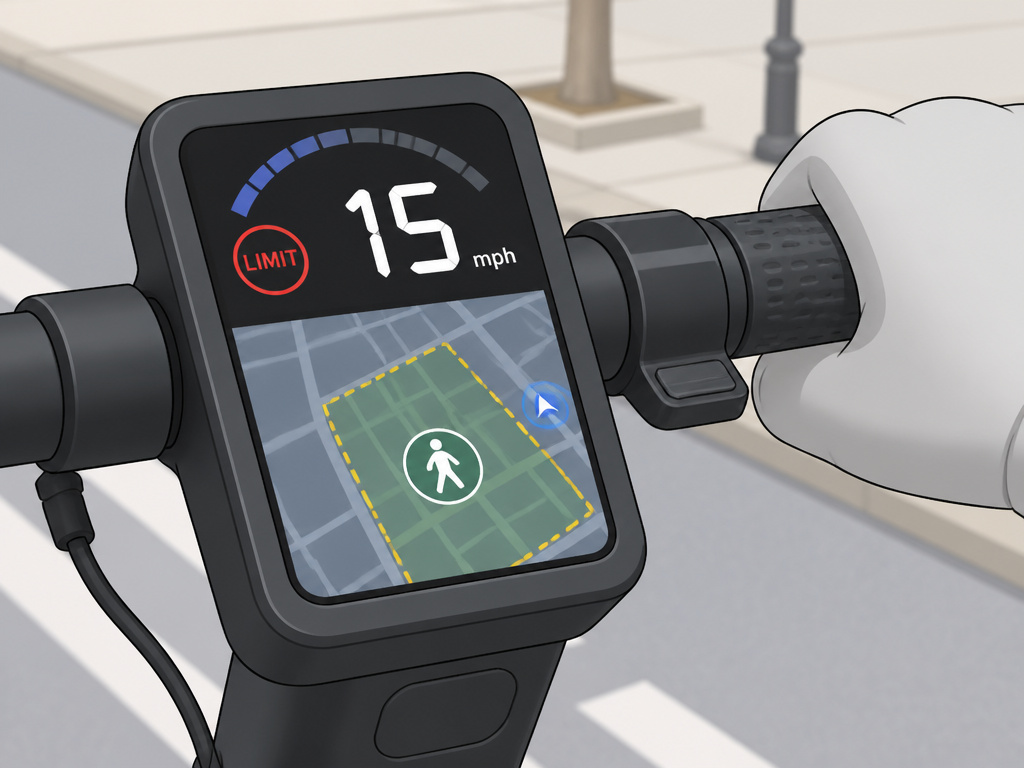
Your scooter’s hardware might be capable of 25 mph, but the law in your city likely says 15 or 20 mph. Manufacturers build this into the software.
Rental scooters from companies like Bird and Lime are the most obvious example. They use geofencing. GPS-based software boundaries, to automatically reduce speed in designated “slow zones” like parks or crowded downtown areas. Many privately-owned scooters also have user-selectable speed modes (Eco, Drive, Sport) that act as electronic governors.
Common mistake: Buying a high-speed scooter for city commuting without checking local laws. In many jurisdictions, scooters capable of exceeding 20 mph are classified as motor vehicles, requiring registration, insurance, and a driver’s license to operate on public roads.
Legal limits vary wildly: * United States: No federal law. Most cities set limits between 15-20 mph on bike lanes and roads. * United Kingdom: E-scooters are currently legal only on rental schemes, capped at 15.5 mph (25 km/h). * European Union: Many countries follow the 25 km/h (15.5 mph) limit for scooters to be classified as “light electric vehicles.”
Before chasing a higher top speed, research your local scooter safety regulations. Riding an illegally fast scooter can result in fines, impoundment, and void any insurance coverage in the event of an accident.
How to Maintain Your Scooter’s Speed
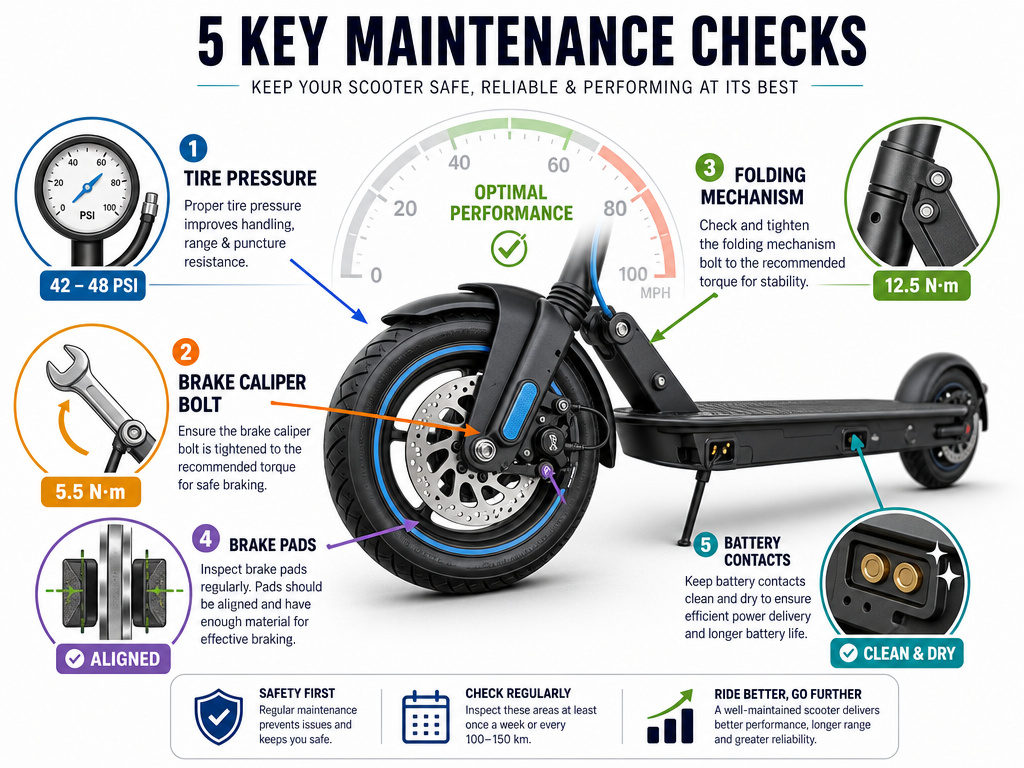
A slow scooter is often a neglected scooter. Speed isn’t just about power; it’s about efficiency. Follow the maintenance schedule in your F30 electric scooter user manual or similar guide to prevent gradual performance loss.
The Ninebot F2 manual provides a perfect template:
| Maintenance Item | Frequency | Action & Torque Spec | Consequence of Neglect |
|---|---|---|---|
| Tire Pressure | Every 3 months | Inflate to 42-48 PSI | High rolling resistance, 15-20% speed/range loss, uneven tire wear. |
| Stem/Handerbar Screws | Every 6 months or 310 miles | Tighten to 5.5±0.5 N·m | Dangerous steering wobble at speed, potential catastrophic failure. |
| Folding Mechanism Screws | Every 12 months or 621 miles | Tighten to 12.5±1 N·m | Structural flex, energy loss in the frame, rattling that saps power. |
| Brake Pad Alignment | Check every 3 months | Adjust so pads don’t drag on disc | Constant friction slows you down, drains battery, overheats brakes. |
| Battery Contacts | Every 12 months | Clean with dry cloth | Corrosion increases resistance, reduces voltage to motor, cuts power. |
The brake check is critical. A slightly misaligned disc brake pad that constantly rubs is like riding with the brakes partially engaged. You’ll feel the scooter struggle to coast and the motor will work harder to maintain speed. After a long ride, touch the brake disc, if it’s very hot even when you haven’t been braking, you have drag.
Battery care is long-term speed care. Storing a scooter in a freezing garage or a hot car trunk degrades the battery’s ability to deliver peak current. Always store it in the recommended temperature range (50–86°F / 10–30°C) and keep the charge between 30-80% for long-term storage.
High-Speed Riding: Is It Worth It?
Speed is thrilling. It’s also exponentially more dangerous. The physics are unforgiving.
- Stopping Distance: Doubling your speed quadruples your stopping distance. At 15 mph, you might stop in 10 feet. At 30 mph, it could take 40 feet or more, assuming perfect braking on ideal pavement.
- Stability: Small wheels (8-10 inches) hit bumps and potholes hard. At 25 mph, a 2-inch pavement crack can become a launch ramp. Scooters with suspension mitigate this but don’t eliminate the risk.
- Protection: A bicycle helmet is insufficient for speeds over 20 mph. High-speed falls require a full-face motorcycle helmet, gloves, and armored clothing to prevent serious road rash and head injury.
For true high-speed enthusiasts, dedicated performance scooters from brands like Dualtron are built for it, with larger wheels, hydraulic brakes, and robust suspensions. These are not commuter scooters; they are recreational vehicles best used on closed courses or private property. The investment in safety gear is as important as the investment in the scooter itself.
Many riders find that for daily use, a capable commuter scooter in the 18-22 mph range offers the best balance of utility, safety, and legality. It’s fast enough to keep up with city traffic flow but slow enough to manage unexpected hazards.
Frequently Asked Questions
Can I make my electric scooter go faster?
Sometimes, but not safely or legally. Methods involve “hacking” the controller software (which voids warranty and can brick the scooter), removing physical speed limiters, or upgrading the battery and controller. These modifications often push components beyond their designed limits, leading to overheating, battery fires, or mechanical failure. It also makes the scooter illegal for road use.
Why does my scooter slow down when going uphill?
Physics. The motor has a fixed amount of power (watts). On flat ground, that power is used almost entirely for speed. On an incline, a large portion of that power is redirected to fight gravity (lifting your weight). The steeper the hill, the more power goes to climbing, leaving less for speed. Dual-motor setups and higher-wattage motors provide more total power to handle both tasks better.
Do electric scooters have speedometers? Are they accurate?
Most have digital speedometers on the dashboard. Their accuracy varies. They typically calculate speed based on motor RPM and wheel size. If you install a larger or smaller tire, the reading will be wrong. Some cheaper models over-report speed by 1-3 mph to make the scooter feel faster. For a true reading, use a GPS-based speed app on your phone as a comparison.
What’s the fastest electric scooter you can buy?
Production models from brands like Rion, Dualtron, and NAMI have models that claim top speeds over 60 mph. These are essentially electric motorcycles with scooter form factors. They require expert riding skills, full motorcycle safety gear, and are not legal for use on public roads, bike lanes, or sidewalks in virtually any jurisdiction.
How does regenerative braking affect speed?
Regenerative braking captures some kinetic energy during braking or coasting and sends it back to the battery. It doesn’t directly increase top speed, but it can help maintain higher average speed by slightly extending range. When engaged, it creates a noticeable drag or slowing effect, which can feel like you’re losing speed if you’re not expecting it.
The Bottom Line
Electric scooter speed is a spectrum bounded by engineering, environment, and regulation. For most riders, the sweet spot lies between 15 and 25 mph, fast enough for efficient commuting, slow enough to remain relatively safe and legal.
Chasing the highest number on a spec sheet often means sacrificing practicality, safety, and legality. Instead, match the scooter’s capabilities to your actual needs. A reliable adult electric scooter that consistently hits 18 mph on your daily route is a better tool than a hyper-scooter that can do 40 mph but is illegal to use and terrifying to ride in traffic.
Focus on consistent performance, not peak bragging rights. Keep the tires hard, the brakes true, and the battery cared for. That’s how you get the most honest speed out of your ride, mile after mile.
