
Electric Scooter Regenerative Braking: Key Benefits & Tech
This post contains affiliate links. As an Amazon Associate, we earn from qualifying purchases.
Regenerative braking on electric scooters is a system where the motor reverses direction during deceleration, acting as a generator to convert the scooter’s kinetic energy back into electrical energy that recharges the battery. This process extends range, peer-reviewed studies show up to a 4% mileage gain, and reduces wear on the physical friction brakes, but it cannot be the sole stopping method.
The mechanism itself is a neat inversion. You press the brake, and instead of just clamping a pad to a disc, you turn the scooter’s drive motor into a temporary power plant. The energy it sends back to the pack isn’t just a gimmick; it’s a measurable top-up that adds miles. That’s the core efficiency win.
What follows is a breakdown of how this generator-mode actually works, where its real-world gains and hard limits come from, and why you’ll still need those old-school mechanical brakes no matter how clever the software gets. By the end, you’ll be able to spot the difference between marketing hype and an engineering spec sheet.
Key Takeaways
- Regenerative braking can recover a small but real amount of energy, with one 2022 study measuring a 4.066% mileage increase on a scooter using a DC magnet permanent motor.
- The system’s effectiveness is capped by battery chemistry, a full or cold battery cannot accept a high-rate charge, forcing the scooter’s BMS to reduce braking force.
- Dual-motor scooters apply regen braking on both wheels, offering smoother deceleration and better energy recovery than single-motor setups.
- Never rely on regen braking alone; a mechanical brake (disc or drum) is the mandatory backup when the battery is full or the system fails.
- Cold weather below 50°F (10°C) significantly weakens regenerative braking performance due to increased battery internal resistance.
The Core Principle: Motor as Generator
Forget about friction for a second. The electric motor that normally spins your wheels forward is, electrically speaking, reversible. When you command it to slow down, the controller cuts power and repurposes the motor’s windings. The spinning wheel turns the motor’s rotor, inducing an electrical current in the stator, the same principle as a hand-cranked flashlight.
This generator effect creates a magnetic resistance against the wheel’s rotation, which is what you feel as the electronic brake kicking in. The resulting current is then fed back through the controller and into the battery pack.
That magnetic resistance is the braking force. Its strength is tunable, which is why many scooter apps let you adjust regen intensity from “Weak” to “Strong.” A stronger setting means more aggressive deceleration and more current sent to the battery, but also a more abrupt stop.
Is there a physical limit to how much energy you can get back? Absolutely. The battery can only absorb charge as fast as its chemical reactions allow. Push current in too fast, and you risk overheating cells or causing permanent damage. The scooter’s Battery Management System (BMS) acts as a strict gatekeeper, throttling the regenerative current to stay within the battery’s safe charging envelope. This is why you can’t just get a “full recharge” from going downhill, the system hits a ceiling.
How Does Regenerative Braking Extend Range?
The numbers are small but concrete. A 2022 study presented at the International Conference on Sustainable Engineering, Infrastructure and Development tested a regenerative braking system on an electric scooter with a DC magnet permanent motor. Their “System 4,” which combined a controller with regenerative braking, achieved a 4.066% increase in mileage compared to using only a speed controller.
The study recorded a total battery consumption of 0.50163222 Ah and a recharged amount of 0.00036778 Ah from regen. That minute recharge translated directly into extra distance. For commuters, this isn’t about eliminating charging stops; it’s about squeezing an extra mile or two from each cycle, which adds up over a battery’s lifespan. This aligns with a key benefit for anyone comparing long-range scooters – every bit of recovered energy counts.
How Does It Compare to Mechanical Braking?
They are fundamentally different tools. A mechanical brake, a disc or drum with a caliper, works through pure friction. It converts kinetic energy directly into heat, which dissipates into the air. It’s a one-way, lossy process that also wears down pads and rotors over time.
Regenerative braking, in contrast, is a recovery system. It first tries to convert motion into storable electricity. Only the energy that can’t be captured by the battery (due to losses in the motor, controller, and wiring) becomes waste heat. The practical result is significantly less wear on your physical brake components. Owners of scooters with robust regen systems might go thousands of miles before needing new brake pads.
Common mistake: Relying solely on the electronic brake for sudden stops. If your battery is at 100%, the BMS has nowhere to send the regenerated current, and the braking force can drop to zero. Your mechanical brake is the fail-safe.
For the smoothest and most controlled stop, the best systems blend both. Initial deceleration comes from the regen system, saving energy and reducing wear, and the mechanical brake finishes the job for a complete halt. This is especially noticeable on dual-motor scooters, where regenerative braking on both wheels provides balanced, predictable slowing before the friction brakes engage.
| Braking Type | Energy Fate | Primary Wear Item | Best Used For |
|---|---|---|---|
| Mechanical (Friction) | Converted to heat, lost | Brake pads, rotors/drums | Final stopping, emergency braking |
| Regenerative | Converted to electricity, stored in battery | Minimal wear on motor/controller | Everyday deceleration, extending range |
Technical Limits and Real-World Performance
The promise of “free energy” bumps into physics pretty quickly. The efficiency of the entire chain, from wheel spin to battery storage, isn’t 100%. The motor and controller generate heat during conversion, and wiring has resistance. But the bigger limits are external.
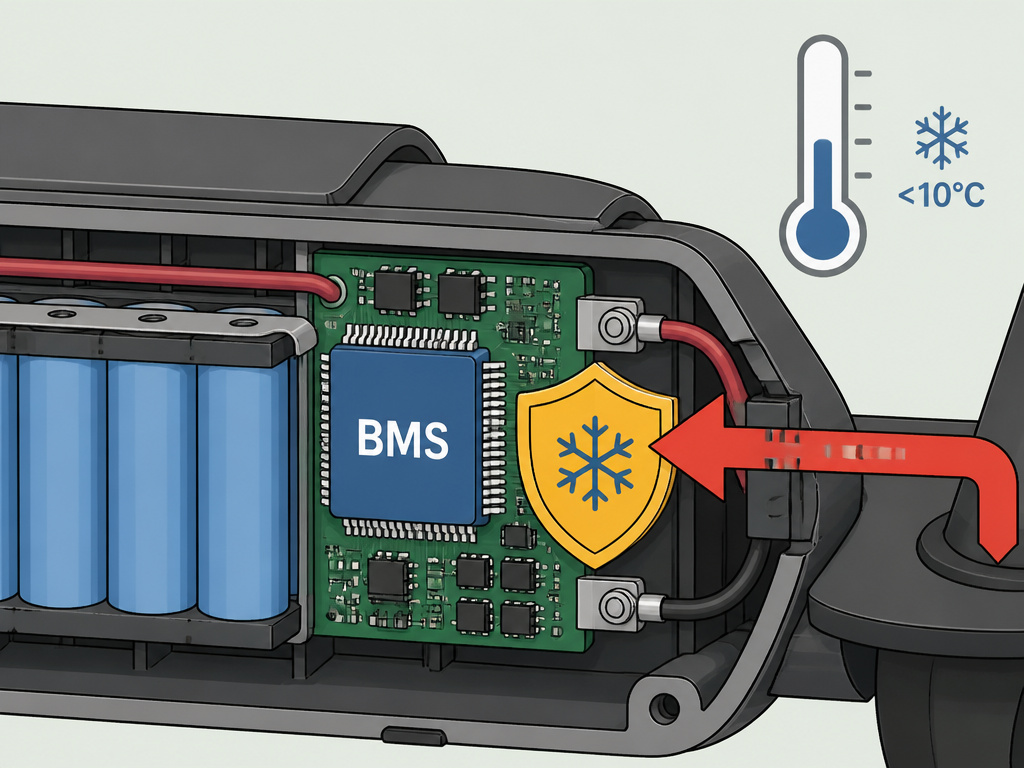
Cold Weather is regenerative braking’s nemesis. Lithium-ion batteries suffer from higher internal resistance when temperatures drop below 10°C (50°F). This resistance limits their ability to accept a rapid charge. To protect the cells, the BMS will drastically reduce the regenerative current it allows. To you, the brake will feel “weaker” or less responsive on a cold morning. The system is prioritizing battery health over stopping power.
A Full Battery presents a similar, but more critical, limit. With no capacity left to absorb energy, regen braking must be disabled or severely reduced to prevent dangerous overcharging. This is the #1 reason you must maintain your mechanical brakes, they are your guaranteed stopping power when the electronics have nothing to give.
Speed Fluctuations also matter. The same 2022 study noted that variations in motor speed (like not holding a steady 500 RPM) caused changes in the regenerative current. Inconsistent deceleration leads to inconsistent energy recovery, which is one reason advertised “range extension” figures are always best-case estimates.
Scooter Design & User Control
Not all regenerative braking systems are created equal, and a lot depends on how the scooter is built.
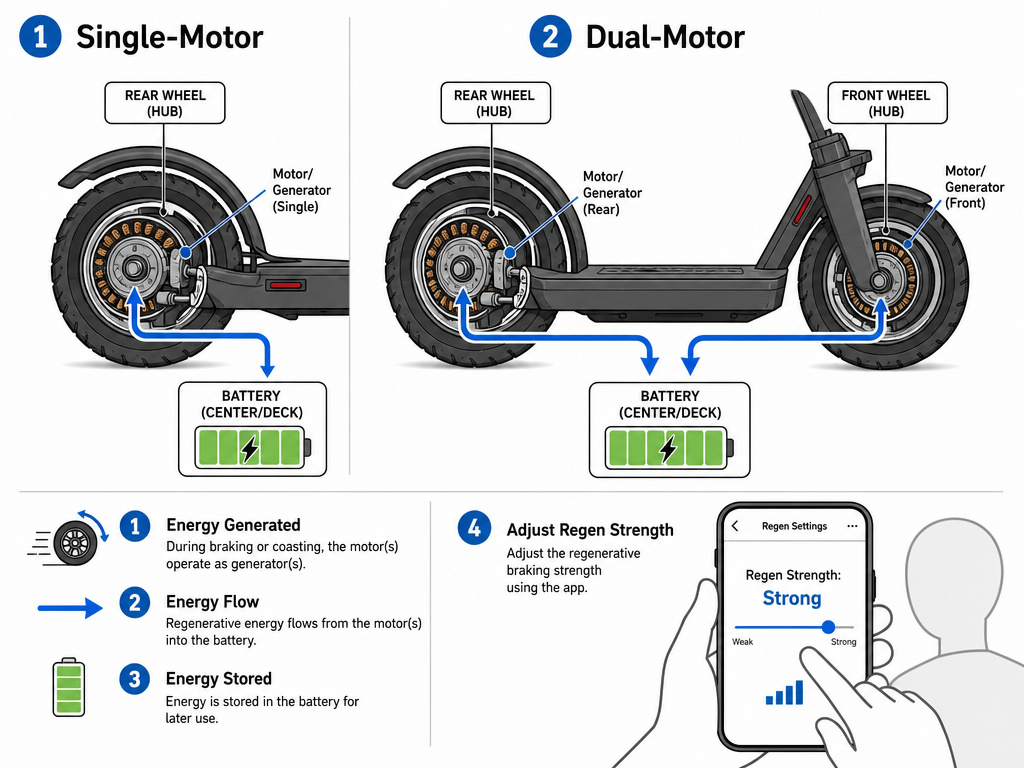
Single-Motor vs. Dual-Motor: A scooter with one drive motor, typically in the rear wheel, only applies regenerative braking to that wheel. A dual-motor scooter can use both motors as generators, providing braking force on both the front and rear. This offers better stability, more total energy recovery, and a smoother deceleration feel.
User-Adjustable Settings: Many modern scooters, like the NIU KQi3, allow you to tweak regen strength via a companion app. A “Strong” setting delivers more aggressive braking and more energy recapture, ideal for stop-and-go city commuting. A “Weak” setting lets you coast farther, which might be preferable for long, open paths where you want to maintain electric scooter speed with minimal drag.
The Controller is Key: The sophistication of the scooter’s electronic speed controller (ESC) dictates how well it can manage the regen process. Advanced controllers using strategies like Fuzzy PID control, referenced in a 2023 study benchmarking the Ola Electric S1, can optimize the trade-off between braking smoothness and energy recovery, adjusting torque in real-time for different drive cycles.
Where this goes sideways: Cranking the regen setting to “Strong” on a fully charged battery before a steep descent. The system may cut out entirely when the BMS blocks charging, leaving you with a suddenly much heavier scooter and only your mechanical brake for control. Test your brakes at low speed after a full charge.
Frequently Asked Questions
Does Regenerative Braking Wear Out the Motor?
No. Using the motor as a generator imposes no additional mechanical wear beyond normal operation. Electrically, it’s a well-understood, reversible process. The main wear items in a regen system are the same as in the drive system: bearings and seals.
Can I Add Regenerative Braking to My Scooter?
Almost certainly not. Regenerative braking requires specific hardware: a motor and controller designed to operate in both drive and generation modes, plus a BMS capable of accepting reverse current. It’s a deeply integrated feature, not an aftermarket add-on.
How Much Range Does It Actually Add?
It’s marginal but measurable. Don’t expect to double your range. The cited study showed a 4% gain. In practical terms, on a scooter with a 20-mile range, that’s less than one extra mile. Its real value is in reducing brake wear and adding that small buffer to your battery range over thousands of charge cycles.
Why Does My Brake Feel Different When the Battery is Full?
Because it is different. When the battery can’t accept charge, the BMS commands the controller to reduce or disable regenerative braking force to prevent damage. The deceleration you feel comes solely from friction, rolling resistance, and air drag, which is much less than the combined force of regen plus friction. Always be prepared for this change in feel.
Is Regenerative Braking Safer Than Mechanical Braking?
It’s not safer or less safe; it’s different. It provides smooth, predictable deceleration and saves your mechanical brakes for when you really need them. However, safety always relies on the mechanical brake as the ultimate, non-electronic backup. A proper suspension system and good tires contribute more to overall safety than the type of braking.
The Bottom Line
Regenerative braking is a smart, efficiency-boosting feature, not magic. It captures energy you’ve already paid for, puts a little back in the tank, and saves wear on your brake pads. The gains are modest, a few percent in range, but real, as shown in the EAI conference paper on regenerative braking.
Its performance is tightly governed by the battery’s condition: cold or full, the system pulls back to protect itself. That’s why your mechanical brake isn’t just a backup; it’s the co-pilot. For daily riding, especially in urban environments, a scooter with a well-tuned regenerative system is a tangible benefit. It makes the machine a little smarter, a little cheaper to maintain, and a little farther-reaching on every trip. Just remember to check those physical brakes before you head out.
