
Are Electric Scooters Legal on Sidewalks
This post contains affiliate links. As an Amazon Associate, we earn from qualifying purchases.
No, electric scooters are generally not legal to ride on sidewalks in most major jurisdictions like New South Wales, Toronto, British Columbia, and the UK. A few cities allow low-speed sidewalk use where no bike lane exists, but the global default is a sidewalk ban. The legality hinges on three things: your local city or state law, whether you’re riding a rental (often restricted to roads) or a private scooter, and if your scooter’s top speed exceeds the legal cap for public roads.
That blanket “no” is the starting point, but it hides a mess of municipal pilot programs, state-level definitions, and speed-capable hardware that flips the script. A Segway P65U sold in New York is the same physical machine sold in Florida, but its legal path forward changes at the state line.
What follows: a breakdown of where the sidewalk ban is absolute, the two-tier system that governs rental versus owned scooters, and the hardware specs, specifically that 25 mph top speed, that push a scooter out of one legal category and into another. By the end, you’ll know how to check your local rules in ten minutes and why buying the fastest scooter isn’t always the smartest move.
Key Takeaways
- Sidewalk riding is banned in most major cities globally; the default assumption should be that it’s illegal unless a specific local sign or bylaw says otherwise.
- Rental scooters operate under stricter, geographically-fenced rules, while private scooters fall under broader state/provincial laws that still usually prohibit sidewalks.
- A scooter’s advertised top speed (e.g., Segway P65U’s 25 mph) can disqualify it from being street-legal in states with lower caps, creating a “too fast for the road, banned from the sidewalk” limbo.
- Enforcement varies wildly: some cities issue warnings, others impound scooters on the spot for sidewalk violations.
- The safety rationale isn’t theoretical; data from hospitals like SickKids in Toronto shows a significant spike in e-scooter injuries, particularly among younger riders.
The Direct Answer: No, With Exceptions
The legal status of electric scooters on sidewalks isn’t a gray area in most places, it’s a bright red line. Authorities in major English-speaking regions have drawn that line clearly.
In New South Wales, Australia, personal e-scooters remain illegal on all road-related areas, including footpaths. The state only permits rented, geo-fenced scooters from approved operators on specific roads and paths during trials. Transport for NSW publishes a detailed list of offenses, with fines attached for everything from riding on a footpath to exceeding a 20 km/h speed limit on roads.
The City of Toronto states plainly that “it is illegal to ride e-scooters on public roads, sidewalks or trails.” The city has explicitly opted out of Ontario’s provincial pilot program, making the prohibition absolute. Their public health justification cites a SickKids Hospital report noting that 85 percent of serious injuries from battery-powered mobility devices were linked to e-scooters.
Common mistake: Assuming a “no sidewalk” rule means you can use the bike lane instead. In places like Toronto, the ban is comprehensive, no public roads, bike lanes, or paths. You’re limited to private property.
British Columbia’s rules are slightly more nuanced but arrive at the same conclusion for sidewalks. The province’s pilot project allows e-scooter use on public roads in participating communities, but it explicitly states: “You cannot ride an electric kick scooter on sidewalks or in crosswalks, except if a sign or traffic control device allows electric kick scooters on sidewalks or in crosswalks.” In practice, such permitting signs are rare.
The UK’s guidance is perhaps the most sweeping, rooted in centuries-old law. GOV.UK states, “It is an offence to use powered transporters on the pavement. By section 72, Highway Act 1835 it is an offence to ride on, or to lead or draw a carriage on a pavement.” This classifies e-scooters as motor vehicles, banning them from pavements (sidewalks), cycle tracks, and dedicated cycle lanes.
The pattern is unambiguous. Sidewalks are for pedestrians. Vehicles with motors, even small ones, are generally excluded.
Why Sidewalks Are Almost Always Off-Limits
The ban isn’t bureaucratic stubbornness. It’s a collision of physics, pedestrian safety, and legal classification.
E-scooters are fast and quiet. A pedestrian walks at about 3-5 mph. Even a scooter limited to 15 mph is moving three times faster. On a shared path, that speed differential is a recipe for collisions, especially when the scooter is silent until it’s right behind someone. The small wheel size, often 10 inches or less, makes e-scooters vulnerable to pavement cracks, expansion joints, and debris that a bicycle’s larger wheels would roll over. A sudden stop or loss of control throws the rider into the path of pedestrians or traffic.
Legally, most jurisdictions define e-scooters as motor vehicles once they have a motor. This places them under traffic acts designed for cars and motorcycles. The Highway Act 1835 in the UK, for example, wasn’t written for e-scooters, but its broad language about “carriages” on pavements captures them perfectly. This classification is why you can be fined for riding without insurance or a license in some areas, even if you’d never need one for a bicycle.
“The small wheels and upright rider position make e-scooters intrinsically less stable than bikes. They are vulnerable to uneven surfaces where minor obstacles like cracks and bumps, potholes, streetcar tracks, or debris can lead to sudden loss of control and serious crashes.” This assessment from Toronto Public Health, drawing on emergency room data, underscores the mechanical instability that sidewalk hazards amplify.
The enforcement mechanism is straightforward. A police officer or parking enforcement officer sees a motorized vehicle on the sidewalk and issues a citation. In cities with rental scooter programs, the scooter itself can be geofenced to slow down or stop entirely if ridden into a prohibited zone like a sidewalk.
Rental vs. Private: A Two-Tier System
Your experience depends heavily on whether you’re riding a scooter you own or one you rented. The rules are different, and rental scooters are typically more restricted.
Rental Scooters (Bird, Lime, etc.):
- Operate under a specific municipal permit. They can only be used within a defined geographic area, often downtown cores or specific neighborhoods.
- Restricted to designated lanes. They are typically programmed to work only on roads with speed limits under 30 mph and in bike lanes. Riding them on sidewalks usually triggers a speed reduction or an automatic stop.
- Strict parking rules. You must end your ride in a designated corral or approved zone, not just drop it on any sidewalk.
- Built-in compliance. The app and scooter hardware enforce local speed limits and no-ride zones.
Private Scooters (Segway, Apollo, etc.):
- Governed by state/provincial law and local bylaws. You must research the rules yourself. There’s no geofence to stop you from breaking them.
- Often have higher performance. Private scooters like the Segway P65U can reach 25 mph, which may exceed the legal speed cap for “low-speed electric vehicles” in some states, rendering them illegal for road use entirely.
- Parking is your problem. You can lock it to a bike rack (if allowed), but leaving it obstructing a sidewalk can lead to it being impounded.
The takeaway? Rental scooters are convenient but inflexible. Private scooters offer freedom but come with the full burden of legal due diligence. Neither category gets a free pass on sidewalks in most major cities.
Speed-Capable Scooters Are a Different Beast

This is where owners of performance scooters need to pay attention. The law often distinguishes between “low-speed electric scooters” and everything else. Your scooter’s maximum capable speed, not the speed you choose to ride, can dictate where you’re allowed to be.
Take the Segway P65U KickScooter. Its manual lists a max speed of approximately 25 mph (40 km/h). That spec immediately disqualifies it from being a “low-speed” scooter in many jurisdictions. For example, California’s law defines a legal e-scooter as having a maximum speed of 15 mph. Delaware also uses a 15 mph cap.
The Segway P65U product manual includes a stark warning: “In the United States, in certain States, an electric kickscooter is not allowed to be used on public road… If its maximum speed capacity… Does not comply with the mandatory requirements imposed by law.” It names New York, Florida, Arizona, and New Jersey as states with specific speed caps.
This creates a problematic gap. If your scooter is too fast for the road (exceeds the state’s speed cap for legal e-scooters), and sidewalks are banned, where can you ride it? The answer, in strict legal terms, is often “nowhere on public property.” Your only option may be private land with the owner’s permission.
| State / Province | Typical Speed Cap for Road Legality | Sidewalk Riding Allowed? |
|---|---|---|
| California (USA) | 15 mph | No |
| New York (USA) | 15 mph (operation above 15 mph illegal) | No, unless locally authorized |
| British Columbia (CA) | 25 km/h (~15.5 mph) | No, except by sign |
| New South Wales (AU) | 20 km/h (~12.4 mph) on roads | No |
Many modern scooters have a speed limiter function in their app or on the display. Using it to cap your top speed at the legal limit is a critical step for compliance if you own a performance model. It’s the difference between a legal vehicle and an impoundable one.
How to Check Your Local Laws in 10 Minutes
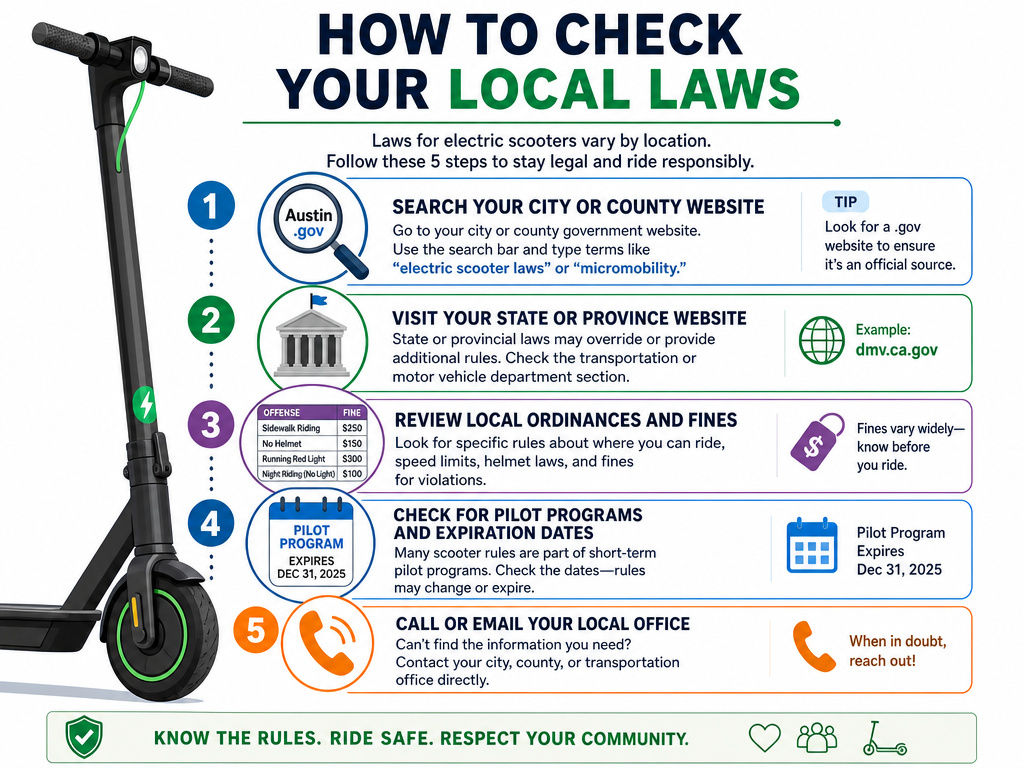
Don’t guess. The rules change at city and county lines. Here’s a reliable process to get your answer.
- Search “[Your City] electric scooter ordinance” or “micromobility pilot program.” Go straight to the
.govwebsite result. Look for a transportation or public works department page. - Check your state/provincial transportation department website. Look for an “electric kick scooter” or “micromobility” section. For example, the Province of BC official rules page lays out everything from device specs to where you can ride.
- Look for a table of offenses. Authoritative pages like the Transport for NSW e-scooter rules list specific fines for sidewalk riding, speeding, and riding without a helmet. This tells you what they actually enforce.
- Watch for “pilot program” language. Many places are running temporary trials. These can change or end, so note the expiration date.
- When in doubt, call. Your local non-emergency police or parking enforcement line can often clarify.
The entire search should take less than ten minutes. The one phrase you must internalize is “it depends on your location.” Assume nothing.
The Real-World Enforcement Landscape
Knowing the law is one thing. Knowing whether you’ll get a ticket for bending it is another. Enforcement is uneven and depends heavily on local priorities and resources.
In some suburban areas, you might ride on empty sidewalks for years without a second glance. In dense urban cores like downtown Toronto or Manhattan, enforcement is more visible. Police in these areas are responding to high pedestrian traffic and specific complaints about scooter hazards. The penalty isn’t always just a fine. Scooters can be impounded, which means paying a hefty retrieval fee on top of the citation.
Rental scooters have shifted the landscape. Because their companies have agreements with cities, they are often required to actively discourage illegal behavior. The Abbotsford Police Department in British Columbia shared an image of a scooter display showing a temporary block message: “It looks like you were misusing this feature by going too fast.” This system-level enforcement is becoming more common.
Your behavior matters. A rider weaving at high speed through a crowded sidewalk is a clear target. Someone slowly and courteously navigating a short, empty sidewalk block to reach a building entrance is less likely to draw attention, though the technical violation is the same. The safer and more predictable you ride, the less likely you are to become an enforcement statistic.
What to Do Instead of Sidewalk Riding
If sidewalks are off-limits, where should you go? Your legal options form a hierarchy of safety and accessibility.
- Bike Lanes: This is the first and best alternative. Bike lane regulations treat scooters like bicycles in many jurisdictions, granting you a dedicated space away from car traffic. Always ride in the direction of traffic.
- Low-Speed Residential Streets: Streets with speed limits of 25 mph or under are often permissible. Ride as far to the right as practicable, signal your turns, and obey all traffic signals.
- Shared-Use Paths (Multi-Use Paths): These are wider paths designated for cyclists, pedestrians, and sometimes scooters. Check local signage. Even on shared paths, yield to pedestrians and control your speed.
- Private Property: With the landowner’s permission, you can ride anywhere. This includes parking lots after hours, long driveways, or designated trails on private land.
The goal is to separate high-speed and low-speed traffic. Scooters mixing with cars on 40 mph roads is dangerous. Scooters mixing with pedestrians on sidewalks is dangerous and illegal. The bike lanes and slow streets in the middle are the designed compromise.
If your daily route lacks these facilities, the practicality of an e-scooter for your commute needs serious review. It might mean opting for a foldable commuter scooter you can carry onto public transit for part of the journey, legally bypassing the problem areas.
Before You Go
The question isn’t really “are electric scooters legal on sidewalks?” The better question is “where can I ride my specific scooter, legally and safely, in my specific city today?”
The global answer tilts hard toward “not on the sidewalk.” Your local answer requires a ten-minute search of your city’s transportation website. Ignore that search, and you risk a fine that could outweigh months of gas savings. More importantly, you risk the safety of people walking, and your own.
For most urban and suburban riders, the path forward is the bike lane. Choose a scooter whose speed aligns with your local laws, wear a helmet every time, and ride predictably. That’s how you stay on the right side of the law, and the pavement.
Frequently Asked Questions
Are e-scooters ever allowed on sidewalks?
Few cities, like Denver, Colorado, permit low-speed sidewalk riding (typically under 6 mph) if no bike lane is available. However, this is the exception, not the rule. The default assumption in most major metropolitan areas should be that sidewalk riding is prohibited.
What’s the difference between a rental and private scooter legally?
Rental scooters operate under a tightly controlled municipal permit that restricts them to specific zones and often disables them on sidewalks. Private scooters are governed by broader state or provincial law, placing the responsibility for knowing and following all local traffic rules entirely on the rider.
My scooter goes 28 mph. Is that legal?
It depends entirely on your location. Many states and provinces cap legal “low-speed” scooters at 15-20 mph. If your scooter’s maximum capable speed exceeds that cap, it may not be legally classified as a scooter at all, potentially barring it from roads and sidewalks. You may need to use a speed-limiter function to cap its top speed to the legal limit.
Can I get a ticket for riding an e-scooter on the sidewalk?
Yes. Fines vary by location but are common. For example, in New South Wales, the penalty for riding an e-scooter on a footpath is a $144 fine. In Toronto, riding any e-scooter on public property can lead to fines under municipal bylaws.
Where is the safest place to ride an e-scooter?
The safest and most legally sound place is in a designated bike lane. If no bike lane exists, a residential street with a low speed limit (25 mph or under) is the next best option. Always wear an approved helmet, use lights at night, and ride predictably with traffic flow.
