
Can You Take Electric Kick Scooters on Public Transit? Guide
This post contains affiliate links. As an Amazon Associate, we earn from qualifying purchases.
Yes, you can often bring an electric kick scooter on public transit, but only if it meets three conditions: it must be foldable, powered off, and kept out of aisles. The full answer depends on your specific transit agency, your scooter’s exact specs, and whether you own it or rented it. Shared rental scooters from systems like Lime or Bird are almost universally prohibited.
That ‘often’ is the problem. You can’t rely on a single national rule because there isn’t one. Every transit authority writes its own book, and the details hidden in the footnotes are where your trip gets stopped cold.
What follows: a breakdown of the three universal conditions, the specific agency rules that turn ‘yes’ into ‘no,’ and the handful of specs you must know before you try to board.
Key Takeaways
- Your scooter must fold to board most buses and trains; a rigid frame is an automatic disqualifier on agencies like Grand River Transit (GRT).
- Shared rental scooters (Lime, Bird, Citi Bike) are banned by the MTA, PVTA, and RTD-Denver, even if they fold.
- Check for agency-specific size and weight limits. Hessen’s RMV imposes a 120 cm length maximum, and the PVTA caps scooters at 50 pounds.
- Charging your scooter on board is prohibited everywhere; turning it on or riding it inside a station or vehicle can get you fined.
- Express buses are a hard no for Personal Electric Vehicles (PEVs) on systems like the MTA, regardless of other allowances.
The Golden Rules for Transit (And How They Change)
Every transit agency’s policy is a variation on a core theme. They start with the same basic prohibitions for safety and liability, then add their own local amendments.
The universal rule: Fold it, power it down, and keep it under your control without blocking doors or aisles. Charging is never allowed.
This isn’t just polite etiquette. It’s the mechanical minimum for sharing a confined public space. A scooter that can’t fold takes up the footprint of a standing passenger. A powered-on scooter is a tripping hazard with a mind of its own if the throttle is bumped. An unsecured scooter in an aisle becomes a projectile during a sudden stop.
The amendments are where policies diverge, and they fall into predictable categories: physical dimensions, power source, and ownership status.
The Foldable Mandate
This is the first and most common gatekeeper. An electric scooter that doesn’t collapse is treated like a bicycle, it’s too bulky for interior vehicle spaces and often can’t be secured safely on exterior bike racks due to its design and weight distribution.
Grand River Transit (GRT) states it plainly: “Only folding scooters are allowed on GRT buses and ION trains. If your scooter cannot fold, it is not allowed.” This is a binary pass/fail. The policy doesn’t care about your scooter’s wattage or top speed if it’s rigid.
The logic is about space and flow. A folded scooter can be tucked between your knees or under a seat. An unfolded one blocks the wheelchair securement area, the priority seating zone, or the standing room needed during peak hours. Drivers are not required to judge whether your particular rigid scooter “fits”; the rule is the rule.
The Ownership Test: Why Rental Scooters Get Left Behind
Here’s a rule that catches countless commuters: your scooter must be yours.
Multiple agencies, including the MTA, the Pioneer Valley Transit Authority (PVTA), and Denver’s RTD, explicitly prohibit scooters that are “the property of a shared or rented PEV provider.” That means Lime, Bird, Spin, and any dockless system scooter you pick up on the street.
Common mistake: Assuming a foldable Lime scooter is okay because it meets the size rule. The rental status voids the permission.
The reason is twofold: liability and battery safety. A transit agency has no way to verify the maintenance history or battery integrity of a scooter that changes hands dozens of times a day. By banning rented devices, they sidestep the risk of a malfunctioning rental unit causing an incident on their property. It also prevents their vehicles and stations from becoming de facto docking stations for private companies.
Power and Charging: The Absolute “Off” Button
No agency permits you to charge your scooter using their outlets. The MTA’s policy is typical: “Charging any PEV… In any MTA facility or on any MTA vehicle is prohibited.”
More broadly, you cannot operate, ride, or even power on your scooter while in a transit facility or vehicle. You must walk it onto the bus or through the station. This prevents accidental throttle engagement, which could injure other passengers or damage property. It also stops people from treating platforms and train cars as personal riding zones.
Agency Deep Dive: When “Usually” Becomes “Never”
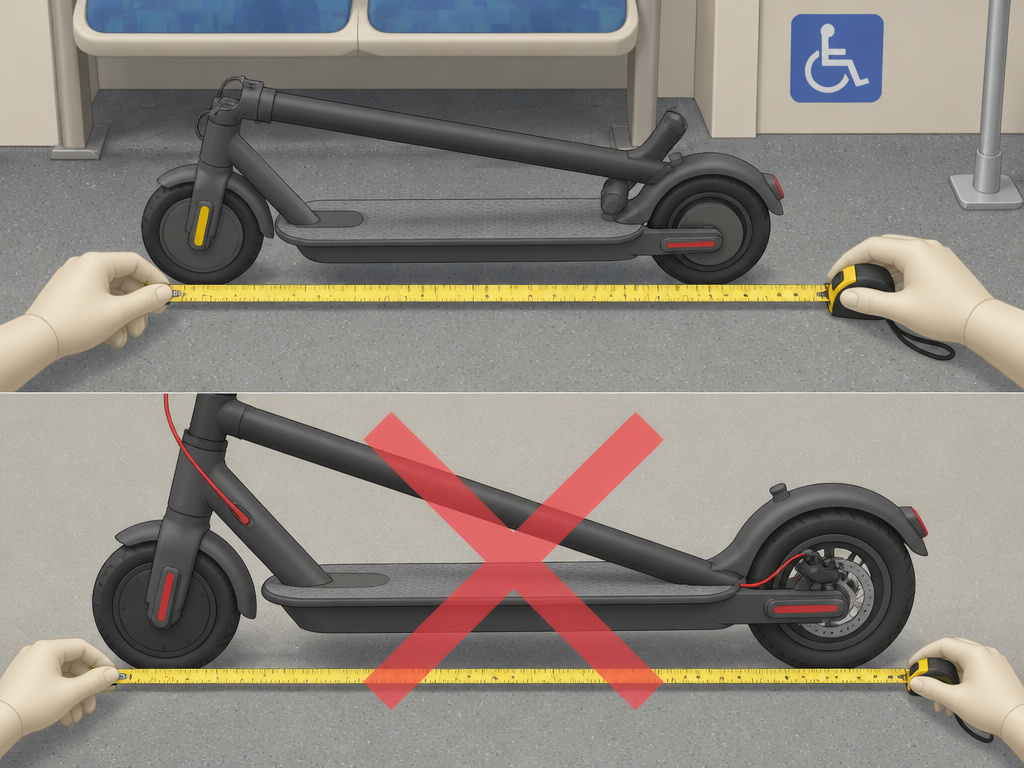
The core rules set the stage, but the specific numbers from individual agencies are what you need to plan a trip. These aren’t suggestions; they are enforceable conditions.
Size and Weight: The Numbers That Ground Your Scooter
While ‘compact’ is subjective, several authorities define it with a tape measure and a scale.
| Agency / Authority | Key Size/Weight Limit | Why This Spec Matters |
|---|---|---|
| RMV (Hessen, Germany) | Total length ≤ 120 cm (≈47 inches) | Exceeding this voids the carriage guarantee, even for medical necessity users. |
| PVTA (Massachusetts) | Weight ≤ 50 pounds (≈23 kg) | Heavier commuter scooters like some Dualtrons exceed this and are barred. |
| MTA (New York) | Weight ≤ 100 lbs; Length ≤ 80 inches | Sets a clear, if generous, upper bound for larger personal scooters. |
| RTD-Denver | Length ≤ 80 inches; Height ≤ 40 inches | Prevents oversized e-bikes and scooters from boarding. |
The RMV’s 120 cm limit is particularly instructive. It comes from a state decree outlining the minimum technical requirements for e-scooters to be carried on scheduled buses. The rule exists so the scooter can safely navigate a bus ramp inclined at a maximum 12% grade without scraping. If your scooter is longer, it physically cannot comply with the boarding procedure.
The Express Bus Loophole Closure
Pay close attention to vehicle type. The MTA’s general PEV policy makes a critical exception: “Adds specific prohibitions for MTA express buses (all PEVs, including foldable, are prohibited).”
You could have the perfect, sub-50-pound, UL-certified, foldable scooter. On a local MTA bus or subway, you’re likely fine if you follow the other rules. Step onto an express bus, and the driver will turn you away. These buses often have different seating configurations, narrower aisles, and higher passenger loads, leading to a blanket ban for operational simplicity.
Medical Necessity vs. General Public
The RMV Hessen decree highlights another layer: preferential access. The regulation for e-scooters “primarily applies to severely handicapped persons whose classification mark is at least ‘G’.” For them, carriage is an obligation for the transit provider, provided the scooter meets the technical specs. For the general public, it’s a privilege granted at the driver’s discretion and subject to space.
This is a crucial distinction. Your right to bring a scooter is not equal to a person’s right to travel with their mobility device under the Americans with Disabilities Act (ADA). Don’t argue with a driver who says there’s no room; the wheelchair securement area gets priority, always.
Your Pre-Boarding Checklist: Don’t Guess at the Gate
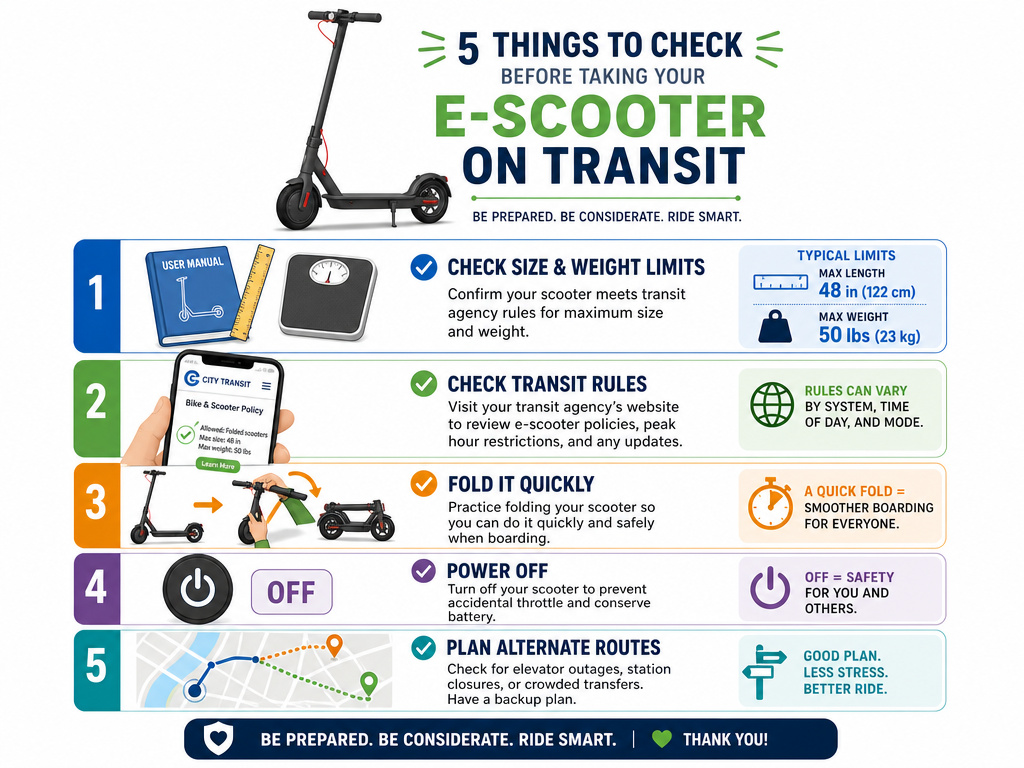
Walking up to a bus stop with your scooter and hoping for the best is a sure way to be late. Run through this list instead.
- Know Your Scooter’s Vital Stats. Dig out the manual or look up the model online. Write down its folded dimensions, weight, and battery certification. If it doesn’t have a UL-certified battery, many agencies like the PVTA and MTA can refuse it on the spot.
- Research Your Specific Transit Agency. A quick web search for “[Agency Name] personal electric vehicle policy” or “[Agency Name] scooter policy” should find the official document. Don’t rely on third-party summaries.
- Practice the Fold. Can you collapse and secure your scooter smoothly in under 30 seconds while holding a bag? If not, practice. Fumbling at the bus door holds everyone up and frustrates the driver.
- Power Down Completely. Don’t just put it in standby mode. Turn the scooter off. This shows the driver you’re following the rules and removes any risk.
- Have a Contingency Plan. What will you do if you’re denied boarding? Know the next bus route, a bike-share station, or a safe place to lock your scooter (if you must abandon your trip).
Skipping step one is the most common error. You assume your scooter is “normal-sized,” but “normal” isn’t a transit policy term. The weight limit or length limit is.
Why These Rules Exist (It’s Not Just Bureaucracy)
Transit authorities aren’t trying to ruin your multimodal commute. Every clause in their policies addresses a real, documented risk.
Battery Safety is the top concern. A damaged or off-brand lithium-ion battery can overheat, emit toxic fumes, or catch fire. By mandating UL-certified batteries and prohibiting charging, agencies minimize the risk of a thermal event in a crowded, enclosed vehicle. The ban on shared scooters ties directly to this, they can’t vet every battery in a floating fleet.
Aisles and Doors are lifelines. In an emergency, passengers and first responders need clear, immediate access to every exit. A scooter blocking an aisle, even temporarily, compromises that. This is why policies from Santa Cruz METRO to the MTA insist devices be stored “out of the way” and “behind the yellow safety lines.”
Driver Discretion is a necessary tool. Policies can’t cover every scenario, a packed bus, an unusual scooter design, a passenger with multiple large items. The driver’s ultimate responsibility is the safe operation of the vehicle. Their request to deny boarding, even if your scooter technically meets the written rules, is final.
Frequently Asked Questions
Are rental electric scooters like Lime allowed on buses?
No. Major transit systems including the MTA (New York), PVTA (Massachusetts), and RTD-Denver explicitly prohibit scooters from shared or rented fleets. This rule applies even if the scooter is foldable and otherwise meets size requirements.
Can I charge my electric scooter on the train or bus?
Absolutely not. Charging any personal electric vehicle using transit agency power outlets is strictly prohibited by every policy reviewed, from the MTA to LADOT Transit. It’s a fire safety and liability issue.
My scooter folds, but it’s pretty heavy. Is there a weight limit?
Yes, and it varies. The PVTA has a strict 50-pound limit. The MTA’s limit is 100 pounds. If your commuter scooter weighs 65 pounds, it’s fine for the MTA but banned on PVTA buses. You must check your local agency’s policy.
What’s the most common reason an electric scooter is denied boarding?
The single most common reason is that the scooter does not fold. After that, it’s attempting to bring a rented scooter or having the scooter powered on while boarding. Knowing your agency’s specific bike lane regulations or sidewalk laws won’t help you here, transit rules are a separate domain.
Do these rules apply to electric skateboards or hoverboards?
They often fall under the same “Personal Electric Vehicle” or “wheeled device” policy. However, hoverboards are specifically banned by the MTA. Electric skateboards are typically treated similarly to scooters, they must be carried, not ridden, in facilities and stored safely onboard.
Before You Go
The short answer to “Are electric kick scooters allowed on public transit?” is a conditional yes. The real answer lives in your transit agency’s PDF policy document and your scooter’s spec sheet.
Your foldable, sub-50-pound, personally-owned scooter with a UL battery will open doors. Your rented, rigid, oversize scooter will end your trip at the bus steps. The difference isn’t mystery; it’s mechanics and policy. Look up your local rules, know your gear’s numbers, and fold it before the bus arrives.
