
What is the Electric Scooter Weight Limit? A Full Guide
This post contains affiliate links. As an Amazon Associate, we earn from qualifying purchases.
The weight limit for an electric scooter is the maximum rider weight the manufacturer has tested the frame, motor, and battery to safely support, typically ranging from 180 lbs for basic models to 265 lbs for premium commuter scooters. Exceeding this limit voids the warranty, strains the motor and battery, and can cause premature failure of tires, brakes, and electronics.
That range isn’t arbitrary. The 85-pound gap between a Razor E500S and a Ninebot MAX G65E is built from different metals, motor windings, and battery chemistries. Hitting the limit on a cheap scooter feels completely different from hitting it on a pro model.
What follows is a breakdown of how these limits are engineered, where they hide on your scooter, and the specific, physical things that break when you push past them. We’ll walk through the manufacturer spec sheets, the role of certifications, and how terrain changes the math.
Key Takeaways
- Check the manual or a sticker on the frame or deck for the official limit; “Maximum Payload” or “Maximum Rider Weight” is the key phrase.
- Overloading trips the circuit breaker on entry-level models and warps motor shafts on heavy-duty ones within weeks.
- Wet, hilly, or rough terrain effectively lowers your scooter’s usable weight capacity by 20-30%.
- Battery chemistry matters: SLA batteries sag under weight faster than modern lithium packs.
- Upgrading for capacity means looking at nominal motor power (450W+), deck size, and tire construction, not just the top number.
How Manufacturer Limits Are Set
Manufacturers don’t pick a weight limit out of thin air. They run the scooter through a battery of stress tests that simulate real-world abuse. The final number is the highest weight at which the scooter passes every test without showing signs of immediate or accelerated failure.
These tests focus on three components: the frame’s weld points, the motor’s heat dissipation, and the battery’s discharge rate. A 2022 Ninebot manual states the maximum payload is validated through dynamic load cycling—thousands of simulated starts, stops, and bumps at the rated weight. The frame is the easy part. The real constraints are thermal.
The motor and controller have finite cooling capacity. A heavier rider demands more torque from a stop, which pulls more current, which generates more heat. The limit is the point where sustained heat would degrade the motor’s permanent magnets or melt the controller’s solder joints.
You’ll find this limit in your owner’s manual under “Specifications.” If the manual is gone, look for a permanent sticker or etching on the frame, often near the rear wheel or on the underside of the deck. It might say “Max. Weight” or “Max. Rider.”
The Physics of Strain: Motor and Battery
The motor feels weight first. Newton’s second law isn’t a suggestion. Accelerating more mass requires more force. On a scooter, that force comes from electromagnetic torque in the motor.
Nominal power—like the Ninebot MAX G65E’s 450W—is the motor’s continuous output rating. Exceed the weight limit, and you force the motor to operate above that nominal zone for longer periods. It draws more amps than the wiring and controller are rated for. The result is voltage sag, increased resistance, and heat. That heat has nowhere to go in a sealed hub motor.
The battery shares the burden. A heavier load increases the amp draw, lowering the voltage faster. For old-school Sealed Lead Acid (SLA) batteries, like those in many Currie and eZip models, this is a death sentence. Their capacity drops sharply under high discharge. A pack rated for 12 miles at 180 lbs might deliver only 6 miles at 240 lbs. The deep-cycle lifespan of about 200 charges shrinks by half.
| Component | Effect of Overloading | Typical Failure Timeline |
|---|---|---|
| Motor & Controller | Overheating, thermal throttling, reduced torque | Performance drop within 1-2 rides, burnout in 2-3 months |
| Battery (SLA) | Voltage sag, reduced range, shortened cycle life | Noticeable range loss within a month |
| Tires & Wheels | Increased wear, pinch flats, bearing stress | Tire wear visible in 2-3 weeks, bearing noise in 1-2 months |
| Frame & Fork | Metal fatigue at stress points, weld cracks | Cracks may appear after 6-12 months of overload |
| Brakes | Longer stopping distance, pad/rotor overheating | Reduced effectiveness immediate, pad wear doubles |
How to Find Your Scooter’s Weight Limit
First, find the manual. Download it from the manufacturer’s website if you must. The spec table is your single source of truth. Look for “Maximum Rider Weight,” “Max Payload,” or “Weight Capacity.” It’s always listed in both pounds and kilograms.
If the scooter is in front of you and the manual is gone, inspect it. Check the deck, the stem near the folding mechanism, and the area around the rear fender. Regulations often require a permanent marking. The format is usually something like “Max. Wt. 220 lbs.”
Common mistake: Assuming the limit is just for the frame. It’s a system rating. The brakes, the throttle response, and the electronic stability controls are all calibrated assuming the rider is at or below that mass.
For older or obscure brands, you might need to dig deeper. Search for the exact model name and “owner’s manual PDF.” Sites that archive manuals for parts sales can be a goldmine. The weight limit is a legal and safety specification; manufacturers don’t hide it.
Once you have the number, be honest with your weight. Include the weight of a backpack, groceries, or a lock. That’s part of the payload. A 200-lb rider with a 25-lb backpack is over the limit on a Razor E500S before the wheels even turn.
Common Weight Limit Ranges by Scooter Type
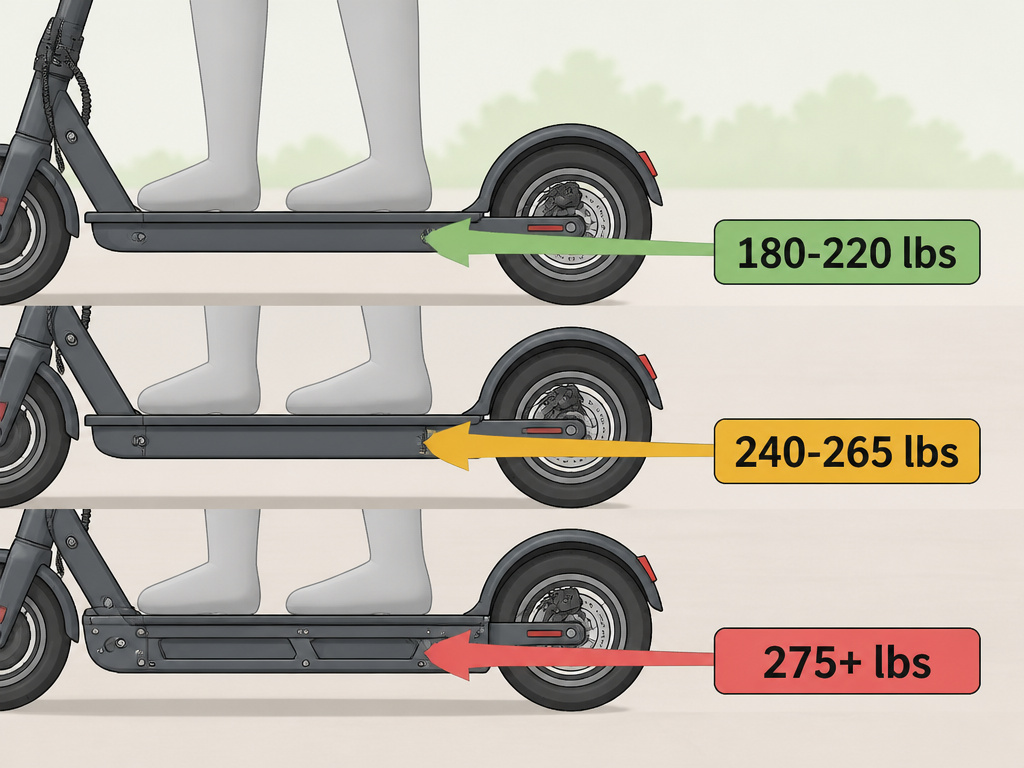 Not all scooters are built for the same job. The capacity tells you the intended rider.
Entry-Level / Toy-Grade (180–220 lbs):
These are the scooters from brands like Razor and the lower-end eZip 300 series. The Razor E500S manual explicitly states a 220-pound limit. They use smaller motors, basic SLA batteries, and plastic components in the drivetrain. They’re for light teens and smaller adults on flat, smooth pavement. The manual for these models often includes a warning: “Rider weight does not necessarily mean a person’s size is appropriate to fit or maintain control.”
Commuter & Mid-Range (240–265 lbs):
This is the sweet spot for most adult riders. It includes workhorse models like the Currie 500DD (240 lbs) and 750DD (260 lbs), and modern standouts like the Ninebot F3 Pro E and Ninebot MAX G65E (both 265 lbs). They feature larger deck areas, more powerful brushless motors, lithium-ion batteries, and reinforced stems. This is the capacity you’ll find on most best adult scooters.
High-Capacity & Performance (275+ lbs):
This territory belongs to specialized, often expensive, heavy adults models. Think dual motor scooters built for torque and rugged scooters with a seat. Their frames are overbuilt, their tires are wide and pneumatic, and their controllers are rated for high continuous current. They don’t just list a higher number; they’re engineered for the sustained strain.
Consequences of Ignoring the Weight Limit
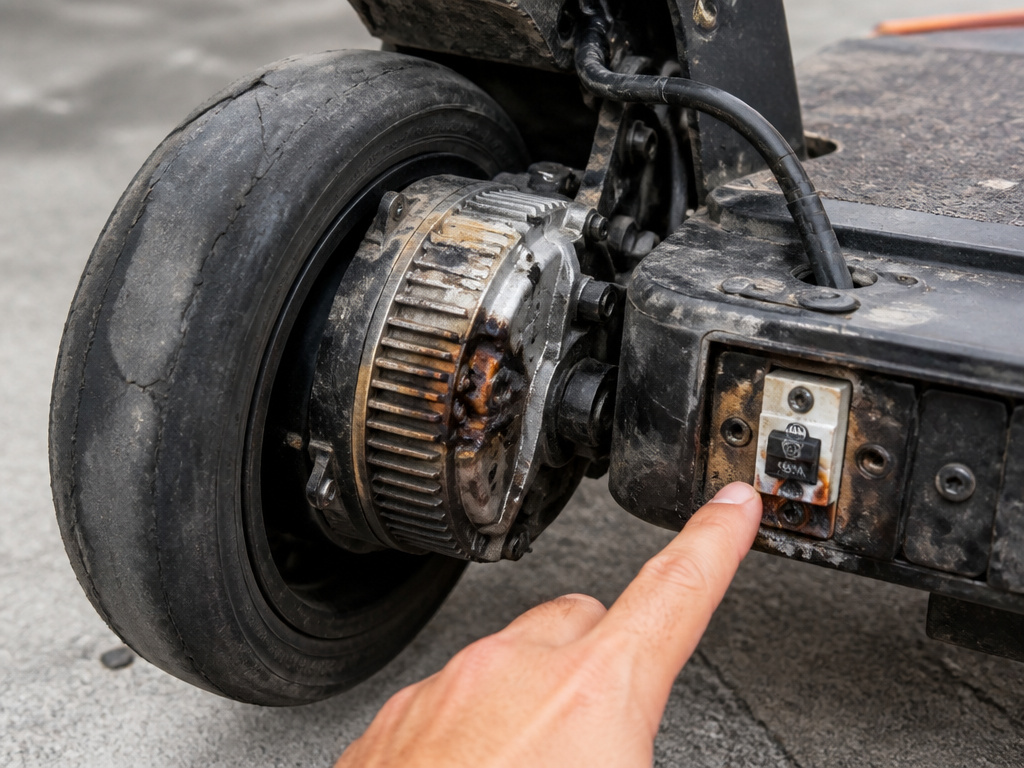 The manual warnings are not scare tactics. They list the specific, verifiable ways the scooter will fail. Physics doesn’t negotiate.
Immediate & Obvious: On many basic scooters, overloading triggers a built-in safety. The Razor E500S manual says exceeding the limit, especially uphill or while towing, can trip the circuit breaker. The scooter simply shuts off. You reset it and go, but repeated trips damage the contacts.
Accelerated Wear: This is the silent killer. Every moving part works harder. Tires develop flat spots and wear through tread in a dozen rides instead of a season. Wheel bearings, pressed against axles never meant for the load, start to howl. Brake pads thin at double the rate.
Motor and Battery Failure: This is the expensive one. The motor overheats, weakening the magnets’ field. Power drops permanently. The battery, consistently deep-cycled beyond its design, loses capacity. A pack that should last a year is useless in six months. These are the repairs that cost more than the scooter.
Where this goes sideways: Riding a scooter at its limit on a hill. The manual’s range and speed figures assume flat ground. A 10% grade can double the motor’s current draw. At the weight limit, that pushes components into a failure zone they were never tested for. The smell of hot electronics means you’ve already done damage.
How Riding Conditions Change the Equation
The printed weight limit is a laboratory number. The real world adds variables that effectively lower it.
Terrain: Hills are the big one. Ascending a slope multiplies the force required. A scooter at its limit on the flat will struggle and overheat on a modest hill. Rough pavement, gravel, and grass increase rolling resistance, again forcing the motor to work harder.
Weather: Cold reduces battery capacity. A lithium pack might deliver only 70% of its rated power at freezing temperatures. That means less available torque for a heavy rider. The Ninebot MAX G65E manual warns that range and performance decrease below 0°C (32°F).
Speed: Riding at top speed consumes more power. A heavier rider creates more aerodynamic drag. Pushing a scooter to its max speed while at the weight limit maximizes current draw and heat generation. It’s the worst-case scenario for longevity.
The rule of thumb is to subtract a 20% safety margin if you regularly encounter hills, bumps, or carry a load. If your scooter’s limit is 250 lbs, treat 200 lbs as your practical max for reliable, long-term use.
Weight Limits vs. Real-World Performance
There’s a difference between a scooter that can hold a rider and one that performs well while doing it. Two scooters with a 265-lb limit can feel completely different.
The Ninebot F3 Pro E, with its 1200W peak motor and hydraulic suspension, will accelerate briskly and absorb bumps smoothly at that weight. An older Currie model with a 260-lb limit and a simple suspension will feel sluggish, with the motor audibly straining on takeoff. The limit is about safety and durability, not comfort or fun.
When comparing, look beyond the top number. A long range scooter needs a large battery and a high weight limit to actually deliver that range to a heavy rider. A model rated for 300 lbs but with a small battery will have a very short range.
I’ve watched riders buy a scooter right at their weight for a short commute, only to find the range halves when they add a backpack and face a headwind. The scooter didn’t lie. The conditions changed the math.
Your choice should be guided by your heaviest typical weight (you + cargo) and your most demanding regular route. If those push the scooter to 90% of its limit, you’re in the red zone. Consider stepping up to a model with more headroom, like those designed for over 250 lbs.
Frequently Asked Questions
What happens if I’m slightly over the weight limit?
Slightly over means 5-10% above. The scooter will work, but everything degrades faster. Expect reduced range, slower acceleration, more noticeable motor heat, and quicker wear on tires and brakes. The warranty is void, so any failure is your responsibility.
Can I modify my scooter to increase its weight limit?
No. The limit is a certified rating for the entire system—frame, motor, battery, brakes, forks, and electronics. Swapping a motor or reinforcing the frame doesn’t recertify the whole package. It creates an unverified, potentially dangerous vehicle and absolutely voids all warranty and liability coverage.
Is the weight limit the same for two people?
Never. The weight limit is for a single rider. Two-person scooters are engineered as such, with longer decks, dual foot placement, and appropriately powerful dual motors. Putting a passenger on a standard scooter overloads the rear axle and destroys the balance, making it uncontrollable and liable to snap.
Do seated scooters have different weight limits?
Yes, and it’s crucial to check. A seated scooter for heavy riders must account for the shifted center of gravity and stress on the seat mount. Their limits are specifically validated for seated use. Using a seat not approved for your model on a scooter at its limit is asking for a catastrophic weld failure.
Are there electric scooters for riders over 300 lbs?
Yes, but they are niche, robust products. You must look explicitly for scooters for 300 lbs or even 400 lbs. These are built with commercial-grade components, often featuring dual motor setups and wide, pneumatic tires. They are a significant investment, reflecting their overbuilt nature.
The Bottom Line
The weight limit on your electric scooter is its most important non-negotiable spec. It’s not a suggestion or a challenge. It’s the result of destructive testing that says, “Past this point, we can’t promise it won’t break.”
Find your model’s real number in the manual. Be brutally honest about your weight plus your gear. If you’re close to the line, or if your daily route has hills, buy headroom. Stepping up to a scooter with a higher capacity isn’t about luxury; it’s about getting the service life you paid for.
For most larger adults, that means starting your search in the 250-265 lb range and understanding that real-world conditions will take a bite out of performance. That’s the engineering reality of anything on wheels.
