
Can You Ride Electric Scooters on Bike Lanes? The Answer
This post contains affiliate links. As an Amazon Associate, we earn from qualifying purchases.
Yes, electric scooters are generally allowed in bike lanes—but only if three things line up: local law explicitly permits them, the scooter meets specific power and speed definitions, and the road’s posted speed limit is low enough. In Toronto, it’s a flat no. In Boise, it’s a must. Everywhere else hinges on your local government’s reading of state or provincial rules.
The nuance lives in those definitions. A 15 MPH e-scooter might be street-legal, while a 20 MPH model sold under the same brand name could be a regulated “motorized vehicle” banned from the same lane. The law cares about the numbers printed on the motor’s spec sheet, not the marketing name on the frame.
What follows is a breakdown of the rules from California to British Columbia, the two ways cities override them, and the physical reasons you’ll hear a cop’s siren if you miss the speed-limit clause on a rural highway.
Key Takeaways
- Your scooter’s maximum assisted speed decides its legal classification. Under 20 MPH is an “e-scooter”; over that often becomes a “motorized scooter” banned from streets and lanes.
- Many states and provinces require bike lane use if a lane is present, with narrow exceptions for turning or avoiding hazards.
- Cities have the final say. Toronto bans all e-scooters on public property, while Boise mandates their use in bike lanes. Never assume state rules are the last word.
- Road speed limits are a hard gate. In British Columbia, you can only ride on roads with a limit over 50 km/h if a designated bike lane exists.
- Injury data from Toronto shows e-scooter falls are more frequent and severe than bicycle crashes, a factor in many municipal bans.
The State-by-State Rulebook
The first variable is your state or provincial vehicle code. This is the baseline law that city rules can tighten, but rarely loosen.
California’s vehicle code is a prime example. California VEH 21229 states that operators of motorized scooters “shall ride within a Class II bicycle lane” whenever one is established. It lists specific exceptions: preparing for a left turn by dismounting, avoiding debris, or approaching a right turn. This is the model many other jurisdictions follow.
The operator of a motorized scooter shall ride within a Class II bicycle lane whenever a Class II bicycle lane has been established on the roadway. This section does not prohibit the operator of a motorized scooter from leaving a bicycle lane under any of the following circumstances: to overtake another vehicle, to prepare for a left turn, to avoid debris or hazardous conditions, or when approaching a place where a right turn is authorized.
Oregon’s approach is similarly direct. Its Oregon Micromobility Guide states a motor-assisted scooter “must use a bicycle lane or path if one is near the roadway and its use is not prohibited by local laws.” Sidewalk use is only permitted to enter or leave adjacent property. Notice the door it opens for cities to be stricter.
New York’s rules add a speed-limit filter. According to the New York DMV, electric scooters can only be operated on highways with a posted speed limit of 30 MPH or less. Municipalities can further restrict this. Sidewalk operation is prohibited unless local law says otherwise.
Then there’s New Jersey, which draws a bright line between device types. Its official guide makes a critical distinction. The New Jersey DOT micromobility guide defines “motorized scooters” as miniature motor vehicles lacking federal safety certification. These are prohibited on any public street, highway, or sidewalk. However, low-speed electric scooters that meet different criteria may be allowed on streets, bike lanes, and bikeways. Your scooter’s wattage and top speed determine which category it falls into.
The most detailed rules come from north of the border. The British Columbia e-scooter rules create a three-tier system based on road speed limits, and they mandate bike lane use in a way that leaves no room for interpretation. | Road Type / Speed Limit | Where You Can Ride | | ————————— | —————————————————————————————————————— | | Highway with a cycle lane | Must ride in the cycle lane at all times. Cannot ride on the road, shoulder, sidewalk, or crosswalk. | | Road ≤ 50 km/h | Must use a designated cycling lane if present. If not, ride as far right as safely possible. | | Road > 50 km/h | May only ride if a designated cycling lane exists. No riding on the main roadway. |
This table isn’t a suggestion. On a highway with a bike lane, you have exactly one legal place to be. Stray onto the road shoulder and you’re in violation.
When Your City Says “No” (Or “Yes, But Here”)
State law sets the floor. Your city or town builds the walls and ceiling. This municipal override is the second variable, and it can completely flip the answer.
Toronto is the most extreme case. In May 2021 and again in May 2024, Toronto City Council decided not to participate in Ontario’s provincial e-scooter pilot program. The result is an absolute ban: it is illegal to ride e-scooters on any public street, sidewalk, trail, park, or bicycle lane in the city. They cannot be operated, parked, or stored on public property. The city cited a SickKids Hospital report showing 85% of serious injuries from battery-powered mobility devices involved e-scooters, and research from the European Transport Safety Council finding e-scooter injury rates “dramatically higher than bicycles.”
Contrast that with Boise, Idaho. Boise City Code Chapter 13 is built on the assumption e-scooters will use bike lanes. It states that operators “shall use a bike lane when present on a roadway and shall not use the roadway itself.” The exceptions are practical: insufficient lane width, unsafe pavement conditions, moving to make a turn, or avoiding an opening car door. The code is designed to integrate scooters into the existing bike infrastructure, not ban them from it.
Other municipalities layer rules on top of state law. Menifee, California, mirrors the state vehicle code but adds local enforcement teeth. Orangetown, New York, limits e-scooters to streets with a 30 MPH speed limit and specifies they must be used “in designated bicycle lanes if so provided.” Always check your local police department or city website for the final word. A state “yes” means nothing if your city council voted “no.”
Speed Limits That Change Everything
The third variable is the most mechanical: speed. It governs both the device’s legality and where it can physically go. Lawmakers don’t just pick these numbers at random.
In British Columbia, the 50 km/h road speed limit threshold exists for kinetic energy reasons. At higher speeds, the speed differential between a small, unstable scooter and surrounding car traffic becomes dangerously high. The province’s logic is simple: if cars are moving over 50 km/h, you need the physical barrier of a designated bike lane for it to be safe. Without one, you’re not allowed.
New York’s 30 MPH limit serves a similar purpose. It keeps scooters on slower, local streets where traffic speeds are closer to their own operational max. This isn’t just about legality; it’s a stability issue. E-scooter wheels are small, often 8 inches or less in diameter. A pothole or crack that a bicycle wheel rolls over can stop a scooter wheel dead, tossing the rider. Higher-speed roads magnify this risk.
Then there’s the device’s own speed capability, which triggers different legal classifications. This is where specs matter more than branding. | Jurisdiction | Device Type | Max Assisted Speed | Power Limit | Bike Lane Status | | ———————- | ———————— | ————————– | ———————— | —————————————- | | Boise, Idaho | E-Scooter | 15 MPH | 300 watts | Mandatory use when present | | Oregon | Motor Assisted Scooter | 15 MPH (operation limit) | 1,000 watts | Must use if available | | British Columbia | Electric Kick Scooter | 25 km/h (~15.5 MPH) | 500 watts continuous | Mandatory use under specific conditions | | Orangetown, New York | E-Scooter | 15 MPH (operation limit) | Not specified | Required in designated lanes |
Common mistake: Assuming a “30 MPH capable” scooter is legal anywhere. Most local laws set operational limits between 15-20 MPH. Riding a faster scooter at lower speeds doesn’t change its legal classification; the capability is what defines it, and that can land it in a banned “motorized vehicle” category.
Your scooter’s motor wattage and top speed aren’t just marketing points. They are the data points a court would use to decide if you were operating a legal “low-speed electric scooter” or a prohibited “motorized scooter.” Keep the manual. Know the specs.
The “Motorized Scooter” Trap
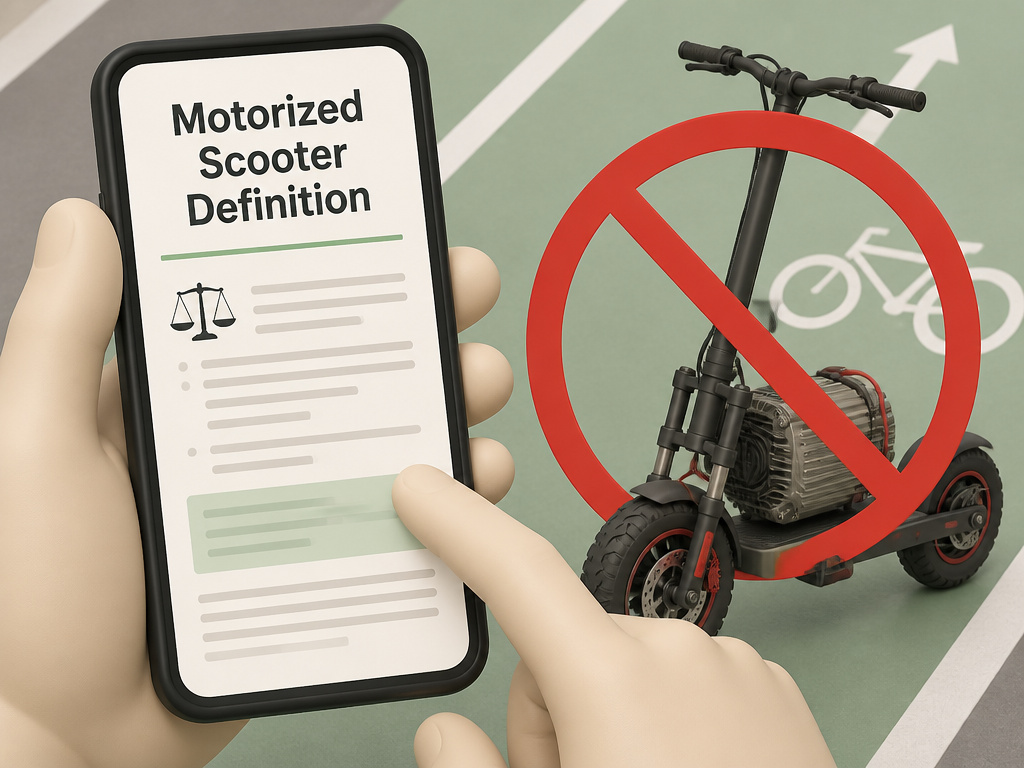 This is the legal distinction that catches owners off guard. Many states, like New Jersey, have a separate category called a “motorized scooter” that is distinct from a “low-speed electric scooter.”
Under New Jersey law, a “motorized scooter” is defined as a miniature motor vehicle that lacks federal safety certification. This category includes pocket bikes, mini motorcycles, and certain high-powered scooters. Critically, these devices are prohibited on any public street, highway, or sidewalk. The only exceptions are for operators with mobility-related disabilities. A town may allow them on designated public property—except for streets and sidewalks.
So, you could buy a scooter marketed as an “electric scooter,” but if its motor exceeds a certain wattage or it’s capable of speeds over 20 MPH, it may legally be a “motorized scooter” the moment you take it onto the road. The ban isn’t on scooters; it’s on a specific technical class of vehicle that many consumer scooters accidentally fall into. This is why checking your local street legal scooters definitions is non-negotiable.
Safety and the Real-World Ride
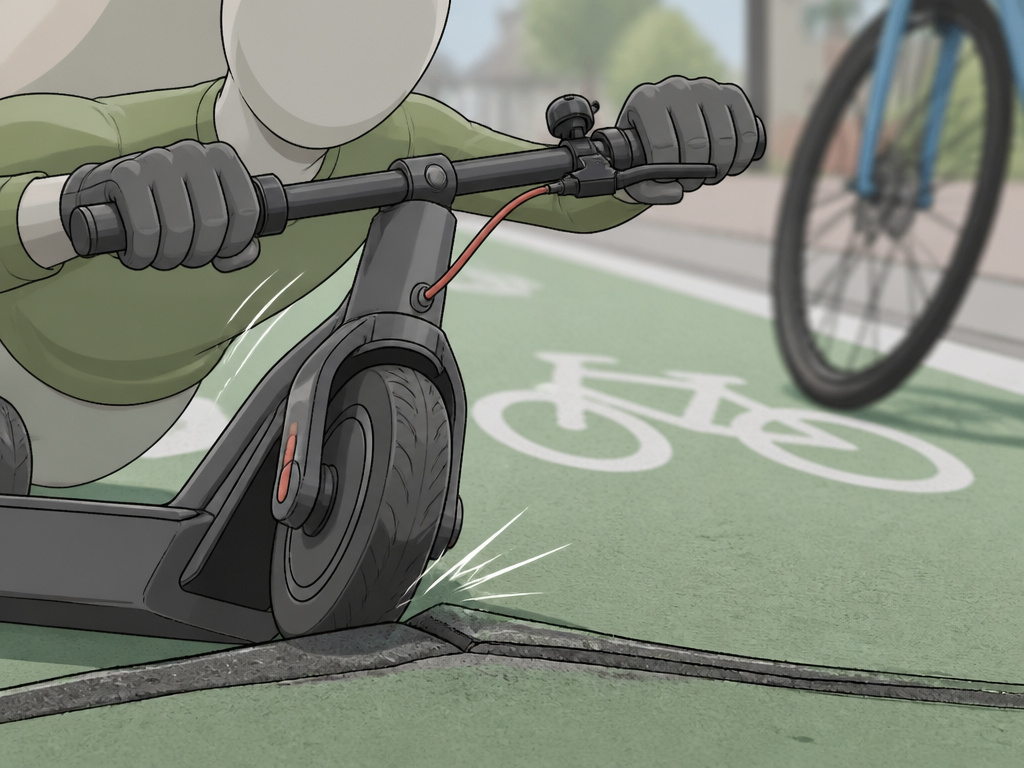 Laws aside, there’s the physical reality of mixing e-scooters, bike lanes, and traffic. The rules are written around real failure modes.
E-scooters have a high center of gravity and small wheels. A seam in the pavement, a patch of gravel, or streetcar tracks—all common in bike lanes—can cause a sudden loss of control. This inherent instability is why the injury rate is higher than for bicycles. It’s also why many laws insist on bike lane use; the lane provides a margin of separation from cars that is literally lifesaving.
When you ride, your path should be predictable. Signal turns, even if your scooter doesn’t have built-in lights. Use hand signals. Drivers are not looking for something moving at 15 MPH in a bike lane; you have to command their attention. At night, a front white light and rear reflector aren’t just good ideas—they’re legal requirements in places like Menifee, California.
Helmet laws vary wildly. Some states require them for all riders, others only for those under 18. Your skull doesn’t care about the law. The data from Toronto’s hospitals shows head injuries are a major component of e-scooter trauma. The safest approach is to wear a properly fitted helmet every time, regardless of local ordinances.
Where this goes sideways: Riding a scooter that’s technically illegal for the road. If you’re in a crash while operating a banned “motorized scooter,” you could be found at fault regardless of the car driver’s actions, and your insurance will likely not cover any damages or injuries.
The City-Specific Exceptions
Even when bike lane use is mandatory, the law carves out pragmatic escape hatches. You are generally allowed to leave the lane to avoid an obstacle, make a turn, or if the lane itself is unsafe.
The Boise City Code lists these exceptions clearly: insufficient width, unsafe pavement conditions (water, dirt, glass), moving to make a turn, or an opening car door. California’s law includes “avoiding debris or hazardous conditions.” The key is that your movement must be done with reasonable safety and, where required, an appropriate signal. You can’t just swerve out because the lane is crowded.
This is also where knowing your local sidewalk regulations is crucial. Some cities allow you to use a sidewalk to enter or leave adjacent property (like crossing to a storefront). Most prohibit sidewalk riding entirely. Dismount and walk if you need to use the sidewalk; it keeps you legal and is safer for pedestrians.
Before You Ride: A 60-Second Checklist
Don’t just grab your scooter and go. Run through this list. It takes a minute and saves a ticket—or worse.
- Check Local Ordinances. Search “[Your City] e-scooter ordinance” or “[Your City] police department micromobility.” This overrules state law.
- Know Your Scooter’s Real Specs. Find the manual or manufacturer’s website. Note the motor’s continuous wattage output and maximum speed capability. Not the advertised “up to” speed, the actual tested capability.
- Plan Your Route. Use a map that shows bike lanes. Avoid roads with speed limits above your local legal threshold (e.g., 30 MPH in NY, 50 km/h in BC). Assume you must use the bike lane where it exists.
- Gear Up. At minimum: a helmet that fits. At night: a white front light and a red rear reflector or light. Consider gloves and knee pads for your first few rides.
- Do a Physical Pre-Ride. Check tire pressure, brake function, and that the folding mechanism (if present) is locked solid. A wobbly stem fails at the worst moment.
This isn’t bureaucratic box-ticking. It’s the difference between a smooth commute and a roadside argument with law enforcement over the definition of a “motorized scooter.”
Frequently Asked Questions
Can I ride my e-scooter in any bike lane?
No. Permission depends on a three-part check: your local city laws, your scooter’s technical specifications (especially speed capability), and the posted speed limit of the road. Cities like Toronto ban them from all bike lanes, while others mandate their use.
What happens if I ride a scooter in a bike lane where it’s prohibited?
You could be ticketed for operating an unregistered or prohibited vehicle on a public roadway. Penalties range from fines to having your scooter impounded. In the event of a collision, you may be found liable for operating an illegal vehicle.
My scooter goes 20 MPH, but I’ll only go 15. Is that okay?
Legally, often no. Laws typically classify vehicles based on their maximum capable speed, not the speed you choose to ride. A scooter capable of 20 MPH may be classified as a “motorized scooter” and banned, regardless of how slow you go.
Are e-scooters safer in bike lanes or on the road?
When permitted, bike lanes are significantly safer. They provide physical separation from faster, heavier car traffic. Riding on the road exposes you to greater speed differentials and reduces your visibility to drivers, increasing collision risk.
Do the same rules apply to rental e-scooters?
Yes. Rental companies are typically required to ensure their fleets comply with local power and speed regulations. However, you as the operator are still responsible for riding them only where permitted by law. Always check the rental app for local riding zones.
How can I find the exact law for my area?
Start with your state or province’s Department of Motor Vehicles (DMV) or transportation website. Then, search for the municipal code for your specific city or town. Local police department websites often post summaries of relevant sidewalk laws and bike lane rules for micromobility devices.
The Bottom Line
The question “are electric scooters allowed on bike lanes” has no universal answer. You need your city’s rules in one hand and your scooter’s spec sheet in the other.
The trend is toward integration, with laws like California’s VEH 21229 and Boise’s code treating scooters as a natural fit for bike lane infrastructure. But powerful counter-trends, driven by solid injury data from places like Toronto, show why blanket bans happen. Your ride is legal at the intersection of device capability and municipal permission.
Assume nothing. Look up your local ordinances before the first ride. That five minutes of research is cheaper than any ticket, and it’s the only way to know for sure.
