
What is the Difference Between a Moped and a Scooter?
This post contains affiliate links. As an Amazon Associate, we earn from qualifying purchases.
**A moped is a specific, legally defined vehicle with an engine under 50cc, a top speed not exceeding 30 mph, and often includes pedals. A scooter is a body style characterized by a step-through frame and a floorboard, but it can have any engine size and speed, making its legal classification variable and often stricter.The real difference is found on your state’s DMV website, in codes like California’s CVC §406, and in equipment standards like VESC V-17. Get the classification wrong, and you’re riding illegally.
That 30 mph and 50cc ceiling is the line. Cross it by even a few cubic centimeters or miles per hour, and you’re no longer looking at a moped in the eyes of the law. You’re dealing with a motorcycle. This shifts everything: the license you need, the insurance you must carry, and the roads you’re allowed to use. The body shape, whether it has a floorboard or pedals, is just packaging around a legal engine.
What follows is a breakdown of the three specs that matter (cc, mph, horsepower), the shocking ways a simple accessory changes your vehicle’s class, and the state-by-state trap that catches thousands of riders. You’ll learn to read a spec sheet like the DMV does.
Key Takeaways
- The legal definition hinges on hard numbers: a true moped cannot exceed 50cc engine displacement, 30 mph top speed, and often 2–4 brake horsepower. Anything beyond that is a motorcycle, regardless of scooter styling.
- A seat is not just a comfort item. Regulatory bodies like the NHTSA have ruled that adding a seat to a low-speed scooter can reclassify it as a moped or motorcycle, subjecting it to street-vehicle laws.
- Across the United States, these vehicles fall under at least nine different naming conventions (e.g., motor-driven cycle, motorized bicycle), making your local DMV’s wording the only definition that matters for licensing.
- Licensing and insurance gaps are the biggest risk. Riders of 51–150cc scooters often face confusion, exploiting lax enforcement but bearing massive liability in a crash.
- Safety gear is non-negotiable. Studies like the BTSCRP Project BTS-19 confirm helmet use is most effective at typical moped/scooter speeds, yet regulation is minimal.
The Core Legal Definitions: Engine, Speed, and Form
Forget what it looks like. Legal classification starts with a tape measure and a stopwatch. Authorities measure three things: engine displacement, maximum capable speed, and sometimes brake horsepower. The body style is a secondary characteristic that can trigger further rules.
The California DMV provides a clear baseline. A moped, or motorized bicycle, has an automatic transmission producing less than 4 gross brake horsepower. A motor-driven cycle has an engine smaller than 149 cc. These are the boundaries between vehicle classes that dictate every rule you must follow. Your local DMV uses similar thresholds, even if the names are different.
A moped is a motor-driven cycle with two or three wheels, foot pedals for muscular propulsion, and an independent power source providing a maximum of two brake horsepower. If a combustion engine is used, the maximum piston displacement is 3.05 cubic inches (50 cubic centimeters). The power source must be capable of propelling the vehicle, unassisted, at a speed not to exceed thirty miles per hour on a level road surface. . VESC Regulation V-17, Section 3.1
This technical definition from the VESC moped construction standard is the blueprint. It combines the power ceiling (2 hp), the engine size limit (50cc), and the speed governor (30 mph). It also mandates a direct-drive system, no manual clutch or gear shifting. This is why many true mopeds feel like they have a ceiling; they are engineered to hit one.
Scooters have no such universal limits. A scooter is defined by its architecture: a step-through frame (no fuel tank between the legs) and a floorboard for the rider’s feet. This design can house a 50cc engine limited to 30 mph, which would make it a moped legally. It can also house a 300cc engine capable of 80 mph, which makes it a motorcycle. This is the root of all confusion. You can have a scooter-style vehicle that is legally a moped, and a scooter that is legally a motorcycle.
| Defining Characteristic | Moped (Legal Definition) | Scooter (Body Style) |
|---|---|---|
| Primary Classification | Legal class based on specs | Physical design & layout |
| Engine Size (cc) | ≤ 50 cc (by definition) | Any size (50cc to 650cc+) |
| Top Speed | ≤ 30 mph (by definition) | Any speed (25 mph to 80mph+) |
| Power Source | ≤ 2-4 brake horsepower | Any output |
| Transmission | Automatic, direct drive only | Automatic (CVT) common |
| Typical Propulsion | Engine only (pedals optional) | Engine only |
Where this goes sideways: Assuming a 50cc scooter is automatically a moped. If its engine is derestricted and can exceed 30 mph, it’s no longer a moped per VESC and most state laws. That modified “moped” is now an unregistered motorcycle.
The Licensing and Registration Maze
Your state’s paperwork doesn’t care about marketing terms. It cares about codes. The California DMV vehicle classification guide spells out the consequences of those engine and speed numbers. Get this wrong, and you’re riding without a valid license or registration, a massive liability.
Here is the stark difference in treatment: * Moped (CVC §406): Requires an M1 or M2 motorcycle license, you must be 16+, and you must wear a helmet. Registration is a one-time $23 fee with special plates, and insurance is not mandatory for registration. You can ride it on most streets. * Motorized Scooter (CVC §407.5): Any class driver’s license will do. It cannot exceed 15 mph, cannot be ridden on sidewalks, and is limited to bicycle paths or bikeways. It requires no registration at all. This category includes stand-up electric scooters. * Motorcycle / Motor-Driven Cycle (>149cc): Requires an M1 license, annual registration, and proof of insurance. It has full access to roads (where permitted by law).
The gap between a 50cc moped and a 51cc “scooter” is a canyon in paperwork and privilege. This is where riders get caught. A popular 51-150cc scooter looks identical to its 50cc cousin but falls into a motorcycle classification. Owners often ride them with a standard driver’s license, betting on lax enforcement. In a crash, that bet fails. Their insurance can deny coverage, and they face penalties for operating without a proper license.
This confusion is systemic. The BTSCRP Project BTS-19 notes that 51–150cc motor scooters are identical in appearance to 50cc mopeds, promoting confusion among users and law enforcement. This ambiguity is “easily exploitable by those seeking to circumvent regulatory requirements.” Don’t be the one exploiting it. Be the one who knows.
Common mistake: Riding a 150cc Vespa with just a car license. The DMV classifies it as a motorcycle. After a collision, the insurance investigation starts with your license class. If it’s invalid for the vehicle, they have a clear path to deny your claim.
How a Single Accessory Changes Everything
Here is the non-commodity hook that most guides miss: classification isn’t just about the factory specs. It can change with what you bolt on. A regulatory letter from the NHTSA makes this terrifyingly clear.
The NHTSA examined a “Tsi Power Scooter“, a small, low-speed scooter sold as “not for in-street use.” Without a seat, it was considered a toy. When equipped with a seat, the NHTSA ruled it was “indistinguishable from a moped,” making it a motor vehicle subject to on-road regulations. This NHTSA regulatory interpretation letter is a landmark case. It shows that a $50 accessory can transform a park path vehicle into something that requires a license, registration, and insurance.
This principle echoes in Europe. TÜV NORD notes that while 50cc mopeds are generally limited to 45 km/h (~28 mph) and don’t need regular inspections, if a moped is “designed to travel faster than 45 km/h,” a mandatory MOT test every two years applies. The design intent, often proven by a higher top speed, overrides the basic category.
The lesson is physical. Before you buy a scooter or modify a moped, ask: “Does this change its capable speed or its fundamental form?” Adding a seat, derestricting the exhaust, or changing the variator weights can push you into a new legal class. The police may not notice until you’re in an accident report. Then, it’s all they’ll see.
Scooter vs. Moped: A Rider’s Practical Comparison
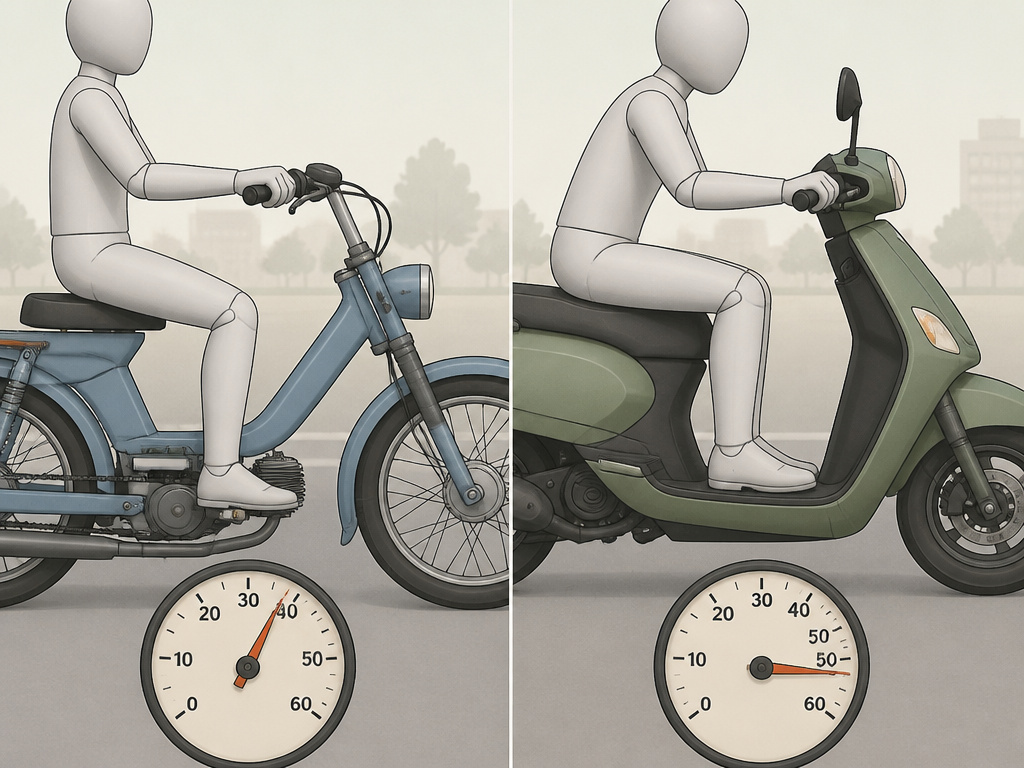 Forget legal jargon for a moment. On the pavement, what does this difference feel like? It comes down to purpose, posture, and performance. Knowing this helps you match the machine to your actual needs, whether you’re looking at best moped scooters for city commuting or scooter-style motorcycles for longer trips.
The Moped Vibe:
- Purpose: Short, slow, utilitarian trips. Think campus, small town, or last-mile from transit.
- Posture: Upright. If it has pedals, your feet are on them in a bicycle position. If not, feet are forward on small pegs.
- Performance: It feels capped. Full throttle gets you to 28-30 mph and stays there. Acceleration is gentle. It’s light and flickable but struggles on any significant hill.
- Best For: The rider who needs simple, cheap transport and has a license for electric scooter or moped already in hand. Also perfect for those considering moped-style ebikes as a pedal-assisted alternative.
The Scooter Reality:
- Purpose: From city commuting to touring. A 50cc scooter feels like a moped; a 300cc maxi-scooter can handle highway speeds.
- Posture: Feet are planted flat on a broad floorboard, legs slightly forward. It’s a relaxed, chair-like seating.
- Performance: Varies wildly. A 50cc scooter performs like a moped. A 150cc model has noticeably more pull and a ~55 mph top speed. A 300cc+ model merges onto freeways confidently. The continuously variable transmission (CVT) means no shifting, just twist and go.
- Best For: The rider who wants the step-through convenience but needs more speed or range. It’s the choice if you’ll ever need to take a road with a 45 mph limit.
Which one wins?
For pure, legal simplicity under 30 mph, the moped is defined and done. For any need for more speed or cargo space, the scooter body with a larger engine is the only answer. Just be prepared to get the motorcycle license. The best scooter motorbikes on the market are fantastic all-rounders, but they are motorcycles.
Why These Distinctions Matter: Safety and Liability
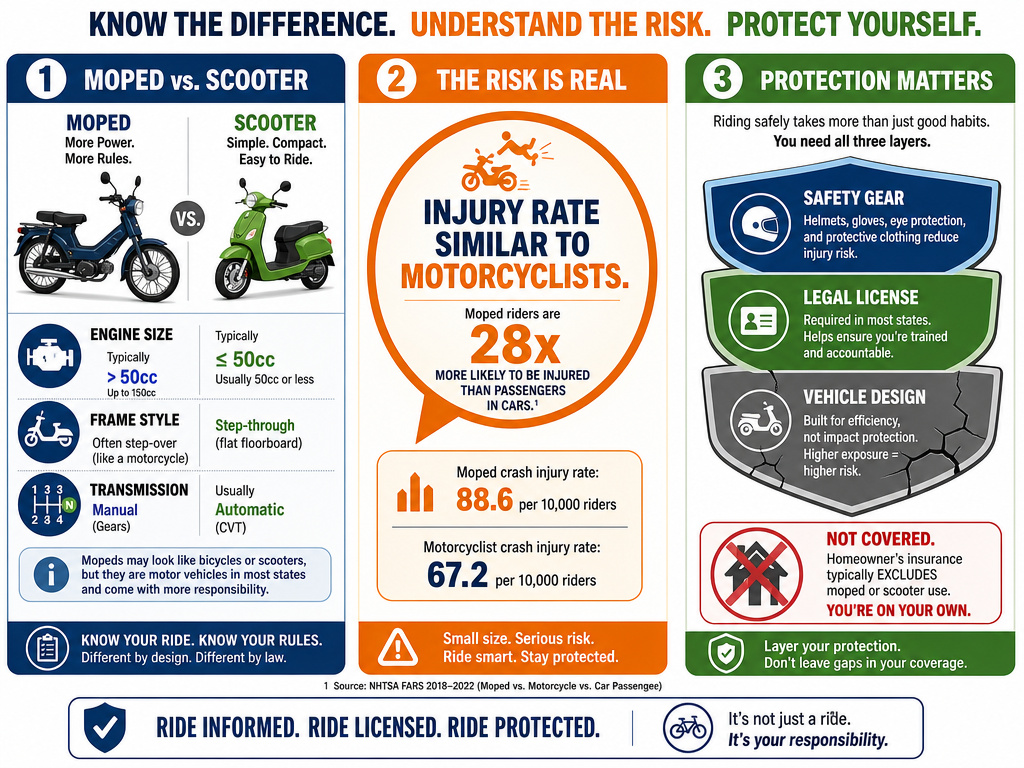 This is about what happens when things go wrong. The BTSCRP Project BTS-19 safety guide frames the stakes perfectly: mopeds and scooters have an injury rate similar to motorcyclists, yet they are surrounded by “minimal regulations and guidance.”
The safety gear you choose is your first layer of protection. A study cited in the BTS-19 report found helmets are most effective at the speeds these vehicles travel. This makes a best scooter helmets or motor scooter helmets purchase critical, not optional. The right full-face or modular helmet is your best investment.
Your legal classification is your second layer. Riding a vehicle that requires a motorcycle license without one voids your insurance. In an at-fault accident, you become personally liable for all damages, vehicle repairs, medical bills, everything. Your standard auto policy will not cover you. The other driver’s insurer will come after your personal assets.
Finally, your vehicle’s intended design matters. A moped built to the VESC V-17 standard has specific lighting, brake, and tire requirements for street safety. A toy scooter with a seat bolted on does not. It likely lacks mirrors, proper brake lights, and tires rated for road surfaces. You are riding a hazard.
The part nobody mentions: Your homeowner’s or renter’s insurance might have an exclusion for motor vehicle liability. If you cause an accident on an unregistered, unlicensed scooter, you could have zero coverage from any policy. The financial hole is bottomless.
Frequently Asked Questions
Is a 50cc scooter a moped?
It can be, but not automatically. If the 50cc scooter’s top speed is limited by the manufacturer to 30 mph (or your state’s limit) and it meets other equipment rules, it will be classified as a moped. If it can go faster, it’s a motorcycle. The 50cc engine size is necessary for a moped classification, but the speed governor is what makes it sufficient.
Do you need a license for a 50cc moped?
Yes, in virtually all U.S. States. Most states require a motorcycle license (often called an M1, M2, or M endorsement) or a specific “moped license” to operate a 50cc moped on public roads. A standard driver’s license is not enough. Always check your state motor vehicle registration rules.
Can a moped go on the highway?
No. By definition, a moped cannot exceed 30 mph. Highways have minimum speed limits typically between 40-45 mph. A moped cannot safely maintain that speed and is therefore prohibited. This is a key difference from larger scooter-style motorcycles, which are designed for highway use.
What’s more reliable, a 2-stroke or 4-stroke moped?
For a moped, a 4-stroke engine is generally more reliable and fuel-efficient. It requires less maintenance (no mixing oil with gas) and lasts longer. However, many classic mopeds use simpler 2-stroke engines. Understanding the 2-stroke vs 4-stroke trade-offs is key for any small engine purchase.
Are electric scooters considered mopeds?
It depends on their speed and power. Low-speed, stand-up electric scooters (under 15-20 mph) are usually classified separately as “motorized scooters” or “electric scooters” with different rules. A seated, electric scooter that can exceed 20-30 mph may be classified as a moped or even a motorcycle, requiring a license and registration. The power output (in watts) is the key metric, similar to cc for gas engines.
The Bottom Line
Stop looking at the shape. Start reading the spec sheet and your state’s legal code. The difference between a moped and a scooter is a contract written in cubic centimeters, miles per hour, and brake horsepower. A moped is a legally limited vehicle. A scooter is a style that can be anything.
Your next step is simple. Before you buy anything with two wheels and a motor, visit your state’s DMV website. Find the exact definitions for “moped,” “motor-driven cycle,” and “motor scooter.” Match those definitions to the vehicle’s actual capabilities, not its marketing. Then, get the correct license. The few hours spent in a motorcycle safety course are cheaper than a single insurance denial.
Finally, gear up. The statistics don’t lie. Whether you choose a nimble moped or a capable maxi-scooter, your helmets for motor scooters and a good scooter security lock are what stand between you and the worst day on the road. Ride to the letter of the law, and you ride with peace of mind.
