
2-Stroke vs 4-Stroke: What’s the Real Difference for You? (53 characters)
This post contains affiliate links. As an Amazon Associate, we earn from qualifying purchases.
A 2-stroke engine produces power with every crankshaft revolution, while a 4-stroke engine needs two revolutions. This single fact dictates everything from the sound and power delivery to the oil you use and the maintenance schedule you follow. A 2-stroke mixes oil with its fuel for lubrication, burns it, and expels it in a smoky haze, completing intake, compression, power, and exhaust in two piston strokes. A 4-stroke keeps its oil in a separate sump, using dedicated valves and camshafts to manage a four-stroke cycle, making it cleaner, torquier, and mechanically more complex.
The distinction is mechanical, not marketing. It changes the weight, the cost to run, and the repair bill waiting for you at 100 hours. Get it wrong and you buy the wrong oil, miss a critical service, or grenade a top end.
What follows: the four-stroke cycle visualized, the two-stroke’s clever port trick, and then the three specs that decide which engine belongs in your garage, trail bike, or boat. By the end you’ll know why a race-spec 4-stroke needs a valve check every 30 hours and why a 2-stroke’s oil ash content can clog an exhaust port.
Key Takeaways
- A 2-stroke’s oil is burned with the fuel; using a 4-stroke oil in one will foul plugs and seize the piston because 4T oil contains detergents and ash that leave deposits when burned.
- Race-prepared 4-strokes demand valve adjustments every 30 hours and a top-end rebuild around 100 hours, a pro job can run over $1,000, while a 2-stroke top-end refresh DIY costs $150-$300.
- The recommended 2-stroke oil ratio (like 32:1 or 50:1) is not a suggestion; straying from it alters lubrication and combustion, leading to piston scoring or carbon fouling.
- For trail riders, clean air filters and gentle use let you stretch a 4-stroke’s service intervals far beyond the manual’s race-spec warnings.
- Carbureted 2-strokes need jetting changes for altitude or cold weather; fuel-injected models adjust automatically, making them more forgiving for variable conditions.
The Mechanical Cycle in 60 Seconds
Forget horsepower and displacement for a minute. The core difference is in the path the piston takes to turn fuel into motion. A “stroke” is one full up or down travel of the piston. How many of those movements it takes to complete the intake, compression, power, and exhaust functions is what gives each engine its name and character.
In a 4-stroke engine, the cycle is: Intake (piston down, intake valve opens), Compression (piston up, both valves closed), Power (spark ignites mix, piston down), Exhaust (piston up, exhaust valve opens). It takes four strokes and two full crankshaft revolutions. A 2-stroke crams intake and compression into the piston’s upstroke, and power and exhaust into its downstroke, using ports in the cylinder wall instead of valves, all in one crankshaft revolution.
The four-stroke is a meticulous librarian. It has a dedicated system, valves and a camshaft, to carefully manage the flow of air and fuel in and exhaust out. This separation makes it efficient and smooth, but it adds parts, weight, and complexity. The two-stroke is the impatient hustler. It uses the piston itself to open and close ports in the cylinder wall, overlapping the functions. This makes it simpler, lighter, and capable of firing twice as often for its size, but it’s inherently messier, letting some unburned fuel slip out the exhaust.
Valves vs. Ports: The Intake/Exhaust Divide
This is the physical manifestation of the cycle difference. A 4-stroke engine has a cylinder head that looks like a miniature cityscape of valves and springs. An intake camshaft opens valves to let the fresh mix in, an exhaust camshaft opens others to let the burnt gases out. The piston’s only job is to compress and be pushed.
A 2-stroke cylinder head is barren by comparison, often just a dome with a spark plug hole. The intake and exhaust are handled by ports, which are simply holes cut into the cylinder wall. As the piston moves up and down, it uncovers these ports at precise moments.
| Function | 4-Stroke Method | 2-Stroke Method |
|---|---|---|
| Intake | Piston down, intake valve opens, vacuum draws in mix. | Piston up, creates vacuum in crankcase, drawing mix through a reed valve into the crankcase. |
| Transfer | Not applicable. | Piston down, compresses mix in crankcase, forcing it up through a transfer port into the cylinder. |
| Exhaust | Piston up, exhaust valve opens, spent gases pushed out. | Piston down, uncovers exhaust port near top of stroke, letting gases escape. |
The 2-stroke’s elegance is also its flaw. Because the exhaust port opens while the piston is still near the top, some fresh fuel mixture escapes straight out the tailpipe. That’s why they’re smokey, less fuel-efficient, and why modern emissions regulations have largely sidelined them for on-road use.
Oil & Lubrication: A Fundamental Split
This is where the rubber meets the road, or more accurately, where the piston meets the cylinder wall. Lubrication is the single biggest operational difference, and it dictates the oil you buy, how you prepare fuel, and the engine’s lifespan.
A 4-stroke engine has an oil sump. Think of it like the engine’s bloodstream. A pump circulates 4-stroke oil from this reservoir to lubricate the crankshaft, bearings, camshaft, and cylinder wall. The oil never enters the combustion chamber in significant amounts; it’s a closed-loop system. This allows for complex additive packages, detergents, dispersants, friction modifiers, that keep the engine clean and protect it over long intervals. Using the wrong motorcycle engine oil here, like a car oil with friction modifiers that can clutch, can ruin a wet-clutch motorcycle transmission.
A 2-stroke engine has no oil sump. The crankshaft, connecting rod, and cylinder wall are lubricated by oil that is mixed directly with the fuel. This 2-stroke oil is burned during combustion. This fact makes its formulation critical.
Where this goes sideways: Using a 4-stroke oil in a 2-stroke engine. The detergents and metallic additives (ash) in 4T oil are designed to be contained in the sump. When burned, they leave hard, abrasive deposits on the piston crown, spark plug, and most critically, in the exhaust port. A blocked exhaust port kills power and can lead to overheating and seizure.
The ash content noted by Castrol is a perfect example of a non-commodity spec. For air-cooled dirt bikes, a higher-ash oil might be fine. For a 2-cycle outboard motor that spends its life at partial throttle, an ashless oil is mandatory to prevent exhaust port blockage underwater. Your owner’s manual isn’t being fussy; it’s telling you which chemical profile your engine’s combustion can tolerate.
The Premix Ratio: It’s Not a Suggestion
You’ll see ratios like 32:1 or 50:1 on bottles of two-stroke lubricant. This is the fuel-to-oil ratio by volume. More oil (a lower second number, like 32:1) means richer lubrication, better protection under high load, but more smoke and carbon buildup. Less oil (50:1) is cleaner but leaves the bearings and piston skirt thinner protection.
| Mix Ratio (Fuel:Oil) | Typical Use Case | Risk If Too Lean (Too Much Fuel) |
|---|---|---|
| 32:1 | High-performance dirt bikes, aggressive riding. | Piston scoring, crank bearing failure from insufficient lubrication. |
| 40:1 | General-purpose dirt bikes, ATVs. | Increased wear, potential overheating. |
| 50:1 | Modern outboards, leaf blowers, lower-performance units. | Spark plug fouling, loss of power, deposits if oil quality is low. |
Mixing by volume is notoriously inconsistent. A proper graduated mixing bottle or a dedicated oil-injection system is the only way to be precise. Eyeballing it with a water bottle cap is how you cook a top end.
Performance, Sound, and Real-World Feel
Ask someone to imitate the sounds, and you’ll get the idea immediately. The 4-stroke produces a deep, rhythmic, braaap-braaap-braaap. The 2-stroke is a frenetic, high-pitched, ringing ding-a-ling-a-ling. This sonic signature hints at the power delivery waiting under your right hand.
Two-strokes are punchy and light. They fire every time the piston comes up, which means they produce power pulses twice as often as an equivalent 4-stroke. This gives them a lightning-fast, explosive hit right off the bottom of the rpm range. The powerband is narrow, it’s either “on the pipe” in its sweet spot or bogging down. This makes them thrilling but demanding to ride, requiring constant clutch and gear work to stay in that zone. Their simplicity means they’re lighter, making machines like the KTM 300 XC-W feel flickable and agile.
Four-strokes are tractable and smooth. With a power stroke only every other revolution, they deliver a broader, more linear swell of torque. You can lug a Honda CRF450R in a higher gear at low rpm without it stalling, and it will pull cleanly to its peak. This tractability makes them easier and faster for most riders over variable terrain. The trade-off is weight, all those valves, camshafts, and the oil system add pounds, and a higher center of gravity.
Common mistake: Choosing an engine based on peak horsepower numbers alone. A 250cc 2-stroke might make similar peak hp to a 250cc 4-stroke, but the 2-stroke delivers it in a violent, sudden burst that can overwhelm beginners. The 4-stroke’s predictable, roll-on power is often faster in real-world trail or track conditions because it’s more usable.
Maintenance & Longevity: The Cost of Power
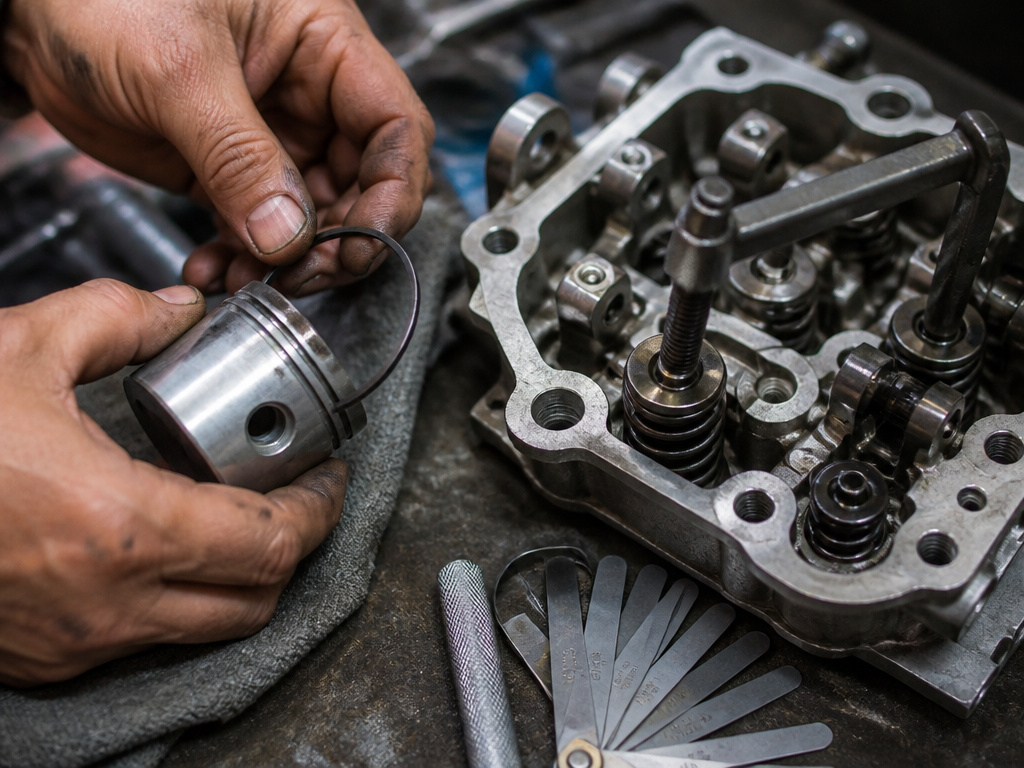
This is the section that hits your wallet and your weekend plans. The maintenance philosophy of each engine type is a direct result of its design.
A modern 4-stroke is a marvel of tight tolerances and stressed components. The valves slam shut thousands of times a minute, and the piston and ring deal with intense combustion pressures. For a race-bred motocross bike, the manual’s 30-hour valve check interval is a real, non-negotiable deadline. The valves stretch and seats wear, causing clearance to tighten. Too tight, and the valve can’t transfer heat to the head, leading to burning and catastrophic failure. A top-end rebuild (piston, rings, pins) around 100 hours is another scheduled expense.
A DIY top-end rebuild for a 250-300cc 2-stroke runs $150-$300 in parts. The same job on a 250cc 4-stroke is more complex (valves, cam chain, more gaskets) and can hit $500-$1200 if you pay a pro. That’s the hidden math of “cheaper to rebuild.”
But here’s the non-commodity insight from the research: those intervals are for race-spec maintenance. A trail rider who maintains a clean air filter, avoids dust, and doesn’t ring the engine’s neck can often double or triple those service hours. The wear happens from dirt ingestion and sustained high rpm, not calendar time.
A 2-stroke’s maintenance is more brutal but simpler. There are no valves to adjust. Instead, the piston, ring, and cylinder are consumable items. The 2-stroke top-end rebuild is a regular refresher, not a sign of failure. Performance drops gradually as the ring wears, and a loss of compression is your cue. Because the engine is simpler, a competent home mechanic can do the job in an afternoon with basic tools.
The Overheating Warning
Four-strokes run hotter, especially in the valve train. In slow, technical terrain where there’s little airflow, an under-spec cooling system or old coolant can lead to overheating.
The part nobody mentions: Sustained overheating doesn’t just boil coolant. It can warp the aluminum cylinder head, causing the valves to no longer seat perfectly. The engine will start hard, lose compression, and need a costly head repair. That’s why technical trail riders often add oversized radiators or fan kits to their 4-strokes.
Carbureted 2-strokes face a different climate challenge: jetting. As noted in the research, altitude or cold weather changes air density, requiring a leaner or richer jet needle setting to keep the fuel mixture correct. Get it wrong, and the engine runs lean (hot, risk of seizure) or rich (fouled plug, sluggish). Fuel-injected models, both 2 and 4 stroke, handle this automatically.
What Belongs in Your Garage?

So, which engine is right for you? The answer lives at the intersection of your use case, mechanical appetite, and nostalgia factor.
Choose a 2-stroke if: You ride off-road exclusively, value lightweight agility, enjoy the raw, explosive powerband, and are comfortable with regular, simpler top-end maintenance and premixing fuel. They dominate in enduro and hard enduro for a reason. A 2-stroke bicycle engine kit for motorizing a bike follows the same logic, maximum power for minimal weight and complexity.
Choose a 4-stroke if: You ride a mix of road and trail, prioritize smooth, tractable torque for easier riding, want lower emissions and better fuel economy, and prefer longer intervals between more complex service procedures. They are the default for street motorcycles, dual-sports, and most modern ATVs.
The old adage “2-strokes are cheaper to buy, 4-strokes are cheaper to own” still holds some truth, but the gap has narrowed. A rebuilt 2-stroke is absolutely cheaper than a rebuilt 4-stroke. But the 4-stroke’s longevity between those rebuilds, if maintained, can be longer.
For small machinery, chainsaws, weed whackers, remote-controlled cars, the 2-stroke’s power-to-weight advantage keeps it dominant. For anything that needs to be clean, quiet, and sip fuel, the 4-stroke wins.
Frequently Asked Questions
Can you put 2-stroke fuel in a 4-stroke engine?
Technically, it will run. The oil in the 2-stroke fuel will burn. But it’s a bad idea. The oil isn’t designed for sump lubrication and can foul spark plugs, clog catalytic converters, and create excessive carbon deposits. It can also contaminate the engine oil if it leaks past the rings. Don’t do it.
Why are 2-strokes banned from roads?
Primarily due to emissions. The scavenging process, where unburned fuel escapes out the exhaust port, releases high levels of hydrocarbons and particulate matter. Modern direct-injection 2-strokes (like some outboards) are cleaner, but the traditional carbureted design can’t meet modern automotive emissions standards.
Which is faster, a 250 2-stroke or 250 4-stroke?
On a dyno, they can make similar peak horsepower. But the 2-stroke delivers it more abruptly in a narrower rpm range, which can feel faster. On a twisty track, the 4-stroke’s broader powerband often makes it quicker because the rider spends less time shifting and can accelerate more smoothly out of corners. Rider skill matters more than the peak number.
Do 2-strokes need to warm up?
Yes, all piston engines benefit from a gentle warm-up. For a 2-stroke, it’s especially important to get the piston and cylinder expanded evenly to their operating clearance. Starting a cold 2-stroke and immediately revving it hard is a surefire way to cause a cold seizure, where the tight, cold piston grips the cylinder wall.
What happens if I use the wrong oil mix ratio?
Too much oil (a “rich” mix, like 20:1) creates excessive smoke, carbon buildup on the piston and spark plug, and can lead to poor combustion and fouled plugs. Too little oil (a “lean” mix, like 60:1) provides insufficient lubrication. The piston, rings, and crank bearings will wear rapidly, leading to lost compression, metal-on-metal scoring, and ultimately, catastrophic engine failure.
Before You Go
The difference between a 2-stroke and a 4-stroke isn’t academic. It’s a practical divide that dictates the smell of your garage, the sound of your weekend, and the line items in your maintenance budget. The 2-stroke is the thrilling, high-maintenance friend who’s a blast in short bursts. The 4-stroke is the reliable, more complex partner for the long haul.
Your next step isn’t to pick a winner. It’s to match the engine’s character to your riding. If you’re deep in the woods and love tinkering, the 2-stroke’s call is undeniable. If you’re covering miles mixed with pavement and want turn-key reliability, the 4-stroke’s torque will win every time. Now you know what you’re listening for when you kick it over.
