
The Top 5 Trucks Having Long Lifespan Trucks You Can Trust
This post contains affiliate links. As an Amazon Associate, we earn from qualifying purchases.
The top 5 trucks with a long lifespan are the Ram 3500, Toyota Tundra, Ford F-350 Super Duty, Toyota Tacoma, and Honda Ridgeline. According to the 2025 iSeeCars study, these models have a 14.7% to 39.7% chance of reaching 250,000 miles, compared to a 13% average for all trucks. The difference lies in how they are maintained against defined duty cycles like ‘Severe’ or ‘Normal’ service, not just in build quality.
That 250,000-mile mark is a filter. It separates trucks that are merely durable from those that are built for a lifetime of work. The data from iSeeCars isn’t a survey of opinions; it’s an analysis of nearly 400 million vehicles to see which ones actually cross the quarter-million-mile threshold in the real world.
What follows: the five models that consistently beat the odds, the mechanical reasons they last, and the non-negotiable maintenance schedules that turn a chance into a guarantee. The key point is which trucks are still on the road a decade later, not which ones look toughest.
Key Takeaways
- The Ram 3500 has a 39.7% chance of lasting 250,000+ miles, the highest of any truck.
- Toyota’s Tundra and Tacoma are the only light-duty/midsize pickups that consistently rank above the truck average for longevity.
- The overall chance for any truck to hit 250k miles fell from 19.4% in 2024 to 13% in 2025, making the top performers even more exceptional.
- Longevity is dictated by a truck’s duty cycle (Severe, Normal, Light) as defined by its manufacturer, not by brand loyalty.
- Skipping even one coolant filter change at 150,000 miles can lead to heater core failure and engine overheating within 30,000 more miles.
The 2025 iSeeCars Longevity Ranking: The Top 5
The iSeeCars study crushes anecdotes with data. Their 2025 analysis of almost 400 million vehicles gives a clear percentage chance for each model to survive to 250,000 miles. For context, the average car has a mere 4.8% chance. The average truck does better at 13%, but that’s down significantly from 19.4% just a year prior. The trucks that buck this trend do so decisively.
The 2025 iSeeCars study found the overall truck average for reaching 250,000 miles is 13%, a notable decrease from 19.4% in 2024. This decline underscores the increasing performance gap between average trucks and the top longevity standouts, which are predominantly heavy-duty models or proven workhorses from Toyota.
Here are the five trucks that stand above the rest, with their specific odds of going the distance.
| Rank | Model | % Chance of Lasting 250,000+ Miles | Vs. Truck Average |
|---|---|---|---|
| 1 | Ram 3500 | 39.7% | 3.1x |
| 2 | Toyota Tundra | 30.0% | 2.3x |
| 3 | Ford F-350 Super Duty | 18.3% | 1.4x |
| 4 | Toyota Tacoma | 25.3% | 2.0x |
| 5 | Honda Ridgeline | 14.7% | 1.1x |
The list is dominated by heavy-duty pickups, with one crucial exception. The Toyota Tundra and Tacoma are the only light-duty and midsize trucks to consistently rank above the segment average. The Honda Ridgeline earns its spot by reliably outperforming many traditional body-on-frame rivals.
The Ram 3500’s lead isn’t a fluke. It held the top spot in the 2024 study as well, with a 42.6% chance. This consistency points to a platform and powertrain combination, particularly the Cummins turbo-diesel engine, that withstands high-mileage abuse.
The Heavy-Duty Advantage: Why 3500s and Super Duties Dominate
Heavy-duty trucks are overbuilt for a reason. Their frames, axles, brakes, and engines are designed for maximum payload and towing, which translates to a larger safety margin during normal use. This engineering philosophy directly feeds longevity.
A Ford F-350 Super Duty frame is made from high-strength steel with reinforced crossmembers. The Ram 3500 uses a similar ladder frame designed to handle a plow or a fifth-wheel hitch without flexing. That same rigidity means less stress-induced metal fatigue over hundreds of thousands of miles. When you pair this with a diesel engine like the Cummins or Power Stroke, built for continuous high-load operation, the recipe for high mileage is clear.
Where this goes sideways: Using a heavy-duty truck for exclusively short, stop-and-go trips. This is classified as “Severe Service” by every manufacturer. Operating a diesel under 5.5 miles per gallon, with excessive idling, collapses the maintenance intervals and can halve the engine’s projected life.
The maintenance schedules for these trucks reflect their intended use. For a Cummins ISX15 engine, the difference between “Severe Duty” and “Light Duty” is stark.
| Duty Cycle | Fuel Economy | Oil Change Interval | Fuel Filter Interval |
|---|---|---|---|
| Severe Duty | < 5.5 MPG | 20,000 miles / 1,000 hours | 30,000 miles |
| Normal Duty | 5.5 – 6.5 MPG | 30,000 miles / 1,000 hours | 30,000 miles |
| Light Duty | > 6.5 MPG | 40,000 miles / 1,000 hours | 40,000 miles |
Ignoring this classification is the fastest way to burn out a $10,000 engine. If your truck lives in city traffic or works on a job site, you’re in the Severe Duty bucket regardless of what the badge says. Your brake pads and shocks will wear faster too, demanding more frequent inspection.
The Toyota Exception: Engineering for the Long Haul
Toyota operates on a different playbook. While the American brands push displacement and tow ratings, Toyota focuses on systemic reliability and minimizing complex failure points. The Tundra’s switch to a twin-turbo V6 (i-FORCE MAX) is a perfect example. It reduced the number of moving parts compared to a V8 while meeting modern efficiency standards.
The Tacoma’s longevity is legendary. Its body-on-frame construction and historically under-stressed four- and six-cylinder engines mean less thermal and mechanical strain. The truck simply isn’t working as hard as a heavier vehicle, so components like the brake systems and transmissions last longer. The aftermarket support for LED headlights and fog lights is vast because owners keep these trucks for 15 years or more.
Toyota’s prescribed maintenance is famously strict, 5,000-mile service intervals are non-negotiable in the manual. This regimented care ensures small issues are caught before they become stranded-on-the-highway problems. It’s a culture of maintenance that owners adopt, and the data proves it works.
TL;DR: Heavy-duty trucks last because they’re overbuilt. Toyotas last because they’re meticulously engineered for low-stress reliability and paired with an owner culture that follows the maintenance schedule to the letter.
The One Thing That Beats Brand: Your Maintenance Schedule
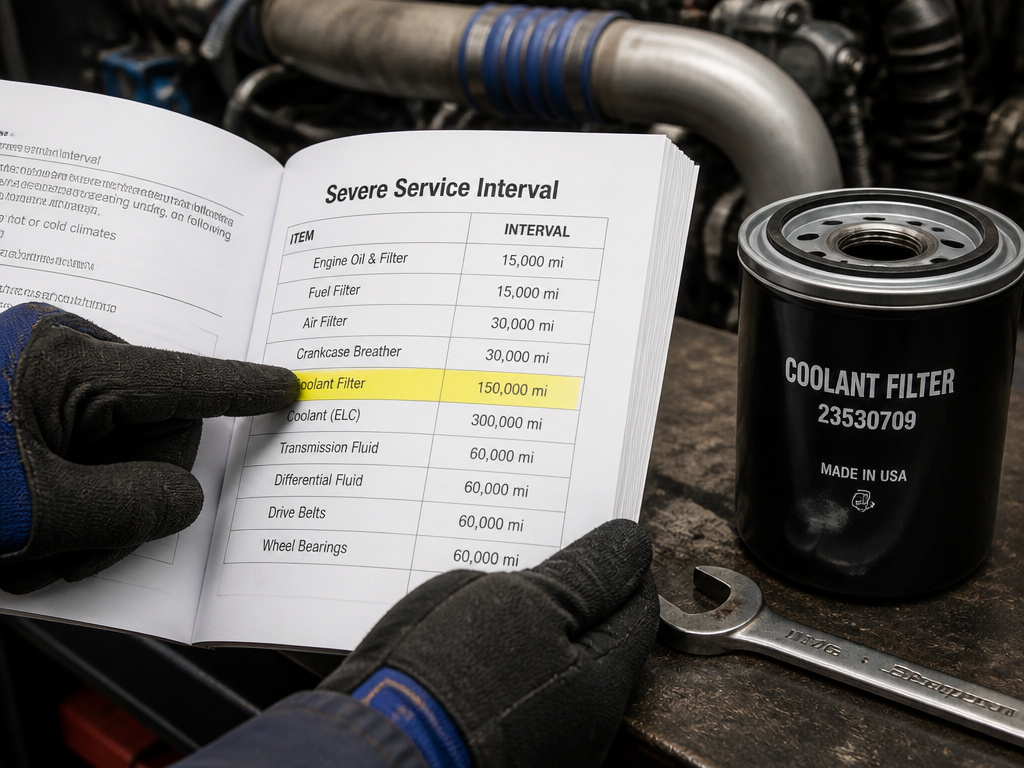 The best truck in the world will die young with neglect. Longevity is a contract between the manufacturer’s design and the owner’s diligence. The focus is on following the correct schedule for your specific use case, not just on oil changes alone.
Manufacturers don’t have one schedule. They have three: Short-Haul (Severe), Long-Haul (Normal), and sometimes a Light-Duty cycle. Freightliner defines Short-Haul as under 60,000 miles a year with lots of stops. That’s most service trucks and plow rigs. Their Maintenance 1 (M1) interval for this service is every 10,000 miles. For Long-Haul over-the-road trucks, that M1 interval stretches to 25,000 miles.
Missing a single interval has consequences. Take the Mack MP8 engine. Its coolant filter replacement is due every 150,000 miles or 12 months. Skip it, and the coolant’s additive package depletes. The result is corrosion and scale buildup in the radiator and heater core. You’ll lose cabin heat first. Then, within another 30,000 miles, the engine will start running hotter until it overheats under load.
Your maintenance toolkit is as important as the schedule. Using a jump starter designed for diesel trucks ensures you don’t fry sensitive electronics. Quality jack stands rated for your truck’s weight are non-negotiable for safe undercarriage work. Investing in an APU (Auxiliary Power Unit) for a long-haul rig eliminates thousands of hours of main engine idling, which is pure torture on the oil and emission systems.
How to Buy a Truck That Will Last 250,000 Miles
 Start with the data, then inspect with a mechanic’s eye. The iSeeCars list is your shopping list. From there, your investigation gets specific.
- Verify Service Records. Look for a consistent, documented history. A stack of oil change receipts is good. A logbook with fuel filter, differential fluid, and coolant service notations is gold. Walk away from a “maintained” truck with no paperwork.
- Check for Duty-Cycle Match. Was this truck used in a way that matches its build? A one-ton dually with a spotless bed and low tow rating use is a better bet than the same model with a fifth-wheel hitch and 200,000 miles of unknown cargo.
- Conduct a Leak-Down Test. For diesel trucks, a cylinder leak-down test performed by a mechanic tells you more about engine health than any mileage number. It measures the sealing integrity of the rings, valves, and head gasket.
- Inspect the Aftertreatment. On diesels 2010 and newer, ask for a forced regeneration cycle report. Look for a history of clogged DPFs or frequent DEF system warnings. These are expensive fixes and indicate poor maintenance or extreme short-trip use.
- Plan Your Upkeep. Before you buy, price out the next major service. For a Ram 3500 Cummins, that’s the 125,000-mile crankcase filter and likely a transmission service. If that cost gives you pause, choose a Tacoma whose 100,000-mile service is less complex.
Common mistake: Buying a high-mileage truck based on a “strong engine” alone. The supporting cast fails first. Listen for worn wheel bearings, check for sloppy steering linkage, and look at the condition of all rubber bushings in the suspension. A $3000 suspension refresh is common at the 200,000-mile mark, even on a truck with perfect compression.
Frequently Asked Questions
What truck brand has the longest lifespan?
Based on the 2025 iSeeCars data, Ram holds the top spot for a single model with the Ram 3500. However, Toyota is the most consistent brand across segments, with both the Tundra and Tacoma ranking in the top five. For a brand-wide likelihood of reaching 250,000 miles, Toyota leads.
Is 200,000 miles a lot for a diesel truck?
Not necessarily. For a well-maintained diesel truck in long-haul service, 200,000 miles is often just mid-life. The key differentiator is maintenance history and duty cycle. A diesel with 200,000 miles of highway towing is typically in better condition than one with 100,000 miles of stop-and-go delivery work.
Do gasoline trucks last as long as diesel trucks?
They can, but the longevity champions are disproportionately diesel-powered in the heavy-duty segment. Diesel engines are built with stronger internal components and operate at lower RPMs, which reduces wear. For light-duty trucks, gasoline engines in models like the Toyota Tundra and Honda Ridgeline prove they can achieve comparable high-mileage lifespans with excellent care.
What is the most important maintenance for longevity?
Following the manufacturer’s severe service schedule if your use is anything other than steady highway miles. This means more frequent oil, fuel, and air filter changes. Beyond that, proactive cooling system maintenance, flushing coolant and replacing filters on time, prevents the corrosion that kills engines.
Can modifications hurt a truck’s lifespan?
Absolutely. Poorly engineered modifications are longevity killers. A cheap lift kit that strains CV joints and ball joints will cost you thousands in front-end repairs. Installing subpar LED headlights or light bars without a proper wiring harness can lead to electrical gremlins. Even performance tuners that delete emission systems can cause turbo and engine damage if not paired with supporting hardware.
The Bottom Line
The top 5 trucks for longevity earn their place through a combination of over-engineering and owner discipline. The Ram 3500, Toyota Tundra, Ford F-350, Toyota Tacoma, and Honda Ridgeline are the data-backed winners.
But the truck itself is only half of the equation. The other half is the maintenance logbook. The difference between a 300,000-mile truck and a scrapped one at 150,000 miles results from specific maintenance actions: a coolant filter changed on time, synthetic oil used in sub-zero temperatures, and recognizing that a ‘work truck’ likely lives its entire life on the severe-duty schedule.
Pick from the proven list. Then commit to the schedule that matches how you actually drive. That’s how you join the quarter-million-mile club.
