
Recall Guide for the Mustang Mach-E Electric Car and SUV
This post contains affiliate links. As an Amazon Associate, we earn from qualifying purchases.
The Ford Mustang Mach-E is an electric SUV that redefined a muscle car nameplate, but its first five years have been defined by three critical, documented recalls: high-voltage contactor overheating from fast charging, 12-volt battery drain from module software bugs, and electronic door latches that can trap occupants during a low-voltage event.
That summary isn’t speculation. It’s the verdict from over a dozen National Highway Traffic Safety Administration (NHTSA) documents spanning from 2023 to 2026. These recalls aren’t minor quirks; they represent systemic engineering challenges in transitioning a high-performance brand to an electric platform. The contactor issue alone prompted a hardware redesign in May 2022.
The rest of this guide walks through each problem with the specific part numbers, failure timelines, and software patches Ford deployed. You’ll see how a modern electric vehicle’s reliability is as much about over-the-air updates and service bulletins as it is about motors and batteries. By the end, you’ll be able to read a Mach-E’s vehicle identification number (VIN) report and know exactly which recalls apply and what the permanent fix actually involved.
Key Takeaways
- The most serious issue is high-voltage battery contactor overheating (Recall 23S56), primarily triggered by repeated DC fast charging and aggressive acceleration. The final fix required a hardware swap to parts NK48-10C666-AC or LK98-10C666-AD.
- Chronic 12-volt battery drains (TSB 25-2058) are often a software problem, requiring updates to the Gateway Module (GWM), Accessory Protocol Interface Module (APIM), and Door Speaker Module (DSM). This repair can take a dealer over 3 hours.
- A low 12-volt battery charge can cause the electronic door latches (Recall 25V404) to remain locked after the front doors close, potentially trapping a child in the back seat. The remedy is a software update to the body control modules.
- Checking a specific VIN on the NHTSA website is more reliable than assuming a vehicle’s build date means it’s clear. Follow-up recalls like 25S14 exist because some cars were logged as fixed but didn’t get the correct software.
- Compared to more established electric SUV models, the Mach-E’s early years show a pattern of post-launch electronic debugging. Later model years (2023+) incorporate these hardware and software lessons.
What Are the Most Common Mustang Mach-E Problems?
The Mach-E’s issues cluster in two areas: high-voltage propulsion and low-voltage body electronics. This split is typical of new EV platforms where the powertrain is novel but the car still relies on a conventional 12-volt system to boot up computers and run accessories.
Direct Current (“DC”) fast charging and repeated wide open pedal events can cause the high voltage battery main contactors to overheat. Overheating may lead to arcing and deformation of the electrical contact surfaces, which can result in a contactor that is prevented from closing or a contactor that welds closed.
This NHTSA finding is the core of the most severe recall. A contactor is a high-voltage switch. If it welds closed, the car might not start next time. If it fails open while driving, you get a “Stop Safely Now” warning and immediate loss of power. Steering and brakes still work, but you’re coasting.
The other flagship problem is parasitic 12-volt drain. The small battery that starts the car’s computers can be exhausted by modules that don’t sleep properly. When the 12-volt battery is dead, the high-voltage system won’t engage. The car is a brick.
Here is how the major issues break down by symptom and cause:
| Problem | Primary Symptom | Root Cause | Official Designation |
|---|---|---|---|
| Loss of Motive Power | “Stop Safely Now” message, wrench light, car coasts. | Overheated battery contactors. | Recall 23S56 / 25V441 |
| 12V Battery Dead | Car completely unresponsive, no keyless entry, cannot charge. | Software bugs in GWM, APIM, DSM modules. | TSB 25-2058 |
| Doors Won’t Open | Exterior handles don’t present, interior rear handles inactive. | Low 12V state causes latch controller to fault. | Recall 25V404 |
| Stuck in Park | “Service Vehicle Soon” message, wrench light. | High resistance in park pawl motor ground circuit. | TSB 25-2622 |
Later model years inherit solutions. A 2024 Mach-E has the updated contactor hardware from the factory. It should also have the door latch software patch. But a 2021 or 2022 model is almost certainly subject to at least one of these campaigns unless its service history is meticulously complete.
Bottom line: The common problems are well-documented and have official fixes. The real variable is whether a given vehicle has received them all.
The High-Voltage Battery Contactor Overheating (Recall 23S56/25V441)
This is the Mach-E’s most significant engineering recall. It affects certain 2021-2022 extended-range and GT models built between May 27, 2020, and May 24, 2022. The culprit is the Bussed Electrical Center (BEC), also called the High Voltage Battery Junction Box.
The BEC contains the main contactors, heavy-duty relays that connect the battery pack to the rest of the car. The original parts (NK48-10C666-AA, NK48-10C666-BA, LK98-10C666-AB) had a design flaw. The contact surfaces could overheat under the high electrical loads of DC fast charging or repeated full-throttle launches.
Where this goes sideways: The heat causes arcing, which deforms the contactor’s surfaces. A deformed contactor might weld itself shut or become stuck open. If it welds closed, the car may drive normally but then fail to start on the next key cycle. If it sticks open while driving, power cuts instantly.
The initial recall (22S41) tried a software patch. It aimed to reduce thermal stress by managing power output during consecutive fast-charge sessions. It didn’t work well enough for already-stressed hardware.
The final remedy, deployed from May 2022 onward, is a hardware replacement. The updated BEC (parts NK48-10C666-AC, NK48-10C666-BC, LK98-10C666-AD) features flat contact surfaces instead of grooved ones. This design dissipates heat better and is less prone to arcing damage.
If you’re looking at a used Mach-E from the affected build period, this repair is non-negotiable. Check the service history for “Recall 23S56” or “BEC replacement.” The work is free at any Ford dealer, but it’s a major procedure that involves depowering the high-voltage system.
The 12-Volt Battery Drain (TSB 25-2058)
While the high-voltage system gets the headlines, the humble 12-volt battery causes the most frequent headaches. The technical service bulletin 25-2058 addresses vehicles that go completely dead overnight, often stranding owners.
The issue isn’t a bad battery. It’s a software bug. Modules like the Gateway Module (GWM), the Accessory Protocol Interface Module (APIM, the infotainment brain), and the Door Speaker Module (DSM) sometimes fail to enter a low-power “sleep” state when the car is off. They continue to draw power, exhausting the 12-volt battery.
The fix is a series of software updates. According to the NHTSA bulletin, the dealer must reprogram the GWM, APIM, and DSM modules. This process can take over 3 hours, as it may require updates to the Telematics Control Unit (TCU) and Instrument Panel Cluster (IPC) as well.
| Module | Function | Why It Causes Drain |
|---|---|---|
| GWM (Gateway Module) | Network router for all car computers. | If it doesn’t sleep, it keeps the communication network active. |
| APIM (Accessory Protocol Interface Module) | Controls the touchscreen, SYNC, and audio. | A software loop can prevent full shutdown. |
| DSM (Door Speaker Module) | Controls audio speakers and may handle door logic. | Can be stuck in an active state awaiting a signal. |
The symptom is clear: you walk up to the car and the keyless entry doesn’t work. The interior is dark. Plugging in a charger does nothing because the computers that manage charging are offline. You need a jump start to the 12-volt battery to wake the car up.
If this happens, the dealer won’t just jump it and send you away. The TSB procedure is specific. They run diagnostics, update the software, and only replace the 12-volt battery itself if testing shows it’s been damaged by the deep discharges.
Electronic Door Latches That Can Trap Occupants (Recall 25V404)

This recall, issued in June 2025 for 2021-2025 models, outlines a frightening scenario. It’s a direct consequence of the 12-volt battery problems.
Here’s the failure chain: The car’s electronic door latches are powered by the 12-volt system. If the battery charge is critically low, the latch control module can fault when a door is closed. In this fault state, the latches may remain locked.
Common mistake: Assuming all doors will mechanically unlock if the battery dies. In this specific fault mode, they might not. This is especially dangerous for rear-seat occupants, like a child in a car seat, who cannot reach the physical mechanical release cables located in the front door panels.
The driver or front passenger gets out and shuts their door. The latch faults and stays locked. Anyone left in the back is now trapped inside a vehicle that may also be unresponsive to key fobs. The risk in an emergency is obvious.
The remedy is a software update to the body control modules. The update changes the logic so the latches default to an unlocked state, or at least a manually operable state, during a low-voltage event. This recall highlights a critical design lesson for electric vehicles: body safety systems must have failsafes independent of the main battery’s state of charge.
Ford’s recall population here is huge, nearly 200,000 vehicles. It shows the issue was fundamental to the latch design for the Mach-E’s entire production run up to that point. If you own one, this software update is a mandatory safety patch.
Stuck in Park & Other Electronic Gremlins
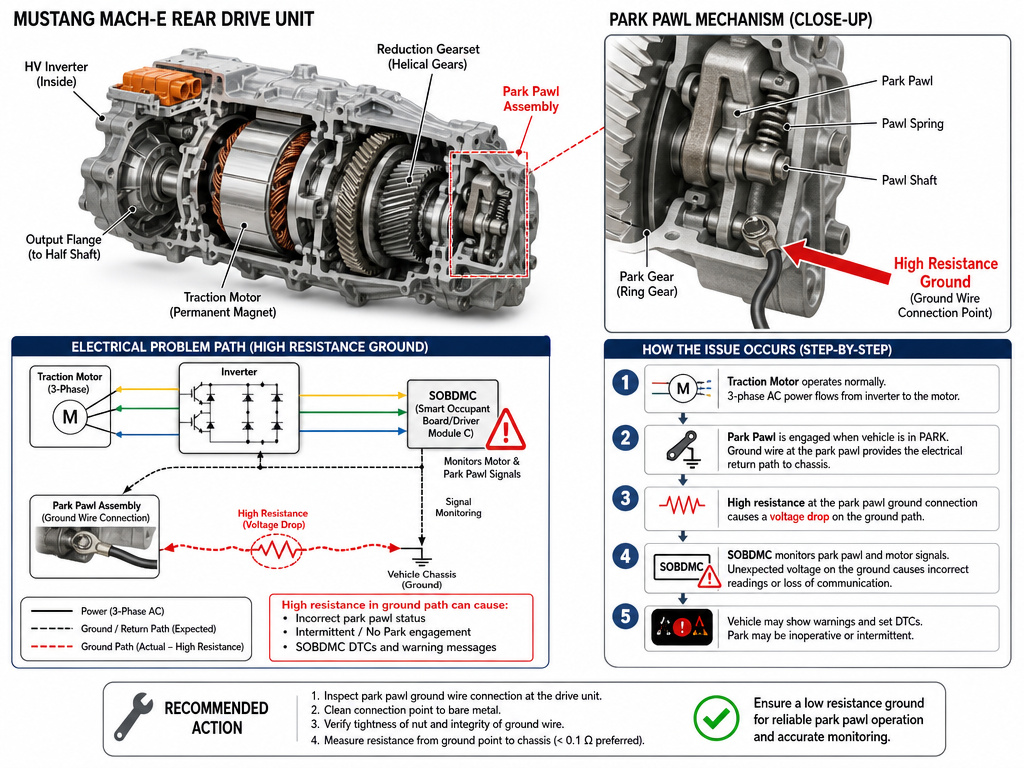
Beyond the major recalls, Technical Service Bulletin 25-2622 details a problem for 2024-2025 models: the car gets stuck in Park with a “Service Vehicle Soon” message. The diagnostic trouble code P07E6:71 points to high ground resistance in the park pawl motor circuit.
In simple terms, the electric motor that engages the parking mechanism isn’t getting a clean electrical ground. The fix is both physical and digital. The dealer installs a new primary drive unit ground wire harness (part RJ8Z-14301-ZA) and reprograms the Secondary On-Board Diagnostic Control Module C (SOBDMC).
This is a good example of a “running change” fix. It’s not a full recall because the condition is not deemed a high-risk safety defect, but it’s a known manufacturing issue with a prescribed repair.
Other sporadic issues include software glitches in the phone-as-a-key system, occasional charging port communication errors, and the typical infotainment system reboots common to many modern cars. These are often resolved with over-the-air updates, which is a major advantage of the Mach-E’s connected platform.
How the Mach-E Compares to Other Electric SUVs
The Mach-E entered a market with established players. How do its early troubles stack up?
The Mach-E’s recalls are specific and mechanical, contactor designs, latch logic. This contrasts with some competitors who faced broader battery manufacturing issues or thermal management system failures. The fact that Ford’s fixes involve both hardware swaps and software updates shows they were learning on the fly.
A key advantage for Mach-E owners is Ford’s relatively dense dealer network for recall repairs. Getting a BEC replaced is a major job, but there’s likely a certified dealer within a reasonable distance. This contrasts with newer EV brands that rely on mobile service or have sparse service centers.
When evaluating the broader landscape of electric SUV models, the Mach-E’s performance and handling are still standout features. Its reliability story, however, is firmly tied to its model year. A late-2022 or 2023 model with all recalls completed is a much safer bet than an early 2021 car.
For those considering other options, our guide on the best electric SUVs covers models that may have had smoother launch periods. Similarly, if your primary concern is all-weather capability, the considerations for electric cars in snow are crucial, as the Mach-E’s available all-wheel-drive system is generally well-regarded.
What Should a Potential Buyer Do?
Your due diligence is everything. Here is a step-by-step checklist.
- Run the VIN. Always check the specific Vehicle Identification Number on the NHTSA website. Don’t rely on build-date ranges alone. Follow-up recalls like 25S14 exist because some cars were incorrectly logged as fixed.
- Review the full service history. Ask for all records. Look for entries that match the recall codes: “23S56,” “25V404,” “TSB 25-2058.” A BEC replacement is a major line item.
- Verify the 12-volt battery. If the car is a 2021-2023 model, ask if the TSB 25-2058 software updates have been performed. A new 12-volt battery is a clue, but not proof of the fix.
- Consider the model year. A 2023 Mach-E likely left the factory with the updated contactor hardware (post-May 2022) and may have fewer software bugs. Later models incorporate these early lessons.
- Factor in running costs. While not a reliability issue, understand that insuring electric vehicles like the Mach-E can differ from traditional cars. Get a quote.
The part nobody mentions: The success of these recalls depends entirely on the previous owner having taken the car in. A private sale with no paperwork is a giant question mark. A certified pre-owned (CPO) vehicle from a Ford dealer is the only channel that guarantees all recall work is completed before sale.
Frequently Asked Questions
Is the Ford Mustang Mach-E a reliable electric car?
For model years 2021 and 2022, reliability was marred by specific, serious recalls related to the high-voltage battery contactors and door latches. Once these recalls are completed, the car should be reliable. Later model years (2023+) benefit from the hardware and software fixes implemented from the factory. It’s not inherently unreliable, but its early production required significant post-launch debugging.
What is the biggest problem with the Mustang Mach-E?
The most critical problem is the high-voltage battery contactor overheating, detailed in NHTSA Recall 23S56. It can cause a sudden loss of motive power while driving. The definitive fix requires physically replacing the Bussed Electrical Center (BEC) with an updated part. All affected vehicles should have this repair completed by a Ford dealer at no cost.
How do I know if my Mach-E has the door latch recall?
Recall 25V404 affects nearly 200,000 Mustang Mach-E vehicles from model years 2021 through 2025. The only way to know for sure if your specific vehicle is included and needs the fix is to enter its 17-character VIN into the recall lookup tool on the NHTSA website or Ford’s official recall site.
Does the Mach-E have a lot of battery problems?
The main high-voltage battery pack itself has not shown widespread failure. The recalls focus on the components attached to it, specifically the contactors in the junction box. There is also a separate, chronic issue with the conventional 12-volt accessory battery draining due to software bugs, which can strand the vehicle but doesn’t damage the main drive battery.
Is the Mach-E considered a good electric SUV?
Yes, particularly for its driving dynamics and performance. It successfully translates the Mustang’s sporty character to an electric SUV format. Its main drawbacks were first-generation teething problems, not a flawed concept. A post-recall model, especially a GT, offers a compelling mix of practicality and excitement that stands out in the crowded electric vehicle market.
Before You Go
The Mustang Mach-E’s story is a classic case study in modern automotive development. It pushed a legendary nameplate into the electric future and encountered predictable, if serious, growing pains. Its reliability hinges completely on a checklist of completed factory recalls.
For a buyer, this means diligence is non-negotiable. A VIN check and thorough service history review are more important than with a typical used car. The reward for that work is a distinctive, performance-oriented electric SUV that has already endured its most significant revisions. Just make sure the paperwork proves it.
