
Insuring Electric Cars: Are They More Expensive? Key Facts
This post contains affiliate links. As an Amazon Associate, we earn from qualifying purchases.
Yes, electric cars are more expensive to insure than comparable gasoline vehicles. The average premium is 25% to 49% higher, driven primarily by repair costs that are 15-30% more expensive and take 14% longer. This gap is narrowing as the market matures, but structural factors like expensive batteries and integrated components keep EV insurance costs elevated.
The 25% figure isn’t a guess. It’s the 2025 average repairable loss severity for battery electric vehicles in the US, down from 30% in 2024 according to Mitchell’s data. This narrowing trend is the key thread, insurers and repair shops are getting better at handling EVs, but the underlying cost physics hasn’t changed.
What follows is a breakdown of the four cost drivers that build your premium: repair costs, total loss risk, parts and labor scarcity, and your specific location. We’ll look at the data from the US, UK, Germany, and France, name the models that cost the most to cover, and explain why the gap exists even when an EV is less likely to crash.
Key Takeaways
- EV insurance premiums are 25-49% higher on average than for gasoline cars, with repair costs being the single largest driver.
- Repairs cost 15-30% more and take 14% longer due to integrated components, expensive batteries, and mandatory safety procedures.
- The Tesla Model X is consistently among the most expensive EVs to insure, with annual premiums often exceeding $4,700 for full coverage.
- Loss frequency (how often you crash) is often lower for EVs, but loss severity (the cost per crash) is significantly higher, which dictates your premium.
- The insurance cost gap is narrowing as the market matures, with the US repair cost premium dropping from 30% to 25% in one year.
The Short Answer: A 25-49% Premium Gap
The numbers vary by country, source, and model, but the direction is unanimous. In the United States, data from 2025 shows the average repairable loss severity for a battery electric vehicle was roughly 25% higher than for an internal combustion engine vehicle. A separate consumer report from Insurify put the average annual premium difference at 49% nationally.
Common mistake: Comparing insurance quotes for an EV and a gas car of the same MSRP. The sticker price is just the opener. The real premium driver is the repair cost calculus insurers run on every model, which heavily penalizes integrated EV designs.
Look at the international data. It tells the same story with local accents.
| Country | EV Repair Cost Premium (vs. ICE) | Source & Year | Key Driver Cited |
|---|---|---|---|
| United States | 25% higher (down from 30% in 2024) | Mitchell, 2025 | ADAS sensor concentration, electrical complexity |
| United Kingdom | 30% higher, 14% longer repair time | Thatcham Research, 2023 | Component integration, battery casing design |
| Germany | 15-20% higher (2021-23) | GDV (German Insurers), 2024 | Market maturity, growing repairer experience |
| France | 23% higher | SRA, 2025 | Heavy weight, complex materials, certified repair networks |
| Canada | 31.8% higher per collision claim | Sussex International / Surex, 2025 | High-voltage systems, battery total-loss risk |
The gap is real, but it’s also dynamic. The 5-point drop in the US from 2024 to 2025 is the signal. As more EVs hit the road, repair networks gain experience, diagnostics improve, and insurers get more data. This is the maturation curve in action. Yet, some costs are baked into the design.
Why Repair Costs Are The Engine
Forget the sticker price for a moment. The single most important number for your insurance premium is the expected cost to fix the car after a crash. This is where EVs face a structural disadvantage.
A rear-strike fender bender that would merit a handful of repairs on a newer gas car could affect up to a dozen powered systems in a comparable EV, entailing numerous hours of repair work and re-calibration. , NAMIC Issue Analysis
The problem is integration. To save weight, a critical goal for range, manufacturers glue components together into single, sealed units. A minor front-end impact that breaks a charging port can mean replacing the entire charger, inverter, and attached cabling as one assembly. A Dacia Spring in a UK test needed £4,000 in repairs from a 6mph bump for this exact reason; the insurer would likely write it off.
The battery is the elephant in the room. It represents up to 50% of the vehicle’s value but is often supplied as a single, non-repairable unit. Scratches on the protective casing can necessitate a full battery replacement, which is frequently more expensive than the car’s salvage value. This makes total losses more common on EVs for seemingly minor damage.
| Repair Factor | EV Reality | Consequence for Insurance |
|---|---|---|
| Parts | >90% are OEM (Original Equipment Manufacturer) | Parts are ~25% more expensive than comparable ICE parts. |
| Labor | Requires certified technicians, specific safety procedures | Adds 1.7 hours for appraisal, 0.9 hours for refinishing vs. ICE. |
| Diagnostics | Software-driven, requires proprietary tools | Longer shop time, higher labor cost, fewer qualified shops. |
| Battery Risk | Damage can require full replacement; thermal runaway fire risk | Sky-high total loss potential; extreme fire suppression costs. |
This last point, fire, is a niche but catastrophic risk. An EV battery fire can reach over 2,500°F and require up to 20,000 gallons of water to extinguish, compared to 1,500°F and 1,000 gallons for a gas car fire. This risk, while statistically low, factors into the complex risk model.
TL;DR: EVs are harder and more expensive to fix. Insurers price for that reality. Your premium is a direct reflection of the bill they expect to pay.
The Models That Cost The Most (And Why)
Not all EVs are equal in the eyes of an actuary. The cars that push premiums highest combine high repair costs with higher-than-average claims frequency.
The Tesla Model X consistently tops the list. One report pegged its average annual full-coverage premium at $4,765, a 36% increase from the previous year. The Model X is expensive to repair due to complex falcon-wing doors, extensive glass, and a high concentration of sensors and cameras. The Tesla Model 3 also often appears due to a claims frequency rate “significantly higher than the industry average.”
Why do some models cost more? It’s a blend of factors also seen in the world of high-performance car insurance: expensive, complex parts and a driver profile that may attract more risk. A vehicle’s safety rating can lower frequency, but it doesn’t change the brutal math of a $20,000 battery replacement.
Where this goes sideways: Choosing an EV with known high repair costs without checking insurance quotes first. The monthly payment might look good, but the insurance bill can erase any fuel savings.
When shopping among hybrid and electric cars, dig into model-specific insurance costs. A Ford Mustang Mach-E electric SUV might have a different profile than a Tesla Model Y, which differs again from a rugged electric vehicle designed for utility. The best electric SUVs for your budget must include the insurance line item.
Location, Location, Location (And Data)

Your address is the second-most powerful factor shaping your EV insurance quote, right after the car itself. This isn’t just about crime rates or traffic density. For EVs, it’s about market maturity.
In regions with high EV adoption, like California, the premium gap shrinks. One report noted a 15-31% higher cost in California, compared to a 49% national average. In states with low adoption like Arkansas or Idaho, the cost to insure an EV can be nearly double that of a gas car.
The part nobody mentions: Low adoption means a thin data pool. Without thousands of claims to analyze, insurers price cautiously, meaning higher. It also means fewer certified repair shops, longer wait times for parts, and higher rental car costs, all of which get baked into your premium.
This creates a vicious cycle, as noted in a Canadian analysis of their collapsing EV mandate: “Adoption’s low, so the premium stays high. But the premium stays high, which leads to adoption being low.” States and provinces are aware of this. Regulatory bodies, like those cited in the state insurance regulators’ analysis, review rate increases, which can act as a brake on runaway costs.
The solution is data. As the fleet grows, insurers move from cautious estimates to precise pricing. This is why the gap is narrowing in mature markets like Germany, as noted in the global insurance research publication.
The Counterintuitive Truth: Crash Frequency
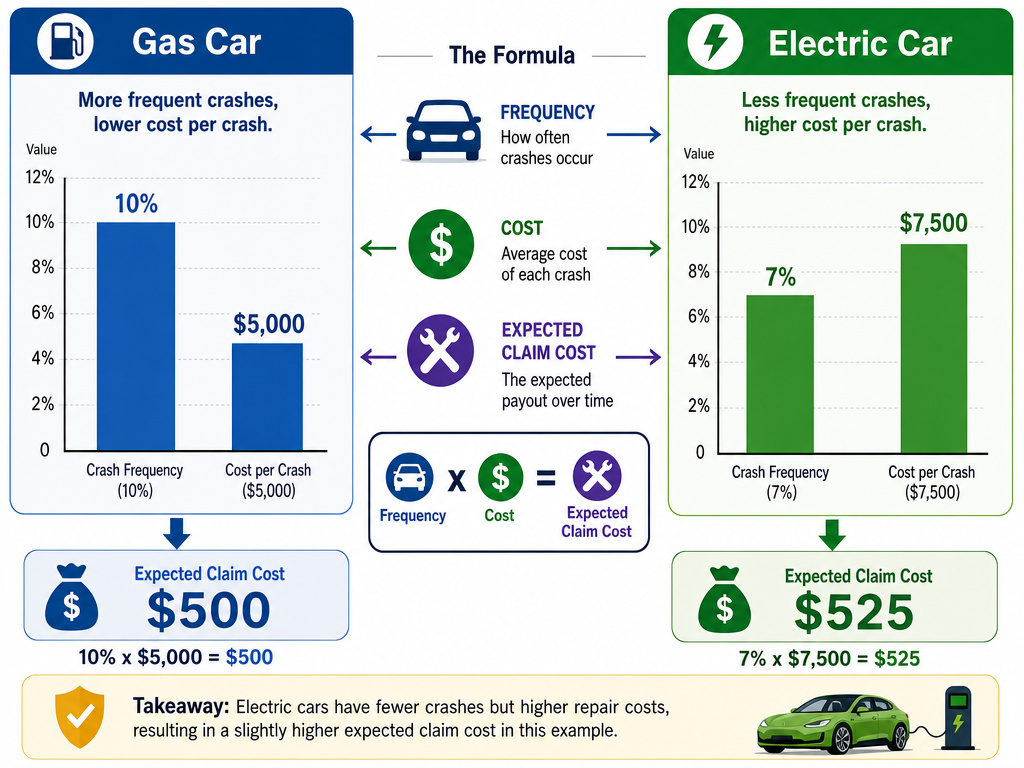
Here’s the twist that often gets lost: many studies show EVs are not more likely to crash than gas cars. In fact, they may be less likely.
Data from Germany found full-comprehensive claim frequency for EVs was 10-15% lower than for comparable ICE vehicles. Analysis of Norwegian data showed EV accident frequency per kilometer was 17% lower. This is attributed to a combination of factors: newer vehicles with more advanced safety systems, different driver demographics, and the instant torque of EVs potentially aiding in accident avoidance.
So why the high premium if they crash less? It all comes back to severity.
Think of it this way: If a gas car has a 10% chance of a $5,000 crash, the expected cost is $500. If an EV has a 7% chance of a $7,500 crash, the expected cost is $525. The lower frequency is overwhelmed by the much higher cost per incident. This is the fundamental equation insurers solve. Your premium covers the pool of expected claims costs, and EVs currently fill that pool with more expensive repairs.
How The Gap Is Narrowing (And What You Can Do)
The trend, confirmed across multiple reports, is toward a smaller premium difference. The US repair cost premium dropped 5 points in a year. The newest EV models have repair costs only 18% higher than conventional counterparts, per Thatcham.
Manufacturers are under pressure from the insurance industry, as detailed in the property-casualty insurer analysis, to design for repairability. This means modular battery packs, accessible charging ports, and using bolts instead of glue. Every step in this direction lowers the insurance risk.
What you can do right now:
- Get quotes before you buy. Never assume. The insurance cost for a Tesla Model 3 and a Chevrolet Bolt EV will be different. Factor it into your total monthly cost.
- Ask about EV discounts. Some insurers, like The Co-operators or Travelers, still offer 5-10% discounts for EVs or hybrids. These are legacy programs and may fade, but use them if available.
- Bundle and use telematics. A clean driving record matters more. Usage-based insurance programs can benefit efficient EV drivers.
- Consider the total cost. Higher insurance is offset by lower fuel and maintenance costs. Run the math over 5 years, not just the monthly payment.
- Choose a repairable model. As you research the best electric cars for snowy conditions or electric four-wheelers, look for models praised for sensible design. A vehicle designed with repair in mind is an insurer’s friend.
The landscape for electric automobiles is evolving. Just as older car insurance has its own rules, EV insurance is developing its own playbook. The gap is real today, but it’s not static. It’s a snapshot of a technology in transition from novel to normal.
Frequently Asked Questions
Why are EV tires a separate insurance consideration?
While tires themselves are a maintenance item, their specific wear patterns on heavy EVs can lead to more frequent replacement. This isn’t a direct insurance cost, but it contributes to the higher overall ownership expense that insurers consider in a model’s risk profile. For a detailed look, see our article on EV tires.
Will my premium go down as my EV gets older?
Not necessarily. Unlike some insurance for older cars, where value depreciation lowers premium, the high repair cost for an aging EV battery or integrated system can keep premiums elevated. The risk of a catastrophic, high-cost repair remains even as the car’s value falls.
Are some EVs cheaper to insure than others?
Yes. Generally, lower-priced models with less complex sensor suites and more modular designs will be cheaper to insure. The premium difference between a Nissan Leaf and a Tesla Model S will be substantial. Always get model-specific quotes.
Is manufacturer-specific insurance (like Tesla Insurance) cheaper?
It can be. Tesla Insurance uses real-time driving data from the vehicle, which can benefit safe drivers. More importantly, Tesla has deep knowledge of its own repair costs and network, which can allow for more accurate, potentially lower pricing compared to traditional insurers using broader, more cautious models.
Does where I charge my car affect my insurance?
Not directly for auto insurance. However, installing a 240V home charger may require an electrical upgrade and could be a factor in your homeowner’s insurance underwriting, as it represents a new electrical load and potential fire hazard.
Before You Go
Electric cars are more expensive to insure, full stop. The premium gap of 25-49% is rooted in repair costs that are 15-30% higher, a reality driven by integrated components and expensive batteries. This is the price of early-adopter technology.
But look at the trend lines, not just the snapshot. The gap is narrowing year over year as repair networks mature and data floods in. The Tesla Model X is an outlier, not the rule. When you shop, get the insurance quote upfront, it’s the only way to see the true total cost.
The math will change. As EVs become the default, not the exception, their insurance costs will settle. For now, budget for the premium, shop it aggressively, and drive knowing that your monthly bill is funding the industry’s learning curve.
