
Ford vs Ferrari Car Comparisons: The Unseen Recall Reality
This post contains affiliate links. As an Amazon Associate, we earn from qualifying purchases.
Ford vs Ferrari car comparisons are about more than horsepower and price. They reveal a fundamental engineering split: one brand builds machines for maximum durability under load, the other for maximum performance at the limit. This shows up not in 0-60 times, but in government recall data and service manuals.
The bridge is in the data. Look past the brochure numbers to the National Highway Traffic Safety Administration (NHTSA) filings. A Ford F-150 recall cites a fractured front axle pinion due to a missed heat treatment. A Ferrari SF90 spec sheet details a magnetorheological damping system with twin solenoids. One document is about a part that shouldn’t have broken. The other is about a part engineered not to. That gap is the whole comparison.
What follows is a breakdown of three layers: the spec sheet fantasy, the engineering intent behind it, and the ownership reality that spec sheets never mention. By the end, you’ll know which numbers actually matter.
Key Takeaways
- Government recall data (NHTSA) provides a concrete, non-marketing metric for real-world durability, revealing failure points like axle shafts and fuel pumps that spec sheets omit.
- Ferrari’s engineering prioritizes performance purity and driver sensation, using technology like the HY-KERS hybrid system to enhance dynamics, not just efficiency.
- Ford’s design focus is on component survivability under extreme load cycles, evidenced by recalls that often trace to a single supplier’s manufacturing step, not the core design.
- The true cost gap isn’t the purchase price. It’s the complexity and exclusivity of service for a hand-built hypercar versus the widespread dealer network and modular repair protocols for a mass-produced truck.
- Choosing between them isn’t about “better.” It’s about whether your priority is unmatched utility with predictable service or peak performance with a dedicated support ecosystem.
The Spec Sheet Showdown
Forget the magazine covers. The real story starts with cold, hard numbers from the people who build them. A Ford Super Duty‘s spec sheet talks about 1,200 lb.-ft. Of torque and a 40,000-pound tow rating. A Ferrari LaFerrari sheet lists a 963 CV hybrid system, active aerodynamics, and a 13.5:1 compression ratio.
These aren’t just bigger versions of the same thing. They are answers to completely different questions.
The LaFerrari’s HY-KERS system was a first for a Ferrari road car, pairing a 800 CV V12 with a 120 Kw electric motor not for fuel economy, but to fill torque gaps and enable dynamic torque vectoring that a purely mechanical drivetrain could not achieve.
The Ford number is about capacity, what the machine can move. The Ferrari number is about capability, how the machine moves itself. One is designed to handle external load. The other is designed to master its own internal forces.
| Metric | Ford F-250 Super Duty (6.7L High Output) | Ferrari SF90 Stradale | What the Number Actually Means |
|---|---|---|---|
| Peak Torque | 1,200 lb.-ft. @ 1,600 rpm | 590 lb.-ft. @ 6,000-8,000 rpm | Ford: low-end grunt for moving mass. Ferrari: high-RPM punch for acceleration. |
| Transmission | 10-speed automatic | 8-speed F1 dual-clutch | Ford: geared for hauling efficiency. Ferrari: geared for shift speed and driver control. |
| Drivetrain | Four-Wheel Drive | All-Wheel Drive | Ford: traction for mud, snow, and grades. Ferrari: traction for putting power down exiting corners. |
| Curb Weight | ~6,700+ lbs | ~3,461 lbs | Ford: mass as a function of payload and towing strength. Ferrari: mass as the enemy of lap times. |
The spec sheet is a promise. The next question is how each company engineers its components to keep it.
Engineering Intent: Durability vs. Purity
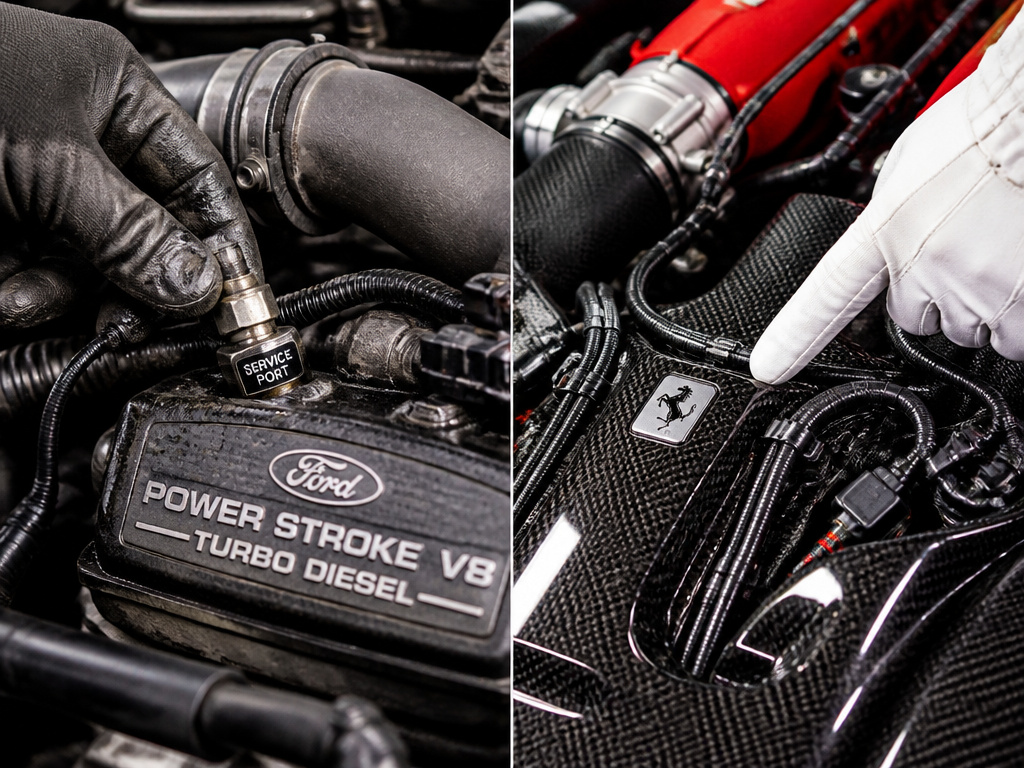
Open the hood. The difference is visual. A Ford 6.7L Power Stroke diesel engine bay is packed, but accessible. Service points are marked. A Ferrari V8 bay is a sculpture of carbon fiber and intricately routed wiring. One is built for the technician. The other is built for the photograph.
This isn’t an accident. It’s intent.
Ford engineers for component survivability. The recalls prove it. The issue is rarely the fundamental design of a Ford’s frame or engine block. It’s a specific batch of parts from a specific supplier on a specific Tuesday. Recall 23V-595 on 2023 F-250 trucks involved left rear axle shafts that missed a complete induction heat treatment. The design was sound. The manufacturing step failed.
Ferrari engineers for performance purity. The technology is in service of sensation. The magnetorheological shocks in a LaFerrari (SCM-E Frs) adjust damping in milliseconds based on steering, braking, and lateral g-forces. The goal isn’t just a smooth ride. It’s keeping the tire’s contact patch perfectly loaded during extreme cornering. The driver feels the difference in the steering wheel.
Where this goes sideways: Assuming a Ferrari’s complexity is just for show. That active damping system is the only thing preventing snap oversteer when the rear hybrid motor delivers its 163 CV instantaneously in a mid-corner.
The Ford’s complexity is in its systems management, controlling turbo boost, exhaust braking, and trailer sway with millions of lines of code. The Ferrari’s complexity is in its physics management, harnessing hybrid torque, aerodynamic downforce, and tire slip angles.
One is about making hard work easier. The other is about making a fast car easier to drive at its limit.
The Ownership Reality Check
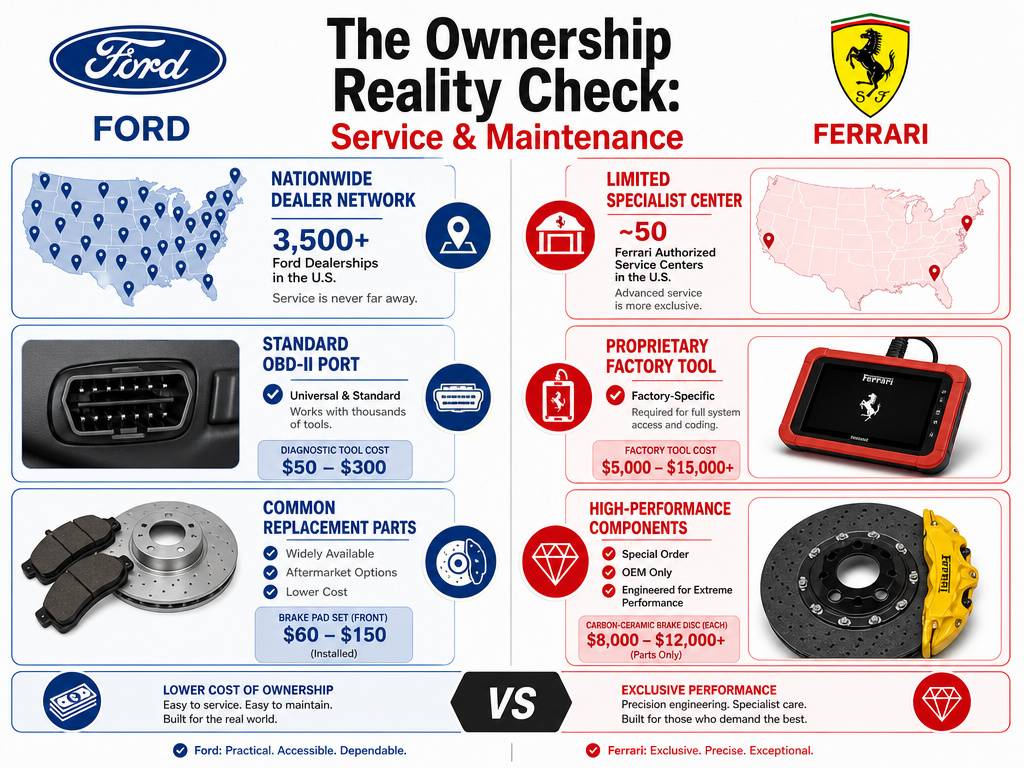
The monthly payment is the smallest part of the equation. The real cost is in time, access, and consequence.
Take your Ford F-150 in for a check engine light related to Recall 24V-957 for the high-pressure fuel pump. You call the 1-866 number, schedule at any of thousands of dealers, and the remedy is a PCM software reflash. It takes an afternoon. The part is a known quantity.
Now imagine a warning light on a Ferrari 812 Competizione. You don’t call a 1-800 number. You call your dedicated service advisor. The car likely goes on a flatbed to a specialist. The technician connects to diagnostic software you can’t buy. The fix might involve a proprietary tool.
The infrastructure is built around each vehicle’s mission. Ford’s network exists to minimize downtime for a tool. Ferrari’s network exists to preserve the integrity of an experience.
| Ownership Factor | Ford Truck Reality | Ferrari Sports Car Reality |
|---|---|---|
| Service Access | Nationwide dealer network; standard OBD-II port. | Limited specialist centers; often requires factory-specific tools. |
| Failure Consequence | Often a tow to the dealer; loaner truck available. | Flatbed to specialist; potential for extended wait for parts. |
| DIY Potential | High for basic maintenance; vast aftermarket support. | Very low; specialized knowledge and tools required. |
| Long-Term Wear | Components designed for replacement (brakes, suspension). | Components designed for performance life, then refurbishment. |
This isn’t about good or bad. It’s about alignment. If you need a vehicle that can be fixed quickly in Billings, Montana, the choice is made. If you accept that maintaining peak performance requires a dedicated channel, the other path is clear.
What’s the Real-World Trade-Off Between a Ford Truck and a Ferrari?
You can’t have both. The trade-off is physical, not financial.
A Ford Super Duty is built around a steel frame. Its suspension is designed for articulation and load-bearing. This gives you that 6,700-pound payload capacity. It also means body roll in corners and a ride that communicates every bump when the bed is empty.
A Ferrari 812 Competizione is built around a carbon fiber tub. Its suspension is designed for minimal flex and instantaneous response. This gives you that telepathic steering feel. It also means a stiff ride that transmits every pavement seam directly to your spine.
The Ford’s trade-off is refinement for utility. The Ferrari’s trade-off is comfort for connection. One isolates you from your work. The other connects you to the road.
Common mistake: Comparing them on “luxury.” A $90,000 Ford Platinum trim has massaging seats and a panoramic sunroof. A $300,000 Ferrari has carbon fiber bucket seats and a fire suppression system. One is about comfort during the commute. The other is about safety during a track day.
The car comparisons that matter aren’t about leather quality. They’re about what you give up to get the core capability. For Ford, you give up sports car dynamics. For Ferrari, you give up daily practicality and repair simplicity.
How Government Data Exposes the Durability Story
Spec sheets are written by marketers. Recall reports are written by lawyers and engineers. For a real-world look at durability, read the NHTSA recall report for 2023 Ford F-150.
That document details how a front axle pinion that skipped heat treatment could fracture, potentially during reverse gear. It’s a specific, documented failure mode with a root cause and a population count (227 vehicles). You won’t find this in a brochure.
This data reveals a pattern. Ford’s recalls often involve high-stress, rotating driveline components from the supplier chain, axles, driveshafts, fuel pumps. The NHTSA recall for Ford F-Super Duty 650-750 cites tie-rod ball studs that underwent an “experimental heat treat process.”
The story isn’t that Ford trucks break. The story is what breaks and why. It’s almost never the core engine or transmission casting. It’s a sub-component from a tier-two supplier, and the fix is a running change on the assembly line or a software update.
Ferrari’s equivalent data is harder to find, as volumes are lower. But the principle holds. Their engineering focus means different failure points, think of complex hybrid battery cooling systems or the delicate calibration of a turbocharger wastegate on a engine producing 128 CV per liter.
The takeaway? Durability isn’t a blanket term. Ford durability is about the driveline surviving years of payloads. Ferrari durability is about the powertrain surviving repeated redline runs.
The Verdict: It’s About the Job
So which is “better”? The question is useless.
The Ford F-250 Super Duty is better at being a Ford F-250 Super Duty. It is the default choice for moving heavy things over uncertain terrain and being fixed anywhere. Its entire ecosystem, from the Ford accessories market to the dealer network, is built for that job.
The Ferrari SF90 Stradale is better at being a Ferrari SF90 Stradale. It is the choice for experiencing the absolute forefront of hybrid performance technology. Its ecosystem, from the factory-trained techs to the premium audio system tuned for engine note, is built for that experience.
Your decision comes down to three questions: 1. What is the machine’s primary task? (Hauling vs. Handling) 2. What does failure look like, and how is it resolved? (Dealer software flash vs. Specialist flatbed) 3. What are you willing to trade? (Dynamic feel for utility, or vice versa)
Answer those, and the spec sheet numbers suddenly make a different kind of sense.
Frequently Asked Questions
Are Ford trucks more reliable than Ferraris?
Reliability depends on the definition. Ford trucks are designed for reliable service under high, repeated load cycles, with a repair system built for speed and scale. Ferraris are designed for reliable performance at extreme limits, with a maintenance system built for precision. A Ford might see the dealer for a recall reflash. A Ferrari requires meticulous scheduled service to maintain its performance envelope. One isn’t more “reliable”, they prioritize different kinds of reliability.
What costs more to maintain, a Ford or a Ferrari?
The Ferrari costs more, by a massive margin. This isn’t just parts costs. It’s the required expertise. A Ferrari annual service is a detailed inspection by a certified technician using proprietary tools. A Ford oil change can be done at any quick-lube shop. The complexity of a Ferrari’s infotainment systems and hybrid powertrain demands specialist knowledge that you pay for.
Can a Ford truck outperform a Ferrari in any way?
Yes, in its designed performance metrics. A Ford F-250 with the 6.7L High Output engine will out-tow, out-payload, and out-climb a Ferrari on a steep, muddy grade every single time. It will also carry more people and cargo in greater comfort. “Performance” isn’t just acceleration. It’s the ability to perform a specific task. The Ford outperforms the Ferrari at being a truck.
Why are Ferraris so expensive compared to Fords?
The cost difference is in material, labor, and volume. Ferraris use extensive carbon fiber, hand-assembled engines, and low-volume, performance-focused components. The development cost of a twin-turbo V8 hybrid system is amortized over a few thousand cars. Ford’s high-strength steel frame and 6.7L diesel are amortized over hundreds of thousands of trucks. You’re paying for exclusivity and an extreme focus on performance metrics most drivers will never use.
Do Ferraris hold their value better than Ford trucks?
It varies by model, but limited-production Ferrari special editions often appreciate. Mainstream Ferrari models still depreciate, but often less severely than a mass-market vehicle due to exclusivity. Ford Super Duty trucks, especially diesel models, are famous for their strong resale value due to their proven utility and durability. Both can be good investments, but for completely different reasons, one as a collectible, the other as a durable tool.
The Bottom Line
Comparing a Ford to a Ferrari is the best way to understand what a car actually is. One is a tool engineered to a price point for a brutal job, with its flaws documented in public recall reports. The other is an experience engineered without compromise for a visceral feeling, with its maintenance rituals part of the ownership contract.
Look past the horsepower war. The real comparison is in the vehicle battery meant to start in -20°F, the car wax formulated for a clearcoat over carbon fiber, and the service invoice that details a software update versus a valve adjustment.
Choose the tool for the job, and you’ll never be disappointed by the numbers.
