
How to Choose the Right Motorcycle Size | Seat Height & CC
This post contains affiliate links. As an Amazon Associate, we earn from qualifying purchases.
Choose the right motorcycle size by matching three things: your inseam to the seat height (using the 85-90% rule), your weight and gear to the bike’s Gross Vehicle Weight Rating (GVWR), and your riding environment to the engine displacement. A 250-300cc bike with a seat under 31 inches fits most new riders; highway use demands at least 400cc, and two-up touring needs 650cc or more.
The 85-90% guideline is a critical safety specification that determines control. That percentage represents how much of your inseam length should equal the seat height, ensuring you can plant your feet flat at a stop.Get this wrong, and tip-overs become a weekly event, not a rare accident.
What follows: the exact seat heights for popular starter bikes, the simple math to check if a bike can carry you and a passenger, and the engine sizes that work for city streets versus long highway runs. By the end, you’ll know which of the three sizing factors matters most for your situation.
Key Takeaways
- Your inseam, not your height, decides the seat height you can manage. Multiply your inseam by 0.85 for the minimum, 0.90 for the ideal maximum.
- The Motorcycle Safety Foundation trains on 150-250cc bikes, but a 250-300cc bike is the practical starting point for most adults on public roads.
- For sustained highway riding (30+ minutes), a 400cc engine is the bare minimum; 500-650cc is where it starts to feel settled and safe.
- Always check the bike’s Gross Vehicle Weight Rating (GVWR). Subtract the bike’s wet weight to find your real payload capacity for rider, passenger, and gear.
- If you can’t perform a walking-speed U-turn in two parking spaces or comfortably hold the bike upright at a stop, it’s too big for your current skill level.
The 85-90% Rule for Seat Height and Inseam
Manufacturer height charts are a rough guide. Your inseam is the real number. It measures from your crotch to the floor in bare feet, and it dictates whether you’ll be standing on your toes or flat-footed at a traffic light.
The community-built 85-90% rule is your benchmark. If your inseam is 30 inches, look for a seat height between 25.5 and 27 inches. This range lets you place the balls of both feet, or better yet, the whole foot, firmly on the ground. That stability prevents the slow-speed tip-over, the single most common beginner accident.
A seat height at 85-90% of your inseam length gives you the platform to hold the bike upright at a stop without shifting your weight off the seat. Drop below 85%, and you might feel cramped; exceed 90%, and you’re on your toes.
This rule explains why a 5’8″ rider can be comfortable on a Suzuki SV650 (30.9-inch seat) while a 5’5″ rider is better suited to a Honda Rebel 300 (27.2-inch seat). Overall height is misleading. Your leg length is the deciding factor.
Specific Models and Their Seat Heights
Here are the numbers for common motorcycles, straight from the spec sheets. Use them with your calculated range.
| Motorcycle Model | Seat Height | Best For Inseam |
|---|---|---|
| Harley-Davidson Street 500 | 25.5 inches | 27 inches or less |
| Honda Rebel 300 | 27.2 inches | 28-29 inches |
| Kawasaki Z400 | 31.1 inches | 33-34 inches |
| Suzuki SV650 | 30.9 inches | 33-34 inches |
| BMW GS series (e.g., R1250GS) | 33-34 inches | 36+ inches |
The Harley Street 500 and Honda Rebel 300 are the go-to picks for shorter riders. If you’re taller, the Kawasaki Z400 and Suzuki SV650 open up. For the very tall, adventure bikes like the BMW GS become viable, but their height and weight make them a poor beginner motorcycle.
Common mistake: Choosing a bike because you can just tip-toe it on the dealer floor. On an uneven road surface with a slight incline, that tip-toe becomes a tip-over. Give yourself margin.
Engine Size (CC): More Than Just a Number
Engine displacement, measured in cubic centimeters or cc meaning, is about usable power, not just top speed. A 300cc engine can reach highway speeds, but it will be working hard. A 650cc engine does it with power in reserve for merging or climbing a hill.
The Motorcycle Safety Foundation uses 150-250cc bikes in its courses. That’s for a controlled lot. For the real world, a 250-300cc motorcycle is the sweet spot for a true beginner. It’s forgiving.
The Highway Displacement Floor
City riding is one thing. Open road is another.
| Riding Scenario | Minimum Recommended CC | Why This Matters |
|---|---|---|
| Occasional highway (<30 min) | 400cc | Engine isn’t strained at 65-70 mph; some passing power remains. |
| Regular highway commute (30-60 min) | 500cc | Maintains speed on grades; less vibration and fatigue. |
| Extended highway touring (1+ hours) or two-up riding | 650cc+ | Sustained power for passing with a passenger or heavy luggage. |
A Kawasaki Ninja 400 can hit 70 mph. But hold it there for half an hour, and the engine sings near its redline. There’s no power left for a quick pass. Step up to a 650cc class bike like the Suzuki SV650, and that same speed sits in the middle of the powerband. The bike feels relaxed. This is the difference between surviving a highway and actually using it.
For riding with a passenger, add 150-200cc to your solo requirement. The extra weight kills acceleration and hill-climbing ability on a smaller engine.
Motorcycle Weight Limits and GVWR
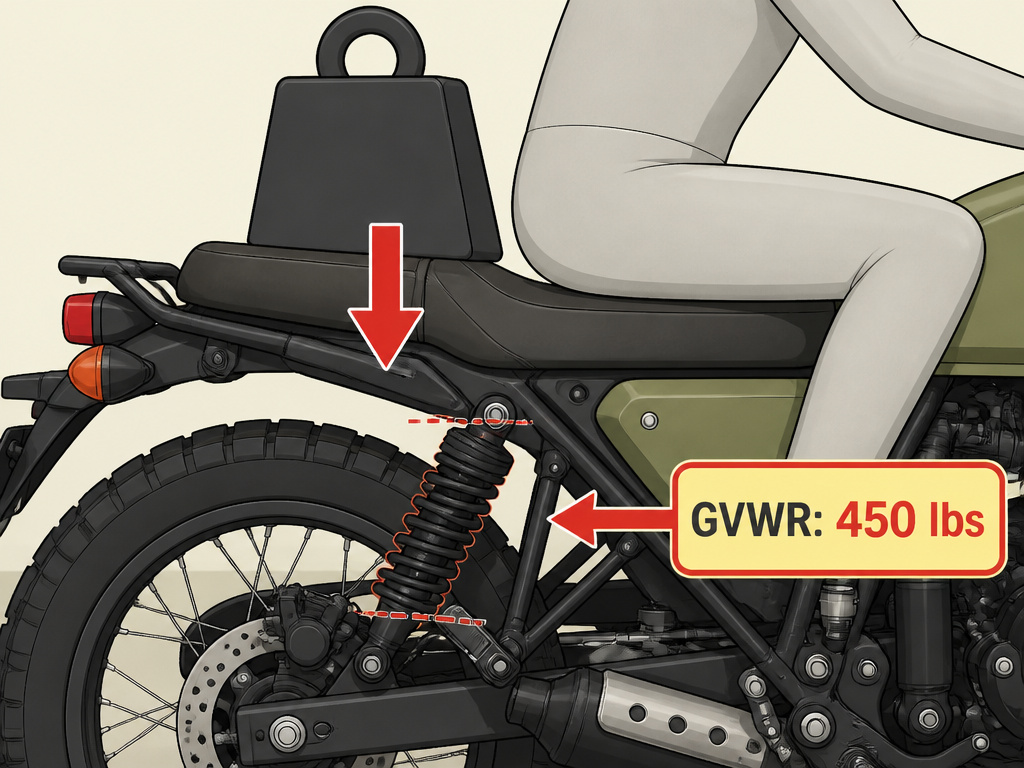
A bike’s dry weight is meaningless. The Gross Vehicle Weight Rating (GVWR) is the critical spec. It’s the maximum total weight the bike is designed to carry: itself, the rider, a passenger, all gear, and a full tank of fuel. Exceed it, and you stress the frame, suspension, and brakes.
The math is simple. Find the GVWR in the manual. Subtract the bike’s curb weight (which includes fluids). The remainder is your payload capacity.
Let’s use the Kawasaki Ninja 400 as an example. Its dry weight is about 375 lbs. Add 15 lbs for a full tank, giving a rough curb weight of 390 lbs. If its GVWR is around 450 lbs, that leaves only 60 lbs of payload capacity. A 180 lb rider with a 20 lb backpack is already 40 lbs over that limit before even adding a passenger. This bike isn’t built for heavy riders or two-up travel.
Where this goes sideways: Ignoring GVWR when you’re a heavier rider or plan to carry gear. The suspension sags, handling gets mushy, and braking distance increases noticeably within the first 100 miles of overload.
Weight Class Guidelines
These class averages hold true, even though some bikes do not publish clear numbers: – 250cc to 500cc: 350-400 lbs capacity. – 500cc to 750cc: 400-500 lbs capacity. – Touring bikes (1000cc+): 500-600+ lbs capacity.
If you’re over 250 lbs, skip the light sport bikes. Look at cruisers, touring bikes, or adventure bikes designed for load. This is also a key reason dual-sport motorcycles can be tricky for beginners, they’re tall, which can be great for tall rider ergonomics, but their suspension is often tuned for a single, lighter rider.
The Physical Test: Is This Motorcycle Too Big For You?
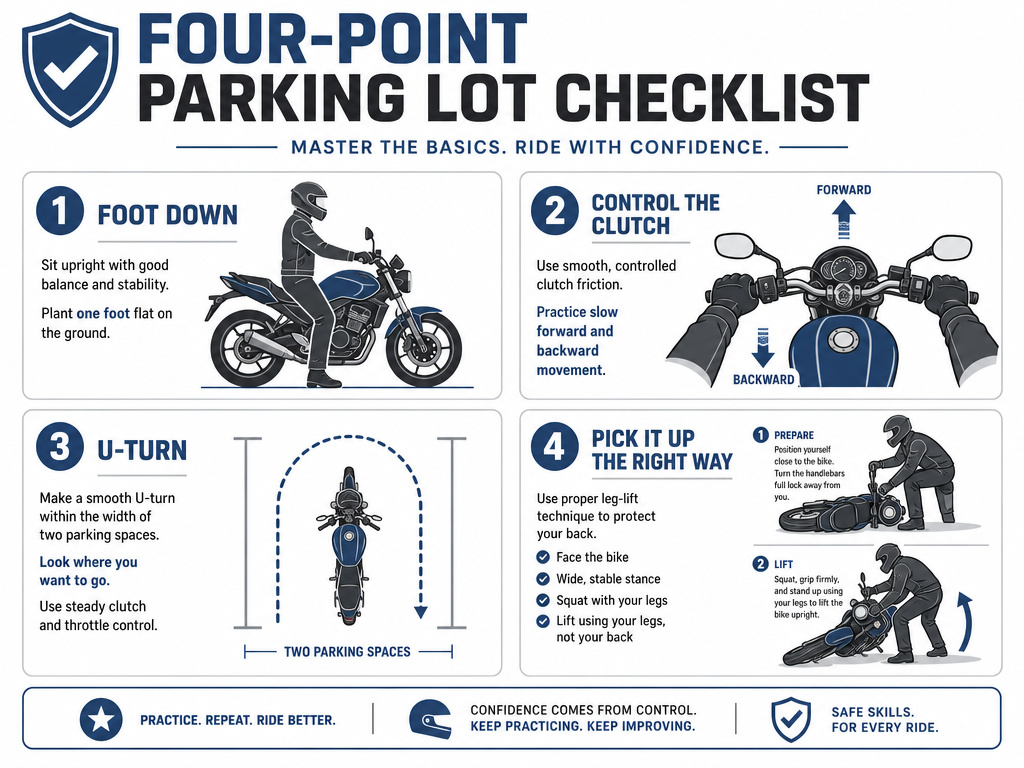
Specs are one thing. Your body and the bike’s physical presence are another. You’ll know a bike is too big within the first five minutes of a test ride, long before you leave the parking lot.
The Parking Lot Checklist:
- Can you flat-foot at least one foot comfortably?
- Can you walk the bike backward and forward without fighting its weight?
- Can you perform a U-turn within the width of two standard parking spaces?
- If you simulate a tip-over, do you feel confident you could lift it back up?
Fail any of these, and the bike is a liability. A bike that feels heavy at a standstill will feel terrifying in slow-moving traffic.
I watched a new rider buy a bike he could only tip-toe. In his driveway, a slight slope made him lose balance. The bike went over, cracked the clutch lever, and dented his confidence for months. He sold it at a loss and bought a Honda Rebel 300. He hasn’t dropped it since.
The throttle is another tell. In first gear, does a tiny twist result in a lurch? That’s a sign the power delivery is too abrupt for your current skill level. ABS brakes](https://theautozenith.com/are-abs-brakes-worth-it-on-a-motorcycle/) are a fantastic safety net, but they don’t help if you’re wrestling the bike’s weight at every stop.
Matching Motorcycle Type to Your Riding
Engine size and seat height tell only half the story. The type of motorcycle defines your posture and, therefore, your comfort and control.
Sport bikes like the Kawasaki Ninja 400 put you in a forward lean. Your weight is on your wrists and your knees are bent. It’s great for agile handling but exhausting on a long ride. Cruisers like the Honda Rebel give you a relaxed, feet-forward posture. It’s comfortable for miles but less nimble in tight corners.
Your riding plans should dictate the type: – City Commuting & Errands: Standard/Naked bikes (Honda CB300R) or small cruisers. Upright posture, good visibility, easy low-speed handling. – Weekend Backroad Fun: Sport bikes (Yamaha R3) or sport standards. Engaging and precise. – Mixed Pavement & Light Off-Road: Dual-sport bikes (Suzuki DR-Z400). High seat height, but versatile. – Long-Distance Touring: Touring bikes (BMW R1250RT) or adventure bikes. Designed for comfort with luggage and wind protection.
Don’t get seduced by a style that contradicts your primary use. A sport bike is misery in stop-and-go traffic. A heavy touring bike is a chore on a twisty mountain road.
How to Choose: Your 5-Step Decision Process
- Measure Your Inseam. Do this honestly, against a wall. This number governs everything.
- Define Your Primary Riding. Be specific. Is it a 30-minute highway commute three days a week? Weekend backroads? This sets your engine size floor.
- Calculate Your Weight Load. Add your weight, your typical gear weight, and if applicable, an average passenger’s weight. Compare this to the GVWR of bikes you’re considering.
- Test for Fit, Not Just Specs. Sit on bikes. Don’t just touch the ground, can you stand on the ground? Can you reach all controls without stretching? Can you see over the tank? Your first motorcycle helmet is a separate but equally vital fit test.
- Rent Before You Buy. A dealer lap doesn’t reveal if your knees ache after an hour. Services exist to rent a bike for a day. It’s the cheapest insurance against a costly mistake.
This process pushes past generic advice. It forces you to confront the trade-offs between a low seat and high ground clearance, or between a light city bike and a stable highway machine. Understanding engine types and drive systems comes later. First, get the size right.
Frequently Asked Questions
What is the best motorcycle size for a 5’8″ rider?
Rider who is 5’8″ typically has a 30-31 inch inseam. This places them comfortably on motorcycles with seat heights between 28 and 31 inches. This opens up most of the beginner and intermediate market, including standards like the Yamaha MT-07, sport bikes like the Kawasaki Ninja 650, and many cruisers.
Can a beginner start on a 500cc motorcycle?
Modern 500cc motorcycle produces about 45-50 horsepower, compared to 25-30 hp for a 300cc bike. That’s a significant jump. While it’s possible, it’s not ideal. The extra power makes mastering clutch control, low-speed balance, and braking fundamentals harder. Starting on a 250-300cc bike for the first six to twelve months builds those core skills safely. The 500cc bike then feels like a rewarding step up, not a constant challenge.
How do I know if a motorcycle is too heavy?
If you struggle to hold the bike upright when stopped on a slight incline, or if you can’t easily paddle it around a parking lot with your feet, it’s too heavy for your current strength and skill. A bike should feel planted, not burdensome. This is one of the biggest beginner challenges to gauge from a spec sheet alone.
Is a 300cc motorcycle good for the highway?
300cc motorcycle can reach and maintain 65-70 mph, but it has little power left for passing or climbing hills at that speed. It’s fine for short highway stints of 20-30 minutes. For regular highway use, especially with traffic, a 400cc engine is the practical minimum, and a 500-650cc bike is where highway riding starts to feel secure and less taxing.
What if I’m taller than 6’2″ or heavier than 250 lbs?
You break the standard advice. At that size, many 250-300cc beginner bikes will feel cramped and their suspensions will be overloaded. You should look at the upper end of the beginner range (400-650cc) for a physically larger bike frame. Focus on cruisers, adventure-touring bikes, or standard bikes known for roomy ergonomics. Your primary filter becomes payload capacity and seat dimensions, not just engine size.
Before You Go
Choosing the right size focuses on selecting a safe learning tool. That tool is a 250-300cc motorcycle with a seat height at 85-90% of your inseam for most new riders.Ignore the temptation to “grow into” a bigger bike. Growth happens in your skill, not in your garage.
Match the bike to your actual life: your commute, your body, and your honest experience level. Get the size right, and every ride builds confidence. Get it wrong, and every ride is a struggle you’ll want to quit. The numbers, seat height, GVWR, cc, are your anchors against a sea of marketing and peer pressure. Use them.
