
Chain Drive vs Shaft Drive: The Key Differences Explained
This post contains affiliate links. As an Amazon Associate, we earn from qualifying purchases.
The difference between a chain drive and a shaft drive comes down to how power gets to the rear wheel and who maintains the connection. Chain drives use a metal chain linking two sprockets, offering high efficiency and easy gearing changes at the cost of weekly upkeep. Shaft drives use a sealed gearbox to spin a driveshaft, delivering smooth power and near-zero maintenance, but with higher weight and repair complexity.
That choice impacts your garage time, your wallet, and how the bike feels when you twist the throttle. The physical link between engine and wheel shapes the machine’s character.
What follows is a look at how each system works, the real-world upkeep they demand, and where the marketing lines about “forever durability” sometimes crack. By the end, you’ll know whether your next bike belongs on stands every Sunday afternoon or spends that time on the road.
Key Takeaways
- Shaft drives require the least routine maintenance, needing fluid changes only every 20,000 to 40,000 km. Chain drives need cleaning and lubrication every 600 to 1,000 miles.
- Chain drives win on raw efficiency and mechanical simplicity, offering the most direct power transfer. Shaft drives lose roughly 5-10% more energy through internal gears.
- A catastrophic chain failure on the road is often a field-repairable nuisance. A shaft drive failure typically means a tow truck and a professional mechanic.
- Wet, muddy, or salt-laden conditions accelerate chain wear exponentially and necessitate immediate cleaning. Shaft drives are largely sealed from these elements.
- While shaft drives are marketed as “lifetime” systems, forum reports show failures can and do happen within warranty periods, contradicting the “bulletproof” myth.
What Is a Chain Drive?
Think of it as a bicycle drivetrain on steroids. A motorcycle chain drive is an open, exposed system. A metal roller chain loops around a front sprocket on the transmission output shaft and a larger rear sprocket attached to the wheel hub.
As the engine turns the transmission, it spins the front sprocket. The sprocket’s teeth catch the chain’s inner rollers, pulling the chain forward. This force spins the rear sprocket and, consequently, the rear wheel. It’s a direct, mechanical linkage with minimal energy loss, which is why chain drives can boast mechanical efficiencies above 95%.
A motorcycle chain drive is an external, unsprung mechanical system consisting of a drive chain, a front (drive) sprocket, and a rear (driven) sprocket. The chain’s link plates engage with the sprocket teeth to transmit torque from the transmission to the rear wheel with high efficiency, typically above 95%.
This design offers clear advantages. Changing the final drive ratio is a simple matter of swapping sprockets, making it a favorite for tuners and racers. The components themselves, a standard 520 or 525 chain, steel sprockets, are widely available and relatively inexpensive. The whole assembly adds very little unsprung weight, which benefits handling and suspension response.
The trade-off is upkeep. That same efficient, exposed system is a magnet for road grit, water, and salt.
What Is a Shaft Drive?
A shaft drive motorcycle encloses the entire power transfer system. Instead of a chain, a spinning driveshaft, much like in a car, runs from the transmission to a gearbox at the rear wheel. This gearbox contains a set of bevel gears that change the drive angle by 90 degrees to turn the wheel.
The beauty is in the seal. All the gears and the driveshaft itself live inside an oil-filled housing. The lubricant is contained, and the moving parts are protected from the outside world. You get a clean, quiet transfer of power with almost none of the external mess or noise of a chain.
Where this goes sideways: Ignoring the fluid. Motorcycle manuals specify replacing shaft drive fluid every 20,000–40,000 km, but some owners skip it entirely, assuming the system is “sealed for life.” The fluid degrades from heat and shear over time. Skipping this change accelerates internal wear, and by 60,000 km, the gears can show measurable pitting that a simple fluid swap would have prevented.
The experience is different. The power delivery feels smoother and more damped, which is a plus for long-distance comfort. There’s no chain whine or lash. The downsides are physical: the system is heavier, adds more unsprung mass, and its internal gears sap a bit more power, making the bike feel less directly connected to your right wrist. Repairs also mean cracking open that sealed case, which isn’t a driveway job for most people.
The Maintenance Reality Check
This is where the theoretical pros and cons hit your weekend schedule. The gap between “low maintenance” and “no maintenance” is where owners form their strongest opinions.
Chain maintenance is a ritual. You need a stand, a brush, a rag, a can of degreaser, and your chosen motorcycle chain oil. The general rule is a clean-and-lube every 600 miles or after any ride in the rain or muck. It’s greasy, tedious, and if you skip it, the consequences are swift and visible: rust, stiff links, and accelerated wear on both the chain and the sprockets.
Shaft drive maintenance is calendar-based, not mileage-based in the same way. You visually check for oil leaks and monitor the fluid level through a sight glass or dipstick. The major service is a fluid drain-and-refill, which the manual schedules at high intervals. The catch is that when this service is due, it often requires specialized tools and a more involved procedure than a simple oil change.
| Maintenance Task | Chain Drive | Shaft Drive |
|---|---|---|
| Primary Upkeep | Clean & lubricate (~every 600 mi) | Check fluid level (periodically) |
| Major Service | Replace chain & sprockets (~15-20k mi) | Change final drive fluid (~20-40k km) |
| Tools Required | Stand, brush, lubricant, basic wrenches | Hex keys, fluid pump, often a service manual |
| Field Repair | Master link, spare chain, basic tools | None possible; requires tow |
For chain owners, investing in a good chain cleaning kit turns a chore into a quicker job. For shaft owners, the peace of mind comes from knowing your final drive will perform consistently from Alaska to Argentina without a Sunday afternoon scrubbing session.
Efficiency, Weight, and the Riding Feel
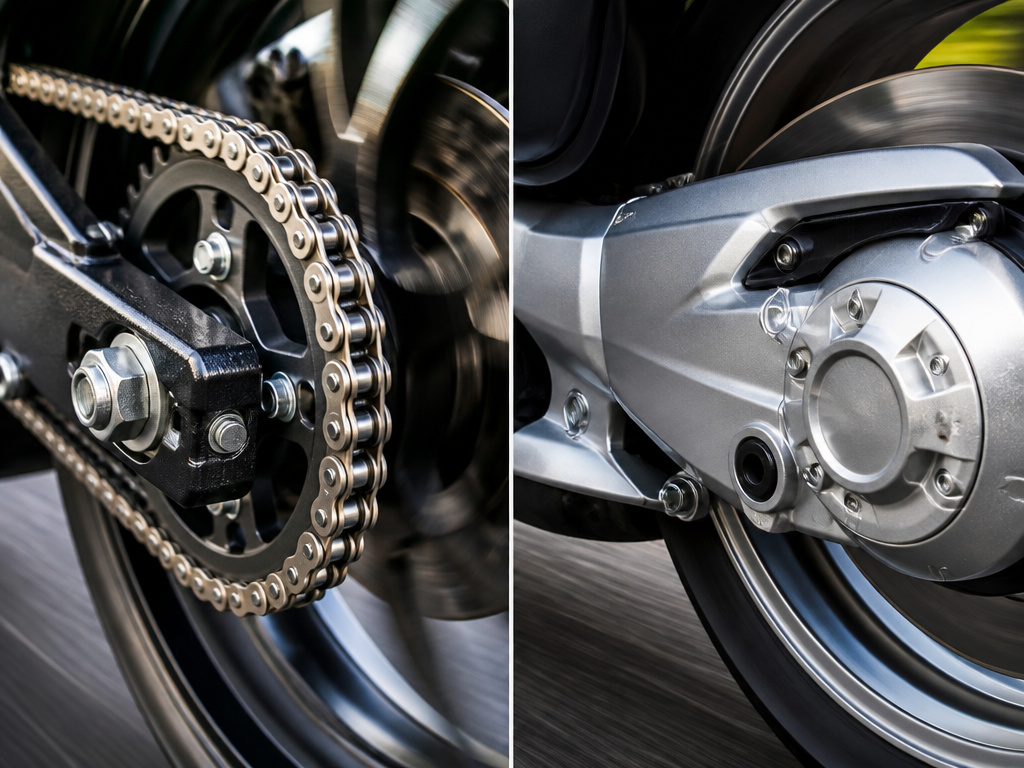 The spec sheets tell one story, but the seat-of-your-pants experience tells another. The mechanical differences between these systems directly shape how a motorcycle accelerates, handles, and sounds.
Chain drives are the athlete of the pair. Their high mechanical efficiency, often cited as over 95% in resources like the UTI motorcycle final drives guide, means almost all the engine’s power reaches the wheel. The lack of internal gearing reduces parasitic loss. This efficiency, combined with minimal unsprung weight, gives a chain-driven bike a lively, immediate feel. You get more snap per throttle input. The trade-off is the constant background whir and the occasional clunk of chain lash.
Shaft drives add mass and complexity between the engine and the tire. The bevel gears and the spinning shaft itself create inertia and friction, which saps a few percentage points of power. That weight is also unsprung, affecting how the suspension reacts to bumps. The result is a sensation often described as “muted” or “damped.” The bike feels smoother and more relaxed, but less razor-sharp in its responses. It’s a trade many touring riders gladly make for reduced NVH (Noise, Vibration, Harshness).
TL;DR: For raw, connected performance, choose the chain. For isolated, serene cruising, choose the shaft.
Which System Is More Reliable? (Spoiler: It Depends)
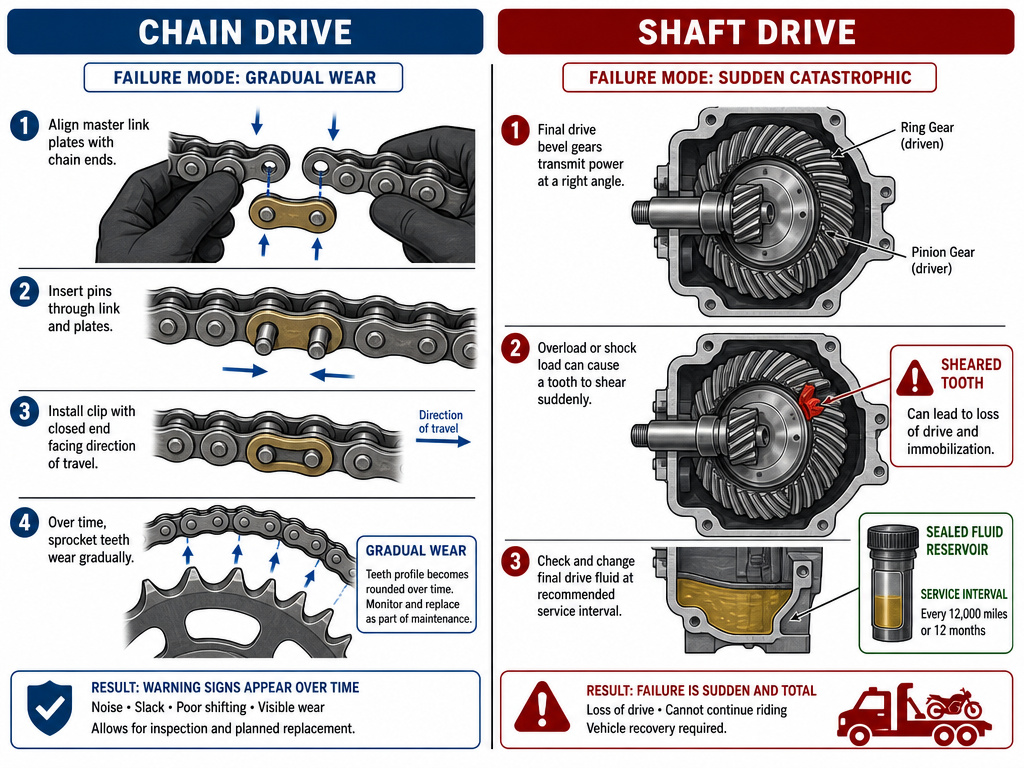 Reliability isn’t just about which part breaks less; it’s about which system fails in a way you can manage. The myth is that shaft drives are indestructible, while chains are fragile. The reality is more nuanced.
A well-maintained chain system is remarkably reliable. The failure mode is usually gradual wear, stretch, sprocket hooking, that gives ample warning. A sudden, catastrophic chain break is rare and often the result of severe neglect. Crucially, if a chain does fail on a trip, a rider with a spare master link and basic tools can often effect a trailside repair and limp home.
Common mistake: Believing shaft drives are “maintenance-free.” They are not. They are “low-maintenance.” The sealed fluid still breaks down from heat and mechanical shear. Forum threads on sites like ADVrider are full of reports from owners who experienced shaft or final drive gear failures well within the factory warranty period, often on high-mileage tourers. The system is durable, but not immortal.
Shaft drive reliability is high, but its failure mode is binary. Because it’s a sealed, internal system, there are no warning signs an average rider can detect. A bearing seizes or a gear tooth shears, and the bike is instantly immobile. There is no field fix. Your trip ends with a tow truck and a bill that reflects the complexity of the repair. Its reliability hinges entirely on following the factory fluid service intervals, which many owners overlook.
Making the Choice: Chain or Shaft?
This isn’t an abstract debate. Your riding habits, location, and mechanical appetite should dictate the answer. Let’s match the system to the scenario.
Choose a chain drive if: * You ride off-road, in motocross, or on aggressive adventure bikes. The ability to change gearing easily and the lighter weight are critical. * You enjoy performance riding or track days, where maximum power delivery and feedback matter. * You are on a budget, both for initial purchase and for ongoing parts replacement. * You don’t mind (or even enjoy) hands-on maintenance and want the ability to perform all repairs yourself. A solid step-by-step chain cleaning guide is your friend. * You ride in a dry, clean climate where chain corrosion is less of a constant battle.
Choose a shaft drive if: * Your primary use is long-distance touring or daily commuting where you value convenience above all. * You ride in wet, wintery, or coastal regions where road salt and constant moisture would torment a chain. * You prefer a cleaner garage and bike, with no oily spatter on the rear wheel and swingarm. * You are less inclined toward DIY and are comfortable with scheduled professional servicing. * You prioritize a smooth, quiet, and low-vibration riding experience.
For the vast majority of street riders, the choice is made for you by the motorcycle itself. Sport bikes and dirt bikes are chain-driven. Large touring machines from BMW, Honda (Gold Wing), and Moto Guzzi are often shaft-driven. Your decision is often which category of bike fits your life.
The Final Verdict on Final Drives
There is no single “best” system, only the best system for the job you need it to do.
A chain drive is a tool of engagement. It connects you directly to the machine’s mechanics, for better and for worse. It rewards diligent care with thrilling performance and punishes neglect with rapid wear. It’s the choice of the tinkerer, the racer, and the rider who doesn’t mind getting their hands dirty.
A shaft drive is a tool of convenience. It isolates you from the drivetrain’s grit and grime, offering a polished, consistent experience mile after mile. It asks little of you between major services but places the burden of any major repair squarely in the hands, and invoice, of a trained technician. It’s the choice of the mile-eater, the commuter, and the rider who measures fun by distance traveled, not hours spent in the garage.
Your next bike likely already has its answer built in. Understanding that answer, why the chain whines, why the shaft is smooth, and what each one will ask of you, is what turns a purchase into an informed partnership.
Frequently Asked Questions
Which is more expensive to maintain, chain or shaft drive?
Long-term, a shaft drive is often more expensive. While it avoids the recurring cost of chains, sprockets, and cleaners, a single major repair, like a final drive unit replacement, can cost several thousand dollars. Chain drive costs are lower but spread out consistently over time for parts like a new chain cleaning kit and replacement chains.
Can you convert a chain drive bike to a shaft drive?
No, it is not a practical or economically feasible conversion. A shaft drive requires a completely different frame design, swingarm, transmission output, and rear wheel hub. The engineering is integral to the motorcycle’s chassis. It would be cheaper and easier to sell the chain-drive bike and buy one designed with a shaft from the factory.
Do shaft drive motorcycles handle differently?
Yes, they can. The shaft’s rotational inertia can cause a phenomenon called “shaft jacking” under hard acceleration or deceleration, which can subtly affect the bike’s pitch and suspension behavior. The added unsprung weight can also make the rear suspension feel slightly less responsive over sharp bumps compared to a lighter chain system.
How often should I really clean my motorcycle chain?
Follow the 600-mile or “after getting wet” rule as a baseline. If you ride in clean, dry conditions on mostly highway, you can stretch it. If you commute daily in rain or ride on dusty trails, you should clean and lubricate more frequently, even after every ride. The chain should never look dry, rusty, or caked with black grime.
Are there any other types of final drives?
Yes. Belt drives are a third major type, primarily found on American cruisers and some modern electric motorcycles. They use a reinforced Kevlar or rubber belt running on pulleys. Belts offer a clean, quiet, and low-maintenance experience like a shaft, but are lighter and more efficient. However, they are vulnerable to being cut by road debris and are not suitable for high-torque or off-road applications.
The Bottom Line
Don’t choose between a chain and a shaft based on myth. Choose based on the relationship you want with your motorcycle.
If you want a hands-on partnership where performance is directly tied to your care, pick the chain. Its needs are clear, its rewards tangible. If you want a turn-key appliance that delivers miles without fuss, pick the shaft. Its costs are deferred, its service scheduled.
Both systems, when matched to their intended use and properly maintained, will deliver years of faithful service. The real failure is putting a low-maintenance shaft drive bike through single-track mud runs, or expecting a high-performance chain drive sport bike to cross a continent without a Sunday spent with a brush and a can of lube. Know what you’re buying, and why.
