
What Does CC Mean on a Motorcycle? How It Impacts Power & Ride
This post contains affiliate links. As an Amazon Associate, we earn from qualifying purchases.
On a motorcycle, “CC” stands for cubic centimeters, a unit measuring engine displacement, the total volume swept by all the engine’s pistons. This number, often rounded for marketing, gives a rough idea of potential power, but a bike’s real performance is decided by its weight, torque, and the rider’s skill.
That gap between the rounded number on the badge and the engine’s actual swept volume is where the real story starts. A Royal Enfield Bullet 350 isn’t exactly 350cc; it’s 346.36cc. Manufacturers round up or down to hit a clean marketing number. Knowing this helps you see past the spec sheet.
The rest walks the connection between cubic centimeters, torque, and what the bike actually feels like on the road. We’ll cover why a heavy touring bike needs a massive engine just to move, why a light sportbike with half the displacement can feel faster, and what the manual says about keeping that engine alive long after you buy it.
Key Takeaways
- CC is a volume measurement, not a direct power rating. It’s the total space inside the cylinders where fuel and air mix.
- Manufacturers round the calculated displacement for clean marketing. A “350” might be 346cc; a “1000” might be 998cc.
- Motorcycle weight is the single biggest thief of engine performance. A heavy bike like a Honda Gold Wing needs a huge CC advantage to feel as quick as a light Kawasaki Ninja.
- Your first 500 miles (800 km) dictate the engine’s long-term health. The Indian Rider’s Manual treats the break-in period as non-negotiable.
- For a new rider, start between 250cc and 400cc. This range has enough power for highway merging but won’t overwhelm you with instant acceleration.
Beyond the Badge: What “CC” Actually Measures
The letters on the side cover tell you a bike’s potential energy budget. Think of CC as the size of the fuel-air mixture’s workspace.
The Mechanic’s Core Question: How Do You Measure a CC?
Engine displacement is calculated using a cylinder’s bore (diameter) and stroke (travel distance). The formula is a constant (π/4) multiplied by the bore squared, multiplied by the stroke, multiplied by the number of cylinders.
For the Royal Enfield Bullet 350, the bore is 70mm and the stroke is 90mm. Plugging those numbers in gives you 346.36 cubic centimeters. The marketing team rounds that up to 350.
Common mistake: Judging a bike solely by its badge CC. A 600cc sportbike and a 600cc cruiser deliver that power in completely different ways, to completely different frames. The sportbike will feel violently fast; the cruiser will feel adequate.
This rounding is universal. A “1000cc” liter bike might be 998cc or 1002cc. The difference is negligible in practice, but it proves the number is a label, not a precise scientific specification.
Why Displacement Isn’t the Whole Story
CC tells you how much mixture the engine can ingest. It doesn’t tell you how efficiently it burns that mixture or how much of that energy actually reaches the rear wheel.
Torque is the rotational force the engine produces. Horsepower is how fast that force can be applied. A high-CC engine in a heavy chassis can feel sluggish because all its torque is used just to move the bike’s mass. A smaller, lighter bike uses a higher percentage of its torque for acceleration.
The Harley-Davidson Road King Special uses a Milwaukee-Eight 107 engine, that’s 107 cubic inches, or about 1750cc. It makes massive torque. But the bike weighs over 800 pounds. That torque moves a lot of metal before it moves you.
| Metric | What It Measures | Why It Matters |
|---|---|---|
| Cubic Centimeters (CC) | Total piston-swept volume | Rough potential for power and fuel consumption |
| Torque | Rotational force (lb-ft or Nm) | Determines low-end grunt, acceleration feel, and hill-climbing ability |
| Horsepower | Rate of work (torque × RPM) | Dictates top speed and high-RPM performance |
| Weight (Wet) | Total mass with all fluids | The single biggest factor in negating or amplifying engine output |
CC Categories Decoded: From Moped to Monster
These ranges are general guidelines. A bike’s purpose within its category matters more than the exact number.
125cc – 300cc: The Commuter & First-Bike Zone
This is the domain of the Honda Rebel 300 and similar entry-point machines. They make between 15 and 30 horsepower. That’s enough power for city streets, light highway use, and learning the fundamentals of throttle control without overwhelming consequences.
For most new riders, a 300cc class motorcycle is the default. It covers the large majority of initial training needs and won’t punish every small mistake with a power wheelie.
Their light weight makes them forgiving and fun on twisty back roads. You’ll use all the gears, learn to carry corner speed, and build muscle memory. The limitation is sustained highway speed; passing maneuvers at 70+ mph require planning.
500cc – 800cc: The Sweet Spot for Versatility
This is the all-rounder category. Bikes here, like many middleweight adventure or standard models, have enough power for two-up touring, confident highway cruising, and spirited backroad play. The weight starts to increase, but so does the torque curve, making them feel less strained.
They’re a logical second bike after a year or two on a 300cc. The jump in power is noticeable but manageable. These engines often last longer because they aren’t stressed to their absolute limit to achieve performance.
900cc and Above: The Performance & Touring Realm
Here, CC becomes a badge of intent. A 1000cc sportbike like a modern superbike is engineered for peak power at high RPMs. It will be brutally fast, tactile, and demanding to ride at its limit.
A 1800cc cruiser or touring bike uses its enormous displacement to generate massive, low-RPM torque. The goal is effortless cruising, not lap times. The weight penalty is severe, but the power delivery is smooth and predictable.
The Three Factors That CC Can’t Tell You (But You Need to Know)
Displacement is a static number. The bike’s life and behavior are dynamic.
1. Weight: The Great Performance Equalizer
This is the non-negotiable physics. A motorcycle isn’t just an engine; it’s a system where the engine must accelerate the entire mass of the bike and rider. A 500-pound, 1200cc cruiser might be slower to 60 mph than a 400-pound, 700cc standard bike. The lighter bike uses a higher percentage of its power for acceleration.
When comparing bikes, always look at the wet weight. That’s the real number the engine has to move.
2. Maintenance & Operating Environment
A number in a manual is for ideal conditions. The Ducati Multistrada 1260 S Owner’s Manual explicitly states that riding in “very damp, muddy, dusty, or dry environments” causes above-average wear. Your 1000cc adventure bike’s service intervals shrink if you actually take it off-road.
The Indian Rider’s Manual is blunt about the first 500 miles (800 km). It’s a break-in period, not a suggestion. Fail to follow it, and you risk “serious engine damage.” This applies whether you have a 600cc Scout or a 1800cc Challenger. The engine’s longevity is programmed in those first few tanks of gas.
3. Technology & Rider Aids
Modern electronics change the relationship between CC and controllability. Ducati’s DWC (Ducati Wheelie Control) on the Multistrada lets you dial how much the front wheel lifts. A 1260cc bike can be made to feel tame. Traction control, ride modes, and quick shifters let less experienced riders manage bigger engines safely.
A 1980s 900cc bike is a raw, demanding animal. A 2020s 900cc bike with all the aids is a civilized, fast tourer. The CC is the same; the experience is not.
How to Use CC When You’re Shopping
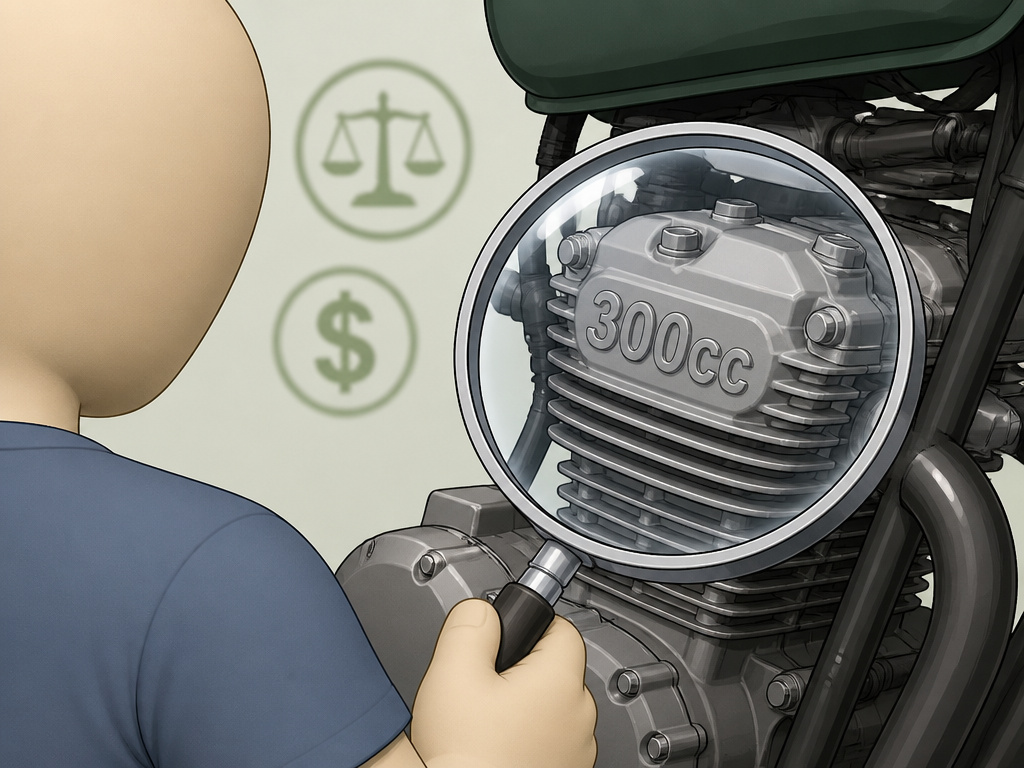 It’s a starting filter, not a finishing decision.
First, be honest about your experience. If you’re new, stick to the 250cc–400cc bracket. Look at a specific beginner motorcycle like the Honda Rebel 300 or a Kawasaki Z400.
Second, match the CC to your primary use case. Need a bike for a two-hour daily highway commute? A 300cc will feel strained; a 500cc–700cc standard or sport-tourer is better. Just riding backroads on weekends? A lighter 400cc might be more fun than a heavier 650cc.
Third, look up the wet weight. Compare two bikes you’re considering. If one has 200cc more displacement but weighs 80 pounds more, the lighter bike might actually feel quicker and more agile.
Finally, remember everything else you’ll need to buy. A bigger CC bike often means higher insurance, more expensive tires, and thirstier fuel consumption. Factor in the cost of proper motorcycle gear and a motorcycle battery charger for maintenance.
Frequently Asked Questions
Is a higher CC motorcycle faster?
Not necessarily. Speed is a function of power-to-weight ratio and aerodynamics. A 1000cc sportbike is fast because it’s light and makes high horsepower. A 1800cc touring bike is heavy and not designed for top speed, despite its massive engine. A 600cc sportbike can easily outrun a 1200cc cruiser.
What CC is good for a beginner rider?
250cc to 400cc is the ideal starting range. Bikes in this category, like the Kawasaki Ninja 400 or the Yamaha MT-03, have manageable power that won’t intimidate, enough performance for highway use, and are usually lightweight and forgiving. Starting on a liter bike (1000cc) is a common and often costly mistake.
Does CC affect fuel economy?
Generally, yes. A larger engine burns more fuel per combustion cycle. But it’s not absolute. A modern, fuel-injected 500cc twin might get better mileage than a carbureted, air-cooled 250cc single-cylinder because of advanced engine management. Riding style, constant full throttle vs. Gentle cruising, matters more than displacement alone.
How does CC relate to motorcycle license restrictions?
Many countries and US states have tiered licensing based on engine displacement or power output. A learner or restricted license often limits you to motorcycles under a certain CC (e.g., 250cc, 400cc, or 650cc). You must check your local Department of Motor Vehicles (DMV) or equivalent authority for the exact motorcycle size and power restrictions that apply.
Can I increase my motorcycle’s CC?
Technically, yes, through big-bore kits that increase the cylinder bore diameter. Practically, it’s a complex, expensive modification that often voids the warranty, may make the bike illegal for road use, and can compromise reliability if not done perfectly. For most riders, buying a bigger bike is a smarter investment.
Before You Go
CC is your first clue, not your final answer. It points you toward a bike’s potential character, a 300cc is a learner, a 600cc is a sporty middleweight, a 1800cc is a tourer. But the real decision happens when you add weight, technology, and your own riding goals to the equation.
Forget the idea that more CC is inherently better. A lighter, smaller-displacement bike you ride confidently is infinitely better than a terrifying liter bike that lives in the garage. Pay as much attention to the owner’s manual’s break-in procedure and the recommended motorcycle oil change intervals as you do to the badge on the crankcase. That’s what determines if your engine lives a long, healthy life.
