
The Best Motorcycle for Tall Riders & How to Choose Yours
This post contains affiliate links. As an Amazon Associate, we earn from qualifying purchases.
You find the best motorcycle for tall riders by looking beyond seat height to the complete rider triangle, the relationship between the seat, footpegs, and handlebars, and picking a style built on long-travel suspension and a tall chassis. Adventure bikes and some sport-tourers dominate the list because their frames prioritize legroom.
Seat height is the starting spec, but it isn’t the whole story. An 870mm seat can feel cramped if the pegs are high and forward or the bars are low. The real measure is the space between these three contact points.
This guide breaks down why tall riders struggle on many bikes, names the specific models across styles that actually work, and provides a decision framework based on inseam and riding preference.
Key Takeaways
- The “rider triangle” (seat, pegs, bars) matters more than seat height alone. A bike can have a high seat but cramped pegs.
- Adventure bikes and dual-sports offer the most legroom by design, with models like the Suzuki V-STROM 800DE and Yamaha Ténéré 700 Rally leading the pack.
- Handlebar risers and adjustable footpegs are not just accessories; they are essential fit modifications for tall riders on most motorcycles.
- Always test-ride before buying. A bike that looks perfect on paper can feel wrong in minutes due to peg placement or bar sweep.
- Cruisers can work for tall riders, but only with forward controls or extended footboards, mid-mount pegs will cramp knees on long rides.
The Seat Height vs. Rider Triangle Problem
The first spec you check is seat height. It’s a useful number, but it’s a vertical measurement from the ground to the seat. It tells you nothing about the horizontal space between the seat and the footpegs, or the reach to the handlebars. This three-point relationship is the rider triangle, and it’s where comfort lives or dies.
A high seat with footpegs positioned directly beneath it creates a knees-up, cramped posture. A tall rider on such a bike looks folded up, and the hips and lower back will ache within an hour. The ideal triangle for a tall rider has a long, diagonal line from the seat to the pegs, allowing a straighter leg angle. The handlebars need to be high enough and far enough back so you aren’t leaning forward excessively.
Where this goes sideways: Choosing a bike based solely on seat height. You buy the BMW R 1300 GS Adventure for its 900mm seat, only to find the cylinder guards dig into your shins on every stop because your legs are so long. The seat is high, but the engine layout and peg placement don’t create the open triangle you need. This exact scenario was noted by a 6’5″ tester, proving that paper specs lie.
Manufacturers don’t publish a standard “rider triangle” measurement. You have to piece it together from the wheelbase, rake, and trail figures, then sit on the bike. Look for a long wheelbase and a relaxed steering head angle, common in adventure and touring bikes, as these usually correlate with more room between seat and pegs.
Sourced Specs and Dimensions That Actually Matter
Let’s move past marketing and look at the numbers that change the fit. Ground clearance is a hidden gem. A bike with high ground clearance, like the Suzuki V-STROM 800DE at 220mm, has a tall frame. That tall frame forces the manufacturer to mount the footpegs lower to maintain usable clearance, which naturally opens up the leg angle. Long-travel suspension, common on adventure bikes, also lifts the whole chassis and contributes to a more open cockpit.
For handlebar reach, look at the fork rake and trail. A steeper rake (a smaller number) usually brings the bars closer to the rider. A more relaxed rake (a larger number) pushes the front wheel further out, often increasing the distance to the bars. The 2026 Honda Gold Wing Tour has a 30.5° rake and a 66.9-inch wheelbase, that long wheelbase is a major reason it fits taller riders, even with a relatively low 29.3-inch seat.
| Critical Dimension | What It Tells You About Fit | Ideal Range for Tall Riders |
|---|---|---|
| Wheelbase | Distance between wheel axles; longer usually means more stretch room. | 60+ inches |
| Rake / Trail | Steering geometry affecting bar reach and high-speed stability. | Look for relaxed rake (higher number) for touring comfort. |
| Ground Clearance | Height of frame from ground; higher clearance often means lower, more relaxed peg placement. | 200mm+ is a good indicator. |
| Seat-to-Peg Distance | The holy grail measurement; must be measured in person or inferred from rider reviews. | The longer, the better. |
The Bennetts Insurance roundup for 2026 provides a solid baseline of seat heights across categories. It lists the Yamaha Ténéré 700 Rally at 910mm, the BMW R1300GS Adventure at 900mm, and the KTM 1390 Super Adventure R at 880mm. These are your starting points for a test sit.
Best Motorcycle Styles for Tall Riders Breakdown
Your body type and riding style decide the category. An adventure bike fits a 6’3″ rider who stands on the pegs off-road differently than a 6’3″ rider who wants to cruise cross-country on pavement.
Adventure & Dual-Sport Bikes
This is the default answer for a reason. The category is defined by high suspension travel, tall frames, and upright seating. The Suzuki V-STROM 800DE is a standout for 2026. Its new 776cc parallel-twin engine is compact, allowing the designers to push the seat forward for a better weight distribution while maintaining a 21-inch front wheel and that critical 220mm of ground clearance. The rider’s hip point is further forward than on many rivals, which helps taller riders shift their weight over rough terrain without feeling perched on the back of the bike.
The Yamaha Ténéré 700 Rally (910mm seat) and the BMW R1300GS Adventure (900mm seat) are the flagship options. The KTM 1390 Super Adventure R (880mm) packs massive power but a slightly lower seat. For newer or budget-conscious tall riders, the Honda CRF300 Rally (885mm) and the Royal Enfield Himalayan 450 (up to 845mm) offer accessible entry points with legitimately tall cockpits.
Sport-Touring & Naked Bikes
These offer a more road-focused, performance-oriented fit. The key is finding models with adjustable ergonomics. The Suzuki GSX-S1000GX+ has an 845mm seat and a front-end design that offers a more upright position than a pure sportbike. The Kawasaki Versys 1100 (840mm seat) and the Yamaha Tracer 9 (adjustable up to 860mm) are built for mile-eating comfort with wind protection.
The BMW S 1000 XR (850mm seat) is the high-performance choice, with a four-cylinder engine and an adjustable seat and bars. These bikes often require simple modifications like handlebar risers, a 30mm rise can transform the reach and relieve wrist pressure.
Cruisers
This is the trickiest category. Standard cruiser ergonomics with mid-mount footpegs are a nightmare for anyone with a 34-inch+ inseam. You need a model designed with or adaptable to forward controls. The riding position shifts from knees-up to legs-out, which can perfectly suit a tall rider’s proportions. When you choose the right motorcycle size, understanding that cruiser fit is about peg position, not seat height, is the first lesson.
Some larger baggers and touring cruisers, with their longer wheelbases and often adjustable seats, can work well. The key is to sit on one and see if your legs can stretch to the controls without your knees hitting the fairing or tank.
Retro & Scrambler Bikes
These often borrow the taller stance of their dual-sport inspirations. The Triumph Scrambler 1200 XE boasts an 870mm seat and a relatively long, flat profile. The new Ducati DesertX can peak at a 900mm seat with the optional high seat kit. These bikes blend style with a potentially excellent rider triangle for taller riders, though their bar reach can sometimes be too short without risers.
Essential Modifications and Gear for the Tall Rider
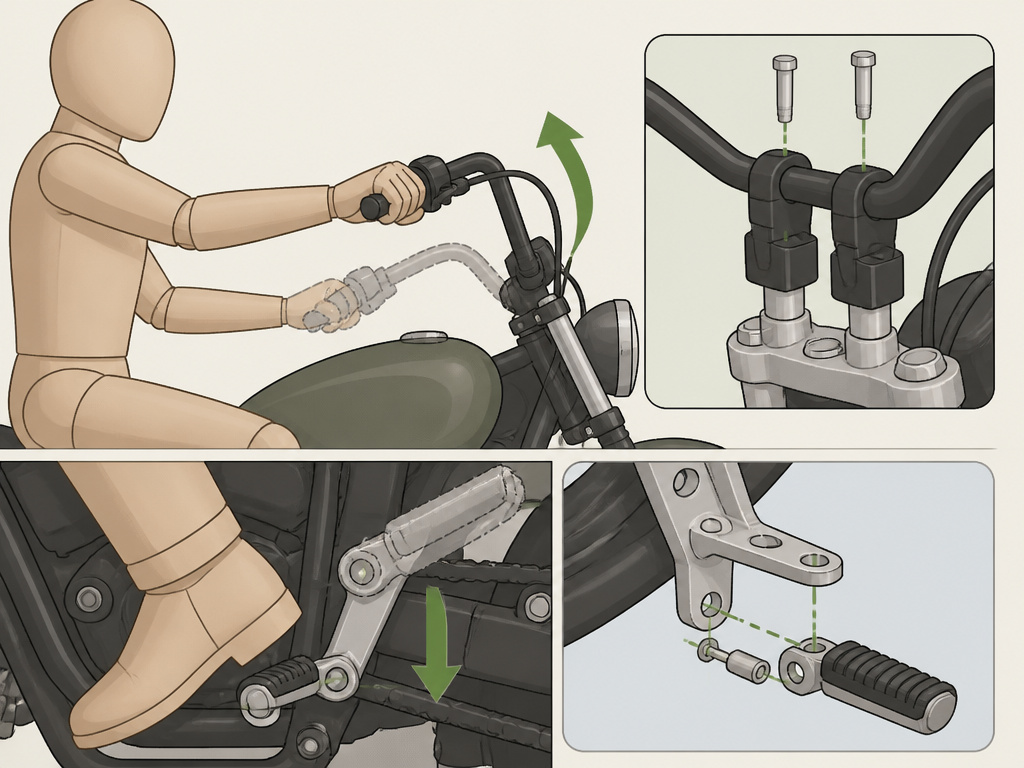
You will almost certainly need to adjust any motorcycle you buy. View these not as optional extras, but as necessary components of your guide to motorcycle ergonomics and fit.
- Handlebar Risers. This is the single most effective change. They move the bars up and back toward you, opening up the chest and relieving pressure on the wrists and lower back. Installation is usually simple, involving longer bolts and sometimes extended brake and clutch lines.
- Adjustable Footpegs. Some bikes have aftermarket peg mounts that move the pegs down and/or back. Even a 20mm drop can change the knee angle dramatically. This mod is more involved but worth it for dedicated touring.
- Taller Seat. Sometimes the stock seat can be reshaped or replaced with a taller aftermarket unit. This increases seat height, so ensure you can still comfortably reach the ground.
- Extended Shift and Brake Levers. If you’ve moved your pegs or have size-13 boots, you might need longer levers to maintain positive contact.
Your gear matters too. A protective motorcycle jacket with a long torso cut prevents a gap from opening up at your waist when you reach for the bars. Proper motorcycle boot recommendations include models with adequate ankle articulation for a comfortable leg angle on the pegs.
I won’t recommend a bike I haven’t wrenched on. The advertised seat height on the Benelli TRK502 X is 840mm. On paper, that’s great. In person, the seat is wide at the front, which effectively raises your inseam requirement, and the peg position feels higher than the ground clearance suggests. It’s a reminder that a spec sheet is a conversation starter, not a conclusion.
The Test Ride Checklist: What to Feel For
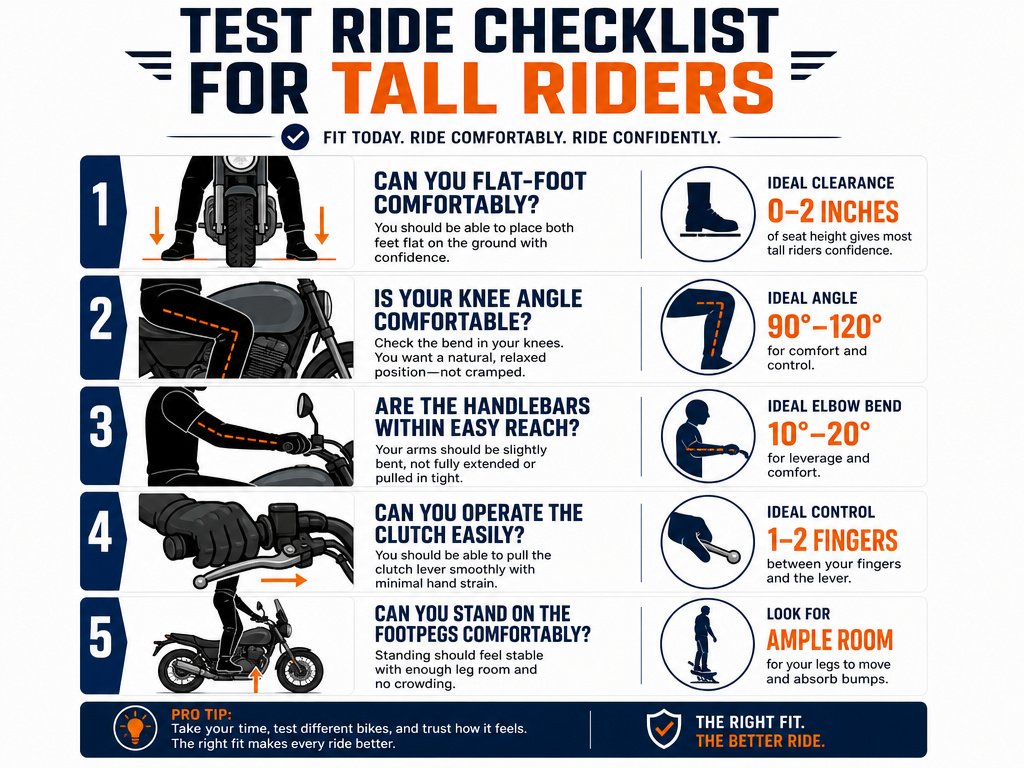
You’ve done the research. Now you need to sit on and, ideally, ride the final contenders. Do this for at least 15 minutes per bike.
- Flat-Foot Check: Can you get the balls of both feet down comfortably? You don’t need to flat-foot both feet, but you need stability at a stop.
- Leg Angle: With the bike upright, are your knees bent at a 90-degree angle or less? More bend is better. Do your knees hit the tank or any bodywork?
- Bar Reach: In your natural riding position, are your elbows slightly bent? Straight arms mean the bars are too far; overly bent arms mean they’re too close.
- Control Reach: Can you operate the clutch, brake, and shift levers without stretching or curling your fingers awkwardly?
- Standing Test: If it’s an adventure bike, can you stand on the pegs comfortably with a slight bend in your knees? Your head should clear the windshield.
If a dealer won’t allow a test ride, at least do a thorough static sit. Move around on the seat, pretend to brake, and check sightlines. Your future self will thank you.
Frequently Asked Questions
I’m 6’5″. Should I just get the tallest seat height bike?
Not necessarily. The tallest seat heights belong to pure off-road dirt bikes and supermotos, like the Ducati Hypermotard 698 Mono at 904mm. These can be punishing on the street. Focus instead on bikes with a balanced rider triangle. The Yamaha Ténéré 700 Rally (910mm) or an adventure bike with risers will likely serve you better for real-world riding.
Are sport bikes completely out of the question for tall riders?
They are challenging, but not impossible. Look for models with more relaxed ergonomics, often labeled as “sport-touring.” The Suzuki GSX-S1000GX+ or BMW S 1000 XR are far more accommodating than a supersport like a Yamaha R1. Expect to add bar risers. For a deeper look at performance-oriented options, our guide to sport bikes for tall riders covers the specifics.
What’s a good beginner motorcycle for a tall rider?
You want a manageable bike with a tall, friendly chassis. The Honda CRF300 Rally (885mm) is a top pick, lightweight, capable, and tall by design. The Suzuki V-STROM 800DE, while larger, is also very manageable with its smooth parallel-twin engine. For a full list tailored to new riders, see our recommendations for beginner bikes for tall riders.
Can I make any motorcycle fit a tall rider?
Within reason. You can add risers, lower pegs, and a taller seat. However, you cannot change the fundamental frame geometry. Trying to fit a 6’4″ rider on a small sportbike with massive modifications is a losing battle that compromises handling and safety. Start with a bike that has the right underlying proportions.
Do cruiser forward controls really help tall riders?
Absolutely. They change the entire leg posture from cramped to stretched. If you love the cruiser style, focus your search on models that offer forward controls as a factory option or have a strong aftermarket for them. Our resource on cruiser bikes for tall riders details which models are most adaptable.
Before You Go
The best motorcycle for a tall rider isn’t a single model. It’s the bike whose frame, suspension, and adjustable points create a cockpit that matches your limbs. Adventure bikes like the Suzuki V-STROM 800DE or Yamaha Ténéré 700 Rally are the safest bets because they’re engineered for space. Sport-tourers like the Suzuki GSX-S1000GX+ come a close second with some tweaks.
Remember the rule: seat height gets you in the door, but the rider triangle decides if you stay. Invest time in the test ride and budget for the essential modifications, risers, pegs, seat. The right bike is out there, and when you find it, the miles disappear.
