
How Credit Score Affects Car Insurance Rates & Premiums
This post contains affiliate links. As an Amazon Associate, we earn from qualifying purchases.
Your credit score affects your car insurance premium by shifting you into a risk category that predicts your likelihood of filing a claim. In most states, a poor score adds an average of $3,838 per year to a full-coverage policy compared to a good score, with some insurers charging over $300 more per month for the same driver profile.
That number isn’t a guess. It’s the concrete result of insurers using proprietary credit-based insurance scores, which are different from the scores lenders use. The practice is banned in only three states outright, but your driving record, location, and the specific insurer’s internal formula create massive price swings.
What follows is a breakdown of the five factors that build your insurance score, the exact states where the rules change, and the one move that can lower your bill faster than repairing your credit.
Key Takeaways
- Poor credit costs an average of $3,838 more per year for full-coverage car insurance than good credit, based on 2026 industry data.
- Insurers use a credit-based insurance score, not your FICO loan score. It weighs payment history (40%), credit utilization, length of history, new credit, and credit mix.
- Only California, Hawaii, and Massachusetts completely ban using credit to set car insurance rates. Michigan has broad exceptions that allow its use.
- Company formulas vary wildly: GEICO and State Farm had a $378 per month difference for the same driver with poor credit in the same ZIP code.
- Improving your credit can take 6 to 24 months to lower your premium at renewal. Switching insurers with your current score can save money immediately.
The $3,838 Penalty: How Much Credit Actually Costs You
The penalty isn’t subtle. Data from 2026 shows the annual premium difference between good and poor credit tiers averages $3,838 for a full-coverage policy. That’s $320 more every month for the same car, the same coverage, and the same driving record.
The size of the penalty depends entirely on which insurer you ask. Every company uses its own internal formula to decide how much to charge for each credit tier. This creates staggering gaps between carriers. For a driver with poor credit, GEICO might quote $212 a month while State Farm quotes $590 for an identical profile, a $378 monthly difference that has nothing to do with driving safety. Shopping around isn’t just advice; it’s the single most effective cost-cutting move for a driver with challenged credit.
Common mistake: Staying with the same insurer for months while working to improve your credit score. The savings from a better score take 6 to 24 months to appear at your policy renewal. Switching carriers with your current score can cut your bill today.
The industry’s defense rests on a correlation documented in studies like the 2007 FTC report to Congress, which found credit-based scores are predictive of claim frequency and cost. Insurers argue this allows them to charge risk-accurate rates. The result is a system where your financial history becomes a permanent line item on your insurance costs.
What Is a Credit-Based Insurance Score?
This is not your FICO score. While both draw from your credit reports at Equifax, Experian, and TransUnion, they are designed to predict different things. A lender’s score estimates your likelihood of repaying debt. A credit-based insurance score estimates your likelihood of filing an insurance claim that costs the company money.
The NAIC consumer insight article breaks down the five general factors FICO uses to build these scores for insurers. The weightings are proprietary, but the categories are standard.
| Factor | General Weight | What It Measures |
|---|---|---|
| Payment History | ~40% | On-time payments for credit cards, loans, and other bills. |
| Credit Utilization | ~30% | Amount of credit used versus your total available limits. |
| Length of Credit History | ~15% | Age of your oldest account and average age of all accounts. |
| New Credit | ~10% | Recent applications for credit (hard inquiries). |
| Credit Mix | ~5% | Variety of account types (credit card, mortgage, installment loan). |
You cannot see this exact score easily. It doesn’t show up on your free annual credit report. If an insurer takes an “adverse action” like denying you or charging a higher premium based on your credit, they must send a notice that may include the score they used. For most people, the only way to gauge it is to understand the factors and manage them.
A credit-based insurance score cannot use personal information like your income, race, or marital status. It also cannot consider whether you are in credit counseling.
Why Do Insurers Care About Your Credit?
The link between credit and claims is correlational, not causal. Industry studies, including the 2007 FTC analysis, found that consumers with lower credit-based insurance scores filed more claims, and more expensive claims, on average. The underlying theory is behavioral: a person’s approach to financial risk may reflect their approach to other risks, like driving cautiously or maintaining a vehicle.
State insurance regulators have accepted this correlation as a legitimate rating factor in most jurisdictions. The National Conference of Insurance Legislators (NCOIL) created a model act in 2002 that many states adopted. It allows the use of credit but prohibits it from being the sole reason for denying coverage or jacking up premiums.
The practice directly affects how companies calculate factors influencing insurance quotes. When you apply, the insurer runs a “soft” credit check, this doesn’t hurt your score, and plugs the data into their model. Your resulting tier (poor, fair, good, excellent) then gets multiplied by a base rate determined by your car, location, and driving record. A low tier acts as a multiplier on everything else.
State-by-State Rules: Where Credit Doesn’t Count
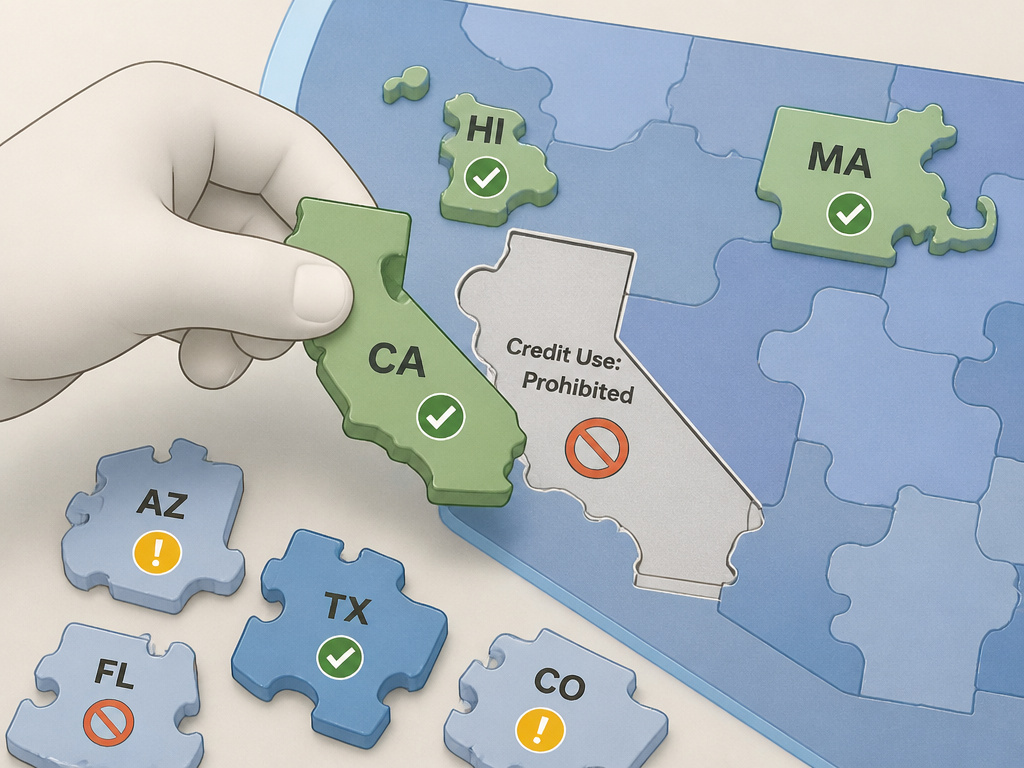
The law is not uniform. Your geographic location is the most important variable after your score itself.
Only three states have a full ban: California, Hawaii, and Massachusetts. In these states, insurers cannot use credit information to set your rate at all. Your premium is based on your driving record, annual mileage, and other traditional factors. Michigan is often incorrectly listed as a fourth ban state; its law has broad exceptions that allow most insurers to use credit.
Many other states have restrictions based on the NCOIL model. These rules might prevent insurers from using credit as the sole factor for a negative decision, or they might ban its use at renewal time. A few states, like Washington, have seen recent legislative pushes to eliminate the practice.
| State | Credit Use for Auto Insurance | Key Details |
|---|---|---|
| California | Prohibited | Banned under Proposition 103 (1988). |
| Hawaii | Prohibited | State law forbids use in personal insurance rating. |
| Massachusetts | Prohibited | Regulations prohibit the use of credit information. |
| Michigan | Restricted | Law has broad exceptions; most insurers use it. |
| Most Other States | Allowed with Restrictions | Often follow NCOIL model; cannot be sole factor for denial/non-renewal. |
If you live outside the three prohibition states, assume your credit is being used. You can contact your state’s insurance department for the specific statute. This patchwork system means a move across state lines can radically change your insurance rates independent of any change in your score.
How to Fight the High Costs
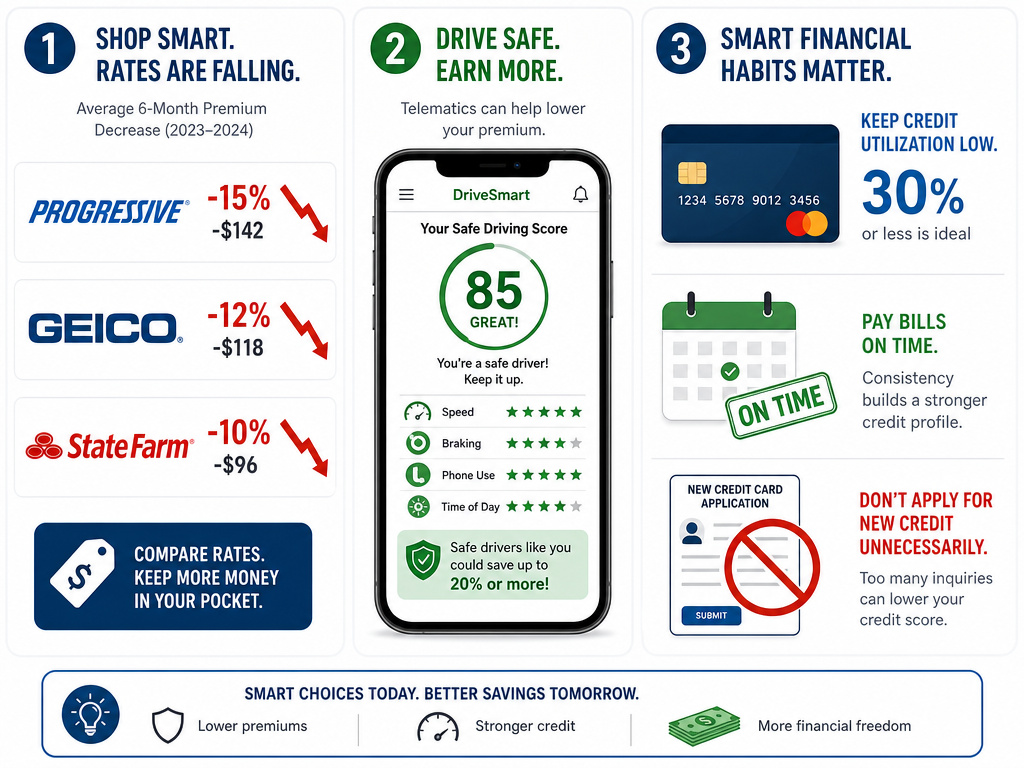
You have two parallel paths: improve your score for the long term, and work around it for immediate savings. The immediate tactics often deliver more cash in hand.
First, shop for new insurance quotes now. Company formulas vary so dramatically that switching is your fastest path to savings. Get at least three quotes. The soft inquiry won’t affect your credit score.
Second, ask about telematics. Programs like Progressive Snapshot or GEICO DriveEasy base your rate on how you actually drive, speed, braking, mileage, not your credit score. If you have a clean driving record, these usage-based insurance programs can cut your premium by up to 40%.
Third, manage the credit factors you control.
- Pay down credit card balances. This is the fastest-moving factor. Get your utilization below 30% of your limit.
- Pay every bill on time. Set up autopay for minimum payments.
- Do not apply for new credit within six months of your policy renewal. A hard inquiry can temporarily lower your score right before the insurer rechecks it.
Improving your score is a slow burn. Changes you make today might not be reflected in your premium until your next policy renewal in six or twelve months. If your renewal is within 60 days, focus on shopping rather than score repair.
When Your Rate Is Already High
A poor credit score often compounds with other high-risk factors, like a recent at-fault accidents or adding a teen driver. The penalties stack.
If you’re recovering from an accident, focus on strategies to save that don’t involve credit, like taking a defensive driving course or increasing your deductible. Remember, the accident will stay on your driving record for 3-5 years, but the credit penalty is perpetual until your score improves.
For young drivers already facing steep insurance for young drivers, a poor parental credit score can make a difficult market nearly unaffordable. In these cases, telematics programs or being added to a parent’s policy (if the parent has better credit) are the most viable options.
Frequently Asked Questions
Does getting a car insurance quote hurt my credit score?
No. Insurers use a “soft inquiry” to check your credit for a quote. Soft inquiries do not affect your credit score and are not visible to lenders. You can get multiple quotes in one day with zero impact.
Can I see my credit-based insurance score?
Not directly through free annual credit reports. You may be able to see a version through some paid credit monitoring services. If an insurer denies you or charges a higher rate based on your credit, the adverse action notice they are required to send may include the score they used.
How long does it take for credit improvement to lower my rate?
It takes 6 to 24 months for credit improvements to be reflected in your car insurance premium. Insurers only re-check your score at your policy renewal, which is typically every six or twelve months. The updated score then influences your new rate.
Is it legal for insurers to use credit?
In most states, yes. The practice is legal and regulated. The 2007 FTC study concluded credit-based scores are effective predictors of risk. Only California, Hawaii, and Massachusetts have outright bans. Many other states have laws limiting how the scores can be used.
What if I have no credit history?
State laws vary, but most prohibit insurers from denying coverage solely due to a lack of credit history. You will likely be placed in a “neutral” or average risk tier. However, some insurers may view a “thin file” as a higher risk than a good history, potentially leading to higher factors affecting rates.
Before You Go
Your credit score is a powerful, often invisible driver of your car insurance bill. The $3,838 annual penalty for poor credit is real, but it’s not a life sentence. The gap between what GEICO and State Farm charge proves that insurer choice matters more than almost anything else.
Move immediately on shopping for new quotes. Explore a usage-based program if your driving is consistently calm. Then, work steadily on the credit factors you control, especially that credit card balance. The system is stacked, but the steps to fight back are straightforward. Your wallet doesn’t have to wait two years for relief.
