
Best Car Insurance for Young Drivers: Compare Top Policies
This post contains affiliate links. As an Amazon Associate, we earn from qualifying purchases.
The best car insurance for a young driver balances adequate protection with cost, and it starts by adding them to a family policy with a carrier like GEICO or National General that prices teens favorably. Full coverage is non-negotiable for any car worth over $5,000, and the premium hinges on three levers: the vehicle itself, the driver’s age, and which discounts you stack.
That last point is where most families leave money on the table. A good student discount isn’t just a line item; it’s a 15-25% cut that compounds with multi-policy and telematics savings. The goal is the right policy that doesn’t collapse after the first fender-bender, not the cheapest possible one.
What follows is a breakdown of the real numbers, the insurers that don’t penalize youth as harshly, and the four discounts that actually change the monthly bill. We’ll also walk through when a separate policy makes sense and how your teen’s car choice can swing the premium by 50% before you even get a quote.
Key Takeaways
- Adding a teen to a parent’s existing policy is almost always cheaper than a separate policy, leveraging multi-car and bundling discounts.
- Full coverage (liability, comprehensive, collision) is mandatory for any vehicle a family couldn’t replace out-of-pocket, typically those worth more than $5,000.
- Vehicle choice is the single biggest factor a young driver controls; a Subaru Forester can cost $500 less per year to insure than a sporty coupe.
- Stack discounts: the Good Student discount (up to 25%), telematics programs, driver’s education, and distant-student discounts can collectively cut a premium by 30% or more.
- Shop quotes at least annually, especially at ages 19 and 21, as insurer pricing algorithms shift and a clean driving record starts to pay dividends.
How Age and Gender Actually Change Your Quote
Age is the primary variable in a statistical model that predicts risk, not just a number on an insurance application. A 16-year-old driver represents the peak of that risk, carrying an average annual premium that can be double that of a 25-year-old.
The drop is steepest in the first few years of a clean record.
The average annual car insurance cost for a 16-year-old is roughly $7,962. By age 25, with a clean record, that average falls to about $4,606, a 42% decrease. This decline accelerates after age 19, as each year of accident-free driving statistically moves the driver out of the highest-risk cohort.
Gender plays a role, but its impact is fading and geographically limited. Young male drivers historically pay more due to higher accident rates. However, several states, including California, Michigan, and Massachusetts, prohibit using gender as a rating factor. In those states, a 17-year-old male and female with identical profiles will get identical quotes. Elsewhere, the difference is real but often smaller than the savings from a single discount.
The takeaway is mechanical, not moral. Insurers price the risk they can quantify. Your job is to feed them data that lowers that risk score: a safe car, good grades, and a driving monitor.
| Age | Approximate Annual Premium | Key Milestone |
|---|---|---|
| 16 | ~$7,962 | Highest risk category; telematics discounts most impactful. |
| 17-18 | ~$6,800 – $7,400 | Good student discount becomes critical. |
| 19 | ~$5,500 – $6,000 | Insurer pricing often shifts; time to re-shop quotes. |
| 21-25 | ~$4,600 – $5,200 | Clean record rewards begin significantly lowering rates. |
The Real Cost of the Car: Vehicle Choice Is Your Biggest Lever
You can’t change your teen’s age, but you control the car they drive. This is the most powerful tool for managing insurance costs. Insurers rate vehicles on repair costs, theft rates, safety features, and, yes, horsepower.
Common mistake: Handing down a sporty coupe or a large, expensive SUV to a new driver. The coupe signals performance risk, and the SUV’s high repair costs guarantee a steep premium.
The sweet spot is a midsize sedan or a small SUV with top safety ratings. These vehicles are inexpensive to repair, have low theft rates, and their safety tech can sometimes earn a discount. According to industry data, specific models like the Subaru Forester or Mazda CX-5 consistently rate as some of the cheapest cars to insure for teens.
The difference isn’t theoretical. Insuring a teen on a Subaru Forester averages about $1,891 per year. A flashy sports car in a high insurance group can easily triple that figure. The math is simple: safer, slower, cheaper-to-fix cars cost less to insure.
Here are the questions to ask before buying a car for a young driver: * What is its insurance group rating or Vehicle Risk Rating? * Does it have modern safety features (automatic emergency braking, lane keeping)? * What is the average repair cost for front-end damage? * Is it a high-theft model?
If you can’t answer these, you’re guessing at the insurance bill.
Liability-Only vs. Full Coverage: A $5,000 Rule
This is a financial decision, not just a coverage one. State minimum liability insurance only covers damage you cause to others. It does nothing for your own vehicle.
Minimum coverage is a gamble that only makes sense if the car’s value is less than $5,000 and you could afford to replace it with cash tomorrow. For any financed, leased, or newer car, it’s a financially catastrophic choice.
Full coverage adds comprehensive (theft, vandalism, weather) and collision (accidents with objects or other cars). For a young driver, this is almost always necessary. The reason is simple: new drivers have the highest accident probability. Skimping on coverage to save $600 a year is pointless if a single at-fault accident totals a $15,000 car you still owe money on.
| Coverage Type | What It Covers | When It’s Necessary for a Young Driver |
|---|---|---|
| Liability | Bodily injury & property damage you cause to others. | State-mandated minimum. Never sufficient as standalone for a young driver. |
| Collision | Damage to your car from an accident, regardless of fault. | Any car worth more than $5,000. Required by lenders. |
| Comprehensive | Non-collision damage (theft, fire, hail, animal strike). | Any car worth more than $5,000. Especially important in areas with high theft or severe weather. |
| Uninsured/Underinsured Motorist | Your injuries if hit by a driver with no or insufficient insurance. | Highly recommended. A significant portion of drivers carry minimal insurance. |
The gap between liability-only and full coverage is where real protection lives. Don’t let a tight monthly budget dictate a decision that could wipe out savings.
The 4 Discounts That Actually Move the Needle for Young Drivers
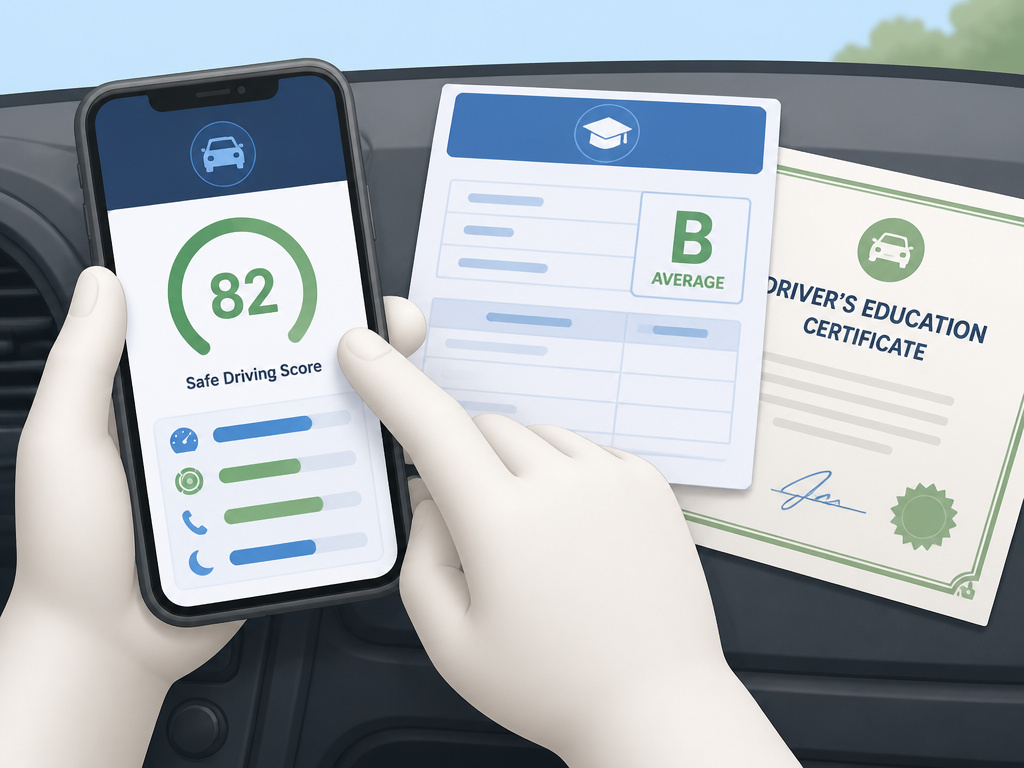
Every insurer advertises discounts. Most are marginal. For young drivers, only a handful change the monthly payment by more than a few dollars. These are the ones to chase and stack.
1. The Good Student Discount (Up to 25%)
This discount is a direct correlation: students who maintain a B average or 3.0 GPA demonstrate responsibility, which insurers correlate with safer driving. State Farm offers one of the most generous versions, up to 25%, and it often lasts until age 25. GEICO and Auto-Owners also offer strong versions.You’ll need a transcript or report card as proof.
2. Telematics / Usage-Based Insurance (UBI) Programs
These programs monitor driving via a smartphone app or a plug-in device. They track speed, braking, mileage, and phone use. For a careful new driver, the savings can be substantial, often 10-30%. The key is choosing the right program. * State Farm Steer Clear: Designed for under-25 drivers, includes training modules. * GEICO DriveEasy: App-based, offers an initial discount just for enrolling. * Allstate teenSMART: Focuses on coaching and behavior monitoring.
Where this goes sideways: Enrolling a lead-footed teen in telematics. Harsh braking and speeding events recorded by the app can actually prevent a discount or, in some programs, lead to a rate increase at renewal. It only works for genuinely cautious drivers.
3. Driver’s Education Discount
Completing an accredited driver’s ed course still matters. It’s not just for the license; it’s a documented proof of training that almost every insurer recognizes. This discount typically stacks with the good student discount.
4. Distant Student / Away-at-School Discount
If your teen goes to college more than 100 miles from home and doesn’t take the car, tell your insurer. This can trigger a discount of 10-30% because the car is driven significantly less and is parked in a (presumably) lower-risk location. It’s one of the most underused discounts in the industry.
Stacking two or three of these is how you turn a $600/month quote into a $400/month reality. They require paperwork and permission, but the payoff is real.
Adding to a Parent’s Policy vs. A Separate Policy: The Math
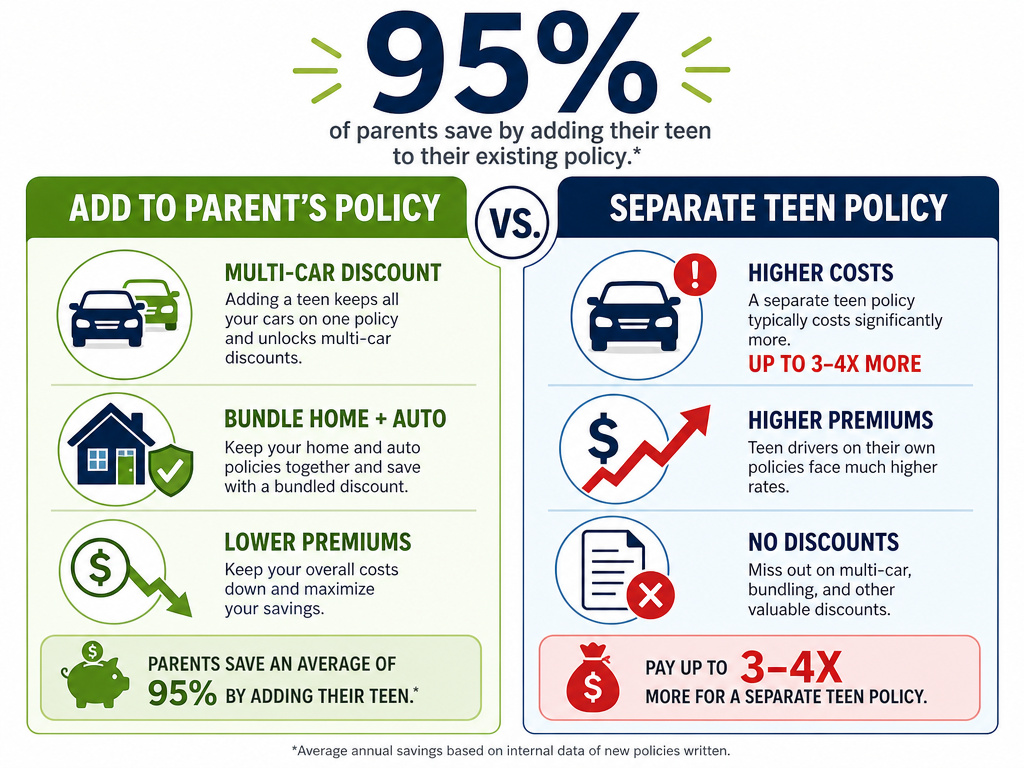
The default should always be to add the young driver to an existing family policy. The math almost never works in favor of a separate policy for a teen.
Adding a teen to a parent’s policy spreads risk and activates multi-vehicle and multi-policy (bundling) discounts. While the parent’s premium will jump, the total household cost is lower than two separate policies. A separate teen policy prices in all the risk with none of the dilution.
There are two narrow exceptions where a separate policy might be considered: 1. The teen owns their car outright, and the parent wants absolutely no financial or insurance entanglement. 2. The teen has a very poor driving record (tickets, accidents) that would skyrocket the parents’ premium to an unaffordable level. Isolating that risk can sometimes be a last-resort containment strategy.
For 95% of families, adding the driver is the clear financial play. It also simplifies management, one bill, one renewal date, one company to call after an accident.
GEICO vs. National General vs. State Farm: Who Prices Teens Best?
Not all insurers view young drivers through the same lens. Some penalize youth more heavily, while others have pricing algorithms that are more forgiving to new drivers. Based on broad industry analysis, three names consistently surface for competitive teen rates.
GEICO frequently comes out as the cheapest for 16-18-year-olds. Their pricing model seems to weigh youth less heavily than some competitors, and their suite of discounts (good student, driver’s ed, multi-policy) integrates well. The GEICO DriveEasy telematics program is a strong option for tech-comfortable families.
National General often beats the market for 19-year-olds. Their model appears to reward individual clean records as they develop, making them a prime candidate for a quote when your teen turns 19, especially if you’ve been with another carrier for a few years.
State Farm is rarely the absolute cheapest on base rate, but their discount structure is arguably the best for young drivers. The combination of a up-to-25% good student discount and the Steer Clear telematics program, which can be stacked, creates a savings potential others can’t match. If the base quote is within 10-15% of the cheapest, State Farm’s discounts can make it the better deal.
The lesson is to get quotes from all three. The “best” company changes based on your teen’s exact age, location, and the car they drive.
Temporary and Special Situation Policies
Standard six-month or annual policies aren’t the only option. Two special situations warrant a different approach.
Temporary Policies: Is your teen home from university for the summer and needs to drive a family car? Short-term policies, lasting from one day up to 28 days, provide full comprehensive coverage without a long-term commitment. They solve a very specific, temporary need and are worth the search if a standard policy seems like overkill.
International New Drivers: A young driver moving to the U.S. From another country presents a unique challenge. Even with years of overseas experience, most U.S. Insurers cannot verify international driving records. They will typically be treated as a brand-new, high-risk driver. The only path is to start building a U.S. Record immediately. Some major insurers have specialized underwriting for this scenario, it requires calling and speaking to an agent, not relying on online quotes.
How to Shop for Quotes the Right Way
Getting quotes is a skill. Doing it wrong wastes time and leaves money on the table.
- Gather Exact Information: You’ll need the teen’s driver’s license number, the car’s VIN, exact mileage, and details of any driver’s ed courses completed.
- Use the Correct Address: For students, use the address where the car is garaged most often (e.g., the university address), not the parents’ home address if the car is at school.
- Quote the Right Coverage: Use a standard profile for apples-to-apples comparison: 100/300/100 liability limits, comprehensive and collision with a $1,000 deductible. This is the industry benchmark for rate analysis.
- Apply All Discounts Mid-Quote: Don’t get a base quote and then ask about discounts. Input the good student, driver’s ed, and telematics enrollment info during the quote process to see the real final price.
- Get at Least Five Quotes: Rates vary more for young drivers than any other group. Check the big names (GEICO, State Farm, Progressive) and a regional insurer or two.
Treat your first quote as a baseline, not an offer. The fifth quote often reveals the market’s true competitive price.
Frequently Asked Questions
What is the fastest way to lower my teen’s insurance cost?
Change the car. Swapping a sporty model for a safe, boring sedan or small SUV like a Subaru Forester or Honda CR-V has a more immediate and dramatic effect than any discount. Next, enroll them in a telematics program if they are a cautious driver.
Does my teen need their own insurance policy?
Almost never. Adding them to your existing policy is almost universally cheaper and simpler. The only exception is if they own their car outright and you want complete financial separation.
How does a credit score affect a young driver’s insurance?
In most states, insurers use a credit-based insurance score. For a teen with no credit history, they will typically use the parents’ score if the teen is on the family policy. This is another reason to keep them on your policy, your established credit can help lower the rate.
Is black box (telematics) insurance worth it?
For most careful young drivers, yes. The potential discount is significant (10-30%), and the feedback can encourage safer habits. However, it’s a terrible idea for a driver with aggressive habits, as the data can prevent a discount or even increase the rate.
When should I re-shop my teen’s insurance?
Mark two dates: their 19th birthday and their 21st birthday. Insurer pricing tiers often shift at these ages. Also, re-shop every year at renewal, loyalty rarely pays in the young driver market. Building a clean record should be reflected in better offers from competitors.
The Bottom Line
The best car insurance for a young driver is a system. Start with the right car, a safe, low-cost-to-insure model.Add them to your policy to leverage household discounts. Then attack the premium with the big four discounts: good student, telematics, driver’s ed, and distant student.
Commit to full coverage for any car you can’t afford to lose. The peace of mind is worth the extra hundred dollars a month.
Finally, shop with precision and often. The insurer that was cheapest at 16 may not be at 19. Your teen’s clean driving record is an asset; make sure it’s paying you back in lower premiums every six months.
