
Guide to Liability Only Car Insurance & State Minimum Costs
This post contains affiliate links. As an Amazon Associate, we earn from qualifying purchases.
Liability-only car insurance is the state-mandated minimum coverage that pays for injuries and property damage you cause to others in an at-fault accident. It does not cover your own injuries or vehicle repairs. The average annual cost is $646, but choosing only the minimum required limits like 25/50/10 leaves you personally responsible for any costs above those amounts.
That number—$25,000 for one person’s injuries, $50,000 total per accident, $10,000 for property—is the line where your insurance stops and your personal assets begin. A single emergency room visit can blow past the per-person limit before the ambulance leaves the scene. The rest comes from your savings, your wages, or a court judgment.
This guide walks through the two specific coverages inside a liability policy, the real math behind choosing limits, and the exact scenarios where a liability-only policy makes sense versus when it’s a gamble. You’ll see the numbers from the insurers themselves and where the gaps are.
Key Takeaways
- Liability-only insurance covers only bodily injury and property damage you cause to others, with strict per-accident financial limits.
- State minimum limits, such as 25/50/10, are often dangerously low; the average property damage claim exceeds $10,000.
- This policy excludes coverage for your own medical bills, car repairs, theft, or weather damage—those require separate coverages.
- It can be a viable choice for drivers of low-value vehicles they can afford to replace, or those with excellent health insurance and no regular passengers.
- Increasing your liability limits is usually inexpensive and is the single most important financial protection you can add to a basic policy.
What Does Liability-Only Insurance Actually Cover?
A liability-only policy is built on two pillars: Bodily Injury (BI) and Property Damage (PD). Think of them as two separate buckets of money your insurer will use to pay others on your behalf. Once those buckets are empty, you’re on the hook for the rest.
Bodily Injury Liability pays for medical expenses, lost wages, and legal costs for people injured in an accident you cause. It does not cover you or your family members in your own vehicle. Property Damage Liability pays for repairs to the other driver’s car, a rental car for them, and damage to structures like fences or mailboxes. It does not pay a cent to fix your own car.
Liability coverage in your car insurance policy pays for property damage and/or injuries to another person caused by an accident in which you’re at fault. This coverage applies as excess protection when you drive someone else’s car, but it will not cover damage to the vehicle you are driving.
The three-number limit format, like 25/50/10, is the rulebook. The first number is the maximum per person for bodily injury ($25,000). The second is the maximum total for all bodily injuries in one accident ($50,000). The third is the total for property damage ($10,000). Hit three cars? That’s still a $10,000 total property damage limit.
The Critical Gaps: What It Doesn’t Cover
Your own car and your own body are completely exposed. A liability-only policy provides zero coverage for these common scenarios: * Your vehicle repairs after any accident, regardless of fault. * Your medical bills or those of your passengers. * Theft, vandalism, fire, or weather damage to your car (hail, falling trees). * Damage from hitting an animal. * A rental car for you while your car is being repaired.
To cover these, you need to add other types of car insurance, specifically comprehensive and collision coverage. For your medical costs, you’d look at personal injury protection or medical payments coverage.
Understanding Liability Limits: Is 25/50/10 Enough?
Those standard minimum limits are a legacy from decades ago. Repair and medical costs have inflated; the limits have not. Sticking with them is one of the biggest financial risks a driver can take.
Let’s say you cause an accident that totals a new SUV and injures two people. The SUV repair bill is $28,000. Your property damage limit is $10,000. You owe the remaining $18,000 out of pocket. One injured person has $40,000 in medical bills. Your per-person bodily injury limit is $25,000. You owe $15,000 for that person alone. The other person’s $20,000 bill might be covered within the $50,000 total, but you’ve already exceeded your limits. The insurer pays up to the limits, then stops. You are personally liable for every dollar beyond that.
| Limit Type | Example (25/50/10) | What It Covers | Real-World Risk |
|---|---|---|---|
| Bodily Injury (Per Person) | $25,000 | One person’s medical bills, lost wages, pain & suffering. | Average bodily injury claim was $26,501 in 2022. A single ER visit can exceed $25,000. |
| Bodily Injury (Per Accident) | $50,000 | All injuries for all people in one accident. | Two moderately injured people can exhaust this. You pay the overage. |
| Property Damage | $10,000 | Other driver’s car repair, structures, rental car. | Average property damage claim was $6,551 in 2022. Totaling one modern car easily surpasses $10,000. |
Where this goes sideways: Choosing limits based only on state law. The law sets a floor for legality, not a recommendation for financial safety. An insurer’s investigation determines fault, but your chosen limits determine your financial survival.
Increasing your limits is often surprisingly cheap. Jumping from a state minimum to 100/300/100 might add only a few dollars to your monthly premium. That buys a massive increase in protection. For catastrophic coverage, an umbrella insurance policy provides an extra million dollars or more in liability protection.
How a Liability-Only Policy Works in a Real Claim
The process is linear and hinges entirely on the limits you selected when you bought the policy. It’s not complicated, but the consequences are permanent.
First, the accident happens, and you are found at fault. The other driver files a claim with your insurance company. Your insurer assigns an adjuster, who investigates and validates the damages. They then pay the other party directly, but only up to your policy limits. They will send you a clear letter stating the claim is closed once those limits are exhausted. Any further communication or bills come directly to you.
Your insurance company’s duty is to defend you, but only within the confines of your contract. If a lawsuit arises from damages exceeding your limits, they may provide a lawyer for the covered portion, but you are personally responsible for any judgment above your limits. This can lead to wage garnishment or liens on your property.
Common mistake: Thinking “full coverage” is a specific product. It’s a casual term that usually means liability plus comprehensive and collision. Always ask for a breakdown of the actual coverages on your declaration page.
Who Should Consider a Liability-Only Policy?
This isn’t a one-size-fits-all decision. For a specific subset of drivers, the math can work in favor of carrying only liability. It’s a calculated risk, not a default.
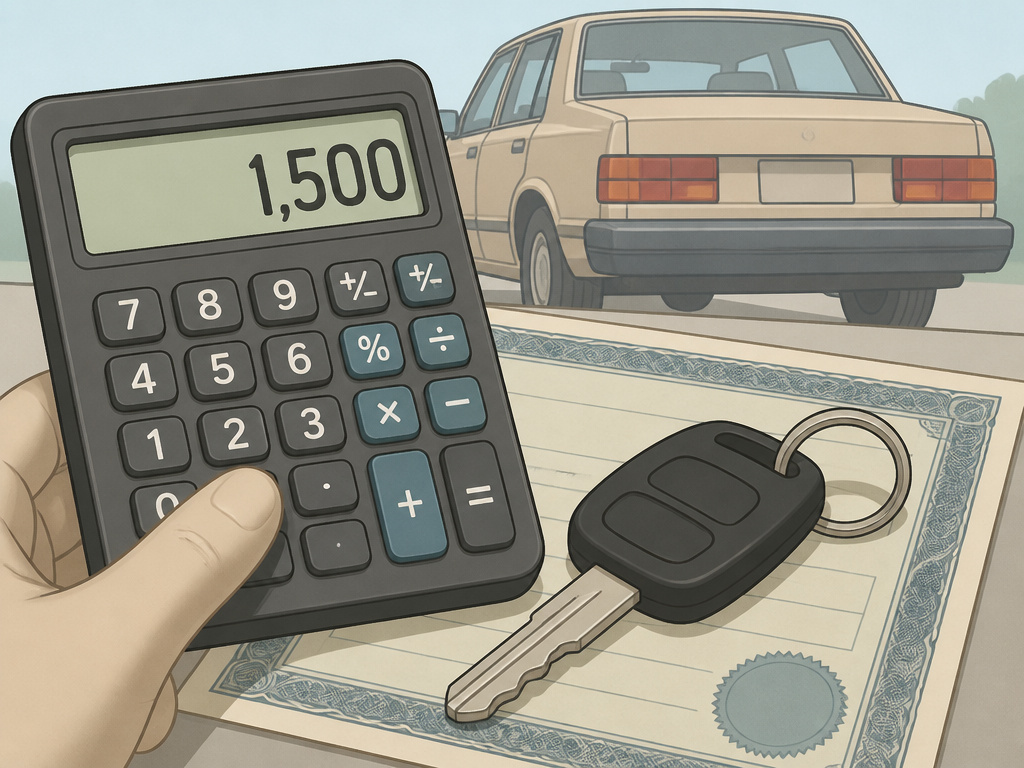
The primary candidate owns a car with a very low market value—think a twenty-year-old sedan worth $1,500. If you can afford to walk away from that car and replace it with cash, paying for collision coverage might not make financial sense. The annual premium could approach the car’s value.
Other scenarios include drivers with exceptionally strong health insurance who rarely, if ever, carry passengers. If your own medical costs are covered and you aren’t responsible for others in your car, the need for medical coverages like personal injury protection diminishes. Someone who stores a classic car and drives it fewer than 1,000 miles a year might also fit here.
Skip this if: You have a car loan or lease. Lenders universally require comprehensive and collision to protect their asset, often with specific deductible for claims rules. You cannot have a liability-only policy on a financed vehicle.
The High-Risk Driver Exception
Drivers with a spotty record who struggle to find affordable insurance might be forced into a liability-only policy through a non-standard insurer. It’s often the last-resort option to maintain legal compliance. In these cases, the priority should be improving your driving record to qualify for better rates and higher limits as soon as possible. Some states may require an SR-22 certificate to prove you carry even the minimum liability coverage.
Liability-Only vs. Other Common Coverages
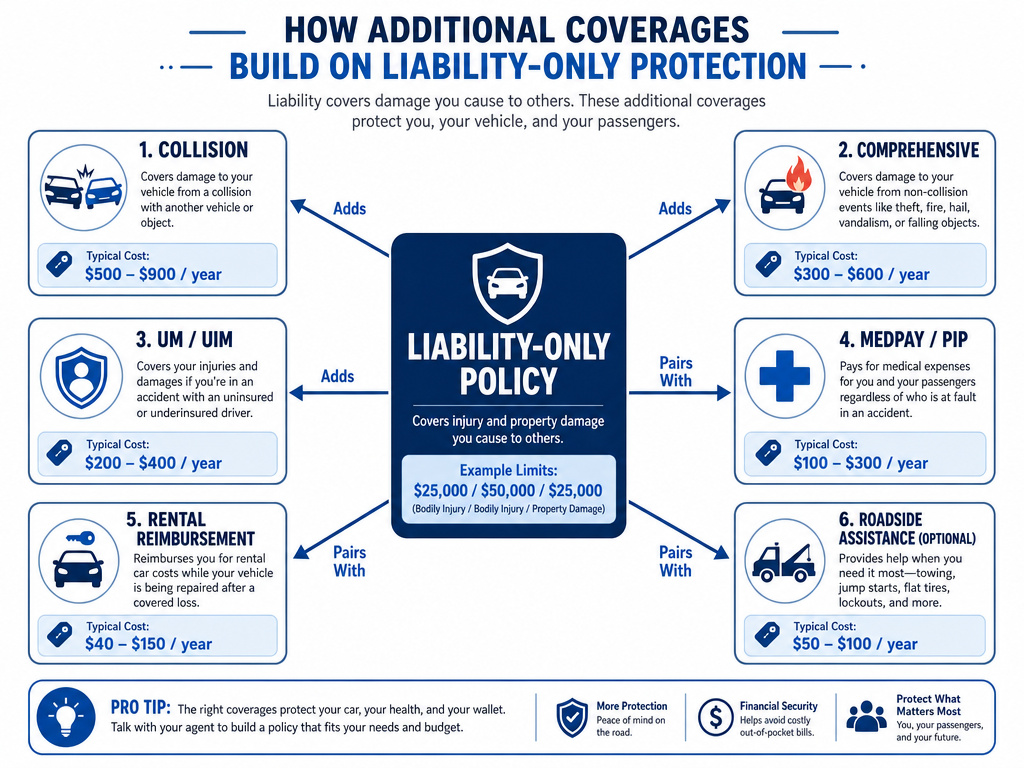
Liability-only is the foundation. Every other coverage type builds upon it to protect you and your property. You cannot purchase most other coverages without first having liability in place.
| Coverage Type | What It Protects | Required? | Pairs With Liability-Only? |
|---|---|---|---|
| Liability (BI & PD) | Other people’s injuries & property. | Yes, in 49 states. | This is the base policy. |
| Collision | Your car’s damage from an accident. | Only if you have a loan/lease. | Adds protection for your vehicle. |
| Comprehensive | Your car from theft, fire, weather, animals. | Only if you have a loan/lease. | Adds non-collision protection. |
| Uninsured/Underinsured Motorist | You when hit by a driver with no/low insurance. | Required in some states. | Yes, crucial add-on. |
| Medical Payments (MedPay) / PIP | Your & passengers’ medical bills. | Required in some no-fault states. | Yes, covers your health costs. |
| Rental Reimbursement | A rental car for you after a covered claim. | Never. | Yes, but only if you have comp/collision. |
The most critical pairing is Uninsured/Underinsured Motorist (UM/UIM) coverage. If you’re hit by a driver with no insurance or minimal limits, your own UM/UIM coverage acts as their missing liability policy for your injuries. It’s a direct backstop to the liability system’s failures.
How to Decide If Liability-Only Is Right For You
Start with a brutally honest assessment of your financial position and your vehicle’s value. Ask the two questions State Farm suggests: “How much can I afford to pay out of my own pocket if I’m responsible for an accident?” and “Could I replace my car tomorrow with cash?”
- Value your vehicle. Check sites like Kelley Blue Book. If the value is less than a few thousand dollars, collision coverage may cost more than it’s worth over a couple of years.
- Audit your health coverage. Do you have robust health insurance that would cover auto accident injuries? Does it cover passengers?
- Assess your assets. Do you have savings, a home, or other assets a court could target if you lose a lawsuit for damages exceeding your limits?
- Get quotes for higher limits. Don’t assume. Call your agent or use online tools. Ask for quotes for 100/300/100 and see the actual price difference. It’s frequently less than $20 a month.
- Consider mandatory add-ons. If you live in a no-fault state, you are required to carry PIP regardless. If you have a loan, you need gap insurance and full coverage.
This decision directly impacts how much insurance you need. The goal is never to be “fully insured” in the abstract, but to be adequately protected against financial ruin. For most people, that means liability limits well above the minimum, plus collision and comprehensive if the vehicle’s value justifies it.
Frequently Asked Questions
Is liability-only insurance the same as “minimum coverage”?
Yes, in most contexts. “Minimum coverage” refers to carrying exactly the lowest amounts of Bodily Injury and Property Damage Liability your state requires to legally drive. It is a liability-only policy. Some states have additional minimum requirements like PIP, which would be included.
What’s the average cost of liability-only car insurance?
According to a NerdWallet analysis, the average annual cost for a policy with state minimum liability coverage is $646. Your cost will vary dramatically based on your location, driving record, age, and the specific limits you choose.
Can I drive someone else’s car with my liability-only policy?
Yes, your liability coverage typically follows you as the driver. It would act as excess coverage over the car owner’s own insurance policy if you cause an accident. However, it still will not cover any damage to the vehicle you are driving.
Do any states not require liability insurance?
New Hampshire is the only state that does not mandate liability insurance. Drivers must prove they can meet financial responsibility requirements in the event of an at-fault accident, which often means purchasing coverage anyway.
What happens if I cause an accident and the damages exceed my limits?
You are personally liable for all costs above your policy limits. The other party can sue you for the difference. If you cannot pay, a court judgment could lead to wage garnishment, liens on your property (like your home), and seizure of assets.
The Bottom Line
Liability-only car insurance is a tool with a specific, narrow purpose: keeping you legal on the road and protecting others from your mistakes. It is not designed to protect you. Treating state minimum limits as a recommendation is a fast track to financial vulnerability.
The move isn’t to avoid liability coverage—it’s to buy enough of it. Boosting your limits from 25/50/10 to 100/300/100 is one of the most cost-effective upgrades you can make. Pair it with Uninsured Motorist coverage. Then, based on your car’s value, decide if adding comprehensive and collision is worth the premium. For a car you can afford to lose, liability-only might work. For your financial future, always buy more liability than the state says you must.
