
Umbrella Insurance Explained: What Is It and Who Needs It?
This post contains affiliate links. As an Amazon Associate, we earn from qualifying purchases.
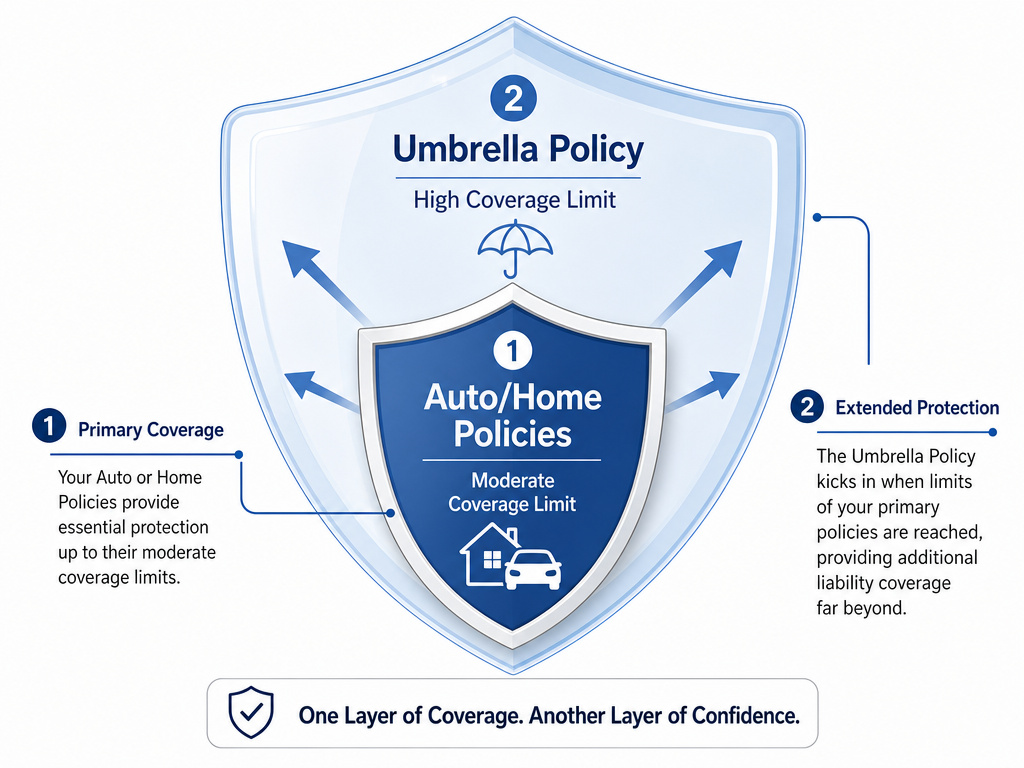
Umbrella insurance is an extra layer of personal liability coverage that activates after the limits on your underlying policies, like auto and home insurance, are exhausted. It protects your savings, home, and future income from catastrophic lawsuits that exceed standard coverage caps. You likely need it if you have significant assets, own property, have teenage drivers, or engage in activities with higher liability risk.
The mechanics are non-negotiable. This coverage doesn’t stand alone; it requires you to maintain specific minimum liability limits on your primary policies. Fail that, and the umbrella policy treats those missing limits as a massive deductible you pay yourself.
What follows is a breakdown of how it functions, what it genuinely covers (and what it never does), and a clear framework for deciding if the added peace of mind is a necessity for your situation. We’ll cut through the insurance jargon and land on the practical stakes.
Key Takeaways
- Umbrella insurance is a secondary layer that only pays after your primary auto or home liability limits are fully used up.
- It mandates “minimum underlying limits”, often $300,000 on home and $250,000/$500,000 on auto, or it won’t pay a claim.
- Beyond just higher limits, it often adds “broadened coverage” for claims like slander or false arrest that standard policies exclude.
- It does not cover business liability, intentional acts, or incidents that occurred before the policy started.
- For most households with a home, savings, or a teen driver, a $1 million policy is a rational hedge against financial ruin.
How Umbrella Insurance Actually Works
Think of your primary policies as a foundation. Your auto insurance has a bodily injury liability limit, say, $300,000 per accident. Your homeowner’s policy has a personal liability limit, often $100,000 to $300,000. Umbrella insurance is the next floor up, but the staircase only appears if you’ve built the foundation to code.
Personal umbrella and excess liability policies respond only when primary policy limits are exhausted. They also require that underlying insurance (auto, home, watercraft) listed on the declarations page is maintained. If underlying coverage isn’t kept, the umbrella policy treats the underlying limits as a deductible.
That last clause is critical. If your insurer requires $300,000 of underlying home liability and you let that policy lapse, the umbrella acts as if you have a $300,000 deductible. A $50,000 slip-and-fall claim on your property would come entirely from your pocket.
The process is sequential. A severe at-fault car accident results in $750,000 in judgments. Your auto policy’s $300,000 liability limit pays its share first. Once that $300,000 is gone, your umbrella policy engages for the remaining $450,000. It also covers the legal defense costs from the moment the claim exceeds your primary limit, which alone can bankrupt you.
This is why understanding your liability coverage is step one. You cannot intelligently add an umbrella without knowing what’s underneath it.
What Umbrella Insurance Covers (And What It Doesn’t)
The coverage splits into two buckets: extended limits and broadened protections.
Extended Limits apply to the liabilities your underlying policies already cover. This is the core function, covering excess bodily injury and property damage from car crashes, dog bites, or a guest’s injury on your property. It’s pure financial backup.
Broadened Coverage is where the value often hides. Many umbrella policies add protections your standard homeowners insurance explicitly excludes. This can include: * Personal injury claims: slander, libel, defamation, false arrest. * Landlord liability for rental properties you own. * Worldwide coverage for incidents occurring outside the U.S.
| Coverage Type | Example Scenario | Standard Policy Typically Covers? | Umbrella Policy Action |
|---|---|---|---|
| Bodily Injury | At-fault car accident with multiple serious injuries. | Up to the policy limit (e.g., $300,000). | Pays the amount exceeding the auto policy limit. |
| Property Damage | You accidentally cause a fire that damages a neighbor’s home. | Up to the policy limit (e.g., $100,000). | Covers repair costs beyond your homeowner’s limit. |
| Personal Injury | A former business associate sues you for slander. | Usually excluded. | May cover legal defense and settlements, often subject to a deductible. |
| Landlord Liability | A tenant’s guest falls on your rental property’s icy walkway. | Excluded under a standard homeowner’s policy. | May provide coverage where your landlord policy ends. |
Common mistake: Assuming an umbrella policy covers business activities. It does not. A side gig, even from home, requires a separate commercial umbrella. Mixing personal and business liability is a fast track to a denied claim.
Other universal exclusions are intentional acts, criminal acts, and liability you assume under a contract. It also will not cover damage to your own property, that’s what comprehensive and collision are for.
Who Actually Needs an Umbrella Policy?
This isn’t a product for everyone. It’s for people whose net worth or lifestyle exposes them to a level of risk that standard insurance ceilings can’t contain. If a lawsuit could wipe out your savings or force the sale of your home, you’re a candidate.
High-Asset Households. The primary purpose is asset protection. If you have substantial savings, investments, or own a home, those are targets in a lawsuit. A $1 million policy places a protective moat around them.
Homeowners & Landlords. Homeownership brings liability. A pool, a dog, or even an uneven sidewalk creates exposure. Landlords face even more risk from tenant-related incidents, making an umbrella a logical extension of their landlord insurance.
Parents of Teen Drivers. Statistically, teen drivers have higher accident rates. A single at-fault crash with multiple injuries can generate a million-dollar claim in seconds. Your state’s minimum auto insurance coverage is a laughable defense.
People with Public Profiles or Certain Hobbies. Serve on a nonprofit board? Have a social media presence? Own horses, boats, or snowmobiles? Your risk of a personal injury lawsuit (libel, directorship liability, recreational mishap) jumps. The broadened coverage clauses exist for these scenarios.
If you rent an apartment, have minimal savings, and no unusual risk factors, your priority is securing robust primary liability insurance, not adding an umbrella.
How to Get Umbrella Insurance and What It Costs
 You cannot buy a standalone personal umbrella policy. It must be added to an existing package of primary insurance, usually your auto and home policies, with the same carrier. This allows the insurer to verify and coordinate those all-important underlying limits.
The cost is lower than most expect. A $1 million personal umbrella policy typically costs between $150 and $300 per year. Each additional million increment costs less, adding a second million might only be an extra $75 annually.
Several factors determine your premium: 1. Your Required Underlying Limits. Higher primary limits mean less risk for the umbrella insurer, which can lower your cost. 2. Number of Properties, Cars, and Drivers. More assets and drivers mean more exposure points. 3. Risk Factors. Teen drivers, certain dog breeds, swimming pools, and trampolines will increase the premium. 4. Your Claims History. A clean record keeps costs down; a recent at-fault accident will raise them.
Start by calling your current auto and home insurer. Ask for a quote and their specific requirements for underlying limits. Then, understand the claim process for an umbrella event, it’s coordinated with your primary insurer.
Umbrella Insurance vs. Simply Raising Your Primary Limits
 This is a practical question. Why not just double your auto liability limit from $300,000 to $600,000 and skip the umbrella?
The answer is breadth and cost-effectiveness. Raising primary limits only increases coverage for that specific policy’s perils. An umbrella does that across all your underlying policies (auto, home, watercraft) simultaneously and adds the broadened coverage for personal injury.
Where this goes sideways: Choosing a $500,000 auto limit over a $300,000 limit plus a $1 million umbrella. You spend more for less total coverage and gain zero protection for home-related lawsuits or slander claims. The umbrella is almost always the more efficient buy for comprehensive protection.
For true peace of mind, the combination is key: maintain strong primary limits as your first line of defense, then use the umbrella as your high-limit, wide-net safety net. This layered approach is how you manage the cost of insurance without gambling on gaps.
Frequently Asked Questions
Does umbrella insurance cover my own injuries?
No. It is strictly liability coverage, meaning it protects you when you are legally responsible for injuries to others or damage to their property. For your own medical bills after a car accident, you would rely on PIP insurance or your health insurance.
Is umbrella insurance worth it for a renter?
It can be, but the case is less automatic. If you have significant savings, investments, or a high-income career that could be garnished, a lawsuit from a guest’s injury in your apartment is a real risk. If you have few assets, prioritize strong renters liability coverage first.
Will umbrella insurance cover me if I’m sued for something that happened before I bought the policy?
No. Coverage is strictly for incidents that occur during the policy period. This is a standard exclusion across all liability insurance.
How much umbrella insurance should I buy?
Common rule of thumb is to purchase enough to cover your net worth (assets minus debts). For most middle-class households, a $1 million policy is the standard starting point. High-net-worth individuals may layer $2 million or more. Review your total exposure with an agent.
Does umbrella insurance have a deductible?
Typically, no. It has an attachment point, the amount your primary policies must pay first. However, for the “broadened coverage” items (like slander) that aren’t covered by a primary policy, a small deductible, often $250 or $500, may apply. Always check the specific policy language.
The Bottom Line
Umbrella insurance is the financial equivalent of a roll cage. You hope never to need it, but its presence defines the difference between a survivable incident and a total loss. It is not a substitute for strong primary coverage levels; it is the mandatory upgrade once those limits become your weakest point.
For anyone with assets to protect, a home, a retirement account, a future earning potential, the math is straightforward. The annual premium is a fraction of the potential legal defense costs alone. It turns a catastrophic lawsuit from a life-altering disaster into a manageable insurance event. In a litigious world, that’s not just coverage. It’s clarity.
