
Learn How to File a Car Insurance Claim Step by Step Today
This post contains affiliate links. As an Amazon Associate, we earn from qualifying purchases.
To file a car insurance claim step by step, you must secure safety, document the scene, notify your insurer, cooperate with the adjuster, and understand your settlement options. The core sequence is universal, but the six-month repair delays cited by the Washington Insurance Commissioner change the math on rental coverage and parts choices.
That timeline isn’t a worst-case scenario anymore. It’s the new baseline in many regions, which means your policy’s 30-day rental limit might run out while your car sits in a shop waiting for a bumper sensor. The steps don’t change, but their stakes do.
What follows is the full walkthrough, from the first call to 911 to the final payment line. We’ll cover the three documents that decide your payout, the one question that locks in your repair shop choice, and how to spot when a “repairable” estimate is actually a total loss in disguise.
Key Takeaways
- Document everything immediately. Photos, witness contacts, and a police report are non-negotiable. Missing details cost you money later.
- Understand your coverage before you need it. Know your deductible, your rental car limits, and whether you have comprehensive coverage.
- Repair delays are measured in months, not weeks. Nationwide parts and staffing shortages mean a six-month wait is possible. Factor this into your rental coverage.
- You have the right to choose your repair shop. The insurer may recommend a network shop, but the final choice is yours. Get your own estimate.
- A settlement offer is not final. You can, and should, negotiate, especially on items like diminished value or the use of non-OEM parts.
The 7-Step Checklist for Filing Your Claim
Forget the generic advice. This is the sequence that matters, in the order that prevents headaches. Skip a step, and you invite delay or dispute.
Before you start: Turn your hazard lights on. If the car is drivable, move it to the shoulder or a parking lot. Do not stand in traffic to take photos. If there are injuries, call 911 first, everything else waits.
- Secure Safety and Call Authorities. Check yourself and passengers for injuries. Call 911 for any medical need or significant property damage. For minor incidents, you may file a police report online later, but an official report strengthens your claim.
- Gather Evidence Like a Investigator. Use your phone. Take wide shots of the entire scene, showing vehicle positions and road conditions. Get close-ups of all damage, on all vehicles. Photograph the other driver’s license plate, insurance card, and driver’s license (with permission). Note the 17-digit VIN, found on the dashboard near the windshield or inside the driver’s door frame. Collect names and phone numbers of witnesses.
- Notify Your Insurer. Fast. Contact your insurance company within 24 hours, even if you’re not at fault. Use their app if they have one; it often creates a time-stamped record and lets you upload photos instantly. Delaying notification can complicate the investigation.
- Cooperate with the Adjuster. An insurance adjuster will contact you to investigate. Provide your evidence packet. Be truthful and consistent. If the adjuster performs a physical inspection, be present to ensure they see all the damage.
- Review the Damage Assessment. The adjuster will provide an initial estimate. This is not a final settlement. You have the right to get independent repair estimates from shops you trust.
- Understand Your Settlement Options. The insurer will declare the vehicle either repairable or a total loss. For repairs, you’ll discuss parts (OEM vs. Aftermarket) and choose a shop. For a total loss, they will offer a payout based on your car’s actual cash value.
- Finalize Repairs or Accept Payout. If repairing, stay in contact with the shop and your adjuster. If accepting a total loss payout, ensure you understand how any outstanding loan is handled, this is where gap insurance becomes critical.
The whole process aims to restore you to your pre-accident position. It rarely feels that way in the middle of it.
What Information Do You Absolutely Need at the Scene?
Your phone’s camera is your most important tool. The goal is to create an indisputable record before vehicles are moved or memories fade.
The non-negotiable evidence list:
- Multi-angle vehicle photos: Context shots from all four corners, plus close-ups of every scratch, dent, and broken component.
- License plates and VINs: For all involved vehicles. The VIN is the vehicle’s fingerprint.
- Other driver’s details: Full name, phone number, insurance company, and policy number.
- Witness contacts: Names and phone numbers for anyone who saw the event.
- Police report number: If officers respond, get the report number and the responding officer’s name.
Where this goes sideways: Relying on a handshake agreement to “work it out later.” Without a police report and photos, a “minor” bumper tap can transform into a disputed injury claim three weeks later. Get the record immediately.
If you have a car dashcam, preserve the footage immediately. That video can settle fault disputes instantly.
How Does the Claims Investigation Work?
Once you file, your insurer assigns a claims adjuster. Their job is to investigate liability, assess damages, and apply your policy’s coverage terms.
The adjuster will: 1. Review all evidence (your photos, police report, any dashcam footage). 2. Possibly inspect the vehicle in person or review shop estimates. 3. Determine who is at fault based on state law and the evidence. 4. Calculate the cost of repairs or the actual cash value of the vehicle.
| Your Responsibility | The Adjuster’s Goal | Risk If You Don’t |
|---|---|---|
| Provide accurate, timely info | Settle the claim efficiently | Delay the process; risk a lowball offer due to missing facts |
| Get your own repair estimate | Ensure their estimate aligns with market rates | Accept subpar repair quality or underestimated costs |
| Ask questions about coverage | Apply the policy correctly | Miss out on benefits you’re owed, like rental reimbursement |
This phase is where knowing your policy pays off. If you only have liability insurance, your own vehicle’s damage won’t be covered unless the other driver is at fault and has adequate insurance.
Navigating Repair Delays and Parts Shortages
 Here’s the reality most generic guides miss: the repair timeline is broken. The Washington Insurance Commissioner guide notes nationwide delays can stretch to six months due to parts and staffing shortages.
This changes two things fundamentally: 1. Your rental car coverage: Most policies have a daily limit and a maximum total (e.g., $30/day, $900 max). A six-month repair would blast through that in a month. You’d pay out of pocket for the remaining five. 2. Parts choices: The adjuster may recommend non-OEM (aftermarket) or used parts to speed things up. You can demand new OEM parts, but you “may have to pay for the difference in cost,” as the Washington OIC states.
Common mistake: Assuming your insurer controls the repair timeline. They don’t. The shop’s backlog and parts availability do. Your insurance contract covers reasonable costs, not indefinite delays.
What to do:
- Check your rental limits immediately. If you have a low cap, start planning for alternative transportation early.
- Discuss parts upfront. If you want OEM parts for a newer car with advanced sensors, be ready to pay the difference. For an older car, certified aftermarket parts might be a sensible compromise.
- Move your car from storage fast. If your car is in a tow yard, storage fees accumulate daily. Authorize the insurer to move it to a free storage location to avoid eating into your settlement.
Understanding Your Settlement: Repair, Total Loss, and Diminished Value
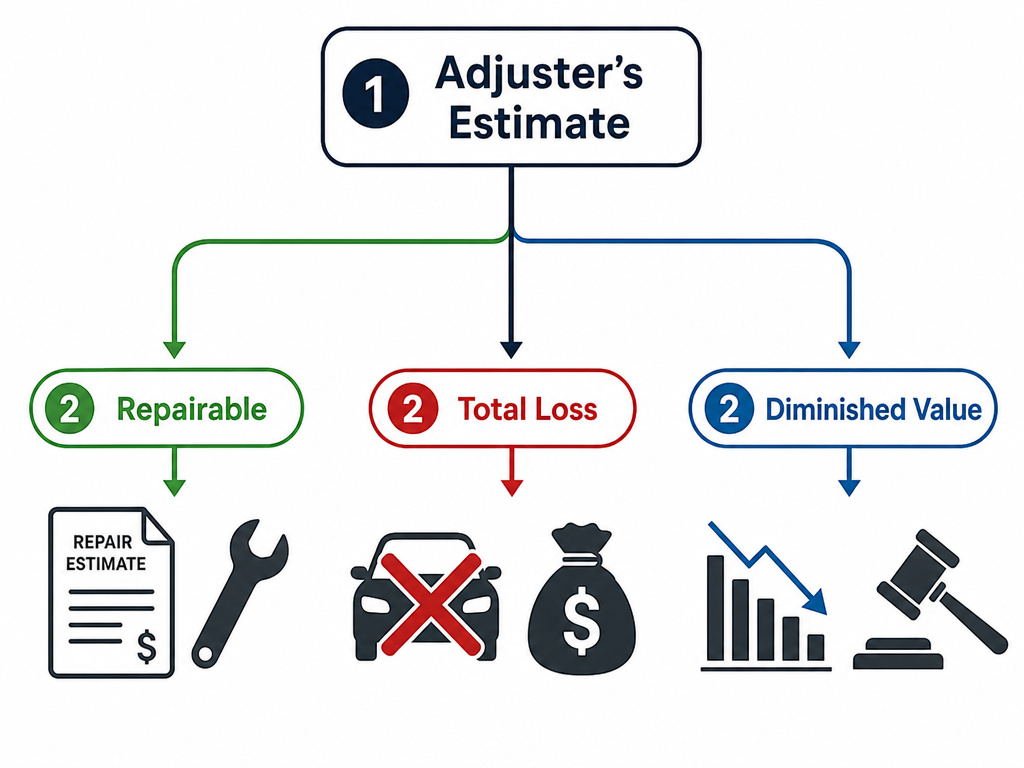 The adjuster’s estimate leads to one of three paths. Your reaction to each path determines your final financial outcome.
If Your Car is Repairable
You’ll receive an estimate detailing the repair costs. You have the right to choose any licensed repair shop. Insurer-recommended shops often come with a repair guarantee, but you are not obligated to use them.
Key decision point: cash vs. Direct pay. Some insurers offer to pay you the repair amount directly (minus your deductible). You can then use any shop and manage the payment yourself. Others prefer to pay the shop directly. Understand which method you’re agreeing to.
If Your Car is a Total Loss
This happens when repair costs exceed a certain percentage of the car’s actual cash value (ACV), often around 70-80%. The insurer will pay you the ACV, minus your deductible if you were at fault.
The gap insurance moment: If you owe more on your loan than the ACV payout, you are responsible for that difference, unless you have gap insurance. Gap coverage pays that shortfall.
The Diminished Value Claim
This is the reduction in your car’s market value simply because it now has an accident history. You typically file a diminished value claim against the at-fault driver’s insurance, not your own.
The part nobody mentions: Proving diminished value requires documentation, often a professional appraisal. Many insurers will initially resist this claim. You must be prepared to negotiate or seek legal advice.
How to Handle Disputes and Negotiate Effectively
You can, and should, question the adjuster’s estimate if it seems low. This is a business negotiation, not a verdict.
Steps to dispute a settlement:
- Get your own estimates. Take the vehicle to two reputable body shops for written estimates.
- Request the adjuster’s worksheet. Ask the insurer to provide, in writing, how they calculated the estimate and which parts they specified (OEM vs. Aftermarket).
- Submit your counter-evidence. Provide your higher estimates and a line-item comparison.
- Escalate politely. If the field adjuster won’t budge, ask to speak to a supervisor or the claims manager.
According to the Consumer Federation of America, courts consistently rule in favor of policyholders when insurance policy language is ambiguous. If a coverage denial seems based on a vague clause, challenge it.
If negotiations fail, you have options: file a complaint with your state’s Department of Insurance, or consult an attorney specializing in insurance law. Remember, an accident can affect your insurance rates for years, so a proper settlement now is an investment in limiting future premium increases.
Special Cases: Natural Disasters, Hit-and-Runs, and Not-At-Fault Accidents
The standard process bends under special circumstances. Here’s how.
Natural Disaster (Flood/Hail/Fire):
- Safety first. Do not approach a burning car. Move away and call fire services.
- Water damage often results in a total loss. Corrosion and mold set in fast.
- Adjusters are overwhelmed after large-scale events. Be persistent and document everything.
Hit-and-Run:
- This is typically covered under your uninsured motorist property damage or collision coverage (minus your deductible).
- A police report is absolutely critical to establish the incident.
- Without another driver to claim against, your own policy’s limits and deductibles apply.
You’re Not At Fault:
- You have a choice: file a claim with your own insurer (and pay your deductible, which you’d later recover) or file directly with the at-fault driver’s insurer.
- Filing with the other driver’s company avoids your deductible but requires you to manage the entire process with a third party.
- Your own insurer may still get involved later through subrogation, where they recover what they paid you from the at-fault party’s insurer.
Frequently Asked Questions
How long do I have to file a car insurance claim?
Check your policy. Most insurers require prompt reporting, often within 24-72 hours of the incident. State laws may also set deadlines. The sooner you file, the fresher the evidence and witness memories.
Will filing a claim increase my insurance rates?
It can, especially if you are found at fault. A single claim can stay on your claims history for three to five years and may lead to a rate increase. Some insurers offer accident forgiveness for your first incident.
What if I can’t afford my deductible right now?
Discuss this with your repair shop and adjuster. Some shops may be willing to work with you or defer the deductible portion until your insurance payment arrives. In a not-at-fault accident, your deductible should be reimbursed once your insurer recovers from the at-fault party’s insurance.
Should I file a claim for a minor scratch or dent?
Consider the cost versus your deductible and potential premium increase. If the repair cost is only slightly above your deductible, paying out-of-pocket might be cheaper long-term than a rate hike. Always report the incident to your insurer if another party is involved, regardless of damage.
Can I cancel a claim after filing it?
Yes, you can usually withdraw a claim before any payment is made. Inform your adjuster immediately. However, the incident may still be noted in your file as an “inquiry” or “zero-paid claim,” which could potentially be seen by other insurers.
The Bottom Line
Filing a car insurance claim is a procedural grind. Your job is to control the variables you can: evidence, communication, and policy knowledge. Assume repairs will take months, not weeks. Assume you’ll need to verify the adjuster’s math. And assume the first offer is just the opening bid.
Get the police report. Use your insurer’s app. Choose your shop. Those three actions alone put you ahead of most claimants. The rest is a test of patience and paperwork, with your pre-accident bank balance as the prize. For the next renewal period, explore ways to lower car insurance after an accident to mitigate the long-term financial impact.
