
Are Dashcams Helpful for Insurance Claims? See the Proof
This post contains affiliate links. As an Amazon Associate, we earn from qualifying purchases.
Yes, dashcams are helpful for insurance claims. They provide objective video evidence that can prove fault, speed up settlements by roughly 35 percent, and protect you against staged accidents and fraud. The footage must be clear, unedited, and legally obtained to be admissible. Most major U.S. Insurers do not offer a direct discount for having one, but the financial protection from avoiding an at-fault claim is far more valuable.
The 35 percent faster settlement figure is a documented outcome from claims where video evidence eliminates the ‘he said, she said’ phase entirely. Adjusters spend less time reconstructing events from conflicting statements.
What follows is a breakdown of how dashcams shift the claim process from a negotiation to a demonstration. We’ll cover the concrete benefits, the legal and technical rules that make or break your footage, and the specific features that turn a recording into compelling evidence.
Key Takeaways
- Dashcam footage can accelerate claim settlements by about 35 percent by providing clear, immediate evidence.
- To be court-admissible, footage must be authenticated under legal standards like Rule 901, which requires verifying the recording’s origin and integrity.
- In two-party consent states like California, audio recording without consent can render your entire video inadmissible; use video-only mode.
- High-endurance microSD cards are mandatory; standard cards fail under continuous write cycles and should be replaced every 6 to 12 months.
- The financial benefit isn’t a premium discount but avoiding a fault determination that could raise your insurance rates for years.
How Dashcams Help Insurance Claims (The Direct Benefits)
A dashcam turns a subjective argument into an objective record. Its value isn’t just in having video; it’s in how that video reshapes the entire claims process.
The most quantifiable benefit is speed. Claims supported by clear dashcam footage settle approximately 35 percent faster than those relying only on witness statements and police reports. That’s weeks or months of rental car hassles and repair delays cut down significantly. The video answers the adjuster’s primary question immediately.
Common mistake: Submitting only the moment of impact. Insurers and the National Insurance Crime Bureau (NICB) need the 15-60 seconds prior to see lane positioning, signals, and following distance for full context.
Fighting fraud is where a dashcam pays for itself instantly. Staged accidents like “swoop-and-squat” scams rely on conflicting stories. Your video provides an undeniable account. For hit-and-runs, which account for nearly 15 percent of crashes, a dashcam with parking mode can capture a license plate, shifting the claim to the other driver’s policy and protecting your insurance record.
Finally, it influences behavior. Knowing you’re recording makes you more conscious of following distance and speed. This isn’t about spying; it’s about creating a culture of defensive driving proof.
| Benefit | How It Works | Outcome for You |
|---|---|---|
| Faster Settlement | Provides immediate, objective evidence. | Resolves claims ~35% faster, reduces rental/repair delays. |
| Fraud Deterrence | Captures staged crashes or hit-and-run plates. | Avoids being held liable for fraudulent or fleeing drivers. |
| Fault Clarification | Shows pre-impact context (signals, lane changes). | Prevents a disputed “word vs. Word” fault assignment. |
| Driver Awareness | Encourages conscious driving when recording. | May reduce risk-taking, leading to fewer incidents over time. |
The Legal & Technical Hurdles (What Makes Footage Admissible)
Footage on your screen is one thing. Footage a court or adjuster must accept is another. Admissibility hinges on authenticity, relevance, and legality. This is where most well-meaning owners trip up.
First, the legal standard. For evidence to be admissible, it must satisfy rules like Rule 901. This means a witness, you, must testify that the video fairly and accurately depicts the scene. The metadata (time stamps, GPS) and the device’s manual help establish this. If the footage appears edited, its veracity is destroyed.
Where this goes sideways: Recording audio in a two-party consent state. In California, recording a conversation without all parties’ knowledge is a crime and makes the evidence inadmissible. The fix is simple: disable audio recording in your dashcam’s settings. The video evidence is what matters for the claim.
Placement is governed by law, not convenience. California Vehicle Code Section 26708 is a good benchmark: your dashcam must be mounted in a lower corner of the windshield within a 5-inch square (driver’s side) or a 7-inch square (passenger side). An improperly placed camera gives the other side an argument that it obstructed your view.
| Requirement | The Rule | Consequence if Ignored |
|---|---|---|
| Authentication | Must satisfy Rule 901 (witness testimony, metadata). | Footage is deemed unreliable and excluded from evidence. |
| Audio Consent | In two-party consent states, all parties must know they’re recorded. | Audio and possibly the entire video clip become inadmissible. |
| Windshield Placement | Must be within a small square in the lower corners (e.g., CA Vehicle Code 26708). | Could be cited as an obstruction, undermining your driving compliance. |
| Data Integrity | Original, unedited file with intact metadata. | Any editing raises tampering suspicions and dooms admissibility. |
The technical specs matter for credibility. A GPS overlay that stamps speed and location is invaluable. It independently verifies your account against false accusations of speeding. Think of it as your video’s notary public.
Setting Up Your Dashcam for Maximum Impact
Buying a dashcam is step one. Configuring it to be a reliable witness is step two. These settings turn a gadget into a tool.
Start with the memory card. This is the most common point of failure. Dashcams continuously write data, which destroys standard microSD cards. You need a high-endurance memory card rated for continuous recording. Even these have a finite life. Replace them every 6 to 12 months. A corrupted card the day of an accident is a very expensive paperweight.
Video quality needs a balance. Higher resolution (1440p or 4K) captures clearer license plates, but it fills the memory card faster and can be overkill. A wide field of view (140–170 degrees) captures more of the scene laterally. Ensure loop recording is enabled so the camera automatically overwrites old footage, but also that it has a “collision lock” feature to protect relevant clips from deletion.
Here’s your pre-drive checklist: 1. Format the memory card monthly in the camera itself. This clears file errors and maintains reliability. 2. Disable audio recording. The legal risk outweighs any potential benefit for a standard insurance claim. 3. Enable GPS logging. The speed and location metadata is critical for evidence. 4. Set the correct date and time. Incorrect timestamps undermine the entire recording’s validity. 5. Adjust the parking mode sensitivity. If your cam has it, set it so passing trucks don’t fill the card with useless clips.
For most drivers, a single-channel, forward-facing dashcam like a Nextbase model is sufficient. If you drive for a ride-share service or want complete coverage, a dual-channel model that records the cabin and the road is worth the investment. The cabin view can disprove false passenger injury claims.
What Insurance Companies Really Do With Your Footage
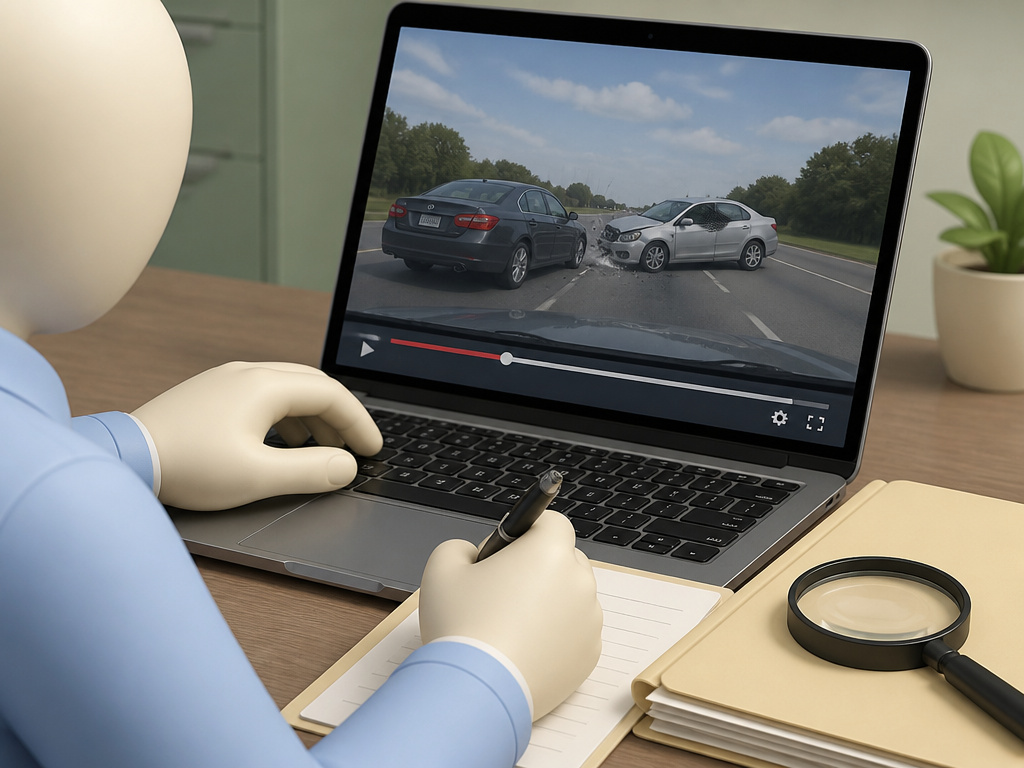 Insurers are pragmatic. They want to settle claims accurately and efficiently. Your dashcam footage is a tool that helps them do that, but the relationship has boundaries.
First, they can request your footage, but they cannot usually demand it without limits. In many cases, they need a court-issued subpoena to access it, especially if there are privacy considerations. You typically volunteer it because it helps your case. When you submit it, upload the original file through their claims portal. Never edit or trim it first.
Insurers typically keep submitted footage for 30 to 90 days, aligning with the investigation window. It’s automatically deleted after unless the claim is disputed or litigated.
Don’t expect a discount. Despite the clear benefits, major U.S. Insurers like Progressive and Erie Insurance do not offer premium discounts just for having a dashcam. The value is indirect: proving you weren’t at fault and avoiding the surcharge that comes with an at-fault total loss or collision claim. The small Ohio-based insurer Branch Insurance is a rare exception, offering a discount for using specific dashcams.
The insurer for the at-fault driver will analyze your footage meticulously. They will look for any detail that could shift even partial blame to you, following distance, signaling, lane position. This is why the pre-impact context is non-negotiable.
Dashcams vs. Other Evidence (The Comparison)
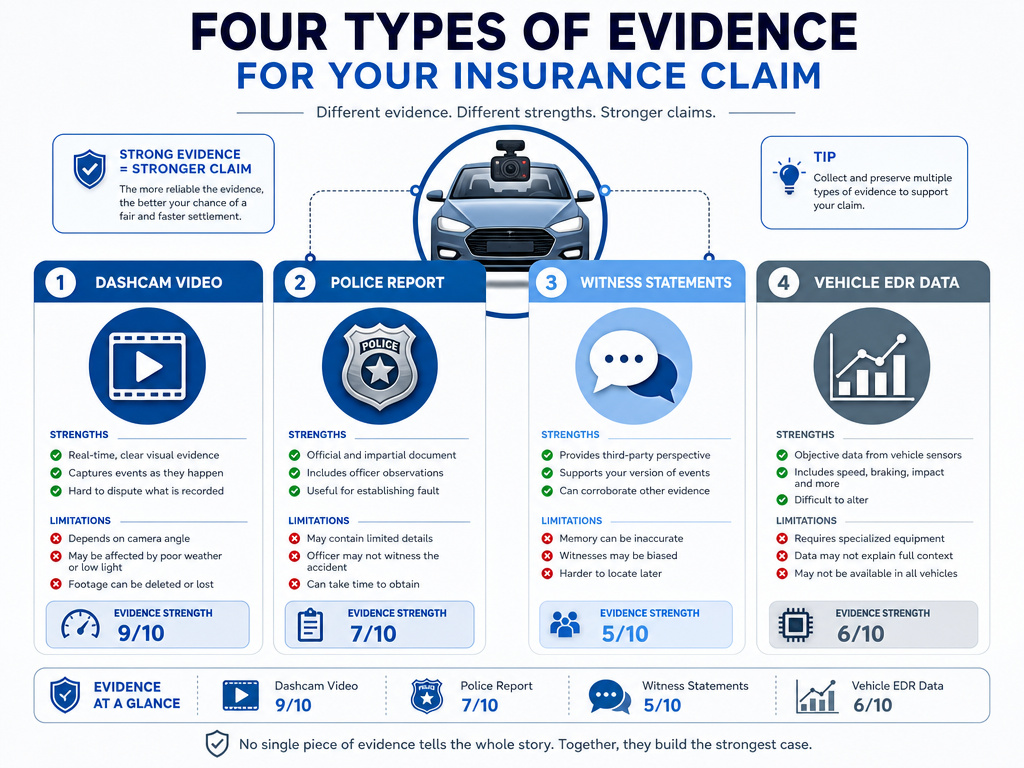 A police report is an officer’s professional opinion based on post-accident investigation. Witness statements are fallible human memories. Event Data Recorders (EDRs) in your car provide technical data like speed and brake application in the final seconds. A dashcam is the only piece that shows the continuous visual narrative leading to the event.
| Evidence Type | Strengths | Limitations |
|---|---|---|
| Dashcam Video | Shows continuous visual context, driver behavior, other vehicles. | Requires proper setup; audio may be illegal; can be challenged if low quality. |
| Police Report | Official document; includes citations and officer’s diagram. | Based on aftermath and statements, not direct observation of the crash. |
| Witness Statements | Provides independent accounts from third parties. | Memory is unreliable; witnesses may leave the scene. |
| Vehicle EDR Data | Provides objective technical data (speed, braking, throttle) from the vehicle itself. | Only captures seconds around the event; requires specialized tools to extract. |
The dashcam’s unique role is providing the “why.” It shows the swerve, the red light run, the sudden stop. It complements the EDR’s “what” (the car was going 32 mph) and the police report’s “where.” Together, they form a nearly unassailable case.
The bottom line: Your dashcam is your lead witness. Corroborate its testimony with the official report and your vehicle’s own data for the strongest possible position.
Frequently Asked Questions
Can dashcam footage get my claim denied?
Yes, if it clearly shows you were at fault. Insurers evaluate all evidence, and the footage could support their decision to deny your claim. Always review the footage yourself before submitting it. If it’s ambiguous or hurts your case, consult with an attorney before sending it to your insurer.
Do I need to tell my insurance company I have a dashcam?
You are not required to, but it’s a good idea. When you initiate a filing a claim, you can mention you have relevant footage. They will guide you on how to submit it. Knowing you have a camera may also encourage a more thorough review from the start.
Is dashcam footage enough to prove my case?
Often, yes. For clear-cut incidents like red-light runners or rear-end collisions, it can be definitive. For complex multi-vehicle accidents, it may be one critical piece among others, like the police report and witness statements. It significantly strengthens your position.
Will a dashcam lower my insurance rates?
In the United States, generally no. Major carriers do not offer a direct discount. The financial benefit comes from preventing an at-fault claim that would cause your post-accident premiums to rise, potentially for three to five years. You’re investing in protection, not a discount.
What is the best dashcam for insurance purposes?
Look for a model with 1440p resolution, a wide field of view, GPS logging, and a reliable “parking mode” if you want parked-car coverage. Brands like Nextbase and Vantrue build models with these evidence-focused features. Reliability and clear video are more important than extra bells and whistles.
Can I use dashcam footage in court?
Yes, if it is admissible. This means it must be authentic (meeting Rule 901 standards), relevant to the case, and legally obtained (following audio consent and placement laws). Your attorney will handle the process of getting it formally admitted as evidence.
Before You Go
A dashcam is a proactive tool, not a passive recorder. Its real value is unlocked before an accident ever happens, by configuring it correctly, using the right memory card, and understanding the legal landscape. The goal is to have no argument at all.
The evidence is objective. A settlement that closes 35 percent faster is the direct result of replacing speculation with a recording. Configure your camera, disable the audio, and drive with the confidence that your most credible witness is always on duty.For the other variables in a claim, like your comprehensive insurance coverage or how a deductible works, your setup is just as important.
