
How Long Does an Accident Stay on Your Insurance Record
This post contains affiliate links. As an Amazon Associate, we earn from qualifying purchases.
An accident stays on your primary insurance record, the LexisNexis CLUE report, for exactly seven years due to the federal Fair Credit Reporting Act. However, the surcharge that raises your rates typically lasts only three to five years, which is your insurer’s look-back window. A DUI-related crash can affect you for a decade or more, and in states like Florida, it stays on your driving record for 75 years.
That seven-year database rule is non-negotiable federal law. The three-to-five-year rate hike is company policy. The gap between those two numbers is where most drivers get confused, and it’s the reason your premium can drop while the accident is still technically on your record.
What follows is a breakdown of the two separate systems tracking your mishap, the exact timelines by state and severity, and the real financial math that determines what you’ll pay. By the end, you’ll know exactly when to expect relief and how to navigate the years in between.
Key Takeaways
- Your accident lives in two places: a 7-year insurance database (CLUE) and a 3-5 year state driving record (DMV). Insurers use the shorter window to price your policy.
- Even calling your insurer to ask about a claim can be logged in the CLUE database. A withdrawn or denied claim still counts as a record.
- A standard at-fault accident raises premiums by roughly 44% on average. That surcharge renews each year for the duration of the look-back period.
- A DUI or reckless driving accident resets the clock. It can affect your rates for 10+ years and may require an SR-22 filing, which labels you a high-risk driver.
- You cannot erase a valid record early. Your only leverage is to dispute errors, maintain a clean record, and shop for new insurers as the surcharge period ends.
The Two Separate Timelines You Must Know
You don’t have one record. You have two, and they operate on completely different clocks. Confusing them is the fastest way to misjudge how long you’ll be paying more.
The first is your motor vehicle report (MVR) from your state’s DMV. This is your official driving history, listing accidents, tickets, and license actions. States control this timeline. Most purge standard accidents after three to five years. New York, for example, keeps them for about four years. More serious offenses like a DUI can linger for a decade or, in Florida’s case, 75 years.
The Comprehensive Loss Underwriting Exchange (CLUE) report, maintained by LexisNexis, logs every auto insurance claim you file for up to seven years from the date of loss, as permitted by the Fair Credit Reporting Act.
The second system is the insurance industry’s own database. This is your true insurance record. Nearly every company reports to it, and every company checks it when you apply for a new policy or renew. The two main databases are LexisNexis’s CLUE and Verisk’s A-PLUS. Their retention rule is federally set at seven years.
The insurer’s look-back period, the three-to-five-year window they use to calculate your premium, is just a slice of that seven-year data. Think of it like a credit report: an old debt might still be listed, but after seven years, it stops dragging down your score. After three to five clean years, the accident stops dragging up your rate, even though it’s still visible on the report.
| Record Type | Who Maintains It | Typical Retention for Standard Accident | What It’s Used For |
|---|---|---|---|
| DMV Record (MVR) | State Department of Motor Vehicles | 3–5 years (varies by state) | Licensing, points, official driving history. Insurers check it for violations. |
| CLUE Report | LexisNexis | 7 years (federal FCRA rule) | Insurance underwriting. Shows claim history regardless of fault or payout. |
| A-PLUS Report | Verisk | 7 years (federal FCRA rule) | Property insurance underwriting. Tracks homeowners and auto claims. |
This split is why you must check both reports after an incident. An error on your CLUE report can haunt you for the full seven years, directly impacting every insurance claim quote you get.
How Fault Changes the Equation (And Your Wallet)
Fault isn’t just about blame. It’s the lever that controls the size and duration of your financial penalty. A not-at-fault accident might be a blip. An at-fault accident is a years-long anchor on your finances.
An at-fault accident is where you bear responsibility. This triggers a surcharge, a direct premium increase, for the entire look-back period. The average hike is about 44%. On a $1,500 annual policy, that’s an extra $660 each year, totaling over $2,000 across a three-year surcharge window. This happens because the insurer paid out on your behalf, and they now see you as a higher risk.
A not-at-fault accident is trickier. In a perfect world, it wouldn’t affect you. In reality, it often still does. Some insurers will raise rates after any claim, arguing that multiple not-at-fault incidents suggest you drive in high-risk areas or situations. Only a few states explicitly ban this practice.
Where this goes sideways: Assuming accident forgiveness makes a claim disappear. It doesn’t. Forgiveness prevents a surcharge with your current insurer, but the claim still lands on your CLUE report. When you shop for new coverage, that next company will see it and may rate you accordingly.
The severity of the damage and the claim payout amount also weigh heavily. A $5,000 collision claim will hurt more than a $500 fender-bender. This is where understanding your comprehensive vs. Collision coverage matters, as the type of claim factors into the insurer’s risk model.
The Consequences of a DUI Are Different
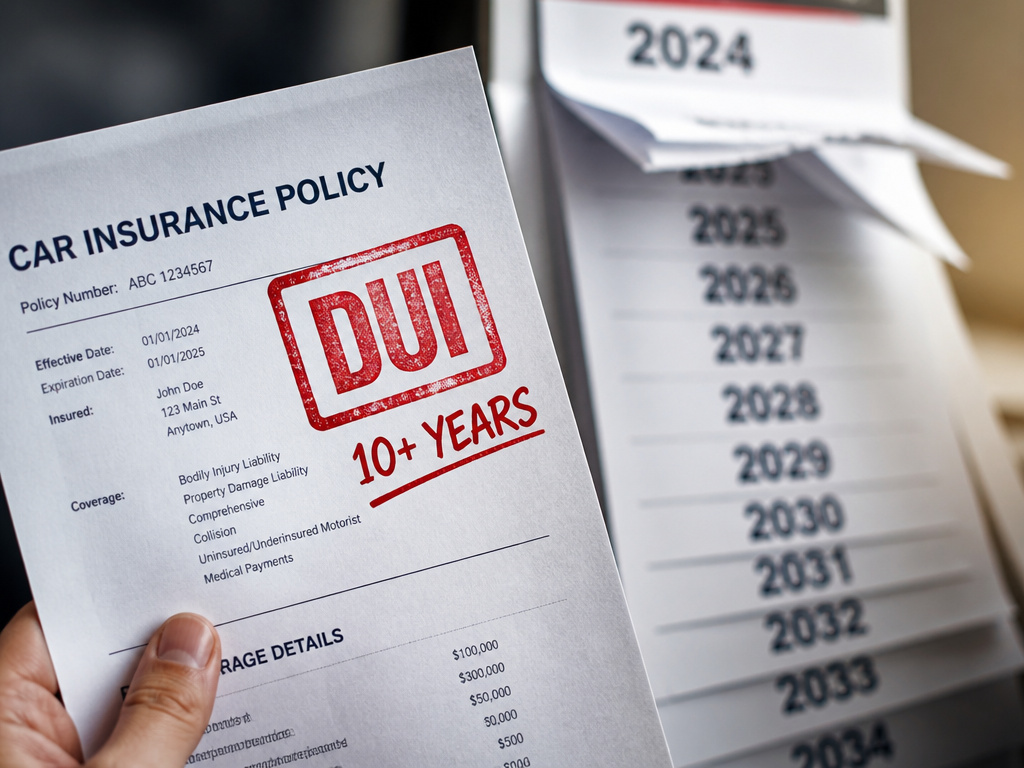 A DUI conviction attached to an accident isn’t just a worse version of a standard crash. It’s a category of its own, with longer timelines and steeper consequences that can reshape your insurance life.
Forget the three-to-five-year rule. A DUI-related accident can affect your insurance rates for a decade or more. Insurers view it as evidence of a behavioral pattern, not a one-time mistake. As agency manager Zack Pope noted, some mutual insurance companies will simply refuse to cover anyone who has ever had a DUI, a lifetime ban.
Most states keep a DUI on your DMV record for 10 to 15 years. Florida mandates a 75-year retention, effectively forever. The insurance impact mirrors this extended timeline. You will likely be forced into a high-risk pool and required to file an SR-22 certificate.
An SR-22 isn’t insurance; it’s a form your insurer files with the state to prove you carry the minimum required liability insurance. Needing one signals to every insurer that you are a high-risk driver. Your premiums can double or triple. The filing requirement itself usually lasts three years, but the stain on your record lasts much longer.
What Stays on Your Record (Even When You Think It Doesn’t)
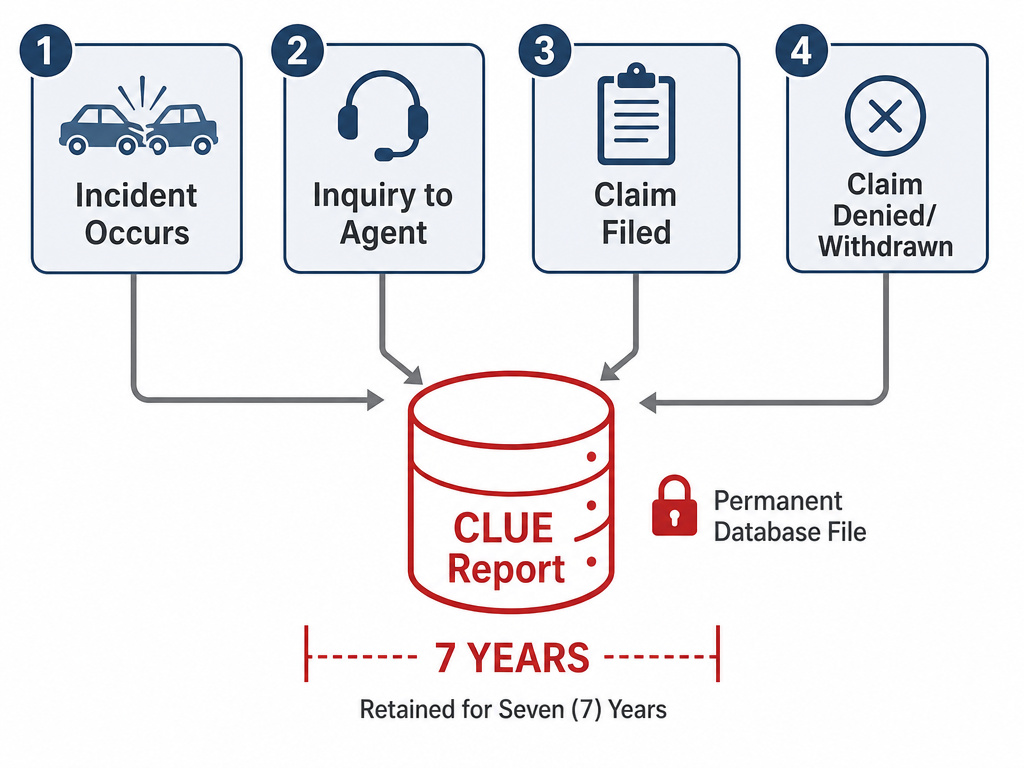 The insurance databases are designed to track loss history, not just paid claims. Several common scenarios create a record that surprises drivers years later.
Many people don’t realize that even inquiring about coverage after an incident can generate an entry in the CLUE database. You might call your agent to ask if a repair is worth claiming, decide not to file, and still find a “loss inquiry” on your report. It’s a footprint of perceived risk.
More concretely, denied or withdrawn claims are still recorded. If you file a claim and your insurer denies it because it’s not covered, or if you withdraw it to handle repairs yourself, that claim activity stays in the system for the full seven years. The database logs the fact that a loss occurred and was presented to the insurer, not whether a check was cut.
This is a critical reason to think carefully before filing a claim for damage close to your deductible amount. The long-term premium increase from the claim record could far exceed the payout you’d receive.
How to Manage the Impact and Find Relief
You can’t speed up the clock, but you can control the damage. A strategic approach during the surcharge period can save you thousands.
First, verify your records. Request your free CLUE report from LexisNexis and your MVR from your state DMV. Look for errors in dates, fault determination, or claim amounts. A mistake here is a seven-year tax on your wallet. Disputing inaccuracies is your legal right.
Second, maintain a perfectly clean record. Any new ticket or incident resets the clock and compounds the surcharge. This is the most powerful thing you can do. As the end of your insurer’s look-back period approaches, start shopping. A new company might weigh your old accident less heavily, especially if you’ve been clean for years.
Easy to miss: Your credit score becomes more important after an accident. Insurers use credit-based insurance scores to assess risk. Improving your score can help offset some of the premium increase from the accident.
Consider a defensive driving course. Some insurers offer a discount for completing one, which can shave a bit off your inflated premium. More importantly, in some states, a course can mask a minor violation from your DMV record, preventing a double-whammy on your rates.
Finally, re-evaluate your coverage needs. While you shouldn’t drop essential protection, you might find savings by adjusting optional coverages or raising your deductible once the high-risk period passes. For a detailed plan, our guide on how to lower insurance after an accident walks through these tactics.
Frequently Asked Questions
Does a no-fault accident go on my insurance record?
Yes, it usually does. The CLUE database records all claims and inquiries, regardless of fault. While a not-at-fault accident may not trigger a surcharge in some states or with some companies, it still becomes part of your seven-year claims history. A future insurer seeing multiple not-at-fault claims may still view you as a higher risk.
Can I get insurance with an accident on my record?
Absolutely. You will pay more, but you can get coverage. You may need to shop beyond the major national carriers. Some companies specialize in non-standard or high-risk auto insurance. An accident alone, especially if it’s older than three years, won’t prevent you from finding a policy, but a recent DUI might require you to seek insurers through a state-mandated SR-22 filing program.
How can I check my CLUE report?
You can request one free report every 12 months through the official LexisNexis Consumer Portal. The process is similar to getting your annual credit report. Review it for accuracy, check the date of loss, type of claim, and payout amount. Errors are uncommon but costly.
Does switching insurance companies reset the clock?
No. The clock is tied to the date of the incident, not your policy. The seven-year retention in the CLUE database and your insurer’s three-to-five-year look-back period continue regardless of how many companies you switch between. Your history follows you via the shared database.
What’s the difference between accident forgiveness and the record falling off?
Accident forgiveness is a policy feature that prevents your current insurer from raising your rates after your first at-fault accident. The accident still appears on your CLUE report. “Falling off” refers to the claim aging past your insurer’s look-back period, after which it no longer affects your premium, though it remains visible in the database for the full seven years.
The Bottom Line
The seven-year rule is fixed. The three-to-five-year rate hike is what you actually feel in your bank account. Your power lies in the gap between them.
Use the first few years to maintain a spotless record, no tickets, no new claims. As you approach the end of your insurer’s look-back window, that’s your signal to shop aggressively. A different carrier might offer a better rate on your now-aged accident. Remember that serious violations like a DUI operate on a different, harsher timeline and will likely require specialized SR-22 insurance.
You can’t change the past, but you can manage the aftermath. Verify your reports, drive clean, and plan your exit from the surcharge period. The clock is always ticking.
