
Auto Insurance Types Car Insurance Explained: State Mandates
This post contains affiliate links. As an Amazon Associate, we earn from qualifying purchases.
Auto insurance types car insurance policies are built from fall into five core categories: liability (bodily injury and property damage), collision, comprehensive, personal injury protection (PIP), and uninsured/underinsured motorist coverage. State law dictates which are mandatory, with minimums like California’s 15/30/5 or Texas’s 30/60/25. Your policy’s Declarations Page lists your specific coverage amounts and deductibles.
That list of coverages is a legal and financial blueprint. Each type protects against a distinct, named risk, and skipping one your state requires can trigger penalties that hit your wallet and your driving record.
What follows: a breakdown of what each coverage actually does, the state-specific minimums you can’t ignore, and the edge cases, like OEM parts or PIP opt-outs, that turn a standard policy into your specific safety net.
Key Takeaways
- Liability insurance is non-negotiable everywhere, but the minimum dollar amounts vary wildly, from $5,000 in property damage in California to $30,000 in Massachusetts.
- “Full coverage” is a sales term, not a policy type. It typically means liability plus comprehensive and collision, but it never covers every possible loss.
- You can often decline optional coverages like PIP or uninsured motorist protection, but you must do so in writing, and driving without them is a calculated risk.
- Your Declarations Page is the single most important document in your policy. It lists your exact coverage limits, deductibles, and the vehicles insured, always verify it against what you think you bought.
- Aftermarket parts are the default for repairs unless your policy specifically includes OEM (Original Equipment Manufacturer) parts coverage, which usually costs extra.
The 5 Core Auto Insurance Types (Explained)
Every car insurance policy is a bundle of separate coverages. Think of them as individual tools, each designed for a specific job. Mixing them up or misunderstanding what they cover is how people find themselves paying for a claim out of pocket.
Liability Coverage: Pays for injuries you cause to other people (Bodily Injury Liability) and damage you cause to their property (Property Damage Liability). It does not cover you or your car. State law sets the minimum limits you must carry.
Bodily Injury & Property Damage Liability
This is the bedrock. If you cause an accident, bodily injury liability pays for the other driver’s medical bills, lost wages, and pain and suffering, up to your policy limits. Property damage liability pays to fix their car, a fence you hit, or a lamppost you took out.
The “15/30/5” you see in places like California breaks down as $15,000 per person for bodily injury, $30,000 per accident for all bodily injuries, and $5,000 for property damage. Texas mandates a higher 30/60/25 structure. These numbers are ceilings. If damages exceed your limits, you’re personally on the hook for the difference.
Collision Coverage
This covers damage to your car from a collision, whether you hit another car, a tree, or a guardrail. It applies regardless of who is at fault. You choose a deductible, the amount you pay out-of-pocket before the insurance kicks in, usually between $500 and $2,000. A higher deductible lowers your premium.
Common mistake: Thinking collision is optional if your car is paid off. It is optional by law, but foregoing it means you’re self-insuring for repairs after any accident you cause.
Comprehensive Coverage
Often paired with collision, comprehensive covers damage to your car from everything except a collision. The list includes theft, vandalism, fire, hail, flooding, and hitting an animal. It also has a deductible. If a tree branch falls on your hood or a hailstorm dimples your roof, comprehensive handles it.
| Coverage | Pays For | Mandatory? | Key Limitation |
|---|---|---|---|
| Liability | Injuries/damage you cause to others | Yes, in all states | Does not cover you or your car |
| Collision | Damage to your car from an impact | No, but lenders require it | Deductible applies; wear/tear excluded |
| Comprehensive | Non-collision damage (theft, weather, etc.) | No, but lenders require it | Deductible applies; often excludes mechanical failure |
Personal Injury Protection (PIP) & Medical Payments
Personal Injury Protection is “no-fault” coverage. It pays for your and your passengers’ medical expenses and lost wages after an accident, regardless of who caused it. States like Massachusetts mandate PIP with an $8,000 limit. In Texas, PIP is included in every policy unless you reject it in writing.
Medical Payments coverage is similar but typically more limited, often covering only medical bills. It’s common in states without a no-fault system. The why-layer here is about cost containment: PIP keeps minor injury claims out of the court system, which theoretically keeps premiums lower for everyone.
Uninsured/Underinsured Motorist Coverage
This protects you if you’re hit by a driver with no insurance or insufficient coverage. Uninsured Motorist Bodily Injury covers your medical costs. Uninsured Motorist Property Damage covers your car repairs if the at-fault driver has no insurance. States like Maryland require you to carry limits matching your liability coverage.
Where this goes sideways: Opting out of uninsured motorist coverage to save $50 a year. If you’re hit by an uninsured driver in an at-fault state, your only recourse is to sue them personally, an often futile effort.
The State Minimums That Actually Matter
The “minimum required auto insurance” is a moving target. It changes at every state line. Buying only the bare minimum is a financial gamble, but you must at least know what that floor is.
A Patchwork of Financial Responsibility Laws
Each state’s financial responsibility law defines the minimum liability limits. The Louisiana Department of Insurance notes that liability insurance is the most common way to meet this requirement. Failing to maintain it can lead to fines, license suspension, and vehicle registration revocation.
The Maryland Insurance Administration has a blunt system: if they can’t verify your coverage, they assess a daily penalty fee for each day your vehicle was uninsured. This isn’t a one-time ticket. It accumulates.
Side-by-Side: California, Texas, and Massachusetts
The numbers tell the story. Here’s how three states define their minimum financial responsibility.
| State | Bodily Injury Liability (Per Person / Per Accident) | Property Damage Liability | Personal Injury Protection (PIP) | Uninsured Motorist |
|---|---|---|---|---|
| California | $15,000 / $30,000 | $5,000 | Not required | Must be offered, can be declined |
| Texas (30/60/25) | $30,000 / $60,000 | $25,000 | Included unless rejected in writing | Must be offered, can be declined in writing |
| Massachusetts | $25,000 / $50,000 | $30,000 | $8,000 minimum | Required (matching liability limits) |
Notice the gap? California’s $5,000 property damage limit wouldn’t cover a new bumper on many modern SUVs. Texas’s higher 30/60/25 structure reflects different cost assumptions. These differences determine whether a claim is covered or leads to a lawsuit.
The part nobody mentions: Massachusetts’ compulsory Bodily Injury to Others coverage has a geographic limit. It only applies to accidents that occur within Massachusetts. If you cause an accident in New Hampshire, your minimum liability coverage might not respond.
Optional Coverages and Endorsements
Beyond the core types, insurers offer add-ons that plug specific gaps. These endorsements tailor a generic policy to your actual life.
Gap Insurance
If your car is totaled or stolen, your insurer pays the Actual Cash Value (ACV), what the car was worth the moment before the loss. If you owe $22,000 on a loan but the ACV is $18,000, you’re on the hook for the $4,000 “gap.” Gap insurance covers that difference. Lenders often require it on financed vehicles.
Rental Reimbursement & Towing
Rental reimbursement coverage pays for a substitute vehicle while yours is being repaired after a covered claim. Limits are usually per day and per incident (e.g., $30/day, $900 max). Towing and labor coverage pays for a tow to a repair shop. It’s low-cost but critical if you don’t have a separate roadside assistance plan.
Custom Parts and Equipment Coverage
A standard policy covers the vehicle as it rolled off the factory floor. If you’ve added custom wheels, a high-end stereo, or a permanent performance chip, you need this endorsement. Without it, a theft or accident claim will not reimburse you for those upgrades.
Reading Your Policy: The Declarations Page
 The Declarations Page (or “DEC page”) is your policy’s cover sheet. The California Department of Insurance defines it as the page containing your name, policy number, coverage types, limits, deductibles, and the vehicles insured. It’s the one page you should always keep accessible.
This is where you check that your coverage levels match what you agreed to buy. It’s also where you’ll find your insurance deductible amounts for comprehensive and collision. If your agent said you have “full coverage,” the DEC page will show the exact dollar limits proving, or disproving, that claim.
How to Choose What You Need
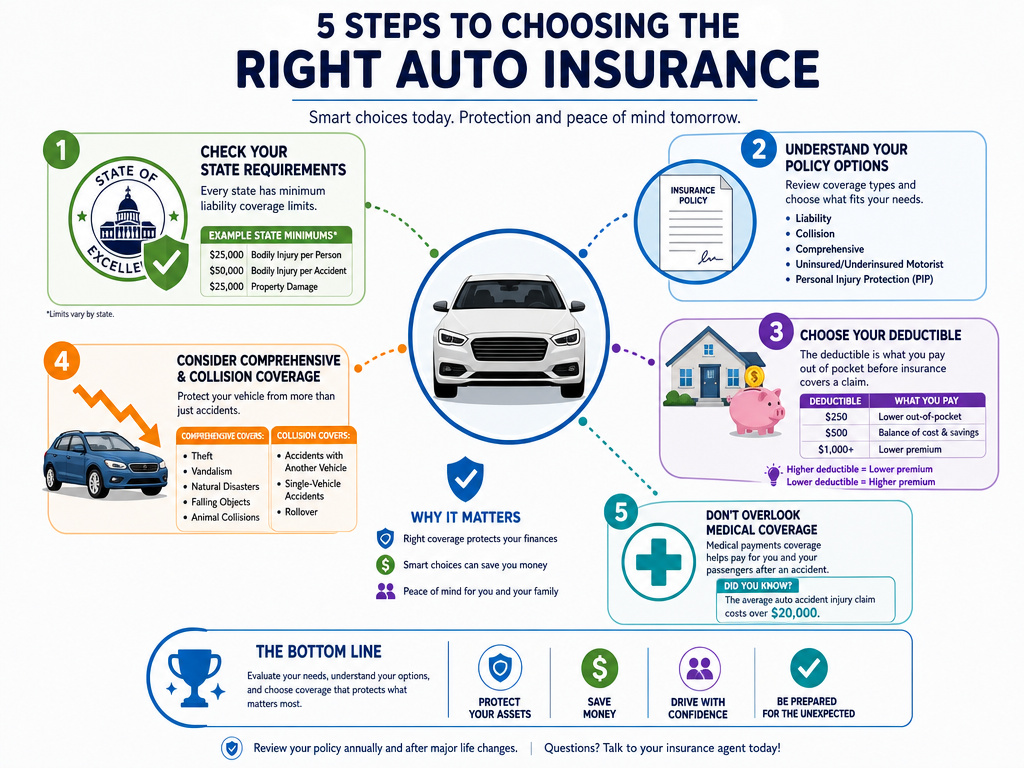 Selecting auto insurance types car insurance requires is a balance of legal compliance, lender requirements, and personal risk tolerance.
- Meet Your State’s Minimum. This is non-negotiable. Use your state’s official guide, like the Texas auto insurance guide, to verify the current compulsory coverages.
- Meet Your Lender’s Requirements. If you lease or finance, the contract will mandate comprehensive and collision coverage, often with a maximum deductible.
- Protect Your Assets. State minimums are designed to protect others from you, not you from financial ruin. If you have savings, a home, or future income to protect, increase your liability limits well above the minimum. An umbrella policy provides an extra million dollars or more of liability protection for a relatively low cost.
- Evaluate Your Vehicle’s Value. The older and less valuable your car, the less financial sense comprehensive and collision make. If the annual premium plus your deductible approaches the car’s value, consider dropping these coverages.
- Consider Your Health Insurance. If you have robust health insurance, you might opt out of PIP or Medical Payments where allowed. But remember, health insurance doesn’t cover lost wages, which PIP often does.
I prefer higher liability limits over a lower deductible. The deductible is a known, manageable cost if I have a claim. A liability lawsuit that exceeds my low limits could wipe me out. That’s a stance born from seeing too many drivers treat state minimums as a recommendation instead of a dangerous floor.
Frequently Asked Questions
What does “full coverage” actually mean?
It’s an informal term, not a policy type. It usually refers to a policy that includes liability, comprehensive, and collision coverages. It does not mean every possible loss is covered, and it doesn’t specify the limits. Always ask for the exact coverage amounts instead of relying on this phrase.
Can I drive a rental car with my personal insurance?
Usually, yes. Your personal liability insurance typically extends to rental cars for personal use. Your comprehensive and collision coverage may also apply, but often with the same deductibles. Always check your policy or call your agent before declining the rental company’s costly damage waiver.
What’s the difference between OEM and aftermarket parts?
OEM (Original Equipment Manufacturer) parts come from your car’s maker. Aftermarket parts are made by other companies. Most standard policies pay for “parts of like kind and quality,” meaning aftermarket. If you want OEM parts guaranteed after a claim, you usually need a specific endorsement, which costs more.
Why is my insurance requiring an inspection?
Some insurers, particularly in states like Massachusetts, may require a vehicle inspection before providing comprehensive coverage on a used car. This is to verify its condition and pre-existing damage. The inspection can often be deferred for a short period, but coverage is suspended if not completed.
What happens if I lend my car to a friend and they crash?
Your insurance is primary. Your liability insurance would cover injuries and damages they cause to others, and your collision coverage would pay for damage to your car (minus your deductible). Their insurance might act as secondary coverage if your limits are exhausted.
Before You Go
Auto insurance is a bundle of specific promises. Liability keeps you legal. Comprehensive and collision protect your investment. PIP and uninsured motorist cover the gaps other drivers leave. Your state’s official handbook, like the Massachusetts auto insurance basics, is the best place to start. Then, build from that minimum with an eye on what you truly can’t afford to lose. The right mix is the one that lets you sleep at night.
