
What Is No Fault Insurance and How It Works State by State
This post contains affiliate links. As an Amazon Associate, we earn from qualifying purchases.
No fault insurance is a state-mandated system where your own car insurance policy pays for your medical bills and lost wages after an accident, regardless of who caused the crash. In its strict form, it also restricts your right to sue the other driver for pain and suffering unless your injuries meet a specific legal threshold. The system operates in 12 states and is built on Personal Injury Protection (PIP) coverage.
That “regardless of fault” clause is the whole point. It was designed to get small injury claims paid fast and get them out of the courts. The trade-off is your legal rights. You give up the chance to sue for a fender-bender whiplash claim in exchange for a guaranteed, if limited, payout from your own insurer.
What follows is the mechanics: the Personal Injury Protection (PIP) coverage that funds it, the lawsuit thresholds that define it, and the patchwork of state laws, from Michigan’s historic unlimited coverage to Kentucky’s choice system, that make it one of the most confusing parts of car insurance. By the end, you’ll know exactly what your policy does if you live in a no-fault state.
Key Takeaways
- No-fault insurance uses your own PIP coverage to pay medical bills and lost wages after an accident, skipping the fault-finding delay.
- The major catch is a lawsuit threshold. You typically cannot sue the at-fault driver for pain and suffering unless your injuries are “serious” under state law.
- Twelve states have true no-fault systems. Eight others are “add-on” states that provide PIP benefits but do not restrict your right to sue.
- Michigan reformed its system in 2020, moving from mandatory unlimited PIP medical coverage to allowing policyholders to choose from several coverage tiers.
- PIP systems are targets for fraud and inflated medical billing, which is a primary reason some states have repealed their no-fault laws.
The Core Mechanism: PIP and Lawsuit Limits
The engine of no-fault insurance is Personal Injury Protection (PIP). This is first-party coverage you buy as part of your policy. After a crash, you file a claim with your own insurance company under your PIP coverage. They pay for your reasonable medical expenses, a portion of lost wages, and sometimes funeral costs or essential services, up to your policy’s limits.
Personal Injury Protection (PIP) is a mandatory first-party benefit in no-fault states. It covers the policyholder’s reasonable medical costs and a percentage of lost wages after an automobile accident, with payment coming from the policyholder’s own insurer irrespective of who caused the collision. This mechanism is designed to expedite claims payment and reduce litigation for minor injuries.
This happens without any determination of fault. Your insurer cuts the check. The other driver’s insurer does the same for their driver. It’s designed for speed.
The trade-off for this streamlined payment is your right to sue. In a traditional “tort” state, if someone else causes an accident that injures you, you can sue them for both your economic losses (medical bills, lost wages) and non-economic damages (pain and suffering). No-fault states restrict that second part.
To step outside the no-fault system and sue for pain and suffering, your injuries must cross a state-defined “threshold.” There are two types.
A verbal threshold uses descriptive legal language. New York’s law is a classic example. New York Insurance Law Section 5102(d) defines a “serious injury” as including death, significant disfigurement, a fracture, or significant limitation of a body function or system. If your injuries don’t meet that definition, you cannot sue.
A monetary threshold uses a specific dollar amount of medical bills. Kentucky used this system, with its threshold set at $1,000 by Kentucky Revised Statutes 304.39-060. If your medical expenses exceeded that amount, you could step outside no-fault and file a lawsuit.
The verbal threshold is more common today. Critics argue it’s been eroded by broad court interpretations, letting more lawsuits through than originally intended and driving up costs.
The 12 No-Fault States (And the Exceptions)
Only twelve states and Puerto Rico operate a true no-fault system. They mandate PIP coverage and restrict lawsuits via a threshold. The list has shrunk over time as states like Florida repealed their laws.
| State | Threshold Type | Key Note |
|---|---|---|
| Florida | Verbal (Repealed 2023) | PIP was required until 2023; system sunset. |
| Hawaii | Verbal | Lawsuits allowed for serious injury. |
| Kansas | Verbal | $4,500 medical expense threshold also exists. |
| Kentucky | Choice | Drivers can opt out of no-fault entirely. |
| Massachusetts | Verbal | $2,000 medical expense threshold for suits. |
| Michigan | Verbal | Historic unlimited PIP now has elected limits. |
| Minnesota | Verbal | Suit allowed for $4,000 in medical expenses or serious injury. |
| New Jersey | Choice | Drivers select a “verbal threshold” or “no threshold” option. |
| New York | Verbal | Strict 30-day deadline to file PIP claim. |
| North Dakota | Verbal | $2,500 medical expense threshold. |
| Pennsylvania | Choice | “Full tort” vs. “limited tort” election. |
| Utah | $3,000 Monetary | Medical expenses must exceed $3,000 to sue. |
Then there are the “add-on” states. These eight states, like Oregon and Texas, require drivers to carry PIP or similar medical payments coverage, but they do not restrict the right to sue. You get the benefit of fast medical payments from your own insurer, but you retain full legal rights against the at-fault driver. This is not true no-fault.
Finally, choice no-fault systems like Kentucky’s and New Jersey’s let the policyholder decide. When you buy insurance, you choose between a no-fault policy with its lawsuit limits or a traditional tort policy. Your premium will be different based on that choice.
A Deep Dive: Michigan and New York
To see how no-fault works in practice, look at its two most prominent examples.
Michigan had the most generous system in the country for decades. Public Act 218 of 1956 mandated unlimited, lifetime PIP medical coverage for your own injuries. This made policies extremely expensive. In 2020, reforms under Public Acts 21 and 22 of 2019 took effect.
Now, Michigan drivers choose their PIP medical limit from several tiers: unlimited, $500,000, $250,000, or opt-out entirely if they have qualifying health insurance. The goal was to lower premiums, though Michigan’s remain among the highest nationally. The state’s law still includes a verbal threshold for lawsuits.
New York runs a strict, comprehensive system codified in its Insurance Law. Its verbal threshold is famously specific. You can read the exact criteria in the Cornell Legal Information Institute Wex entry. The law also mandates what PIP must cover: all necessary medical and rehab expenses, 80% of lost wages (with caps), and a death benefit.
Where this goes sideways: Missing New York’s 30-day deadline to file a PIP claim. Insurers can deny your entire medical benefits claim if you’re late, leaving you to pay out of pocket or fight a legal battle for an extension.
The Wikipedia no-fault insurance article notes that these systems were meant to lower premiums, but a RAND Corporation study found costs are often higher in no-fault states due to increased utilization and fraud.
The Problems: Fraud, Cost, and Confusion
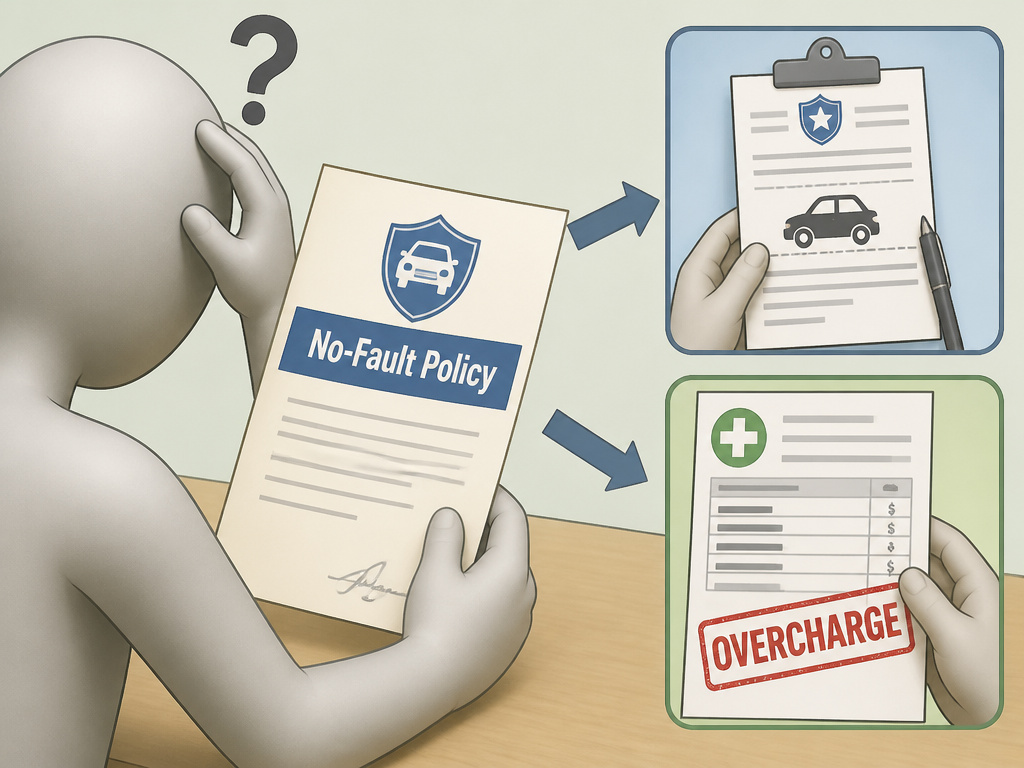 No-fault systems have well-documented failure modes. The most corrosive is PIP fraud. Because insurers must pay claims without questioning fault, dishonest medical providers and clinics have run “no-fault mills.” They bill for unnecessary procedures, expensive equipment, and prolonged treatment for minor soft-tissue injuries.
This inflates the cost of PIP coverage for everyone. It’s a primary reason states like Florida eventually abandoned their system.
The second problem is threshold erosion. When courts interpret terms like “significant limitation” broadly, more injuries qualify as “serious.” This pokes holes in the lawsuit restriction, letting more cases into the court system and undermining the system’s cost-saving premise.
Finally, there’s sheer confusion for drivers. Many people think “no-fault” means no one is found responsible for the crash. That’s wrong. Police still issue tickets, and insurers still assign fault for the purpose of paying for vehicle damage under liability insurance and for adjusting your insurance rates at renewal. No-fault only applies to personal injury claims.
How No-Fault Affects You (The Real-World Scenarios)
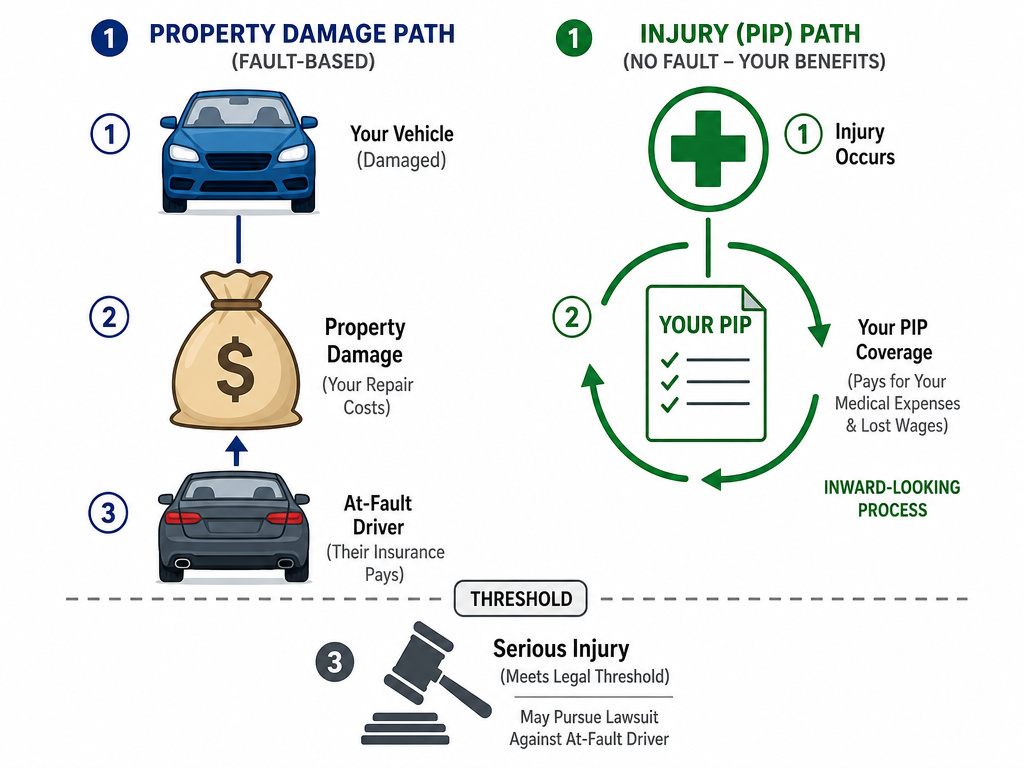 Your experience with a total loss accident is different in a no-fault state. The property damage portion of the claim, who pays to fix or replace your car, is still handled under traditional liability rules. The at-fault driver’s property damage liability coverage pays for your car. The no-fault system doesn’t touch this.
For injuries, the process is inward-looking. You deal only with your own insurer for your medical bills and lost wages, up to your PIP limit. This can feel simpler after a minor crash. There’s no waiting for the other insurer to accept liability.
But after a major injury, the limits feel tight. If your medical bills exhaust your $50,000 PIP limit, you must then rely on your health insurance. And if you want compensation for your pain, you and your lawyer must prove your injuries meet the state’s “serious injury” threshold, a legal fight that the no-fault system was supposed to avoid.
Your insurance record will still show an at-fault accident if you caused the crash, impacting your premiums. The no-fault label doesn’t grant immunity from rate hikes.
Frequently Asked Questions
Does no-fault insurance pay for car repairs?
No. No-fault insurance, specifically PIP coverage, is only for personal injury expenses like medical bills and lost wages. Damage to your vehicle is covered either by your own collision coverage (if you have it) or by the at-fault driver’s property damage liability insurance.
Can I sue someone in a no-fault state?
Yes, but only under specific conditions. You can sue the at-fault driver for pain and suffering (non-economic damages) if your injuries meet the state’s “serious injury” threshold. You can always sue for economic damages that exceed your PIP policy limits, but this is less common.
What’s the difference between PIP and MedPay?
Both are first-party medical coverages. The key difference is that Personal Injury Protection (PIP) is broader, often covering lost wages and essential services, and is mandatory in no-fault states. Medical Payments (MedPay) is simpler, usually covering only medical expenses, and is common in “add-on” or traditional tort states as an optional supplement.
Why do some states not have no-fault insurance?
Many states have repealed no-fault laws or never adopted them due to concerns over rising costs from fraud and litigation, and a belief that the traditional tort system with optional MedPay is more effective and affordable for drivers.
How do I file a no-fault claim?
You file a claim with your own insurance company under your PIP coverage, just as you would for a collision claim. You should report the accident immediately and submit all medical bills and documentation of lost wages directly to your insurer. The process for the vehicle damage portion is separate and goes through the at-fault driver’s liability insurance.
The Bottom Line
No-fault insurance is a trade-off: faster medical payments for limited legal rights. It lives and dies by the details of your state’s law, the PIP limits you selected and the legal definition of a “serious injury.”
If you live in one of the twelve no-fault states, check your policy’s PIP coverage limit now. Is it $50,000 or $250,000? That number is your medical safety net after a crash. Understand that your right to sue is not gone, but it’s guarded by a legal threshold.
For everyone else, the system is a useful lesson in how car insurance is shaped by local politics, court rulings, and the constant tug-of-war between quick payouts and the high cost of fraud. It’s never just about who hit whom.
