
The Real Accuracy of Online Car Insurance Quotes Explained
This post contains affiliate links. As an Amazon Associate, we earn from qualifying purchases.
Online car insurance quotes are estimates, not guaranteed prices. Their accuracy depends entirely on the precision of the information you provide and the insurer’s subsequent verification of your driving record, vehicle details, and location. A quote is legally an invitation to negotiate, not a binding offer, and most carriers honor it for about 30 days before re-rating you.
That distinction between estimate and guarantee is where the real cost hides. The number you see online is a starting point calculated from your self-reported data. The final premium is set after the insurer pulls your motor vehicle report, verifies your address, and may check your credit-based insurance score. Any mismatch between what you typed and what they find changes the price.
What follows is a breakdown of the three factors that decide whether your quote sticks, the one piece of data that locks it down, and why using an AI chatbot for this is a proven way to get a number you cannot trust.
Key Takeaways
- A Vehicle Identification Number (VIN) is non-negotiable for accuracy; skipping it lets the system guess your car’s specs, which always changes the final rate.
- Online quotes expire in roughly 30 days; after that, insurers can re-run your data with updated reports and new rate filings.
- Aggregator sites (like Compare.com) use soft credit pulls, but applying directly to an insurer triggers a hard check that can affect your credit score.
- A 2026 study found 20% of AI-generated insurance advice contained major inaccuracies, including hallucinated discounts and outdated regulations.
- Always check an insurer’s NAIC complaint index before buying; a score above 1.0 means they have more customer complaints than average for their size.
The Single Most Effective Thing You Can Do
Enter your 17-character Vehicle Identification Number. Every time. Do not select your car from a dropdown menu.
The VIN tells the insurer‘s algorithm the exact trim, engine, safety features, and factory-installed equipment for your specific vehicle. A dropdown menu for a “2020 Honda Accord” represents an average. It might assume you have the base model LX, not the Touring trim with automatic emergency braking. That safety feature alone can qualify for a discount that a generic selection misses entirely. The system defaults to average values, which often overstate or understate the true replacement cost and risk profile.
Where this goes sideways: Skipping the VIN. The quote defaults to average specs for your model. When underwriting verifies the actual car, the premium adjusts, always upward if your car is more expensive to repair or replace than the average guess.
This isn’t about convenience. It’s about eliminating the insurer’s ability to assume. Without the VIN, you are asking for a quote on a hypothetical car. Your real car has a real identification number stamped on the dashboard and door jamb. Use it.
What Online Quote Systems Actually Check (And What They Assume)
The online form is a data-gathering tool. It feeds your answers into the carrier’s rating algorithm, a proprietary set of rules that weighs risk. The system makes critical assumptions until it can verify facts with third-party sources.
Think of the quote as a preliminary risk score. The final underwriting process is the audit. That audit pulls from databases you cannot directly control when filling out a form.
| Factor You Enter | What the Quote Assumes | What Underwriting Verifies |
|---|---|---|
| Driving History | Your self-reported accidents and tickets are complete and accurate. | Your official Motor Vehicle Report (MVR) from the state DMV. |
| Garaging Address | You live where you say you do, and the car is parked there nightly. | Property tax records, prior policy addresses, and sometimes even mailing list data. |
| Vehicle Details | The year, make, and model you selected (or the VIN you entered) are correct. | The VIN decode against national vehicle databases to confirm trim and equipment. |
| Coverage History | You have no lapses in coverage, or you accurately reported any gaps. | The Comprehensive Loss Underwriting Exchange (C.L.U.E.) report, which shows past claims. |
| Credit Information | Your credit-based insurance score is stable (in states where it’s permitted). | A hard or soft pull from a credit reporting agency like LexisNexis or TransUnion. |
The gap between the “assume” column and the “verify” column is your financial exposure. A clean driving record you proudly enter can be contradicted by an MVR showing a forgotten speeding ticket from 13 months ago. An address you just moved to might not match the public records an insurer checks, flagging your application for closer review.
Common mistake: Treating the quote form like a casual survey. Every field is a variable in a risk equation. An estimate is only as good as its inputs.
This verification step is also why two seemingly identical quote processes can yield different results. A direct quote from Geico’s website uses their own real-time algorithm. A quote for Geico from an aggregator site like The Zebra might use a simplified, generic version of that algorithm. The direct quote is almost always more reliable because it skips the middleman’s approximations.
Why Your Final Premium Almost Never Matches the Quote
Three mechanisms trigger a change between the online estimate and the final bill: data verification, coverage mismatch, and state-specific rule sets.
First, data verification is not optional for the insurer. They must check your MVR and claims history to legally issue a policy. If your MVR shows an accident you didn’t list, the premium increases. If their property records show your roof is five years older than you stated on a homeowner’s quote, the premium increases. This is not a penalty. It’s a correction to the risk model.
Second, coverage mismatch makes price comparisons worthless. A $800 quote for liability-only coverage is not cheaper than a $950 quote for full coverage with a $500 deductible and rental reimbursement. Online forms often default to state minimums to generate a attractively low number. You must deliberately select equivalent coverage levels across every quote to compare real costs.
If your final premium increases due to information in a consumer report, federal law requires the insurer to send you an adverse action notice. This notice must include the name of the reporting agency and your right to dispute inaccuracies. It’s your legal proof that a data point changed your rate.
Third, AI tools and even some aggregators fail at state-specific rules. A Forbes Advisor review of AI shopping tools noted they often rely on outdated or generalized data. Massachusetts law, for example, prohibits using credit information or occupation in rating. An AI chatbot trained on national data might incorrectly factor those into a quote for a Boston driver, rendering the number useless. Always verify a surprising quote against the official insurance requirements document for your state.
The Hidden Costs of Convenience: Aggregators vs. Direct Quotes
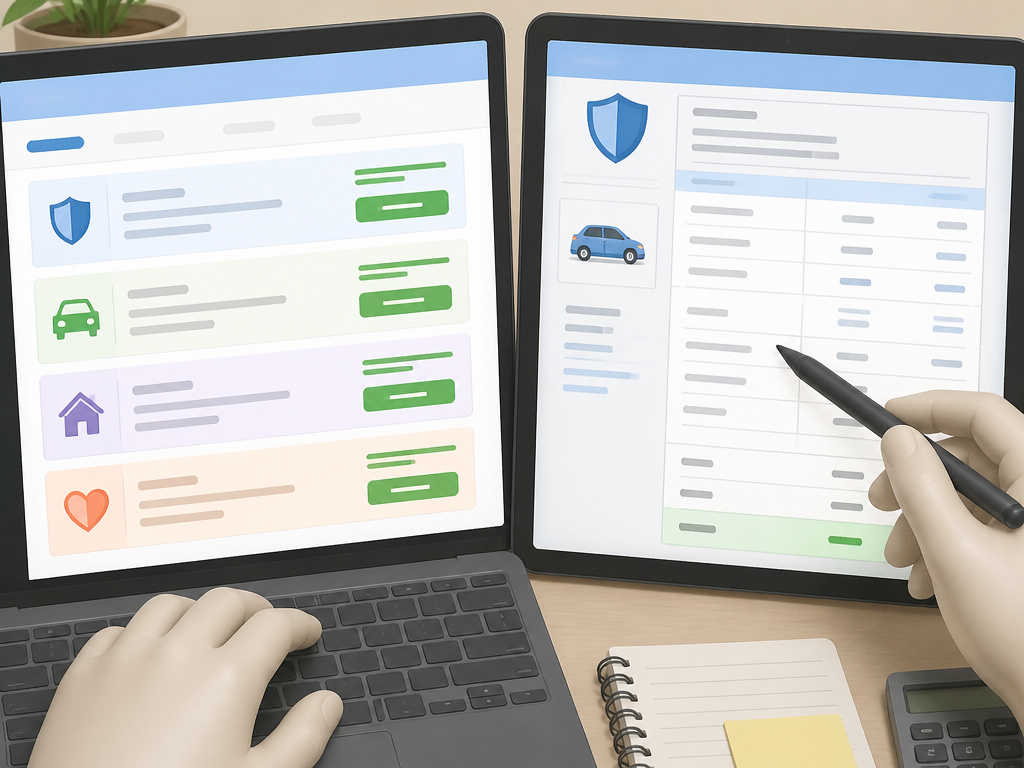
You have two paths: use a comparison aggregator site or go directly to insurer websites. Each has a different impact on accuracy and your wallet.
Aggregator sites (e.g., Insurify, Compare.com) are lead generators. They make money when you click through to an insurer. To get you to click, they prioritize speed and a wide range of quotes. This means: * They often use soft credit inquiries that don’t affect your score. * They may present simplified coverage options. * They cannot show every discount, like those for usage-based insurance programs that require a monitoring period.
Direct quotes from an insurer’s own website use their live rating engine. The process is slower but more precise. The number you see is the price their system calculates with your actual data, before underwriting. The trade-off is you have to repeat the process for each company.
Which is more accurate? For a standard driver with a clean record, a direct quote is superior. It reduces the layers of approximation. For someone with a complex history, a recent at-fault accident, a credit score that’s just rebounding, a need for an SR-22 filing, the direct quote is the only responsible option. Aggregators will often default such profiles to a few high-risk specialists, missing potential options.
How to Vet the Number and the Company
A cheap quote from a terrible insurer is not a good deal. Before you get excited about a low number, do two minutes of due diligence.
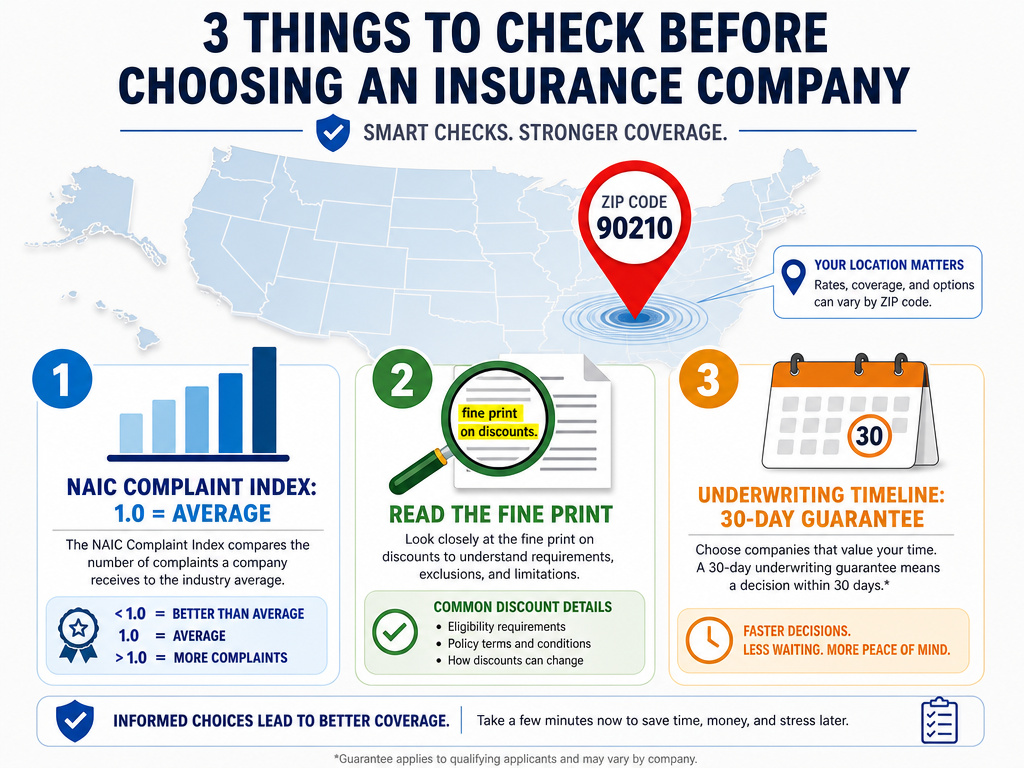
- Check the NAIC Complaint Index. The National Association of Insurance Commissioners publishes a complaint ratio for every licensed carrier. A score of 1.0 is average. Above 1.0 means more complaints than expected for its size. A score of 0.5 means fewer. This index is the clearest signal of customer service quality you will find.
- Read the fine print on discounts. Is that “safe driver” discount applied immediately, or only after six months of claim-free driving? Is the “bundling” discount dependent on also buying a homeowners policy from them? The initial quote often includes every discount you might qualify for, not every discount you will get.
- Confirm the underwriting timeline. Ask how long the quote is guaranteed. The industry standard is 30 days, but some are shorter. Also, ask if you can request a pre-binding underwriting review. This extra step lets an underwriter preliminarily approve your file before you pay, locking in the rate and preventing surprises.
Your ZIP code is one of the heaviest weights in the pricing algorithm. It dictates local accident frequency, theft rates, and even weather-related claim risks. A quote that seems too good to be true might be from a carrier that doesn’t understand the risk in your specific neighborhood. Their low price today could mean massive rate hikes at renewal after they pay out their first few claims in your area.
Frequently Asked Questions
How long is an online car insurance quote good for?
Most insurers honor an online quote for approximately 30 days. After that window, they can re-rate you using updated credit information, new motor vehicle reports, or revised rate filings. If your life circumstances change within that period, you get a ticket, move, or buy a new car, the quoted rate is void.
Can I get an accurate quote without a credit check?
In most states, no. Even if a site uses a “soft pull” that doesn’t impact your score, insurers in 95% of states are legally allowed to use a credit-based insurance score as a rating factor. The only way to avoid it is to live in a state like Massachusetts, California, or Hawaii that bans or heavily restricts the practice. Your quote will still involve a background check, but the credit and insurance link will be severed.
Why did my final premium come back higher than the quote?
The three most common reasons are discrepancies in your driving record (an unreported ticket on your MVR), inaccurate vehicle details (using a dropdown instead of a VIN), or a mismatch between your stated garaging address and public records. The insurer’s underwriting process found a risk factor your self-reported data omitted.
Are AI tools like ChatGPT reliable for getting insurance quotes?
No. A 2026 study by the European Broadcasting Union found one in five AI responses had major accuracy issues. For insurance, these tools hallucinate discount details, miss state-specific regulations, and use outdated rate information. They are useful for understanding basic concepts, but never for obtaining a quotable price. Always use a tool connected to a real insurer’s rating database.
Is it better to use an independent agent or get quotes online?
For complex situations, use an independent agent. They have access to carrier portals you don’t and can navigate nuanced rules for drivers with DUIs, gaps in coverage, or classic cars. For a straightforward policy renewal where you’re just checking the market, online direct quotes are efficient. An agent’s value is in guidance and access, not necessarily in finding a lower price you couldn’t find yourself.
Before You Go
Online car insurance quotes are a powerful shopping tool, but they are a starting gun, not a finish line. The number you see is a snapshot of a hypothetical version of you. The real you must pass through underwriting.
The sequence that works: gather your exact VIN, current policy details, and driver’s license. Get three direct quotes from insurers with strong NAIC complaint scores. Select identical coverage levels on each. Treat any quote more than 20% below the others with deep suspicion, it’s likely missing a critical coverage or based on flawed assumptions. Finally, understand that the final price is conditional. It depends on the audit matching your story.
Your goal isn’t the lowest quote. It’s the most reliable one. A quote that survives verification from a reputable company is the only one that matters. Everything else is just noise on a screen.
