
How Does Adding a Teen Driver Affect Your Insurance Costs?
This post contains affiliate links. As an Amazon Associate, we earn from qualifying purchases.
Adding a teen driver to your car insurance policy more than doubles your annual premium, with an average national cost of $5,740 per year in 2026. This represents a 142% increase for a two-driver family, driven by systemic crash-risk data that prices a 16-year-old as higher risk than a driver with a DUI conviction. The increase is unavoidable, but its size depends on your state, carrier, vehicle assignment method, and the discounts you stack.
The jump from roughly $3,200 to over $7,700 is actuarial math. Insurers price adults on individual history, but new teens get rated against the collective crash statistics for their age group.Those numbers, from the NHTSA, show drivers 20 and under cause 8.5% of fatal crashes while being only 5.1% of licensed drivers.
What follows is the breakdown of that $5,740 figure: where it comes from, the three rating levers that change it, the state-by-state spread that can swing your bill by thousands, and the stackable discounts that cut 30% or more off the top. By the end, you’ll know exactly what to ask your agent and which mistake to avoid in the first 30 days.
Key Takeaways
- The average annual cost to add a 16-year-old driver in 2026 is $5,740, a 142% increase that more than doubles a typical family’s premium.
- A new teen driver is priced as higher risk than a driver with a DUI; the teen surcharge averages $454 more per year than the DUI penalty.
- Rates drop at specific ages: an average of 10% at 19, 5% at 20, and 6% at 21, with another major drop at 25.
- Your insurer’s driver-vehicle assignment method is critical, some companies automatically assign the costliest driver to your most expensive car unless you specify otherwise.
- Stacking discounts (good student, multi-car, telematics) can reduce the teen premium by 30-40%, but the single biggest savings move is keeping them on your policy instead of a standalone one.
How Much Does Adding a Teen Driver to Insurance Cost?
The national average for adding a 16-year-old to a parent’s policy hit $5,740 per year in January 2026, according to a Bankrate analysis. For a typical married-couple policy that cost $3,184 without the teen, that’s a $2,556 annual increase, or about $213 extra every month.
The Insurance Information Institute (III) recommends a minimum liability coverage of $100,000/$300,000/$100,000 for parents of teen drivers. Skimping here to save money exposes you to massive financial risk if your teen causes an accident.
That $5,740 figure is an anchor. It moves based on your starting point. ValuePenguin’s 2026 data shows a two-driver family’s premium jumping from $3,184 to $7,699, a 142% increase, when adding a 16-year-old. The increase is slightly lower for one-car families (44%) and three-car families (62%), as the risk spreads across more vehicles.
| Driver Age Added | Average Annual Cost | Increase vs. Base Policy | Key Trigger for Drop |
|---|---|---|---|
| 16-year-old | $5,740 | 142% | N/A |
| 18-year-old | $4,941 | 104% | High school graduation |
| 21-year-old | $4,212 | 32% | Age milestone |
| 25-year-old | $2,581 | 25% | “Adult” rating tier |
The most shocking comparison is to other risk categories. That $5,740 teen premium is $454 more per year than the average cost to insure a driver with a DUI conviction.Drivers with speeding tickets pay $2,441 less than teens, and an at-fault accident costs $1,879 less. This gap exists because insurers have no behavioral data for your specific teen; they’re pricing against the systemic, proven risk of inexperience.
The Mechanism Behind the Rate Shock
Why does a spotless 16-year-old with straight A’s cost more to insure than an adult who drove drunk? The answer is in the underwriting models. Adult car insurance rates are based on individual behavior, your accident history, your credit score, your tickets. A teen has none of that.
Instead, insurers use age-group crash statistics from sources like the NHTSA. In 2021, drivers 20 and under were 5.1% of licensed drivers but caused 8.5% of fatal crashes and 12.6% of all crashes. That disproportionate risk is baked into the base rate for every new teen driver, regardless of their personal maturity.
Where this goes sideways: Assuming your teen will be assigned to the old sedan. Some insurers use a “household rating” model that calculates the teen’s premium as if they have access to the most expensive vehicle on the policy. If you have a luxury SUV listed, your teen’s rate reflects that risk unless you explicitly assign them to a specific car.
This leads to the critical concept of driver-vehicle assignment. You must call your insurer and ask how your policy handles it. If they use a household model, you need to formally assign your teen to the safest, least-valuable car on the policy, typically a sedan with high safety ratings. This one call can cut hundreds off the annual quote. It also interacts with other rating factors like your zip code rates, which set the baseline for all vehicles at your address.
State-by-State Variation: Your Location Is a Multiplier
The $5,740 national average hides a canyon of difference between states. Where you live often matters more than which carrier you pick. According to ValuePenguin, adding a 16-year-old in Rhode Island increases the premium by 225.3% (or $5,828), while the same move in a more moderate state might see a 100% jump.
This variation is driven by local factors: litigation costs, frequency of insurance fraud, state regulatory environments, and even regional weather patterns. A family in Florida will pay nearly double what a family in California pays for identical coverage on the same car with the same teen driver.
| State | Approximate Increase for Adding a 16-Year-Old | Primary Driver of High Cost |
|---|---|---|
| Rhode Island | 225% | Dense urban areas, high repair costs |
| California | 191% (for a 21-year-old) | Population density, high medical costs |
| Nevada | Highest monetary increase ($4,291 for a 21-year-old) | High litigation environment |
| Iowa | 40.2% (for a 25-year-old) | Competitive market, lower base rates |
The takeaway is that national averages are a starting point, not a prediction. You need a quote from carriers that write policies in your specific state. A regional insurer like Erie, which operates in 12 states and D.C., often undercuts national carriers like GEICO or State Farm within its territory because its risk models are tuned to local conditions.
The Discount Stack That Actually Cuts the Cost

You can’t change your state or your teen’s age, but you can attack the premium with discounts. The goal is to stack them. A teen with a B average, a completed driver’s ed course, and a telematics device in a safe car can see rates 30-40% below the un-discounted quote.
Here is the actionable list, in priority order:
- Good Student Discount: Requires a B average or 3.0 GPA. Saves 5-25%. State Farm offers the highest potential here, and it’s the easiest discount to qualify for.
- Multi-Car Discount: If your teen has their own vehicle, adding it to your existing policy triggers this. GEICO’s version can save up to 25% per additional vehicle.
- Telematics/Usage-Based Program: Programs like State Farm’s Steer Clear or Allstate’s teenSMART monitor driving behavior. They can save 5-20%, and the data gathered can lead to even lower rates at renewal. Weigh the privacy trade-off; these programs track speed, braking, and phone use.
- Driver’s Education Completion: A state-approved course knocks off 5-15%. It often stacks with the good student discount.
- Distant Student Discount: If your teen goes to college more than 100 miles from home and doesn’t take a car, you can save 10-30%. This is one of the most underused discounts in the industry.
Common mistake: Buying a cheap, old car for your teen to “save on insurance.” Older cars lack modern safety features, which can make them more expensive to insure for collision and increase injury risk. Insurers prefer and often discount cars with high IIHS safety ratings.
The most powerful discount isn’t listed because it’s a structural choice: keeping your teen on your policy. A standalone policy for a teen costs 40-55% more because it loses the multi-car, multi-policy, and loyalty discounts attached to your account. Companies like State Farm and GEICO allow the parent to remain the named insured even if the teen is the car’s registered owner, preserving those savings.
How Coverage Needs Change (And What Never To Skip)
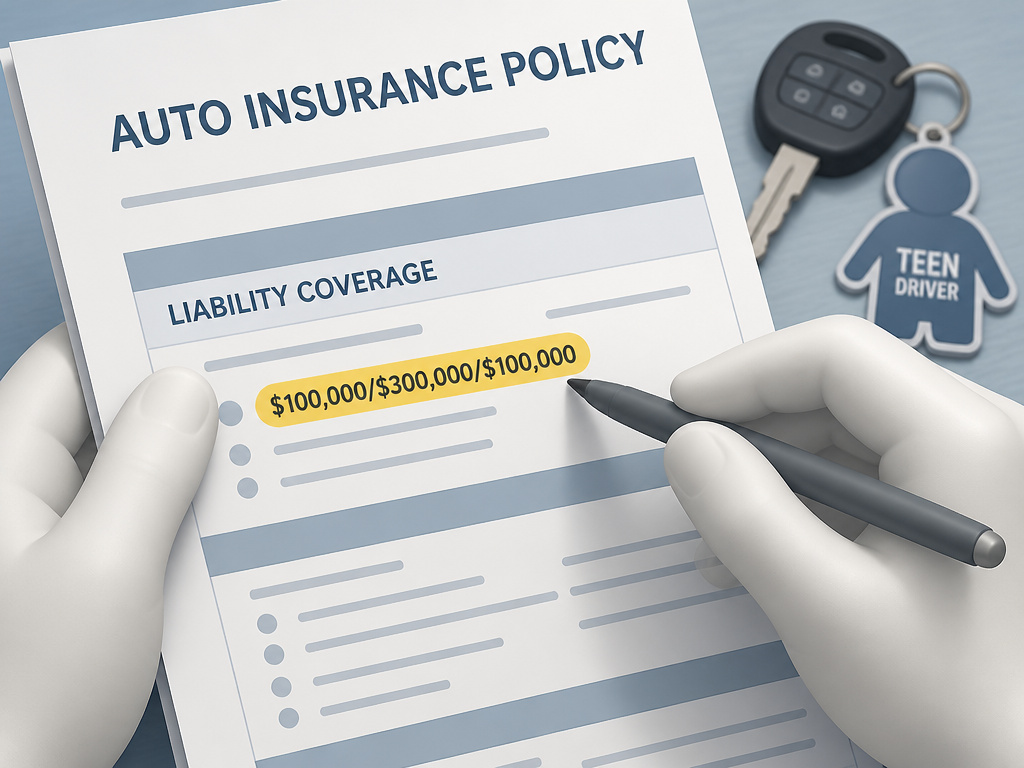
Adding a teen involves significant cost and risk exposure. This is the moment to reevaluate your liability limits.The minimum state requirements are almost always inadequate when a statistically higher-risk driver is behind the wheel.
The III’s recommended minimum of $100,000/$300,000/$100,000 is a wise floor. That’s $100,000 per person for bodily injury, $300,000 per accident, and $100,000 for property damage. If you have significant assets like a home, consider an umbrella policy for an extra million dollars in coverage. It’s cheaper than you think and it activates after your auto liability is exhausted.
Never waive comprehensive and collision coverage to save money on a teen’s policy. Their higher crash probability means you’re far more likely to need it. The potential out-of-pocket repair or replacement cost dwarfs the premium savings.
This is also the time to understand how an at-fault accident will play out. A teen’s first accident can have a prolonged effect on your insurance record, keeping rates elevated for three to five years. This makes defensive driving courses and telematics programs, which promote safe habits, a dual investment in both current discounts and future rate stability.
Timing: When to Add Them and When Rates Fall
The clock starts ticking with the learner’s permit. Many insurers, like Nationwide, advise speaking with an agent at this stage. Some won’t charge extra until the full license is issued, but getting the teen listed on the policy ensures there’s no coverage gap.
The three non-negotiable times to shop for quotes are: 1. When the teen gets a learner’s permit (to lock in your carrier for the license phase). 2. 30 days before they get their full license (to compare 3-5 final quotes). 3. At the 18-month mark of licensed driving (telematics data from the first year can unlock better rates from competitors).
Rate reductions follow a predictable age-based schedule. Data from Progressive shows average drops of 10% at age 19, 5% at 20, and 6% at 21. Another significant drop happens at age 25, when drivers typically move into the lowest-risk “adult” tier. Maintaining a clean driving record is the only way to guarantee these drops happen on schedule. A single ticket or accident can reset the clock and delay the descent for years.
The NAIC notes that in some states, premiums may drop at high school graduation or age 18. This often coincides with the end of Graduated Driver Licensing (GDL) night-time or passenger restrictions, which insurers view as risk-reducing.
Frequently Asked Questions
Does a teen need their own insurance policy?
Almost never. Adding them to your existing policy is consistently 40-55% cheaper. A standalone policy forfeits your multi-car, multi-policy, and loyalty discounts. The only exception is if the teen will be the primary driver of a luxury or high-performance car that you don’t want on your policy.
How much does insurance drop when a teen turns 18?
The drop isn’t automatic at 18. The bigger decrease comes from completing high school (which can trigger a discount) and from turning 19. According to Progressive, the average rate decreases by 11% for the 19-20 age group compared to 18-year-olds. A clean record is required.
Can I not add my teen to my policy to save money?
This is a catastrophic risk. If your teen is a licensed household member and drives your car, they must be listed on your policy. If they cause an accident while unlisted, your insurer can deny the claim entirely, leaving you personally liable for all damages and medical costs. It also constitutes insurance fraud.
Do all insurance companies charge the same for teens?
No. There is a massive spread. MoneyGeek’s 2026 analysis found a $745 per month difference between the cheapest and most expensive carrier for a 16-year-old. This is why comparing quotes from national carriers (GEICO, State Farm, Progressive) and a strong regional option (like Erie) is non-negotiable.
Are usage-based insurance programs worth it for teens?
They are one of the most effective tools for reducing the teen premium. Programs like Snapshot (Progressive) or DriveEasy (GEICO) provide direct feedback on driving habits and reward safe behavior with discounts. The initial discount is just the start; the data collected can be used to argue for lower rates at renewal or when switching companies.
The Bottom Line
Adding a teen driver transforms your car insurance from a predictable expense into a major budget line. The $5,740 annual average is a hard number, but it’s not a fate. You control the levers: assigning them to the right car, stacking every possible discount, and choosing a carrier with competitive rates in your state.
The process starts with a single call to your insurer to ask about driver-vehicle assignment. Then, get three quotes before the license is issued. Focus on safety ratings over a low purchase price when choosing their car. And reinforce that a clean driving record is about safety and is the only path to the 10%, 5%, and 6% rate drops that turn the teen surcharge back into a manageable premium. The first year is the most expensive.It gets cheaper from there, provided nothing goes wrong.
