
The Truth: Are Car Insurance Rates Higher for Red Cars?
This post contains affiliate links. As an Amazon Associate, we earn from qualifying purchases.
No, car insurance rates are not higher for red cars. No major insurer in the United States uses vehicle color as a rating factor. Your premium is calculated from your driving record, location, vehicle make and model, age, coverage choices, and credit history. The color does not appear on your application or in your Vehicle Identification Number (VIN).
The VIN is the key. That 17-character code tells the insurer everything about your car’s risk profile, engine size, safety features, trim level, theft rating. It never includes a paint code. The system is blind to color by design.
What follows is a breakdown of the seven things that actually move your premium, the one scenario where color can matter, and the psychological reasons this myth refuses to die.
Key Takeaways
- Your car’s factory paint color is never a question on an insurance application.
- Insurers price risk using your Vehicle Identification Number (VIN), which contains no color data.
- A 2007 Monash University study found low-visibility colors like gray, silver, and black were associated with a higher crash risk, not red.
- A custom paint job can increase premiums because it raises the vehicle’s repair cost, requiring a Custom Parts and Equipment (CPE) endorsement.
- The myth persists due to attribute substitution, people replace a complex question about risk with a simple, vivid one about a “fast-looking” color.
What Factors Actually Affect Your Insurance Rates?
Forget the paint. Insurers build a risk profile from concrete, verifiable data. Your driving history carries the most weight, but it is just one piece of a larger puzzle they solve to predict the likelihood and cost of a claim.
An at-fault accident or a DUI conviction can increase your premium by 40% or more. That spike lasts for three to five years, depending on your state and carrier.
Your location matters down to the ZIP code. Urban areas with higher traffic density, accident rates, and theft frequency cost more to insure than rural ones. A move across town can change your rate even if your driving record is spotless.
The car itself is a major variable. A sports car’s high-performance engine and expensive repair costs signal higher risk than a family sedan’s. Safety features like automatic emergency braking can earn discounts, but a history of high theft claims for your model can cancel them out.
| Rating Factor | What It Tells the Insurer | Typical Impact on Premium |
|---|---|---|
| Driving Record | Likelihood of causing a claim. | Very High (+20% to +100% for major violations) |
| Vehicle Make & Model | Repair cost, theft rate, safety performance. | High (Sports car vs. Minivan) |
| Credit-Based Insurance Score | Statistical correlation to claim frequency. | Moderate to High (Where permitted by state law) |
| Annual Mileage | Exposure to road risk. | Moderate (Low mileage discounts available) |
| Coverage Limits & Deductible | How much risk you transfer vs. Retain. | Direct (Higher limits = higher cost) |
Your age and years of experience are hard-coded into the model. Drivers under 25 pay significantly more due to statistical crash rates. Some insurers also consider your occupation, marital status, and prior insurance history, a lapse in coverage is a red flag.
Finally, your coverage choices directly set the price. Opting for state-minimum liability is cheaper than full coverage with low deductibles. It is a direct trade-off between monthly cost and out-of-pocket expense when a claim happens.
The VIN: Why the System Can’t See Color
The Vehicle Identification Number is a 17-character code that acts as your car’s fingerprint. It is the primary data source insurers use to identify your vehicle’s specs without ever laying eyes on it.
The VIN decodes to reveal the country of origin, manufacturer, vehicle attributes, and model year. It specifies the engine type, transmission, and restraint systems. It is how the insurer knows if your Ford F-150 has the base V6 or the high-output turbo V6.
The VIN standard (ISO 3779) does not include a code for exterior paint color. This is an intentional omission, color is not an actuarial data point.
When you get a quote online or give your information to an agent, you provide the VIN. The insurer’s system pulls all the relevant mechanical and safety data from it instantly. The process is automated and colorblind. They do not ask for the color because the system that calculates the price has no field to enter it.
This is why a red Honda Civic LX and a gray Honda Civic LX, identical in every way except paint, will get the same insurance quote. The VIN is the same for both cars. The rating algorithm cannot differentiate.
The Psychology of a Persistent Myth
If the data is so clear, why does the belief endure? The explanation is not in actuarial tables but in human psychology. We are wired for simple, vivid stories over complex, invisible systems.
The technical term is attribute substitution. When faced with a difficult question, “How do insurers calculate my risk?”, the mind substitutes an easier one, “Does this car look fast?” Red is culturally coded for speed, danger, and attention. A bright red coupe feels riskier than a beige sedan, so we assume it must be.
Confirmation bias does the rest. You hear a story about a friend with a red Mustang who pays high insurance. The anecdote sticks. You forget the ten other people with red cars who pay average rates. The unusual case becomes the rule in your mind.
The myth is also flattering. It externalizes blame. If your premium is high, you can blame the flashy paint instead of your speeding ticket or your low credit score. A story that protects self-esteem is a story that gets repeated.
Custom Paint: The Only Color Exception
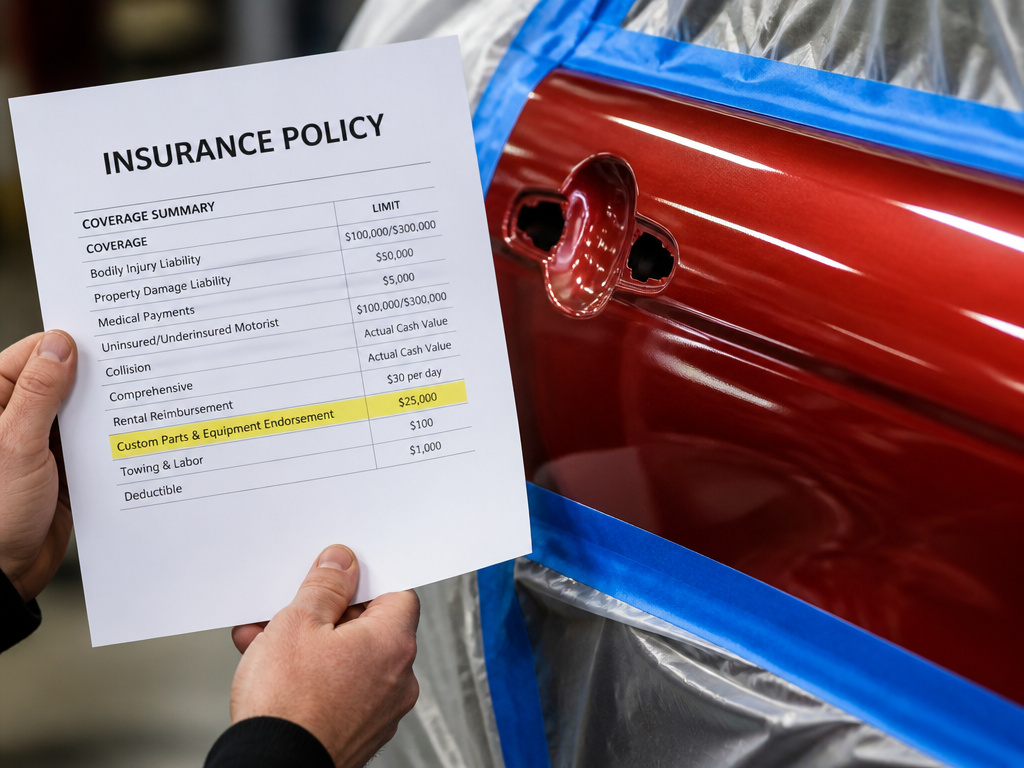
Factory paint is irrelevant. A custom paint job is not.
If you spend $5,000 on a professional candy-red respray or a chrome wrap, you have modified the vehicle’s value and repair cost. That matters to your insurer.
Where this goes sideways: Failing to declare a custom paint job. After a total-loss accident, the insurer will pay out the value of a stock-colored vehicle. You eat the cost of the paint job.
Most standard auto policies have limited coverage for aftermarket modifications, usually around $1,000 to $2,500. For proper protection, you need a Custom Parts and Equipment (CPE) endorsement. Progressive, for example, offers CPE coverage with a typical limit of $5,000.
You must proactively add this endorsement and declare the value of the modifications. The insurer will then adjust the vehicle’s insured value accordingly, which will increase your comprehensive and collision premiums. It is not the color itself they are rating; it is the increased financial risk of repairing a specialized finish.
Do Red Cars Get Pulled Over or Stolen More?
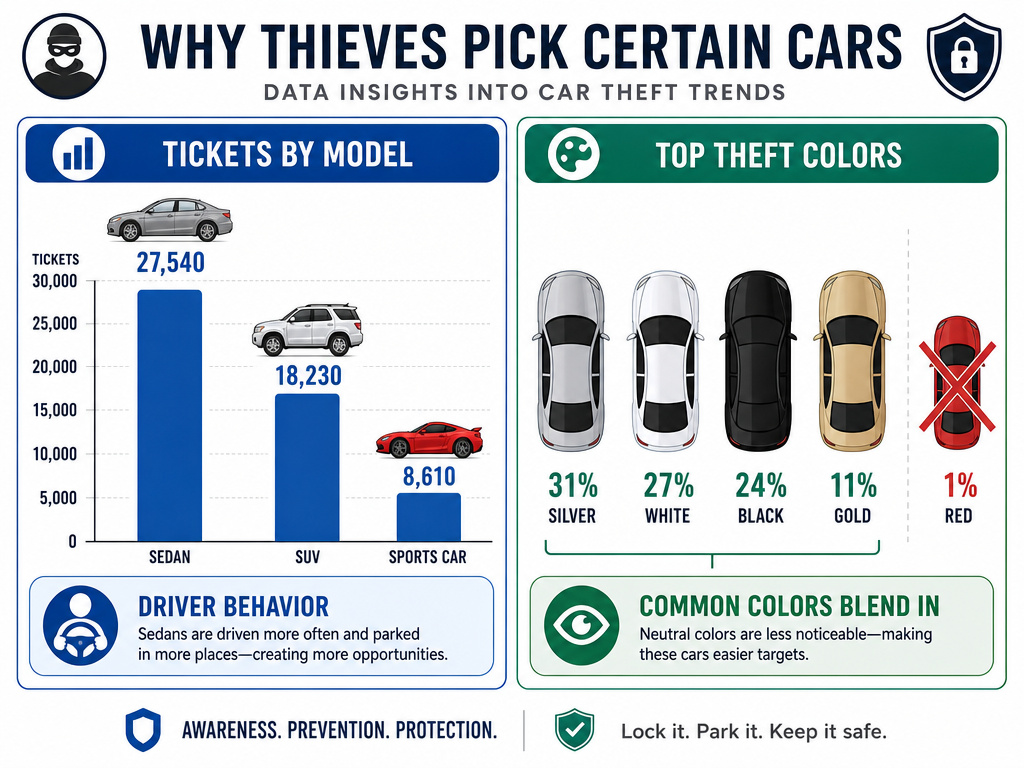
The second leg of the myth is that red cars are law enforcement magnets and theft targets. The data does not support this.
Police pull over drivers for behavior, speeding, erratic lane changes, broken taillights. A 2016 analysis by Insurance.com found certain models were ticketed more often, suggesting types of drivers are drawn to certain cars, not that cops target colors.
As for theft, a 2012 report by CCC Information Services found thieves preferred nondescript colors like silver, white, black, and gold. These colors are common, making stolen vehicles harder to identify. A bright red car is more conspicuous and therefore a less ideal target for a thief trying to blend in.
The real theft risk comes from your vehicle’s make, model, and trim level, information perfectly captured in your VIN. A high-demand truck or SUV in any color is a bigger target than an economy car in fire-engine red.
What the Research Actually Says About Color and Safety
The most cited piece of research on color and safety is a 2007 study from Monash University in Australia. It is often misrepresented.
The study found that vehicles in low-visibility colors, gray, silver, black, blue, and red, were statistically associated with a higher crash risk than white or other high-visibility colors. Notice red is in the low-visibility group. The increased risk was most pronounced in daylight hours.
However, the researchers were clear: the effect of color was small compared to other factors like vehicle type and light conditions. The study did not conclude that red cars are the most dangerous. It suggested that any color blending into the road or sky might be harder to see.
This finding has never been incorporated into U.S. Insurance rating models. The safety difference is not significant enough to outweigh the massive, proven predictors already in use.
How to Actually Lower Your Insurance Premiums
Since color is off the table, focus on the levers you can pull. Your driving record is the biggest. A clean record for three to five years unlocks the best rates. If you have a violation, look into defensive driving courses; some states and insurers offer discounts for completing them.
Bundle your policies. Insuring your car and home with the same company often triggers a multi-policy discount of 10% or more. Increase your deductible if you can afford a higher out-of-pocket cost during a claim. Moving from a $500 to a $1,000 deductible can noticeably lower your premium.
Ask about every discount: low annual mileage, good student, anti-theft devices, automatic payment, and paperless billing. Use telematics if you are a calm driver. Programs like Progressive’s Snapshot or State Farm’s Drive Safe & Save monitor your driving and can reward safe habits with substantial discounts.
Finally, shop around. Insurers weight factors differently. Your current company might heavily penalize a recent claim, while another might focus more on your credit score or vehicle safety rating. Get quotes every two to three years.
Frequently Asked Questions
Do insurance companies ask for your car’s color?
No. When applying for a quote, you provide the vehicle’s make, model, year, and VIN. The VIN gives the insurer all the mechanical and specification data they use for rating. Color is not part of the application process.
Does a matte black wrap affect insurance?
Yes, if it is a custom aftermarket modification. A professional vinyl wrap changes the vehicle’s appearance and repair cost. You should add a Custom Parts and Equipment (CPE) endorsement to your policy to cover its value. Failure to do so could result in a denied claim for wrap damage.
Are some car colors cheaper to insure?
No. All standard factory paint colors are treated the same. A white, black, silver, or blue version of the same car with the same VIN will receive an identical insurance quote from any major carrier.
Where did the red car myth start?
The myth likely stems from the association between red paint and high-performance sports cars. Sports cars cost more to insure due to their power, repair costs, and driver risk profiles. People mistakenly attributed the higher cost to the iconic red color rather than the vehicle’s engineering.
Can my credit score affect my car insurance rate?
In most states, yes. Insurers use a credit-based insurance score, which is derived from your credit report but used differently than a lending score. Statistical data shows a correlation between credit history and claim likelihood. States like California, Hawaii, and Massachusetts prohibit this practice.
Before You Go
The color of your car is a personal choice, not a financial sentence. Pick the red, the yellow, the neon green that makes you happy. It will not change your insurance bill.
Your premium is a math problem based on concrete data about you and your vehicle. Spend your energy on the variables that actually count: drive safely, maintain good credit, choose the right coverage, and shop your policy periodically. That is how you control cost, regardless of what’s in the paint booth.
