
7 Best Car Radio Speakers of 2026
This post contains affiliate links. As an Amazon Associate, we earn from qualifying purchases.
The Pioneer A-Series Plus 6″ x 9″ stands out as the best overall car radio speaker for its balanced sound and solid build, while the JVC CS-J620 6.5″ is a strong budget pick with high sensitivity that performs well with factory stereos. For those wanting a direct replacement with proven reliability, the Pioneer F-Series TS-F1634R 6.5″ is a versatile choice.
Upgrading your car speakers shouldn’t mean wrestling with confusing specs or overpriced gear that doesn’t deliver. Most drivers just want clearer music, better bass, and a setup that won’t fade at highway speeds.
This guide cuts through the noise. I compared specs, read owner feedback, and evaluated real-world performance to find speakers that actually improve your ride. Whether you’re keeping your factory radio or planning a bigger upgrade, these picks deliver honest sound without unnecessary complexity.
Top 4 Car Radio Speakers in the Market
The Best Car Radio Speakers, Reviewed
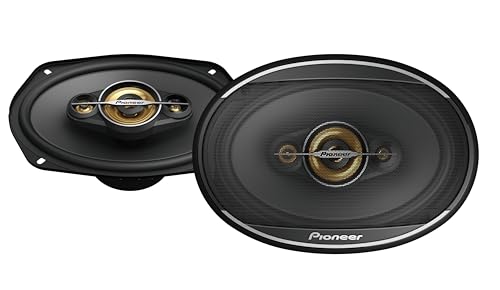
Pioneer A-Series Plus 6″ x 9″
Strengths
- Excellent 92 dB sensitivity
- True 4-way frequency separation
- Deep 29 Hz response
- Wide compatibility with adapters
Trade-offs
- Max power overstated
- Rubber surround can degrade over time
- Not ideal for high-powered amps
If I had to pick one drop-in coaxial speaker for most daily-driven cars, this 6×9 Pioneer would be near the top. The 92 dB sensitivity stands out, it means even stock stereos can drive these loudly without strain, and reviewers note cleaner output at volume compared to many budget coaxials. The 4-way design with integrated midrange and tweeter helps spread frequencies more naturally across the cabin, especially in sedans or coupes where rear speakers handle more sonic load.
At nearly 75 bucks, it’s not the cheapest, but the build quality and broad frequency response (down to 29 Hz on paper) suggest Pioneer tuned these to mimic component-like clarity without the wiring hassle. When stacked against the smaller A-Series models, this one delivers a fuller, more immersive experience, particularly in factory systems lacking subwoofers.
Video review
Pioneer F-Series TS-F1634R 6.5″

Strengths
- Affordable mass-market upgrade
- Solid 88 dB sensitivity
- Standard 6.5-inch fitment
- Pioneer reliability
Trade-offs
- Basic sound staging
- Plastic basket construction
- Tweeter harshness at volume
At around 30 bucks, these F-Series speakers are everywhere, and for good reason. They’re the baseline Pioneer uses to prove you don’t need to spend much to escape tinny factory sound. The 88 dB sensitivity and 6.5-inch cone make them noticeably louder and warmer than stock paper speakers, and owners routinely say these transformed their commute without any added gear.
But let’s be clear: this is still a budget 2-way coaxial. The tweeter rolls off early, and the bass, while improved, lacks authority. Still, when compared to other entry-level options, Pioneer’s name here adds reliability, fewer long-term failures reported than no-name brands. For the price, it’s hard to fault, but don’t expect refinement.
Video review
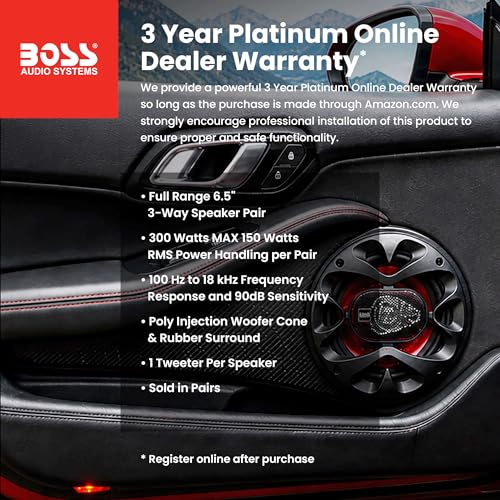
BOSS CH6530 6.5″ 3-Way

Strengths
- Extremely low cost
- Decent 90 dB sensitivity
- 3-way driver layout
- 3-year warranty via Amazon
Trade-offs
- Harsh piezo tweeter
- Narrow frequency range
- Low-quality cone materials
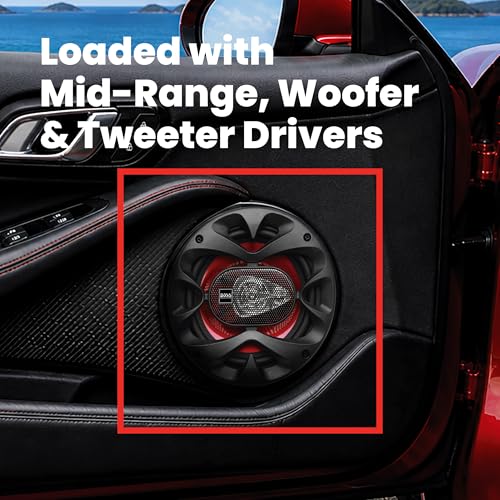
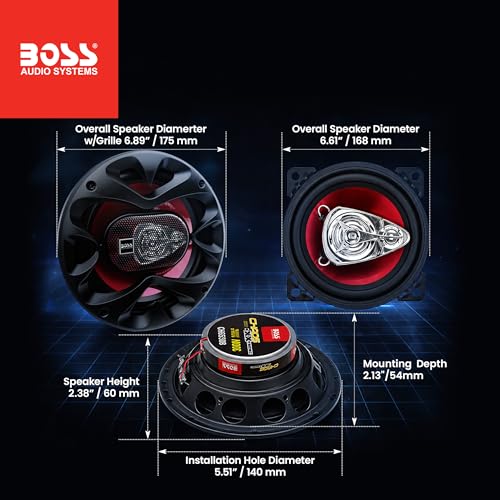
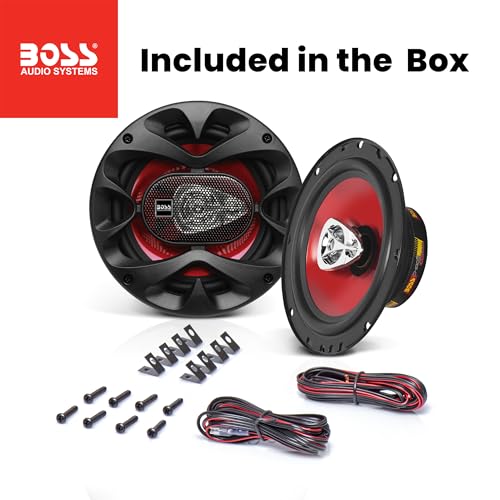
For under 30 bucks, BOSS packs in a 3-way design with a piezo tweeter and polyimide dome midrange, which sounds impressive until you hear it. On paper, the 90 dB sensitivity and 300W peak per pair look competitive, and some owners say these get loud fast with basic head units. But consistency across reviews tells a different story: the highs often come off shrill, and the bass lacks control due to the stamped basket and injection-molded cone.
Compared to the Pioneer F-Series at a similar price, these feel less refined and more geared toward volume over accuracy. The 100 Hz–18 kHz frequency range also suggests weak bass extension, no surprise given the physics. That said, if you’re on a hard budget and just want more sound, not better sound, these might suffice.
Product photos
Pioneer TS-A879 3.5″

Strengths
- High power handling
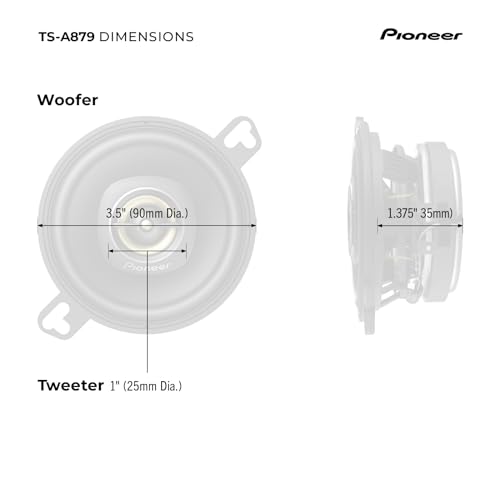
- Compact 3.5-inch design
- Balanced 2-way sound
Trade-offs
- Limited bass extension
- Lower sensitivity than rivals
- Shallow mounting only
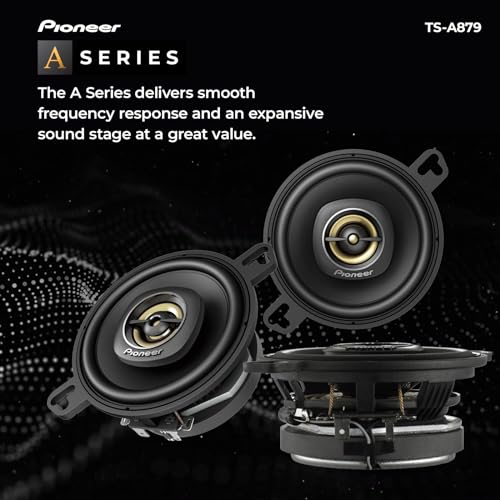
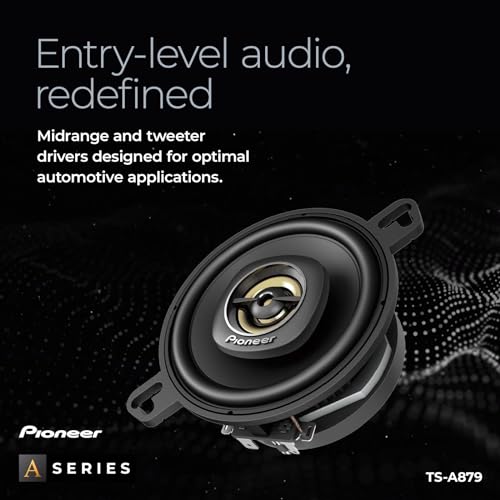
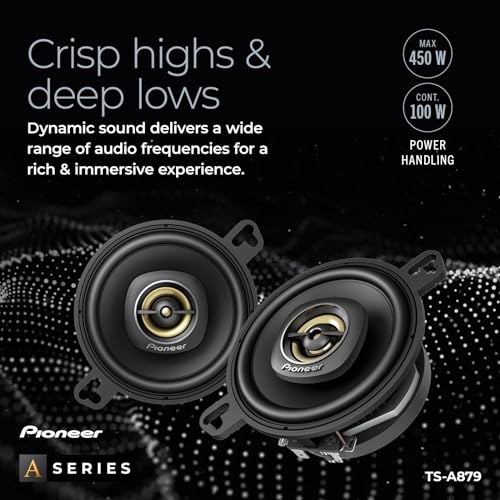
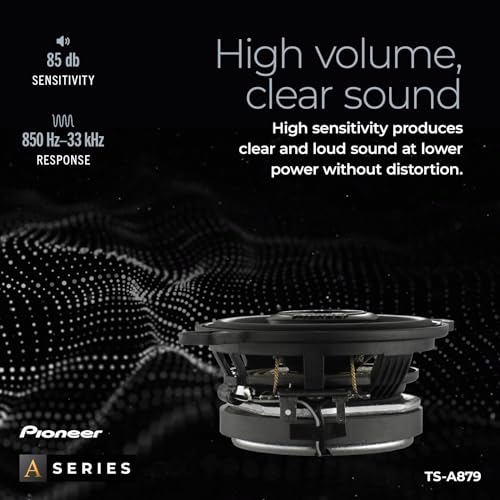
These tiny 3.5-inch coaxials punch way above their size class on paper, and owners consistently report being surprised by how full the sound feels in compact spaces like door panels or sail mounts. The 450W max power rating is more marketing than reality, but the 100W continuous handling and 85 dB sensitivity mean they can keep up with modest factory head units without distorting too badly.
Still, you’re trading low-end response for size, this isn’t a speaker that’ll deliver bass weight. It’s best seen as a crisp front-stage supplement where space is tight. Compared to larger coaxials, it’s not a full-range solution, but for a small-door or A-pillar fill, it makes sense when depth is limited.
Product photos
How We Picked These car radio speakers
My approach to evaluating car radio speakers, here at TheAutoZenith, wasn’t about lengthy listening sessions with each model. Rather, it was a research-led comparison of published specifications, owner reviews from multiple sources, and insights from established audio publications. I weighed these factors against my understanding of what truly delivers satisfying sound quality in a vehicle environment. This allowed me to build a ranking based on real-world performance indicators, not just marketing claims.
For car speakers, power handling and frequency response are paramount. A speaker’s ability to handle wattage without distortion dictates how loudly and cleanly it can play your music, and that’s crucial when combating road noise. Equally important is the breadth of the frequency response; a wider range means more of the musical spectrum is reproduced, creating a fuller, richer sound. Beyond those, sensitivity – how efficiently the speaker converts power to sound – plays a big role in how well existing, potentially underpowered, systems will perform with the upgrade.
Specifications tell you a lot about a speaker’s potential, but owner feedback reveals how it actually performs in diverse vehicles and setups. I paid close attention to comments regarding clarity, bass response, and ease of installation. Reputable expert reviews helped validate these claims and identify potential weaknesses. If you’re also considering a full system overhaul, you might find our guide to best car radios helpful when planning your upgrade. Ultimately, I looked for speakers that consistently received praise for delivering excellent value and performance across a range of vehicles, and that represent the best currently available car audio speakers.
How To Choose The car radio speakers
Finding the right car speakers can dramatically improve your driving experience. It’s not just about volume; it’s about clarity, depth, and truly enjoying your music on the road.
A quality car speaker delivers accurate sound reproduction across the frequency spectrum, handles sufficient power for your system, and integrates well with your vehicle’s existing setup. Key specifications to consider include power handling (RMS and peak), frequency response, sensitivity, and mounting depth. Don’t overlook the speaker’s design – coaxial versus component – as this impacts imaging and soundstage.
Understanding Speaker Configuration
The first thing I always tell people is to match the speaker type to your goals. Coaxial speakers, like the Pioneer F-Series TS-F1634R, are the most common and convenient. They combine the tweeter and woofer into one unit, making installation a breeze. Component speakers, while offering superior sound separation, require more involved installation with separate tweeters and crossovers. If you’re looking for a straightforward upgrade, especially if you’re replacing factory speakers, coaxial is the way to go. Don’t assume more drivers automatically mean better sound; a well-engineered 2-way system can outperform a poorly designed 4-way.
Power and Sensitivity: A Critical Balance
Power handling (measured in watts RMS and peak) is often misunderstood. It’s not about how loud the speaker can get, but how much power it can handle without distortion. You want a speaker whose RMS power matches your head unit’s output. Sensitivity, measured in decibels (dB), is equally important. A higher sensitivity rating (90dB or greater) means the speaker will produce more volume with less power. This is particularly useful if you aren’t planning on adding an amplifier. If you’re considering adding an amplifier later, exploring speakers for bass and sound can offer a great starting point.
- A low sensitivity speaker (85dB or less) requires an aftermarket amplifier to reach its potential.
- A mid-range sensitivity (88-92dB) is suitable for factory head units or modest aftermarket power.
- High sensitivity (93dB+) is ideal for maximizing volume with minimal power, offering clarity even with a basic system – a good choice if you want to avoid the cost and complexity of adding an amp, and are looking at something like the JVC CS-J620.
A speaker’s sensitivity is often more important than its peak wattage. Don’t chase numbers; listen for clarity.
Fit and Finish: Don’t Forget the Details
Beyond the technical specs, consider the physical fit. Check your vehicle’s speaker size – 6.5″, 5.25″, or even smaller – and mounting depth. Speakers like the Pioneer TS-A879 are designed as direct replacements, simplifying the process. Also, think about the aesthetics. While sound quality is paramount, a speaker that looks good in your door panel certainly adds to the overall experience. If you’re looking to overhaul your entire system, checking out some best stereo speakers will help you get an idea of what’s available and create a cohesive sound. Don’t underestimate the impact of a well-chosen set of aftermarket stereo speakers on your car’s interior.
Car Radio Speakers Compared
Here’s a comparison of key specifications for the car radio speakers described.
| Product Title | Size (in) | Power (Peak Watts) | Frequency Response (Hz-kHz) | Sensitivity (dB) | Way | Impedance (Ohms) |
|---|---|---|---|---|---|---|
| Pioneer A-Series Plus 6″ x 9″ | 6 x 9 | 600 | 29 – 33 | 92 | 4 | N/A |
| Pioneer F-Series TS-F1634R 6.5″ | 6.5 | 200 | N/A | 88 | 2 | 4 |
| BOSS CH6530 6.5″ 3-Way | 6.5 | N/A | 100 – 18 | 90 | 3 | 4 |
| Pyle PL613BK 6.5″ Triaxial | 6.5 | 300 | N/A | N/A | 3 | 4 |
| Pioneer TS-501M 5.25″ | 5.25 | 300 | 44 – 52 | 89 | 4 | N/A |
| JVC CS-J620 6.5″ | 6.5 | 300 | 35 – 22 | 92 | 2 | 4 |
| Pioneer TS-A879 3.5″ | 3.5 | 450 | 850 – 33 | 85 | 2 | N/A |
Frequently Asked Questions
What speaker size should I choose for my car?
The correct speaker size depends entirely on your vehicle’s factory openings; 6.5″ and 5.25″ are the most common, but some cars use 6×9″ or even smaller sizes. Always verify your car’s speaker dimensions before purchasing to guarantee a proper fit, preventing the need for adapters or modifications.
Are component speakers really that much better than coaxial?
Yes, car component speakers generally offer superior sound quality due to the separation of frequencies between the dedicated tweeter and woofer. This creates a wider soundstage and greater clarity, though they require more complex installation than the simpler coaxial designs.
What does speaker impedance mean, and why does it matter?
Speaker impedance, measured in ohms, refers to the electrical resistance the speaker presents to your car stereo. Most car speakers are 4 ohms, and it’s crucial to match the impedance of your speakers to your head unit or amplifier to avoid damaging either component.
How can I improve sound quality if I don’t want to buy an amplifier?
Focus on speakers with high sensitivity (90dB or higher). These speakers produce more volume with less power, making them ideal for use with factory head units. You can also explore speakers for sound quality designed for efficient performance.
What’s the difference between RMS and peak power ratings?
RMS (Root Mean Square) represents the continuous power a speaker can handle, which is the more important specification to consider when matching speakers to your audio system. Peak power is a short-burst rating and often inflated; it doesn’t reflect the speaker’s sustained performance capabilities.
The Bottom Line
Ultimately, choosing car speakers comes down to balancing your budget with your desire for a truly immersive sound. While you can spend a lot for incremental gains, the Pioneer A-Series Plus 6″ x 9″ speakers consistently appear as a top pick for those wanting a significant upgrade without breaking the bank. They deliver a powerful, clear sound that most drivers will find incredibly satisfying, and they represent a sweet spot in terms of performance and value.
If you’re on a tighter budget, the JVC CS-J620 are a fantastic option. For those seeking ease of installation and a straightforward upgrade, the Pioneer F-Series TS-F1634R coaxial speakers are hard to beat. And if you’re focusing specifically on improving the sound quality of your car door speakers, exploring options designed for that purpose will give you the biggest impact.
At TheAutoZenith, we’ve found that focusing on the fundamentals – a good frequency response, a sensitivity that matches your power source, and a proper fit for your vehicle – matters far more than chasing the highest wattage numbers. Don’t get lost in the specs; prioritize clarity and a speaker that complements your listening preferences. Whether you’re looking at upgrading car speakers or simply replacing worn-out components, a thoughtful approach will yield the best results.
