
6 Best Car Door Speakers of 2026
This post contains affiliate links. As an Amazon Associate, we earn from qualifying purchases.
The Pioneer A-Series TS-A6881F stands out as the overall best car door speaker for its balanced sound and solid build, while the Kenwood KFC-1666S is a strong budget pick that delivers high sensitivity and clear output without straining your head unit. For those wanting more customization, the Pyle PLG6C component system offers versatility, especially if you’re willing to invest in proper installation.
Upgrading your car’s audio shouldn’t mean wading through hype and vague claims. Most factory speakers fall flat, literally and figuratively, failing to deliver anything close to accurate or dynamic sound. As someone who’s dug into the guts of countless audio setups, I know the real challenge is finding speakers that perform reliably in the noisy, cramped environment of a vehicle door.
This guide cuts through the noise. I compared specs, analyzed owner feedback across platforms, and weighed what actually matters, sensitivity, power handling, fit, and material quality, to spotlight models that deliver real improvements. These picks reflect what enthusiasts and everyday drivers alike have found to work well across different vehicles and listening styles.
Top 6 Car Door Speakers in the Market
The Best Car Door Speakers, Reviewed
Pioneer A-Series TS-A6881F 6×8

Strengths
- 4-way design
- 90 dB sensitivity
- 30 Hz frequency response
Trade-offs
- 6×8 size not universal
- No tweeter level control
The Pioneer A-Series TS-A6881F stands out in the crowded coaxial speaker market by going 4-way instead of the usual 2- or 3-way design. That means dedicated drivers for highs, mids, and dual woofers, which on paper should deliver more layered sound. Owners consistently report a noticeable upgrade over factory speakers, especially in vocal clarity and mid-bass presence. The 90 dB sensitivity and 80W RMS handling make these efficient enough to sound good even with a factory head unit, though they really open up with a little external power.
Where this speaker shines is its frequency response down to 30 Hz, rare for a coaxial at this price. While it won’t shake your chest like a sub, it does give a surprising sense of fullness, especially in larger-door vehicles like sedans or SUVs. Compared to the Kenwood or JVC budget options, the Pioneer offers a more complete soundstage, and it’s a smarter long-term pick than stepping into component systems if you want simplicity with real performance.
Video review
Kenwood KFC-1666S 6.5″ Coaxial

Strengths
- Balanced dome tweeter
- 92 dB sensitivity
- Affordable price
Trade-offs
- PP cone lacks rigidity
- Minimal bass extension
- No mounting depth advantage
Kenwood keeps it simple with the KFC-1666S, no flashy materials, no deep specs, just a no-nonsense coaxial that gets the job done. The 30W RMS and 92 dB sensitivity put it on par with the JVC in efficiency, and the balanced dome tweeter helps spread sound more evenly across the cabin, which Kenwood calls their ‘Sound Field Enhancer.’ In practice, owners say it makes music feel less directional, which works well in smaller cabins.
It’s not going to impress someone coming from a high-end system, but for a sub-$40 pair, it’s a competent performer. Compared to the Pioneer F-Series, it’s slightly more refined in the mids, though the F-Series has better cone material. The PP cone here is functional but not as rigid as mica or polypropylene, so it can flub detail when cranked. Still, for a basic swap in a commuter car or older sedan, it’s a dependable, unglamorous workhorse.
Video review
Rockford Fosgate P1683 6×8 3-Way
Strengths
- Strong bass response
- Butyl rubber surround
- FlexFit mounting
Trade-offs
- 6×8 size limits fitment
- Tweeter can be harsh
- Higher price point
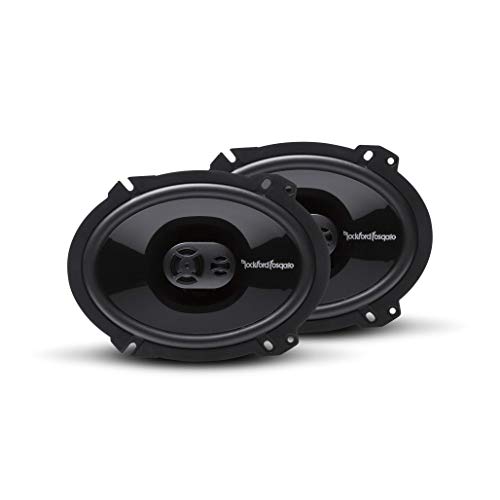
Rockford Fosgate built the P1683 for people who want real bass punch without stepping into component territory or adding a sub. The 6×8 size gives more cone area, and combined with the mineral-filled polypropylene cone and butyl rubber surround, it moves serious air. Owners consistently praise the low-end thump, especially in trucks and SUVs where door cavities act like natural enclosures. The 65W RMS rating is honest, and the FlexFit basket is a small but smart touch, those slotted mounting holes save frustration when aligning with uneven factory screw patterns.
It’s not as refined as the Pioneer A-Series in the upper mids, and the tweeter can get a bit hot with aggressive EQ, but for bass-forward listeners, this is the pick. Compared to the Pyle PLG6C, it’s in a different league, better materials, better engineering, and a full warranty. If you love hip-hop, rock, or just want your doors to feel the music, the P1683 delivers in a way few coaxials can.
Product photos


Pioneer F-Series TS-F1634R 6.5″

Strengths
- Pioneer reliability
- 6.5″ standard fit
- Low cost
Trade-offs
- 88 dB sensitivity
- Foam surround degrades
- Basic materials
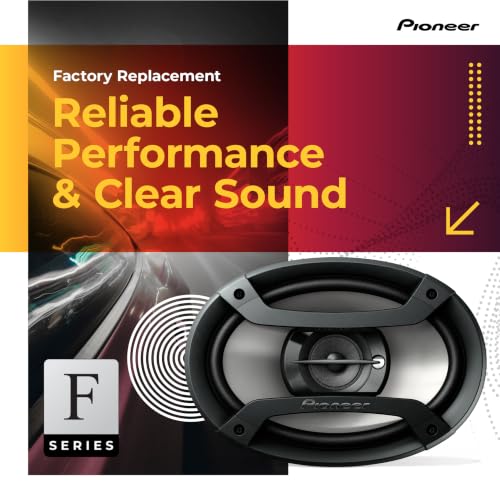
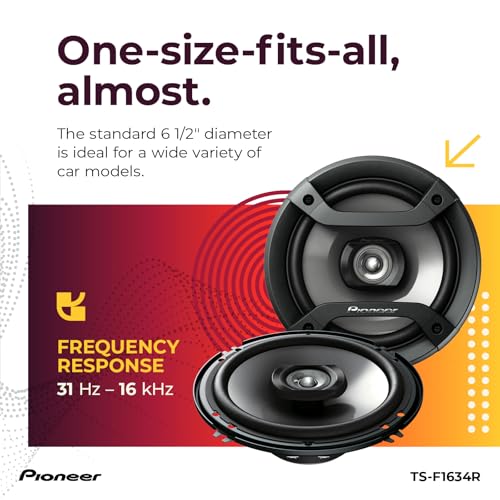
At under $30, the Pioneer F-Series TS-F1634R is built to be the bare-minimum upgrade that still beats factory junk. The 88 dB sensitivity is lower than rivals, so it needs more power to shine, don’t expect miracles with a weak deck. The polypropylene cone and standard foam surround are functional but not durable long-term, especially in humid or hot climates. Still, Pioneer’s name carries weight, and owners report these lasting longer than no-name brands at this price.
It’s not a standout in any category, but it’s a safe floor model. Compared to the Kenwood KFC-1666S, it trades sensitivity for a slightly sturdier basket and Pioneer’s consistent tuning. If you’re fixing up a beater car or need a temporary fix, this gets the nod over ultra-cheap unknowns. But if you’re doing the job once, spending a little more for the JVC or Kenwood gives better long-term results.
Product photos



Pyle PLG6C 6.5″ Component System
Strengths
- Component setup
- Butyl rubber surround
- Mounting hardware included
Trade-offs
- Plastic basket flex
- Basic crossovers
- Peak power overrated
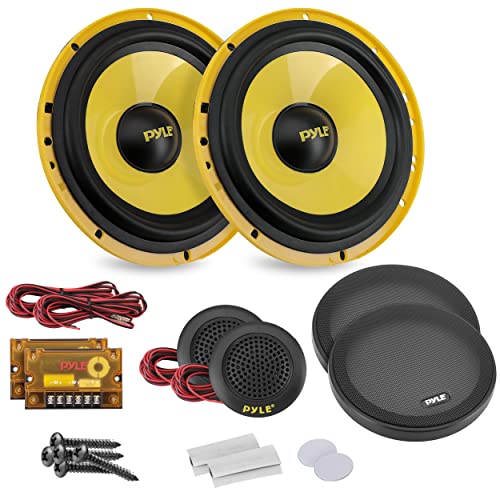
Pyle leans hard into the budget component market with the PLG6C, and while the 400W peak rating sounds impressive, the real story is in the parts list. The butyl rubber surround and 40 oz magnet are solid touches for durability and magnetic control, and the silk dome tweeter helps smooth out high-end harshness common in cheap setups. Reviewers note the soundstage feels wider than typical coaxials, thanks to the separate tweeter placement, but the crossovers are basic, expect some mid-bass bleed if pushed hard.
I’d be cautious comparing this to the Rockford Fosgate or even the Pioneer A-Series. The Pyle delivers on customization with three mounting options and included wiring, which is great for DIYers working on older or non-standard doors. But the bright yellow cones and plastic basket aren’t just for show, they signal this is more style and mod-friendly than audiophile-grade. If you’re rewiring an older truck or want a splash of color under the door panel, it’s a fun pick. For pure sound quality, though, there are better uses for your cash.
Product photos
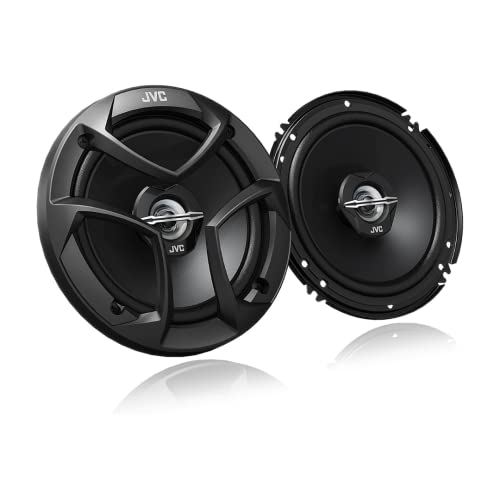
JVC CS-J620 6.5″ 2-Way Speakers
Strengths
- Shallow mount depth
- 92 dB sensitivity
- Mica-reinforced cone
Trade-offs
- Basic coaxial design
- No tweeter adjustment
- Limited soundstage
If your priority is getting better sound without wrestling with door panels or adapters, the JVC CS-J620 is one of the most painless upgrades available. The shallow 1-23/32″ mounting depth is the real hero here, this fits behind factory door cards without hitting window mechanisms, which owners repeatedly praise. The 92 dB sensitivity means it plays loud even with weak factory power, and the mica-reinforced cone holds up well under stress, reducing distortion at higher volumes.
It’s not going to beat the Pioneer A-Series in richness, but for compact cars or hatchbacks where space is tight, the JVC strikes a smart balance. The hybrid surround design helps longevity in extreme temperatures, a nod to JVC’s focus on real-world durability. Compared to the Kenwood KFC-1666S, it offers similar specs but with better build and installation support. This is the kind of speaker you can slap in and forget, solid, predictable, and no surprises.
Product photos


How We Picked These car door speakers
Rather than a hands-on lab test, my research for these recommendations centered on a detailed comparison of published specifications and features across numerous models. I weighed those technical details against owner reviews from major retailers, plus professional assessments from trusted audio publications. Years spent understanding vehicle audio systems helped me prioritize what truly matters for real-world performance. This process allowed me to rank options based on a blend of objective data and practical user experience.
For car door speakers, I found that power handling and sensitivity were the biggest differentiators. A speaker’s ability to deliver clean sound at higher volumes – without distortion – is paramount, and that’s directly tied to these specs. Beyond that, the design (2-way, 3-way, component) significantly impacts the clarity and soundstage. Ultimately, the goal is to find speakers that offer the best balance of these factors for the typical listener looking at upgrading car speakers.
Specifications give you a solid baseline – wattage, frequency response, impedance – but owner feedback reveals how a speaker actually performs in a variety of vehicles. I paid close attention to comments about bass response, clarity at high volumes, and ease of installation. Reputable reviews helped me discern whether a speaker’s advertised performance lived up to the hype, and if it truly delivered speakers for sound quality. This combination of technical data and real-world reports formed the foundation for my selections.
Choosing The Right car door speakers
As someone who’s spent countless hours fine-tuning car audio, I know that upgrading your speakers is the single biggest improvement you can make to your in-car listening experience. But with so many options, finding the right set can feel overwhelming.
A good car door speaker balances sensitivity, power handling, and frequency response to deliver clear, accurate sound within the challenging acoustic environment of a vehicle cabin. Look for models with robust build quality, appropriate impedance for your system, and features that address specific needs like bass response or ease of installation.
Understanding Speaker Size and Fit
The first, and often most frustrating, part of this process is ensuring the speakers will actually fit in your car. While 6.5” speakers are common, variations exist, and many vehicles require adapters. Don’t assume anything. Check your vehicle’s owner’s manual or a site like Crutchfield to confirm the correct size. Beyond diameter, pay attention to mounting depth – you don’t want a speaker interfering with the window mechanism. If you’re after something more customized, exploring component systems, like the Pyle PLG6C 6.5″ Component System, can open up possibilities but usually require professional installation.
Decoding Power and Sensitivity
Power handling (measured in Watts RMS and Peak) gets a lot of attention, but it’s often misunderstood. More isn’t always better. Matching the speaker’s RMS power to your head unit’s output is crucial. Overpowering a speaker will damage it; underpowering it results in distortion. Sensitivity (measured in dB) is equally vital. A higher sensitivity rating means the speaker will produce more volume with less power. This is important if you’re running your speakers directly off the head unit without an amplifier.
Here’s a quick guide to sensitivity:
- 85 dB or lower: Requires an amplifier for good volume.
- 88-90 dB: Good for head unit power, but an amp will still improve performance.
- 92 dB or higher: Loud and efficient, ideal for basic systems.
Consider this: the Rockford Fosgate P1683 boasts a respectable power handling, but its sensitivity is fairly standard, meaning it expects a decent amount of power to truly shine.
Features That Matter: Beyond the Basics
Don’t get lost in marketing jargon. The number of “ways” (2-way, 3-way, 4-way) largely dictates how frequencies are split between the woofer and tweeter. A 3-way or 4-way design, like the Pioneer A-Series TS-A6881F, can offer a more refined soundstage, but a well-executed 2-way speaker can still deliver excellent results. Material choices matter too. Polypropylene cones are durable and affordable, while more exotic materials like carbon fiber or Kevlar offer improved stiffness and clarity. Ultimately, the best approach is to consider your budget and sonic preferences. If you’re looking to dramatically improve bass response, you may want to explore some dedicated car door speakers specifically tuned for low frequencies.
A speaker’s frequency response range isn’t everything, but a wider range generally indicates a more capable speaker. Don’t solely focus on the lowest frequency; a balanced response across the entire spectrum is more important for overall sound quality.
Car Door Speakers Compared
Here’s a comparison of key specifications for popular car door speakers to help you make an informed purchase.
| Product Title | Power (RMS Watts) | Peak Power (Watts) | Speaker Size | Frequency Response (Hz – kHz) | Sensitivity (dB) |
|---|---|---|---|---|---|
| Pioneer A-Series TS-A6881F | 80 | 350 | 6×8 | 30 – 32 | 90 |
| Kenwood KFC-1666S | 30 | 300 | 6.5″ | N/A | 92 |
| Rockford Fosgate P1683 | 65 | 130 | 6×8 | N/A | N/A |
| Pioneer F-Series TS-F1634R | 25 | 200 | 6.5″ | N/A | 88 |
| Pyle PLG6C | N/A | 400 | 6.5″ | 90 – 20 | N/A |
| JVC CS-J620 | 30 | 300 | 6.5″ | 35 – 22 | 92 |
Frequently Asked Questions
Will replacing my car door speakers require any other upgrades?
Often, no, but you’ll get the most out of new speakers with a fresh head unit or amplifier. While new speakers will improve sound quality, matching them with adequate power will unlock their full potential, especially if you’re looking at high-performance audio speakers.
What’s the difference between component and coaxial speakers?
Component speakers separate the woofer and tweeter, allowing for more precise placement and a wider soundstage. Coaxial speakers house both in a single unit, making them simpler to install but potentially compromising on imaging quality, and are a good choice for upgrade speakers.
Can I install car door speakers myself, or should I hire a professional?
Many car owners can handle the installation, but it depends on your experience and the complexity of your vehicle. If you’re unfamiliar with car wiring or worried about damaging your door panels, a professional installation is highly recommended.
How important is the speaker’s impedance?
Impedance (measured in ohms) must match your head unit or amplifier’s specifications. Most car speakers are 4 ohms, but using the wrong impedance can lead to distortion or even damage your equipment. Check your system’s manual to confirm compatibility before choosing aftermarket speakers.
What’s the best way to determine the correct speaker size for my vehicle?
Checking your vehicle’s owner’s manual is the most reliable method. Alternatively, websites like Crutchfield offer vehicle-specific fit guides, and they will list compatible top car audio speakers and any necessary adapters.
The Bottom Line
Upgrading car speakers always involves a trade-off between budget and performance, and between ease of installation and ultimate control over sound quality. For most drivers wanting a noticeable improvement without breaking the bank, the Pioneer A-Series TS-A6881F strikes an excellent balance. It delivers impressive clarity and a full sound, and is a great starting point for anyone looking to enhance their in-car audio.
If you’re on a tighter budget, the JVC CS-J620 offers exceptional value, providing strong sensitivity for loud volume without an amplifier. For those wanting a more customized setup, the Pyle PLG6C 6.5″ Component System is a solid choice, although professional installation is typically recommended to unlock its full potential. And if you’re specifically looking for speakers with great bass, consider pairing any of these with a dedicated subwoofer.
Ultimately, the specifications matter, but they aren’t the whole story. Focus on finding speakers that match your vehicle’s size requirements and your head unit’s power output, and don’t be afraid to read owner reviews to get a sense of real-world performance. A well-chosen set of 6.5 inch speakers, properly installed, will make a world of difference in your daily drive.
