
Are ABS Brakes Worth It on a Motorcycle? Safety Evidence
This post contains affiliate links. As an Amazon Associate, we earn from qualifying purchases.
Yes. For the majority of street riders, motorcycle ABS is objectively worth the investment. It is a verified, data-backed safety system that reduces fatal crash rates by up to 31% and improves stopping distances, especially when conditions are imperfect or the rider makes a panic stop.
That 31% figure is the top-line result from a peer-reviewed study examining a decade of fatal crash data. The system’s purpose is brutally simple: stop your wheels from locking so you stay upright and in control during maximum braking.It’s a physical override for human panic, and it works.
The rest of this guide cuts through the myths and “feels” to show you the actual numbers, the mechanical reality, and the scenarios where ABS matters most. We’ll look at what the IIHS and MSF studies actually measured, how a modern Bosch or Nissin ABS module thinks, and why a 2024 Indian Challenger recall for brake-light software has anything to do with your safety.
What follows: three key data points, two common failure modes you can avoid, and one clear recommendation for anyone riding on public roads.
Key Takeaways
- ABS reduces fatal crash involutions by 22-31% per registered vehicle year, according to IIHS and NHTSA-funded research.
- The benefit isn’t equal for every bike type. Cruisers and touring bikes see the biggest reduction (over 30%), while supersport riders see a smaller, but still significant, 12% drop.
- Stopping distances improve most on wet surfaces. The Motorcycle Safety Foundation (MSF) found ABS cut stopping distances by an average of 10.8% over the best non-ABS stops in wet tests.
- ABS is not maintenance-free. Using non-standard tire sizes or running incorrect pressures can disrupt its calibration and reduce effectiveness.
- The system is a safety net, not a performance enhancer. It doesn’t make you stop shorter than a perfect, practiced threshold-braking expert on perfect pavement. It makes a near-perfect stop far more likely when you’re scared, surprised, or on gravel.
What the Hard Data Says
Let’s start with the only question that matters: does ABS actually prevent crashes? The answer comes from two massive datasets. The Insurance Institute for Highway Safety (IIHS) analyzed fatal crashes across 65 motorcycle models from 2013 to 2019. Their largest motorcycle ABS research concluded bikes with ABS were involved in 22% fewer fatal crashes per 10,000 registered vehicle years.
An earlier, NHTSA-funded peer-reviewed ABS research study covering 2003-2011 data found an even stronger effect: a 31% reduction in the fatal crash rate.
Where this goes sideways: Assuming ABS benefits all riders equally. The IIHS data shows the reduction is strongest for standard and cruiser motorcycles (32%), significant for touring bikes (25%), but smaller for sport (19%) and supersport bikes (12%). The theory is riding style and typical use case matter.
But fatal crashes are the worst-case scenario. What about just stopping quicker? The Motorcycle Safety Foundation conducted controlled tests, pitting ABS against skilled riders using conventional brakes. Their ABS vs conventional brake test report is revealing. On dry pavement, a skilled rider can match or slightly beat ABS. Add water, a rider less than 100% focused, or a loaded bike, and ABS wins consistently.
The MSF’s wet-surface tests showed ABS improved stopping distances by an average of 5%. When both brakes were applied on a wet surface, that improvement jumped to 10.8%. The biggest gain? A loaded motorcycle braking with both brakes on wet pavement: 15.5% shorter stops with ABS.
| Scenario | Surface | ABS Stopping Distance Improvement | Why It Matters |
|---|---|---|---|
| Both Brakes, Loaded Bike | Wet | 15.5% | Real-world panic stop with passenger/luggage |
| Both Brakes | Wet | 10.8% | Common emergency situation in rain |
| Overall Average | Wet | 5.0% | General safety margin in adverse conditions |
| Rear Brake Only, High Speed | Dry | Up to 17% | Prevents fishtailing during rear-only application |
The data has a clear voice. ABS provides a measurable, statistically significant safety advantage in the situations where riders are most vulnerable: unexpected obstacles, poor traction, and high-stress moments. It’s the difference between a controlled stop and a low-side crash when you grab a handful of brake on a painted road line or a patch of dirt. This is the core principle behind wearing protective gloves or a protective jacket, it’s gear for the unexpected.
How ABS Actually Works (The Simple Version)
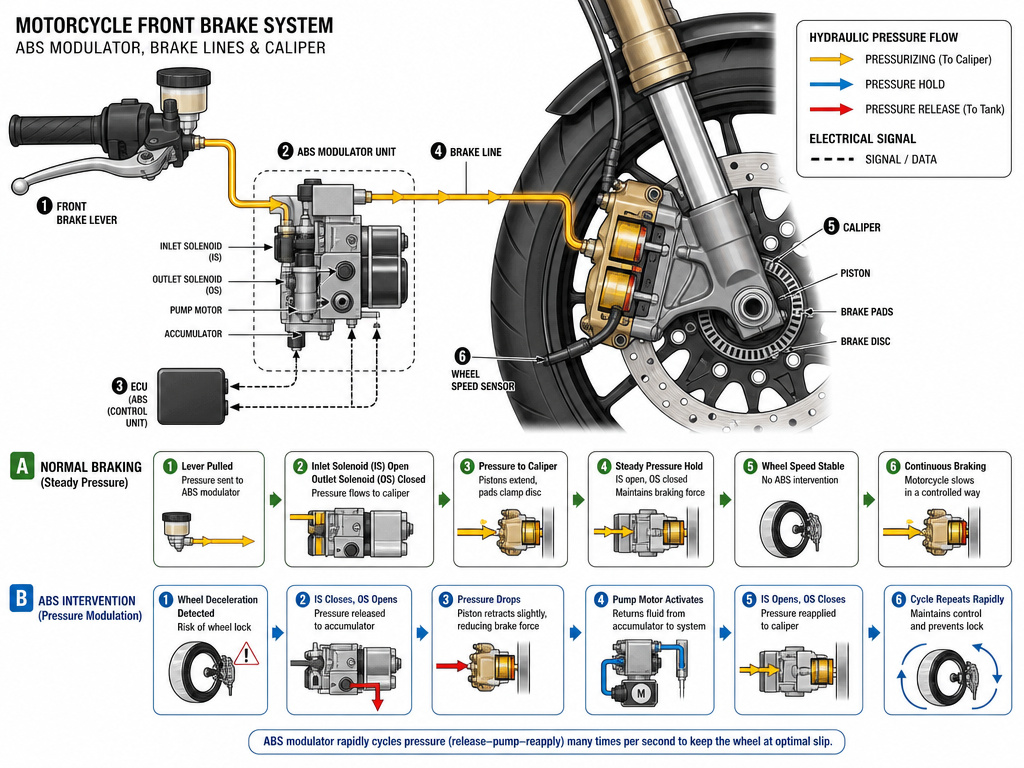
ABS is a simple feedback loop. A tone ring with teeth spins with your wheel.A sensor reads those teeth passing by, telling the ABS module how fast each wheel is spinning. The module’s only job is to compare front and rear wheel speed. If it senses one wheel decelerating much faster than the other, a sign it’s about to lock, it commands a valve to momentarily release pressure to that brake’s caliper. It pulses. Release, apply, release, apply, up to dozens of times per second. You feel it as a rapid shudder in the brake lever or pedal.
The goal is to keep the wheel rotating just at the threshold of locking, where tire traction is maximized. A locked wheel has almost zero directional control. This is especially critical for the front wheel; locking the front on a motorcycle almost guarantees a crash.
Common mistake: Pumping the brakes when you feel ABS activate. The system is already doing the pumping for you at a speed no human can match. Your job is to apply firm, continuous pressure and let the electronics manage the details. Easing off when you feel the pulse wastes stopping distance.
This electronic mediation is why pairing ABS with proper riding in the rain technique is so powerful. In low-traction conditions, human judgment of the lockup point is poor. ABS knows precisely where that edge is, every single time, regardless of whether the pavement is wet, dusty, or covered in leaves.
ABS vs. Conventional Brakes: When Each Has an Edge
You’ll hear skilled track riders say they don’t need or want ABS. They’re often right, for the track. On a perfect, dry surface with a rider who practices threshold braking daily, a non-ABS system can offer more direct feedback and slightly shorter stopping distances. The rider is the ABS, modulating pressure perfectly at the limit of traction.
But that’s a best-case scenario with no consequences for failure. On the street, the variables stack up against you.
The Street Case for ABS:
- Variable Traction: Roads have oil, coolant, sand, metal plates, and painted lines. ABS adjusts instantly to these changing surfaces.
- Panic Reactions: In a true emergency, the natural human reaction is to grab the brakes hard and freeze. ABS turns that panic grab into a controlled stop.
- Inclines and Loads: Going downhill or carrying a passenger shifts weight dynamics. ABS compensates, preventing rear-wheel lift or lockup.
The Track Case for Conventional (or Switchable ABS):
- Predictable Environment: Track surfaces are clean and consistent.
- Advanced Techniques: Some riding styles, like backing the bike into a corner with rear brake, are hindered by intrusive ABS.
- Feedback: Some riders prefer the raw, unfiltered feel of non-ABS brakes for precise control.
For most street riders, the choice is clear. The street is not a controlled environment. The advantage of conventional brakes is theoretical; the advantage of ABS is documented in crash reports. Think of it like a airbag vest. You hope never to use it, but its presence fundamentally changes your risk profile during the one incident that matters.
The Legal and Practical Requirements
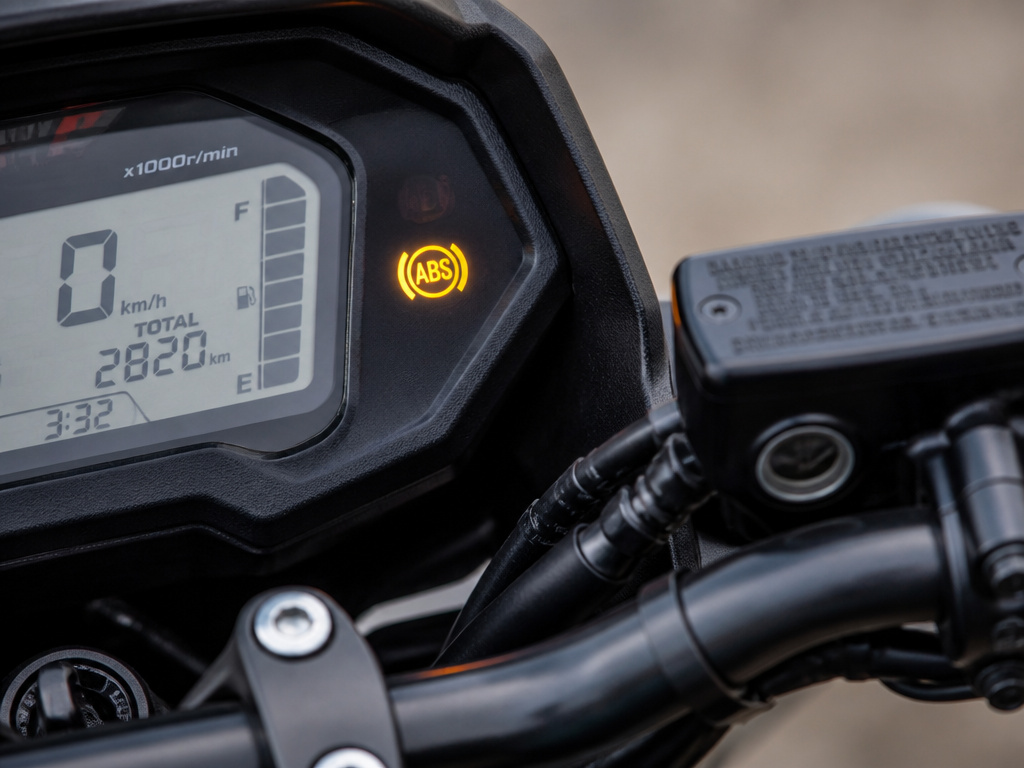
Is ABS required by law? In the United States, no federal mandate exists, unlike in the European Union where ABS is compulsory for all new motorcycles over 125cc. However, the legal framework is built to support it. Federal Motor Vehicle Safety Standard (FMVSS) No. 122 sets the federal braking performance requirements. It defines ABS and outlines its required behaviors, including that a yellow warning lamp must activate if the system malfunctions.
This NHTSA final rule publication from 2021 even updated the rules to allow an international ISO symbol for the ABS malfunction light instead of text, harmonizing U.S. Standards with global ones. The regulatory intent is clear: ABS is a recognized, standardized safety system.
Practically, this means two things for owners: 1. If your ABS light is on, the system is disabled. You’re riding with conventional brakes. Get it serviced. 2. You cannot freely modify your wheels and tires. As Harley-Davidson‘s manual states, using non-standard sizes or severely incorrect tire pressures can alter wheel rotational speed, “upsetting ABS calibration and adversely affecting its ability to prevent wheel lockups.” This isn’t corporate padding; it’s physics. A different rolling diameter changes the speed data the sensor reads.
Worth knowing before you start: A slow-flashing ABS light at startup (under 3 mph) is normal system self-check. If it stays on or flashes rapidly while riding, you have a fault. On some models, like certain Indians recalled in 2024, a software glitch could even cause the brake lights to illuminate unexpectedly, a reminder that ABS is a computer system that needs correct software and hardware to function.
Common ABS Configurations and What They Mean
Not all ABS is created equal. Understanding the basic types helps you know what you’re buying.
Standard (Non-Linked) ABS: This is the most common setup. The front and rear brake systems are independent, each with its own ABS modulator. Pulling the front lever only activates front ABS; pressing the rear pedal only activates rear ABS. It’s simple and effective.
Combined Braking System (CBS) with ABS: Often found on scooters and some touring bikes. Applying one brake (usually the rear) automatically applies a measured amount of force to the other brake. When combined with ABS, it’s very effective for preventing over-braking by inexperienced riders. The MSF study noted CBS particularly shined in rear-brake-only tests.
Cornering ABS / IMU-Equipped ABS: The current gold standard. This system uses an Inertial Measurement Unit (IMU), a gyroscope and accelerometer, to know the bike’s lean angle, acceleration, and pitch. It can adjust ABS intervention dynamically. Braking hard while leaned over? Cornering ABS will modulate pressure to avoid standing the bike up or losing front-end traction. It’s a significant step forward and is becoming common on premium models from BMW, Ducati, Kawasaki, and KTM.
Choosing between them often comes down to budget and bike type. For a first bike or a commuter, standard ABS is a massive upgrade. For a sport-touring or adventure bike you plan to push, cornering ABS is worth the hunt.
Limitations and When ABS Can’t Help
ABS is a brilliant tool, but it’s not a force field. It operates within the laws of physics. It cannot overcome: * Insufficient Traction: If you hit a deep oil slick or a sheet of ice, no braking system can create grip where there isn’t any. * Poor Judgment: ABS won’t save you if you enter a corner too fast. Its job is to help you stop in a straight line, not bend the laws of turning physics. This is where skills like countersteering and avoiding target fixation are irreplaceable. * Mechanical Failure: A ruptured brake line, seized caliper, or failed master cylinder is beyond the scope of ABS to fix. * Rider Interference: Stomping on the rear brake and yanking the front while slammed back in the seat can still pitch you over the bars. ABS prevents wheel lock, but it doesn’t prevent weight transfer from poor body position.
The system also has a lower speed threshold, usually around 3-6 mph, below which it disengages. This is why you can still lock the wheel at walking speed.
The bottom line? ABS is a critical layer in a full safety strategy. It works alongside your helmet selection, your riding boots, and, most importantly, your own developed skill. It’s the airbag to your seatbelt.
Frequently Asked Questions
Does ABS shorten stopping distance?
It depends. On perfect dry pavement with an expert rider, the difference is negligible or slightly in favor of conventional brakes. In the real world, on wet roads, with a less-than-expert reaction, or on a loaded bike. ABS consistently provides shorter, more controlled stops. The MSF’s data shows clear improvements in wet and loaded scenarios.
Is motorcycle ABS worth the extra cost?
Yes. The cost has come down dramatically, often adding a few hundred dollars to a new bike’s price or available as a $500-$1000 option package. Compared to the cost of a single low-side crash, deductible, plastic, lever, mirror, bar end, it pays for itself instantly. Compared to the potential medical and long-term costs of a crash it might prevent, it’s one of the most cost-effective safety additions you can make.
Can you add ABS to a motorcycle that doesn’t have it?
Retrofitting ABS is almost always prohibitively expensive and complex. It requires the module and pump, wheel speed sensors, tone rings, a new wiring harness, and often a new ECU. The labor and parts cost would far exceed the value of most older motorcycles.It’s a feature you buy on the new or used bike, not add later.
Does ABS work on dirt or gravel?
Standard street ABS can be overly aggressive on loose surfaces, as it interprets wheel slip as an impending lockup. Many modern adventure and dual-sport bikes have “ABS Off-Road Modes” or switchable rear ABS. These modes allow more wheel slip for better control in dirt. You should always disable rear ABS for serious off-road riding where locking the rear wheel for steering is a desired technique.
What does it mean if the ABS light stays on?
Solid or rapidly flashing ABS light indicates a system fault. The ABS is disabled, and you are riding with conventional brakes. The cause could be a faulty wheel speed sensor, a problem with the tone ring, a fuse, or the ABS module itself. You should have it diagnosed. Riding without functional ABS means you’ve lost that safety net.
The Bottom Line
Are ABS brakes worth it on a motorcycle? The evidence is a pile of peer-reviewed studies, insurance claim analyses, and federal regulations several inches thick. For anyone using a motorcycle as intended, on public roads, with traffic, in changing weather.ABS is as fundamental a safety purchase as a DOT-approved helmet.
It doesn’t replace skill. It compensates for the inevitable gap between your practiced skill and your panicked reaction. It is the single most effective electronic rider aid ever developed for motorcycles. When you’re looking at your next bike, make “ABS equipped” a non-negotiable line item. Your future self, facing a suddenly stopped car or an unexpected patch of gravel, will thank the engineers, not just your reflexes.
