
Are Motorcycle Airbag Vests Worth It? The Deciding Factors
This post contains affiliate links. As an Amazon Associate, we earn from qualifying purchases.
Motorcycle airbag vests are worth it if they are certified to the European standard EN1621-4 and your jacket is listed as compatible by the manufacturer. They reduce crash impact energy by up to 95% compared to unprotected falls and are triggered within 50 milliseconds. The second deployment halves the replacement cost, but mandatory factory service every two years or 500 hours locks in long-term expense.
That “EN1621-4 certified” clause is the dividing line. It’s not just a marketing stamp. It’s a protocol that includes three impacts on a single vest and narrow-object tests, which is the scenario where your chest hits the edge of a car roof rack or a fence post. The alternative, CRITT certification, only tests flat impacts on pavement.
What follows: the specific protection numbers from the standards, the real-world testing that refutes the “vest under a jacket” worry, and the exact service schedule that turns a one-time purchase into a running cost. By the end, you’ll be able to read any product page’s spec sheet in ten seconds and know if it fits your riding.
Key Takeaways
- The EN1621-4 standard is the one you want. It requires testing against narrow-edge impacts, unlike the French CRITT standard which only tests flat surfaces.
- Your vest requires mandatory factory service every two years or 500 riding hours. Skip this, and the manufacturer states the system may not function within its “Envelope of Protection.”
- The second deployment is cheaper. Brands like Alpinestars design their airbag bladders to withstand multiple inflations. You pay for new gas cartridges, not a whole new vest.
- Electronic vests are not for stunting. The algorithms are tuned for natural riding dynamics. A 12 o’clock wheelie or a seat-stand wheelie is outside their design scope and may not trigger protection.
- They work under a jacket, but the jacket must have 4cm of extra circumference or stretch panels. Worn under a tight leather suit, the airbag can’t inflate correctly and protection fails.
What Does “EN1621-4 Certified” Actually Mean?
It means the vest has survived a laboratory gauntlet most competitors don’t attempt. The certification protocol for EN1621-4:2013 is the benchmark.
First, the vest must withstand three separate impact tests in each protection area, chest, back, using the same bladder. This isn’t a one-and-done product. It’s a validation of durability. The lab environment is controlled to 23°C (±2°C) and 50% humidity (±5%) for 48 hours before testing to eliminate environmental variables.
The narrow-object impact test is the whole point. A certified vest is struck with a 5kg hemispherical impactor on a guided vertical drop tower. This simulates hitting a car door edge, a signpost, or a roof rack. The competing CRITT standard omits this test entirely, only evaluating flat-surface impacts.
The performance threshold is a transferred force of ≤2.5 kN for Level 2 protection. To visualize that, a standard Level 2 passive back protector passes at ≤9 kN. An EN1621-4 Level 2 airbag is therefore transferring at least 72% less force to your body on paper.
Here’s what gets measured, and why it matters:
| Test Parameter | Requirement (EN1621-4) | Why It Matters to You |
|---|---|---|
| Protection Duration | Remains inflated at protective pressure for ≥5 seconds. | Covers the primary and secondary impacts in a multi-event crash. |
| Narrow-Object Impact | Must be tested. | Real-world crashes often involve edges, not just flat asphalt. |
| Multiple Impacts | Same bladder must survive 3 tests. | Indicates bladder material durability; lowers cost after a minor crash. |
| Activation Mechanism Safety | Lanyard break point ≥4x activation force. | Prevents accidental deployment from a snag while walking the bike. |
The final, often overlooked, test is ergonomics. The standard requires that a rider wearing the deflated vest can still pick an object up from the floor. It’s a practical check against vests so bulky they restrict the mobility you need to control a motorcycle.
The Two Types of Airbag Systems: Electronic vs. Mechanical
Your choice here dictates where you can ride, how you maintain it, and what happens after a crash.
Electronic systems like the Alpinestars Tech-Air or Dainese D-air use an onboard Electronic Control Unit (ECU) with accelerometers and gyroscopes. They sample motion 1,000 times per second. The algorithm decides if a crash is happening.
The advantage is autonomy, no tether to the bike. The disadvantage is a defined operating envelope. The Alpinestars Tech-Air 3 V2’s ECU is certified to function between -20°C and +40°C. Go outside that, and the system might not arm.
Common mistake: Assuming an electronic airbag is for off-road or stunting. Alpinestars explicitly states its Tech-Air systems are “not designed for full-on ‘stunting’ (e.g., 12 o’clock wheelies, seat stand wheelies).” The algorithm is tuned for natural riding dynamics, not controlled crashes.
Mechanical systems like those from Helite or the Rock Tool Co Touring Pro use a lanyard clipped to your motorcycle. A sudden separation yanks a trigger, releasing compressed gas. There’s no battery, no algorithm, no temperature limit besides the gas itself.
The advantage is brutal simplicity. The disadvantage is the tether. Forget to clip in, and you have zero protection. Crash with the tether still attached in a low-side, and it might not deploy at all.
| System Type | Best For | Key Limitation |
|---|---|---|
| Electronic (Alpinestars, Dainese) | Street riders, sport touring, commuters. | Not for deliberate stunting or extreme off-road. Requires periodic charging & service. |
| Mechanical (Helite, Hit-Air) | All-around use, beginners, riders who forget electronics. | Tether can be forgotten or snagged. No crash detection until you separate from the bike. |
The deployment speed difference is academic for most crashes. An electronic system like Tech-Air fires in under 50 milliseconds. A mechanical system is arguably faster, as it’s a direct mechanical action. For a rider hitting an object from one meter away at 39 mph, the body travel time is about 60 milliseconds, both systems aim to beat that.
The Protection Numbers: What 95% Impact Reduction Really Covers
A manufacturer’s “up to 95% impact reduction” claim is rooted in the EN1621-4 test data. Level 2 certification means the vest transferred ≤2.5 kN of force during testing. Compare that to the force transmitted without any protection, which can be 50 kN or more in a serious impact, and the 95% figure is mathematically sound.
But what does it protect? An electronic vest like the Tech-Air 5 covers shoulders, chest, ribs, collar bones, and the full back, essentially everywhere a t-shirt covers. The Dainese Smart Air and Tech-Air 10 models add hip and tailbone coverage. The protection is primarily against blunt trauma and impact forces, not abrasion.
Where this goes sideways: Wearing an airbag vest instead of a proper abrasion-resistant jacket. The vest is an impact protector, not a slide protector. Most vests certified to EN17092 (for abrasion) only meet the lowest “Level A” requirement for key impact zones. Slide through that, and you’re down to skin.
This is where the IRC-24 conference paper on wearable airbags provides a crucial non-commodity insight. The 2024 study simulated an airbag inflating under a motorcycle jacket and found “no ribcage injuries were noticed due to the inflation.” The maximum chest deflection was 10.58 mm, which is only 3.94% chest compression, far below the 24% threshold for minor rib injuries. The jacket did not hinder the airbag’s protection; in some higher-speed impacts, it actually improved energy absorption.
The takeaway: The “vest under a jacket” question is settled by research. It works, provided the jacket has the required expansion space.
The Post-Crash Reality: Service, Cost, and Timelines
You will send your vest back to the manufacturer. This is the single largest hidden factor in the ownership equation.
An Alpinestars Tech-Air system has a mandatory service interval of two years or 500 hours of operation, whichever comes first. The factory manual states that exceeding this interval means “there is the possibility that the System will not function inside the Envelope of Protection.” The service involves a full diagnostic of the ECU, inspection of the airbag bladder, and replacement of expired gas inflators.
The part nobody mentions: The gas inflator cartridges have a shelf life. They are high-pressure vessels. Their certification (UNI EN 16263) includes safe handling procedures, which is why you can’t just mail old cartridges back in a plastic bag. The service center handles the hazardous material.
After a deployment, the process is more involved. For an Alpinestars Tech-Air 3 V2, the airbag bladder itself is certified for up to six inflations. If the bladder is intact after your crash, you only pay for new gas inflators, about £90 per cartridge in the UK. The third repack, however, costs more (around £200) because it includes replacing the bladder as a preventative measure.
Here is the cost timeline for a single crash with a Tech-Air 3 V2:
- Crash occurs. Vest deploys. You are protected.
- Within days: Ship the entire vest to an authorized service center. You cannot repack it yourself.
- Service center: Downloads crash data from the ECU, inspects bladder for tears or stress, replaces the two spent gas inflators.
- Cost: ~£180 for the repack service and cartridges (US price is approximately $180). You wait 1-3 weeks.
- Return: Vest arrives back, reset and ready. Your total downtime is the shipping and service period.
Compare this to a mechanical system. If you crash a Helite vest, you pull the spent CO2 cartridge, install a new one you bought online for about £30, and repack the bladder yourself following a video guide. You’re back on the road in an hour.
The electronic system’s service model is a closed ecosystem. It guarantees safety through professional inspection, but it trades your time and a higher recurring cost for that assurance.
Battery Life, Charging, and the 10-Year Lifespan
An electronic vest is a gadget. Its 40-hour battery life (for the Tech-Air 3) is a week of riding for most people. The vest turns on when you zip it up and arms after 10 seconds of riding motion. It turns off when you unzip it.
The battery is not user-replaceable. After years of charge cycles, its capacity will drop. The ECU itself has a finite lifespan. Alpinestars explicitly recommends replacing the entire system 10 years from the date it was first worn, regardless of apparent condition, due to “natural degradation and breakdown of materials.”
This is a significant, predictable end-of-life cost. It transforms the purchase from gear you use until it wears out into a product with a hard expiration date.
Compatibility and Fit: The 4cm Rule
 The protection physics are simple. The airbag needs volume to inflate and create a protective cushion. Constrict that volume, and the pressure can build up against your body or, worse, fail to inflate fully.
Alpinestars’ compatibility guideline is specific: if worn under a jacket, the jacket must have at least 4cm of extra circumference around your upper torso, or it must have stretch panels designed to expand. Tight, non-stretch racing leathers are incompatible. Many modern textile and adventure jackets have these panels and are listed in the brand’s online compatibility checker.
Worth knowing before you start: Trying on a vest with your jacket. Zip everything up. Have a friend pull hard on the shoulders of the vest from the outside. If you feel significant binding or the jacket material doesn’t give, it’s too tight. The vest should move independently inside the jacket.
A vest worn over a jacket sidesteps this issue but introduces another: you lose access to your jacket’s pockets and vents, and you add an extra outer layer that can affect temperature management. The best airbag vests designed for over-jacket wear, like the Tech-Air 3 V2 Canvas, add their own storage and are built from tougher, weather-resistant materials.
Are They Worth It? The Decision Matrix
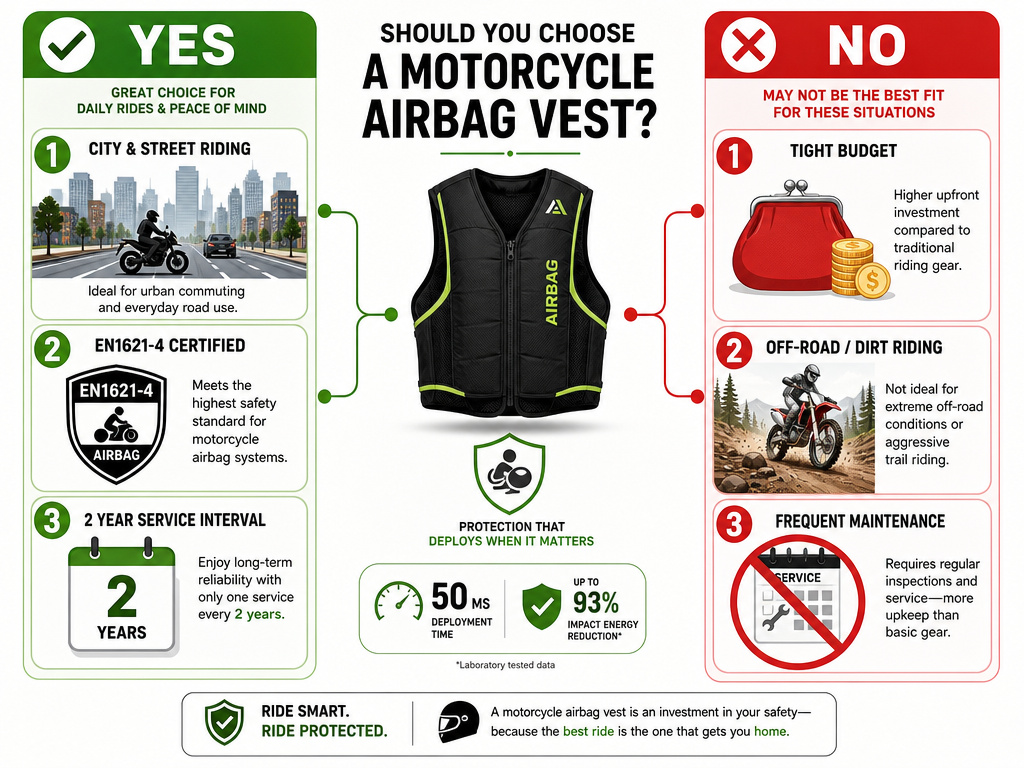 The value question collapses to your crash probability, riding style, and tolerance for recurring costs.
Yes, an airbag vest is worth it if:
- You ride regularly on streets with mixed traffic.
- You are buying a new, EN1621-4 certified electronic or mechanical system.
- You accept the 2-year service cycle and potential post-crash repack fees as part of the safety budget.
- Your protective jackets or suits are listed as compatible.
No, skip it for now if:
- You are on an extremely tight budget and the vest cost would come from funds for a essential motorcycle boots or a high-quality helmet. Those are non-negotiable basics.
- Your primary riding is low-speed, off-road, or involves stunting where electronic systems aren’t designed to work.
- You cannot commit to the service schedule. An unchecked airbag is a question mark, not a guarantee.
For the majority of street riders, the added layer of impact protection is a logical next step after a good helmet, jacket, gloves, and boots. The technology is proven, the standards are rigorous, and the real-world injury reduction is documented. It’s not a magic force field, but it is the single most effective piece of impact protection you can add to your motorcycle armor setup.
Frequently Asked Questions
How many times can an airbag vest be deployed?
It depends on the brand and model. An Alpinestars Tech-Air 3 V2 airbag bladder is certified for up to six inflations if undamaged. The system has two gas inflators, allowing for two deployments before they need replacing. After the fourth deployment, the system locks and requires a full factory service.
Can you wear an airbag vest with a backpack?
Yes, but with strict limits. Alpinestars states a backpack should weigh no more than 6kg (13lbs) and must not be strapped tightly across the chest, as this can hinder expansion. The straps need slack to allow the shoulder airbags to inflate. Many riders prefer a motorcycle vests with external pockets to avoid backpacks altogether.
Do motorcycle airbag vests work in a low-side crash?
Electronic systems are designed to detect low-sides, but they are not guaranteed to trigger in every instance, especially at very low speeds. The algorithm must distinguish a controlled slide from a crash. Mechanical systems will only deploy if the tether is pulled, which may not happen in a simple low-side where you don’t separate far enough from the bike.
What’s the difference between an airbag vest and an airbag jacket?
An airbag jacket has the airbag system permanently integrated into a motorcycle jacket, like the Dainese D-air® jackets or the airbag jackets from other brands. A vest is a standalone garment worn under or over your existing jacket. Vests offer more flexibility across seasons and jacket styles but add an extra layer.
How do you maintain an airbag vest?
For electronic vests: charge the battery every few weeks, update the firmware via the app when prompted, and send it for professional service every two years or 500 hours. For mechanical vests: visually inspect the tether and stitching regularly, replace the gas cartridge after any deployment, and follow the manufacturer’s cleaning instructions (usually hand-wash after removing the airbag bladder).
The Bottom Line
An EN1621-4 certified airbag vest is a significant, measurable upgrade in impact protection. It turns a potentially rib-breaking hit into a manageable shove. The decision isn’t about faith in technology, the testing standards and the research papers are clear.
It’s about logistics. Can you live with the two-year service calendar and the potential week-long turnaround after a crash? If your answer is yes, and your jacket fits the 4cm rule, then the value is undeniable. Start with a proven model like the Alpinestars Tech-Air 3 or a mechanical Helite, and treat the service fee as part of your tire-and-brake maintenance budget.
If the service model or the upfront cost is a deal-breaker, double down on the fundamentals: a CE Level 2 back protector in your jacket, solid motorcycle gloves, and armored pants. The airbag is the next step, not the first. But for riders who log miles in traffic, it’s a step worth taking.
