
Your Guide on How to Ride a Motorcycle in the Rain Safely
This post contains affiliate links. As an Amazon Associate, we earn from qualifying purchases.
To ride a motorcycle in the rain safely, you need three things: waterproof gear you can trust, a braking technique that loads the tire before the ABS triggers, and a lane position that keeps you out of oil slicks and visible to cars. Modern street tires offer about three-quarters of their dry grip on wet pavement, but that grip plummets to near-zero the instant you hydroplane.
That traction number comes from track testing, not a marketing sheet. It’s the physical ceiling you work under. The early stage of a rainstorm is the most dangerous period, the first half-hour lifts a slick film of oil and road grime to the surface. Your job is to manage visibility, tire load, and surface selection until it washes away.
What follows is a breakdown of the gear that works, the braking method that stops you fastest with ABS, and the riding position that cuts your crash risk in half. By the end, you’ll know which part of the lane to avoid, why your visor fogs, and when to just pull over.
Key Takeaways
- Modern sport-touring and street tires like the Michelin Road 6 offer about 75% of dry grip on wet pavement, but zero grip during hydroplaning.
- Leather-soled boots are a direct hazard in the rain; they lose all friction on wet footpegs and pavement.
- For bikes with ABS, the shortest wet stop comes from loading the front tire with progressive pressure, not just grabbing the lever and letting the system work.
- Ride in the left tire track of your lane to avoid the center oil slick, maximize visibility to oncoming traffic, and find slightly drier asphalt.
- A Pinlock visor insert is the single most effective item for preventing fogging; anti-fog sprays fail within one ride.
The Gear That Actually Works in Wet Weather
You can have perfect technique, but if water is running down your back and fog is blinding you, you’re done. Good rain gear is not about staying dry for comfort, it’s about maintaining focus and dexterity. Shivering hands make brake modulation impossible.
Start with a one-piece rain suit or a two-piece system from a brand like Klim or Rev’it. The seams must be taped. A two-piece is easier to put on at a gas station, but the one-piece seals better. Underneath, a moisture-wicking base layer does more for warmth than a thick cotton hoodie. Cotton holds water against your skin and chills you fast.
Your helmet needs a Pinlock visor insert. This is a plastic double-pane system that creates a thermal barrier. Anti-fog sprays and treated visors fail after one heavy rain or a few wipes with a gloved hand. The Pinlock works until the seal degrades, which takes years. Don’t ride in the rain without one.
Where this goes sideways: Wearing leather-soled boots. RevZilla’s professional riders explicitly call this a “bad idea” for wet weather. The sole becomes a frictionless pad on a wet footpeg or gas station concrete. You will slip mounting or dismounting the bike. That’s how ankles break.
Gloves are the weak point. Even the best waterproof riding gear has limits at the wrists. Gauntlet-style gloves with a long cuff that goes over your jacket sleeve slow the ingress. Look for gloves with a HyVent or Gore-Tex insert, not just a DWR-coated leather shell. The latter wets out in twenty minutes.
| Gear Item | Critical Feature for Rain | What Happens If You Skip It |
|---|---|---|
| Jacket & Pants | Taped seams, waterproof membrane (Gore-Tex, HyVent) | Water soaks through in 10-15 minutes; core body temperature drops, leading to slowed reaction times. |
| Boots | Full-grain leather or textile with rubber sole | Leather soles slip on wet metal pegs; non-waterproof boots fill with water, adding weight and numbing feet. |
| Gloves | Gauntlet cuff, waterproof insert | Water channels down your arm into the glove, soaking your hand completely within 30 minutes. |
| Helmet | Pinlock anti-fog insert system | Visor fogs irreversibly at low speeds or when stopped, forcing you to ride with it open or blind. |
For your bike, consider adding a windshield if you don’t have one. It pushes a surprising amount of rain over your shoulders and reduces the load on your jacket’s waterproofing. Just make sure any add-on is securely mounted, a shaking windscreen distracts more than it helps.
Braking in Wet Conditions: The ABS Nuance
The old rule was to squeeze gently and avoid the front brake. That’s obsolete for any bike made in the last decade with anti-lock brakes. ABS prevents wheel lock, but it doesn’t create grip. Your stopping distance is still determined by how much traction your tires can find.
Here’s the nuance from professional instruction: if you instantly grab a handful of front brake on wet asphalt, the tire hasn’t built up load. The ABS will trigger early, cycling pressure before you’ve achieved maximum deceleration. The system is doing its job preventing a lock, but you’re leaving stopping distance on the table.
The better method is to apply the front brake progressively in the first half-second. This transfers the bike’s weight forward, loading the front tire and pressing its tread blocks into the pavement. Then you can increase pressure toward the limit. The ABS might still activate, but it will do so later, at a higher braking force. Use both brakes together, the rear adds stability.
Technical Snippet: In wet conditions, motorcycle ABS systems monitor wheel deceleration rates. If a wheel decelerates too quickly versus the other (indicating an impending lock), the system modulates brake pressure in pulses. This preserves steering ability but can extend stopping distance if triggered before optimal tire load is achieved.
If your brakes get wet from a deep puddle or washing, the manual says to apply them lightly while riding at low speed to dry them. This is good advice. The friction heats the rotor and pads, evaporating the water film. Do this before you need maximum power.
What about non-ABS bikes? The principle is the same, load the front tire progressively, but the margin for error is thinner. Practice this in a wet parking lot until you can feel the front tire begin to skid, then release slightly. That’s your personal traction gauge. Do not practice panic stops on the street.
Vision and Lane Position: Seeing and Being Seen
Rain reduces visibility for everyone. Your helmet visor is covered in droplets, car windows are fogged, and spray from trucks creates a wall of mist. This is where dynamic lane positioning pays its highest dividend.
The center of your lane is dangerous. It collects a blend of engine oil, transmission fluid, and general grime from cars. When the rain starts, this mixture floats to the surface, creating a slick film that remains long after the rest of the road looks clean. Avoid it.
Instead, ride in the left tire track of your lane. This puts your tires on slightly cleaner asphalt, worn smooth by car tires. It also positions you further from oncoming traffic in your lane, giving you a buffer. Crucially, it makes you more visible to drivers in oncoming cars, they see your single headlight offset from the line of traffic ahead of you.
Common mistake: Hugging the right side of the lane to be “safe.” This places you in the blind spot of cars in the next lane, puts you closer to merging traffic, and often positions your tires on the uneven, debris-laden shoulder edge.
When you approach a curve, use the outside-inside-outside line. Enter wide, near the centerline, turn through the apex in the left track, and exit wide again. This gives you the best view through the corner and the largest radius, requiring less lean angle for the same turn speed. Less lean means more tire contact patch facing the road.
If the rain is light, you can sometimes see “dry lines”, tracks where car tires have pushed water aside. These offer marginally better traction. But be wary of debris like leaves or gravel that also accumulate there. And never trust a painted line, manhole cover, or tar snake in the wet. They become ice.
The Physics of Hydroplaning and How to Avoid It
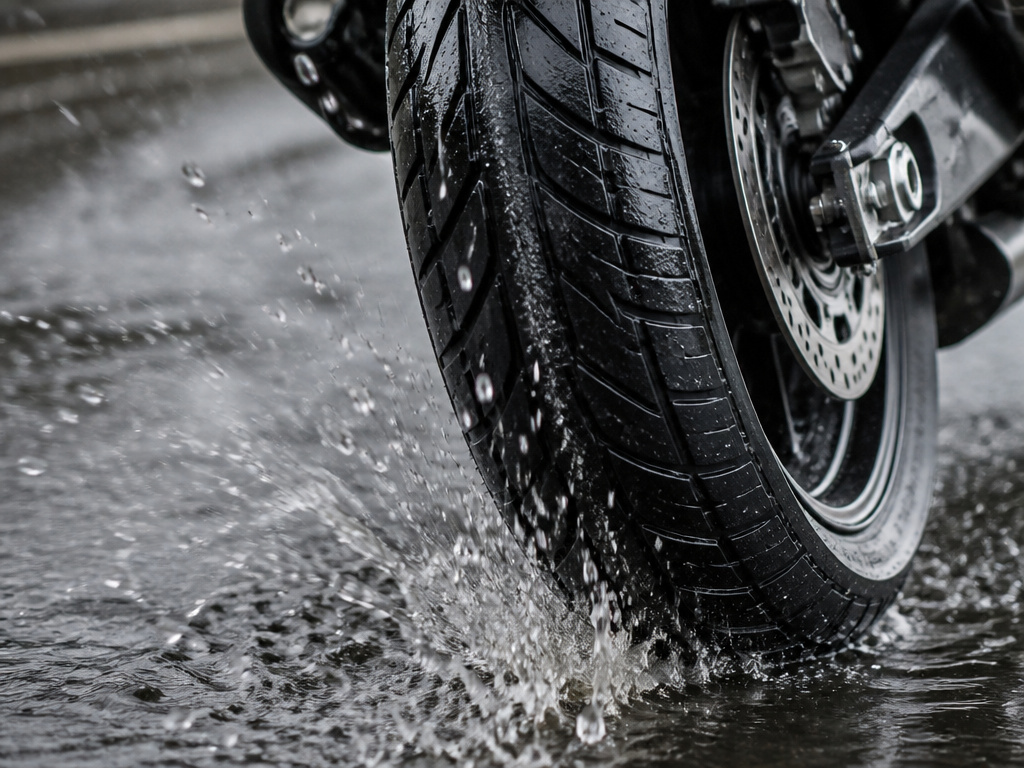
Hydroplaning isn’t just losing a little grip. It’s the complete separation of the tire from the road by a layer of water. At that point, steering and braking inputs do nothing. You are a passenger.
It happens when water cannot escape the tire’s contact patch fast enough. The three factors are water depth, tire tread depth, and speed. A worn tire hydroplanes first. A tire with siped tread and deep channels evacuates water more efficiently.
The NSW Motorcycle Rider Handbook emphasizes managing speed and road position to mitigate hazards. That’s the official line. The physical truth is that even a new tire has a hydroplaning speed threshold. For a motorcycle tire, that’s lower than for a car tire due to the narrower patch.
If you see a wide, deep puddle or flowing water across the road, slow down before you enter it. Keep the bike as upright as possible, lean increases the chance of the tire skimming. Grip the tank with your knees, relax your arms, and let the bike track straight. Avoid sudden throttle or brake changes. Once you’re through, gently tap the brakes to dry the rotors.
| Symptom | Likely Cause | Immediate Action |
|---|---|---|
| Front end feels light, steering goes vague | Hydroplaning beginning | Roll off throttle smoothly, do not brake, keep handlebars straight. |
| Rear tire slides out in a straight line | Accelerating over a painted line or metal surface | Reduce throttle gently, keep steering straight, let bike settle. |
| Brake lever feels soft, stopping power weak | Water on brake rotors/pads | Apply brakes lightly while riding at low speed for 100-200 feet to generate heat and dry them. |
| Visor completely fogged, zero visibility | Humidity inside helmet, no anti-fog system | Crack visor open slightly to equalize temperature, or pull over safely to install a Pinlock. |
Severe weather changes the game. Torrential downpour where you can’t see the tail lights of the car fifty feet ahead? Flooded roads where water depth is unknown? Freezing rain that can ice your brakes and tires in minutes? These are not conditions to “tough out.” The smart move is to take the next exit, find shelter, and wait it out. No ride is worth that risk.
Bike Preparation and Post-Ride Care

Rain riding accelerates wear. Road grit mixes with water and acts as a grinding paste on chains, brake components, and fork seals. The bike also gets filthy. A little prep before you head out and care after you get back makes a big difference.
Before a wet ride, check your tire pressures. Under-inflated tires are more prone to hydroplaning and have a deformed contact patch. Make sure your chain has a light coat of a wet-weather lubricant like Motul Chain Paste. A dry chain will rust quickly when sprayed with road water.
During the ride, listen for changes. A gritty feel at the brake lever can indicate contaminated pads. A driveline lurch might be a chain skipping over a rusted link.
After the ride, don’t just park it. Hose the bike down with clean water to remove road salt and acidic grime. Focus on the radiator fins, brake calipers, and chain. Dry the bike with a soft cloth or air compressor, especially around electrical connections and switches. A detailer like S100 Total Cycle Cleaner cuts the grime without harsh chemicals.
Easy to miss: The crankcase breather tube. Honda’s manual says to service it more frequently if you ride in the rain. Water and muck can get in, and if it overflows, it contaminates the air filter. Check it after a series of wet rides.
If you’ve been riding in heavy rain, consider pulling the seat and side panels to let everything air out. Moisture gets everywhere. Letting the bike sit wet in a garage invites corrosion, especially on steel fasteners and bare metal parts.
Frequently Asked Questions
How much less traction do I have in the rain?
Modern street tires like the Michelin Road series or Pirelli Angel GT offer about three-quarters of the traction they provide on dry pavement, assuming the surface is clean, wet asphalt. This drops to near-zero on metal plates, painted lines, or during hydroplaning.
Should I use my front brake in the rain?
Yes, and you should use it first. Apply the front brake progressively to load the tire before increasing pressure. On a bike with ABS, this technique yields the shortest stopping distance by delaying the system’s intervention until higher braking force is achieved.
What is the best lane position for rain riding?
Ride in the left tire track of your lane. This avoids the oily slick in the center, provides a buffer from oncoming traffic, improves your visibility to drivers, and often places your tires on slightly drier pavement. Avoid the far right side of the lane where debris collects.
Can rain damage my motorcycle?
Rain itself won’t damage a modern motorcycle, but neglect will. Road grime, salt, and acidic pollutants mixed with water accelerate corrosion on chains, fasteners, and brake components. Always rinse the bike with clean water after a wet ride and dry it thoroughly.
How do I stop my helmet visor from fogging up?
Install a Pinlock anti-fog insert. This is a double-pane system that creates a thermal break. Anti-fog sprays and treated visors are temporary solutions that fail during a long ride or after wiping the visor. The Pinlock is a permanent fix for the life of the insert.
Is it safe to ride through a puddle?
It depends on depth and speed. Slow down before entering any standing water. Cross it with the bike upright, maintaining steady throttle. Avoid puddles near the edge of the road where debris or potholes may be hidden. After crossing, lightly apply the brakes to dry the rotors.
Before You Go
Riding in the rain is a skill, not a gamble. It hinges on preparation, choosing gear that keeps water out and vision clear, understanding how your brakes actually work on wet pavement, and picking a lane position that gives you every physical advantage.
The difference between a miserable, white-knuckle ride and a confident, controlled one comes down to specific choices. Get the Pinlock. Avoid the center lane. Load the front tire. And know when the rain has won, pulling over is always the right call if visibility or control drops to zero.
Your bike is more capable than you think in the wet, but only if you work within its limits. Those limits are defined by physics, not bravery.
